


University Hall
When The Ohio State University opened its doors on September 17, 1873, seven faculty members were there to teach the two dozen students who had arrived to obtain a college degree. At the time there was only one building on campus – University Hall – and it included not only classrooms, but a chapel, a library and living quarters for both students and some faculty members. The faculty lived on the top floor; consequently, that part of the building was known by students as the “Saints’ Roost.” (The students lived in the cellar, referring to it as “Purgatory.”) Thomas Mendenhall, the last surviving faculty member, recalled in 1920 that these men were underpaid, all lacking a Ph.D at the time of their appointment, and were given charge of a broad area of study that would shock the “modern” professor. Given these conditions, is it any wonder why the students came up with the “Saints” nickname?

Edward Orton, 1875
Edward S. Orton Sr. (1829 – 1899) was originally from New York where he graduated from Hamilton College at age 17. The following year he went to seminary and taught at several institutions before becoming professor, then president, at Antioch College in Ohio. A year later he was named the first President of the new Ohio Agricultural and Mechanical College and the chair of Geology. Orton also developed the first campus museum in University Hall. In 1881 Orton resigned from his duties as President in order to serve as state geologist. He was 44 when he took the appointment, and held it until his death eight years later.

Robert McFarland, 1873
Robert W. McFarland (1825 – 1910) was a self-educated Scotsman, who, despite his lack of a formal education, was described as having knowledge that was “encyclopedic.” While at OSU, and in addition to his teaching duties, he apparently worked for several hours a day, six days a week, for four years, to calculate the form of the earth’s orbit and the longitude of its perihelion for the previous five and a half million years. McFarland taught at the College until 1885 when he accepted the presidency at Miami University.

T.C. Mendenhall, 1873
Thomas Corwin Mendenhall (1841 – 1924), from Columbus, was a renowned physicist and scientist whose education was attained through public schools. He had previously taught at Columbus’ Central High School, and came to the new college for five years before leaving to join the faculty at the Imperial University of Japan. Three years later he returned to Ohio, and the College, before resigning in 1884 to pursue other academic interests. In 1919 he was named to the Board of Trustees of the renamed Ohio State University, and he served in this capacity until his death in 1924 at the age of 83.

Joseph Millikin, 1873
Joseph Millikin (1840 – 1882) taught English and modern languages and literature at the College as well as serving as the school’s librarian. Originally from Hamilton, Ohio, he graduated from Miami University at the age of 19, then attended Princeton Theological Seminary with an intent to become a minister. Known for his frail health, he came to the College in 1872 and was remembered as teaching philosophy in addition to Latin, Greek, French, German, Anglo-Saxon and the Romance languages, depending on the session. He taught at the College until 1881, at which point his poor health forced his resignation. He died in 1882.

S.A. Norton, 1888
Sidney Augustus Norton (1835 – 1918), of Cincinnati, taught at several high schools before being appointed professor of chemistry at Miami Medical College in Cincinnati, where he received his medical degree. He taught chemistry at the new College from 1873 until 1899 when he was appointed professor emeritus. Norton also had a reputation for his broad intellect, being familiar with many different branches of science, as well as history, literature and the arts.

N.S. Townshend, 1883
Norton Strange Townshend (1815 – 1895) was the eldest original faculty member to be appointed, at 58 years old. He first served as a Trustee for the new College, but resigned from this position so he could be named professor of agriculture. He served the University as a professor until January 1892, and afterwards was named professor emeritus. Originally from Northamptonshire, England, he journeyed with his parents to Ohio in 1830 and received his medical degree from the University of New York in 1840. He became involved with both the temperance and the anti-slavery movements, and was elected to Congress in 1850. He died at his home, on the University grounds, in 1895.
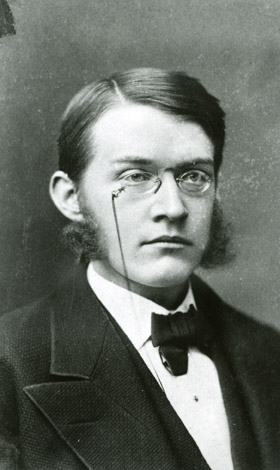
J.H. Wright, 1874
John Henry Wright (1852 – 1908) was both the last original faculty member to be appointed as well as the youngest, at age 21. He was born in Persia, to missionary parents, and he came to America when he was eight years old. He graduated from Dartmouth in 1873, and after arriving at what was to become Ohio State, he was one of the faculty members to live in University Hall during the college’s first year. Though he arrived with virtually no teaching experience, he was knowledgeable in the areas he taught (Ancient languages and literatures) and was said to have made a lasting impression on his students. He stayed at the college only for three years; he eventually taught at Harvard, where he also served as dean of the graduate school for many years.





Recent Comments