From Woody's Couch

Our Playbook on OSU History

Category: Early University history (page 8 of 14)

From founding, OSU community celebrated Thanksgiving with a day’s respite

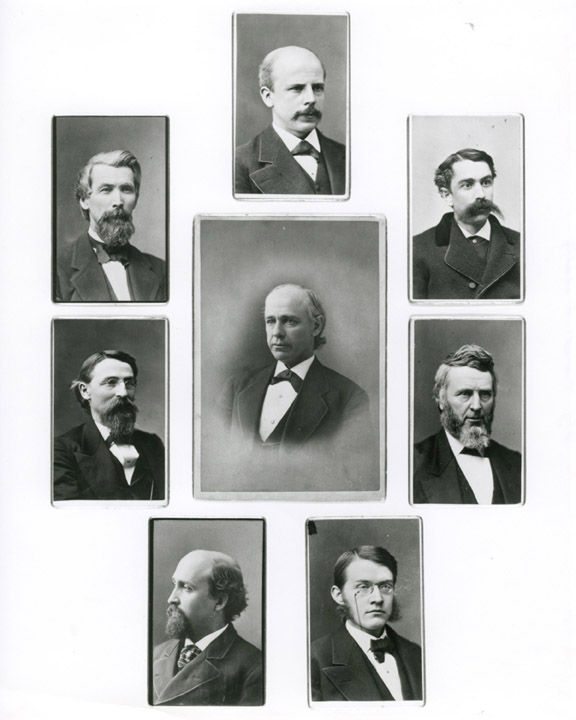
The first faculty of the University, 1873

The first faculty of the University, 1873

On Friday, November 21, 1873, just over two months after the University first opened its doors, the faculty were talking about taking a vacation.

In this particular case, it made sense: Not even a week later, Thanksgiving would be celebrated, so they needed to decide whether classes would be held that Friday. The faculty minutes for that date – the group’s 10th meeting ever – say “that Thursday Nov. 29 (Thanksgiving day) and the Friday following be allowed as holiday by the college, and that all college exercises be disbanded.” It was the only item of business for that meeting.

During World War II, Thanksgiving Day was a holiday for only civilians on campus. All Army and Navy-related classes were still in session on Thanksgiving. At that time, the Commencement ceremony for Autumn Quarter fell in early December, so classes on the Friday after Thanksgiving were considered a must.

In 1945, after the war was over, it was decided that no classes would be held from the Wednesday night before Thanksgiving until the following Monday – a first since before the war – to allow students to travel home for the holiday. In 1946 University faculty and staff were given both Thanksgiving Day and the following Friday off again in recognition for all of the overtime hours they had put in throughout the quarter with the record number of students enrolled that year.

President Bevis, 1948

President Bevis, 1948

In 1947 President Bevis ordered classes to be held the Friday after Thanksgiving, with the tradeoff that employees would get Christmas Eve, Christmas Day and Boxing Day, as well as the following weekend off. He stated that the University’s payroll deadlines, as well as orientation and fee payment deadlines necessitated the working Friday.

Classes were again eliminated for the Friday off as early as 1957, according to the Lantern, although OSU employees still had to show up to work. In the mid-1970s, during the nationwide energy crisis, the academic calendar was changed so that finals were completed by Thanksgiving. University employees still had to work the day after the holiday. By the mid-1980s, however, University classes were cancelled and University offices were closed both days.

–Filed by C.N.

Orange and black as school colors? No thanks, we’ll take Scarlet and Gray

Curtis Howard, 1878

Curtis Howard, 1878

When the very first senior class started planning for its commencement in the spring of 1878, members decided the first diplomas issued by The Ohio State University (the Board of Trustees had just changed the name from the original Ohio Agricultural and Mechanical College) should look festive. So the class decided to tie around the diplomas ribbons that featured the school colors.

Being a young university, however, no school colors had yet been chosen. So the senior class appointed a committee of three to choose them: Curtis Howard, who graduated that year, Harwood Poole, who graduated in 1881, and Alice Townshend, an 1880 graduate.

According to a later account by Townshend, the three students went to various dry good stores in the area to sample colors and ended up choosing orange and black. They later learned, however, that these were already the colors of Princeton University.

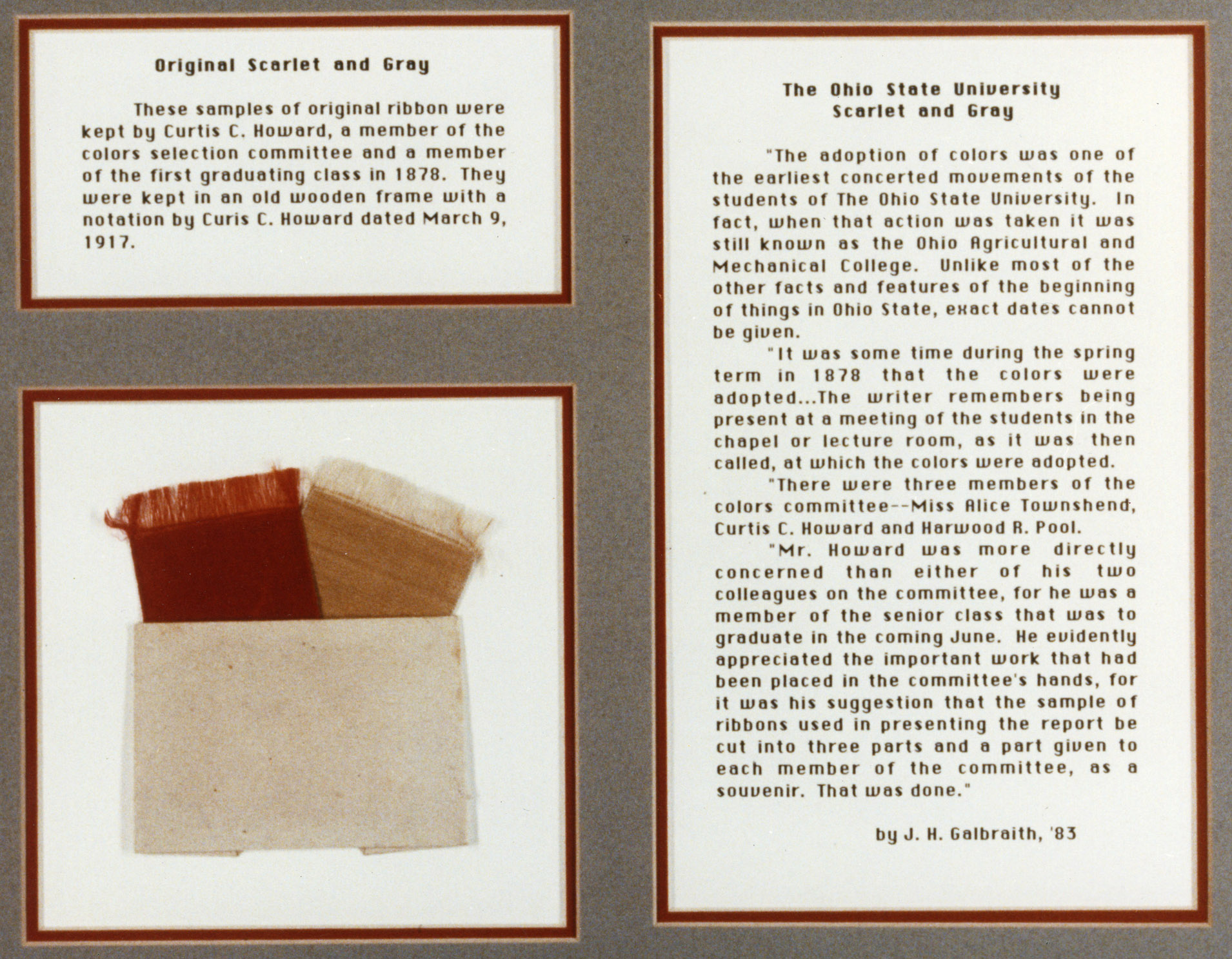
Howard's original ribbons

Howard’s original ribbons

So they tried again and selected scarlet and gray – for no reason other than they liked the two colors together and to their knowledge, no other university or college had them as school colors. After the colors were selected, the original ribbons were cut into three pieces and given to each committee member as souvenirs.

Flash forward to 1917 when Howard is going through his personal effects and finds his souvenir ribbons. (Poole had died by then and Townshend had not kept hers.) Howard wrote to his friend, John Galbraith, that the ribbons were still “wrapped in a paper filter as I had placed the away 39 years ago. These have been in the dark and I am certain have not faded…” He donated them to the university, and according to a 1920 alumni magazine article, they were mounted in a mahogany frame and hung in Sullivant Hall.

John Kleberg poses with the scarlet and gray ribbons, 1989

John Kleberg poses with the scarlet and gray ribbons, 1989

Sometime after that, they disappeared.

Flash forward again to 1989: John Kleberg, then assistant vice president for business and administration, receives a visitor at his office who claims to represent an individual who acquired the ribbons from the resolution of an estate and wishes to remain anonymous. The ribbons were wrapped in porous paper and framed. On the back of the frame was the letter Howard had written to Galbraith.

For a time, Kleberg hung them in his office, but being the good steward of history that he has proven himself to be many times over with the Archives, Kleberg transferred them to the Archives.

Framed scarlet and gray ribbons

Framed scarlet and gray ribbons


Filed by C.N.

Archives month: Uniform shows OSU’s long involvement in military education

Naddy's ROTC uniform

John Naddy’s ROTC uniform

This summer, the Archives hosted several events for alumni who were interested in learning more about OSU history. We demonstrated this history through a number of items, including a World War II-era ROTC uniform, once owned by John Naddy, a 1948 graduate in Business Administration.

The uniform, worn by members of the Reserve Officers Training Corps, was one of a long line of such garments worn by OSU male students since the university was founded in 1870. At that time, land-grant institutions like Ohio State were required to provide military sciences classes. In 1880, OSU required all male students to take classes in military education during their first two years of University enrollment.

The outbreak of World War I had several Ohio State leaders concerned about the defense of the nation and the role of military education in that defense. What resulted came to be known as “the Ohio Plan,” which was co-authored by then-President William Oxley Thompson, General Edward Orton, Jr., (OSU Professor of Ceramic Engineering) Commandant of Cadets Colonel George L. Converse (Commandant of Cadets in the Department of Military Science) and alumnus Colonel Ralph D. Mershon. The Ohio Plan was incorporated into the National Defense Act of 1916, and it established the ROTC as a national program.

John Naddy, 1948

John Naddy, 1948

The Ohio Plan made military drill and basic coursework mandatory for all male students for their first two years. After that, they were free to stop training or to choose to enroll in a program that would earn them a commission in the U.S. Army upon their graduation. In 1945 the University added a Naval ROTC, and in 1946 an Air Force ROTC program was established. Military education was compulsory until 1960 when the University began offering other coursework options to fulfill the requirements.

As for Naddy, along with the uniform that he donated to the Archives in 2006, he wrote a letter giving some details about it: He bought the uniform in 1941 for about $28. With the uniform came two blue dress shirts, white gloves, a canvas belt with a brass buckle, and a black tie. It sounds like quite a bargain, except that Naddy was making only 39 cents per hour as a stockboy at a local electric supply store.

As an added bonus, Naddy related in the letter how he met his future wife: “In 1942 I met my future wife in a geography class. Professor Carlson said if any student has trouble seeing the board please move forward. She did. I did. That’s how we met.” According to the letter, as of 2006, they had been married 60 years.

For more information on OSU’s current ROTC program see: http://arotc.osu.edu/.

Older posts Newer posts