From Woody's Couch

Our Playbook on OSU History

Category: Early University history (page 11 of 14)

One Book to Rule Them All: Students’ Rules and Regulations, 1906-69

President William Oxley Thompson’s foreword to the 1906 edition of Students’ Rules and Regulations reads as follows:

This little book is printed for the convenience of student in order that they may know the rules and regulations in which they are interested as a matter of guidance.  The book will be published annually with such revisions as are made from time to time.  Students are requested to keep this as a matter of reference.  Its intelligent use will save the time of the student and of the University officers.

This “little book” does indeed contain many guidelines for students at the time.  Many are similar to current policies, as evidenced by the following rule from the 1906 edition:

Although smoking was prohibited indoors, it was okay on a cannon.

Use of Tobacco Prohibited

The use of tobacco in any form in the lecture rooms, halls, corridors, doorways, stairways, laboratories and libraries of the University is prohibited.

But many reflect the changes that have taken place on campus in the past century. For example, the University has grown considerably since 1906, when the student population barely topped 2,000 and the President had considerably more interaction with individual students:

Living Arrangements

The President shall have authority to supervise the living arrangements of students not residents of the City of Columbus, and to order the immediate withdrawal of any student from any boarding or lodging house in which he deems the surrounding are undesirable.

Excuses for Absence:
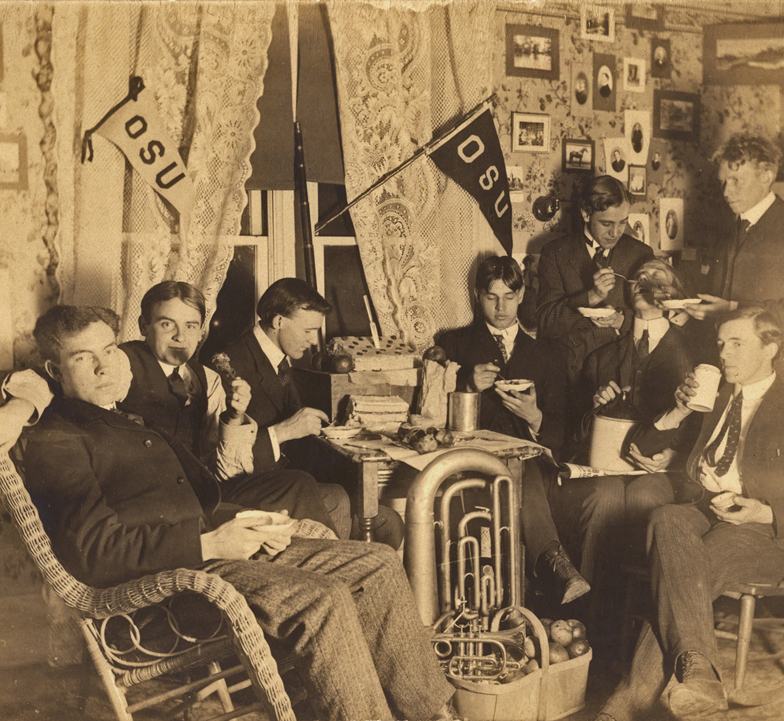
“Banquet” on Woodruff Avenue, 1900s

All absences of individual students from the city, for any purpose, involving absence from college exercises, must be accounted for to the President; and in all possible cases permission must be previously obtained.

Excuses will not be granted for absences of more than two weeks’ standing, unless the absence has been continuous.

Another significant difference in rules from years past is the role of the Department of Military Science. The Morrill Act of 1862, the legislation that paved the way for land grant colleges like The Ohio Agricultural and Mechanical College, decreed that “the leading objects [of these schools] shall be, without excluding other scientific and classical studies, and including military tactics, to teach such branches of learning as are related to agriculture and the mechanic arts.” According to the 1906 Rules:

All able bodied male students under 25 years of age at date of first entrance into the University or of any re-entrance after one year’s attendance at, and one or more years’ absence from, the University shall be required to report to the Military Department for service at the first regular drill hour. Each student will be required to drill three hours per week for two years, during the first two years of his attendance at the University.

In our next blog post, we’ll show you some of the revisions that were made over the years and reflect the changing times on campus.
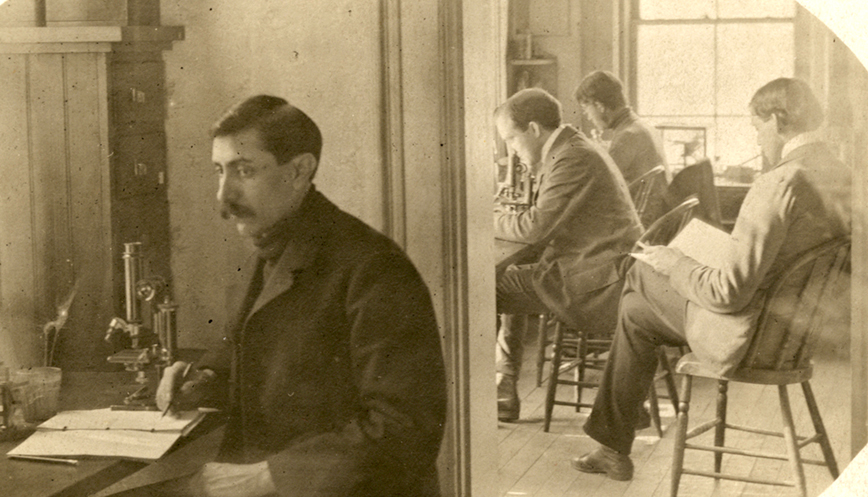
 

Summer School: Failure, brought to you by the letter “E”

By the time this Botany class was held in the early 1900s, students would have still been receiving an “M” for passed with merit through an “F” for failed.

Recently, a patron asked us why in the world OSU issues an “E” instead of an “F” for a failing grade in a class. So we investigated, and here is what we discovered:

When the university opened its doors in 1873, the marking system for classes was “Pass,” “Fail,” “Conditional,” or “Passed with merit.” This continued until 1894 when the Office of the Registrar added “Absent” as an additional mark.

Around 1890 the first individual permanent academic record cards were kept for students and the grading system was changed. Students then received “M” for passed with merit, “Cr” for credit, “P” for passed, “C” for condition, and “F” for failed. This grading system continued with few changes until 1914 when the system incorporated “G” for good and “A” for average, and removed “Cr.”

A more traditional grading system, “A-E,” was adopted July 1, 1922, when the University switched its academic calendar to quarters. In 1955 the university added, among others, the marks of “F” for filed absent, “I” for incomplete, and “P” for progress.

While researching the grading system, we came across an article in the April 1923 Ohio State University Alumni Monthly explaining the university’s decision to incorporate a point system with the grades given to students. According to an excerpt entitled “Incentive to Scholarship” faculty wished to “stimulate a higher grade of scholarship through a more exacting requirement for a degree.” It seems many students were doing the minimum amount of work needed to pass a class, and by changing to a point system faculty could place a more exact, numeric value on the output of each student. This would allow for the university to deny diplomas to those whom the faculty felt did not deserve such an achievement.

The excerpt ended by stating “The superior student should be given an opportunity to reach his goal unhindered by the drag of mediocrity in his classmates.” Indeed.


Summer School: Since 1896, learning happens all year long

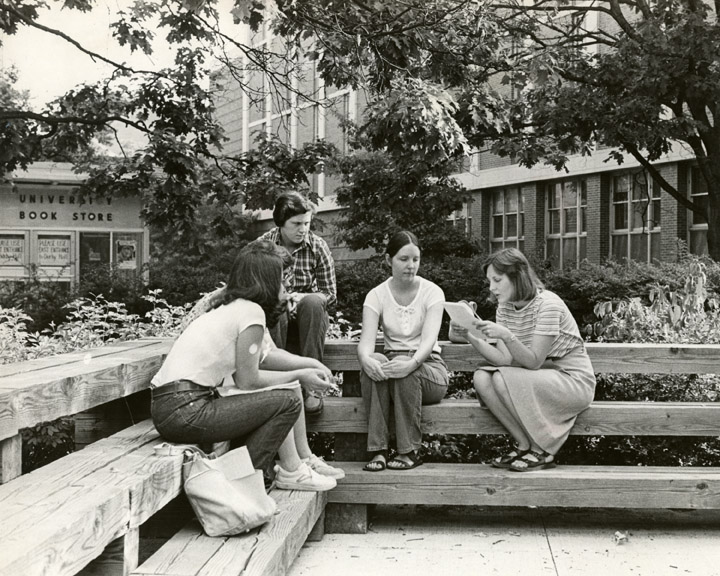
1977

It’s that time of year again: While some of you might be lolling around for the next nine weeks before the fall semester begins, a significant number have gone back to school.

OSU students have been taking classes during the summer for more than 115 years. In 1896, a Summer School was formally established at the University. A summer school catalog told students, “the grounds of the University are large and delightful, and in summer especially attractive and restful.” By 1937, the number of summer school students had reached 5,000. The onset of World War II also caused more courses to be offered, and in new subjects, such as pre-flight aeronautics and Japanese.

Last year, a total of roughly 21,000 students were enrolled at all the campuses, according to the Office of the Registrar’s quarterly enrollment highlights (http://registrar.osu.edu/serrs/intadobe.asp). This year, however, those summer enrollment figures are expected to drop by about 30 percent. Find out why in this article in the Columbus Dispatch:

http://www.dispatch.com/content/stories/local/2012/06/17/summer-enrollment-at-osu-down-30.html

Filed by C.N.

Older posts Newer posts