From Woody's Couch

Our Playbook on OSU History

Category: Administration (page 4 of 6)

Happy 100th birthday to Rec Sports!

1910s

1910s

Athletic events have been held at Ohio State almost from the beginning, when student groups organized races from High Street to University Hall, tug-of-war contests across Mirror Lake, and informal football games on the grounds west of Neil Avenue. It wasn’t until December 1913, though, that the University decided to get involved and organize an “Intra-Mural Athletic Association.”

Intramural sports owe a debt of gratitude to former Director of Athletics Lynn St. John, both for his vision and his willingness to carry it out. In 1913 the University reorganized the Department of Athletics, appointing former student St. John as its head. J.W. Wilce (namesake of the Wilce Student Health Center) was also appointed as head football coach and director of intramural athletics. Ohio State had joined the Western Conference in 1912, and St. John was committed to providing “competitive athletics for every student.”

Women's track, 1929

Women’s track, 1929

The intramural program was soon a success, with other colleges asking for advice on starting their own programs. In fact, despite a brief interlude during World War I, the program grew from its five original sports (football, baseball, basketball, tennis, and track and field) to about 20 sports (both team and individual) in 1921. These included soccer, swimming, and bowling for team sports, and fencing, cross country, fowl shooting and golf for individual competitors. By 1937, there were 21 sports for men, with 10,000 participants, and 14 sports for women, with more than 1,000 participants.
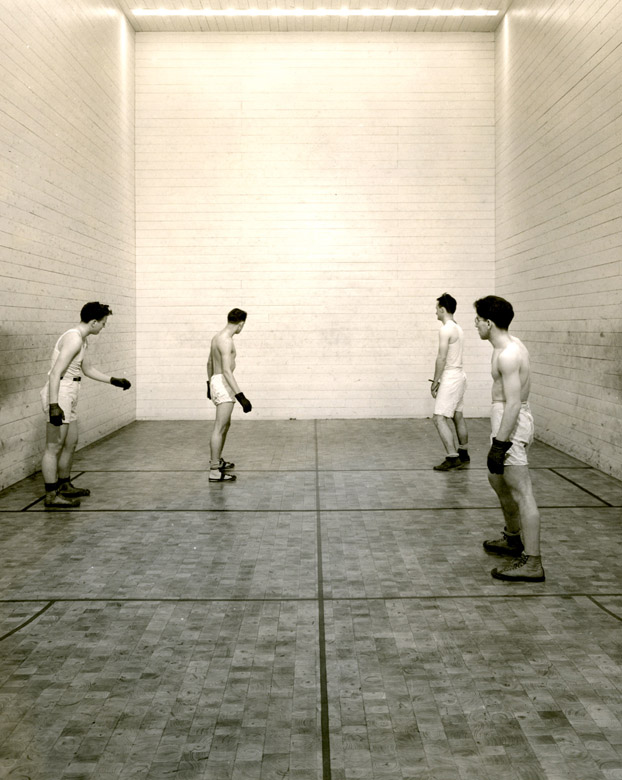
Handball court in Larkins, nd

Men playing handball in Larkins Hall, no date

Many of the men’s indoor sports were played at Larkins Hall, first opened in 1931 as the Men’s Gymnasium and Natatorium, and located just east of where the Recreation and Physical Activity Center (RPAC) now stands. Women’s indoor recreational sports were played at Pomerene Hall, which opened in 1927.

By 1968, however, recreational facilities were deemed insufficient by a University committee charged with evaluating the program. The report found that while the number of students participating in intramurals had tripled since 1945, the number of facilities had decreased slightly. Ohio State, in fact, was far behind other Big Ten universities; for example, while Indiana University had 29 indoor basketball courts at the time, Ohio State had six.
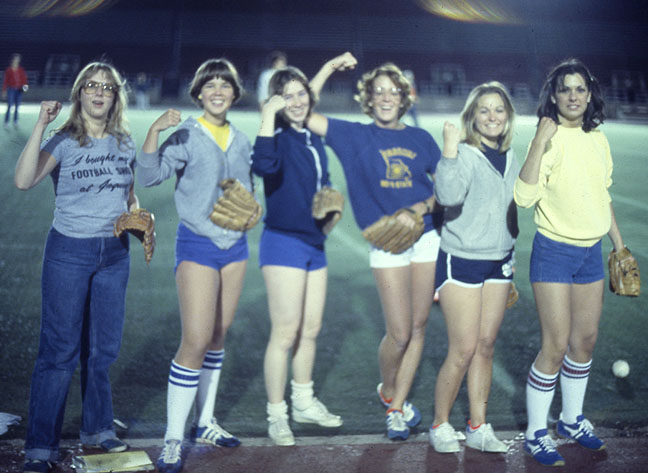
Intramural softball group, 1978

Intramural softball group, 1978

By 1970 OSU’s intramural program was the nation’s largest, encompassing around 30 sports. Today, OSU offers more than 25 different sports throughout the year, ranging from traditional football, basketball and soccer to indoor cricket, chess, “wallyball,” and something called “Battleship” involving canoes and bucket-wielding participants in a pool. It does so at a wide variety of venues, from the Jesse Owens North, South, and West Recreation Centers, which opened in 1976, to the nearly 600,000-square-foot RPAC, which opened in 2005.

So if you are looking for something to do this year, check out the department’s web site. For more on its history, check out its historical timeline.

Filed by C.N.

Twelve Days: For OSU undergrads, Park served as a constant counselor

Dean Joseph Park (left), with students, 1951

Dean Joseph Park (left), with students, 1951

One of the people Ohio State should never forget is Joseph A. Park, the University’s first Dean of Men. His greatest contribution may have been the Stadium Scholarship Dormitories, which helped thousands of male students attend OSU who otherwise could not have afforded to do so. But his long service as a calm counselor, ready to help in a crisis – or in some cases, get a student out of a jam – is what endeared him to thousands of students and led to his name on one of OSU’s dorms.

Born in Cleveland on October 7, 1893, Park graduated from Cleveland’s West High School before coming to Ohio State in 1914. At OSU, he was active in the YMCA, the fraternity Alpha Tau Omega and Sphinx, the senior men’s honorary. He also served on the staff of the Makio. During his junior year he was drafted to the Army, where he entered officer training. He returned to Ohio State in 1919 as a 1st Lieutenant, graduating in 1920. He married Ruth Vera Webb that June, and they had two daughters, Ruth and Mary.

Park, n.d.

Park, n.d.

As a senior, he had served as secretary for the campus YMCA; he held that position until 1927 when then-OSU President George Rightmire went looking for a position he was calling “student councilor.” Rightmire selected Park, whose job title changed to Dean of Men two years later. A new position at the time, the job changed greatly over the years as the campus grew. But Park didn’t change that much: He was always ready to listen and offer a helping hand or piece of advice.

Though he was responsible for the well-being of thousands of male undergraduates, he always kept a calm demeanor – and a phone at his bedside. Often the late-night calls were the results of normal college stress—or to bail students out of jail. In fact, the writers at the Sundial, OSU’s humor magazine, once said of Park’s position: “Some of the problems would tax a Supreme Court Justice schooled in psychiatry.”

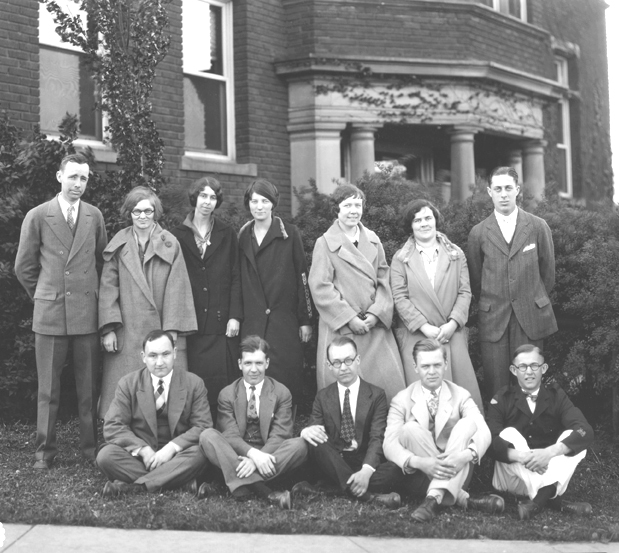
Park with students, 1930

Park with students, 1930

Park didn’t seem to mind, saying once that “the trouble is more than offset by the fun.” Indeed, he gave the bride away at dozens of weddings, and he and his wife chaperoned hundreds of campus dances and parties. On a questionnaire he listed his hobbies as “student life.”

Besides being a counselor and fill-in parent to students, Park also had the opportunity to make some lasting changes to the University structure. In 1927, when he was still a senior and YMCA secretary, Park proposed the creation of an office of director of student affairs and a student court, and the creation of a Student Senate. Eventually, all of these proposals came to fruition.

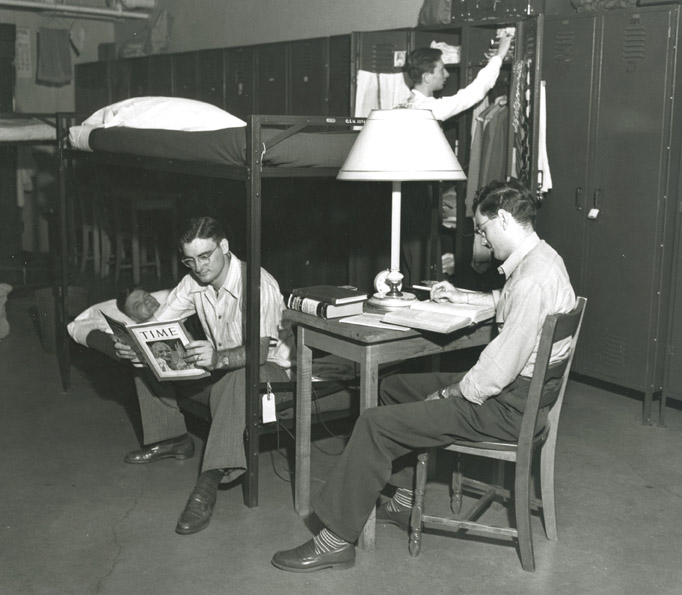
Students in the Stadium Dorm, 1947

Students in the Stadium Dorm, 1947

Park’s most notable contribution, though, was the establishment in 1933 of co-operative housing system in the Stadium for low-income male students. Known as the Stadium Scholarship Dorms, they helped keep students in school by offering affordable housing in exchange for working in the dorms at jobs like cleaning and serving in the dining area. This housing philosophy still exists in the Stadium Scholarship Program.

Park died on April 19, 1952. He was 59. In 1959, Park Hall was one of three then-new dormitories (Stradley and Smith were the others) built to provide more dorm space for men on campus.

– Filed by C.N.

Twelve Days: Newton put School of Nursing on the map

Mildred Newton, 1960

Mildred Newton, 1960

Mildred Emily Newton was born on July 3, 1901 in Cedar Fall, Iowa. After receiving degrees in nursing and education from Northwestern, USC and Stanford, Mildred Newton came to Ohio State as director of the School of Nursing in 1951, a position she held until her retirement in 1968. She was credited for making the nursing program at Ohio State what it is today.

Under her supervision the program gained national accreditation, expanded its baccalaureate program and started a graduate program and a program in nursing research. Besides her academic achievements, Ms. Newton was in demand nationally as a volunteer. She worked closely with the Kellogg Foundation, the National League of Nursing as well as working for the U.S. Department of Defense.

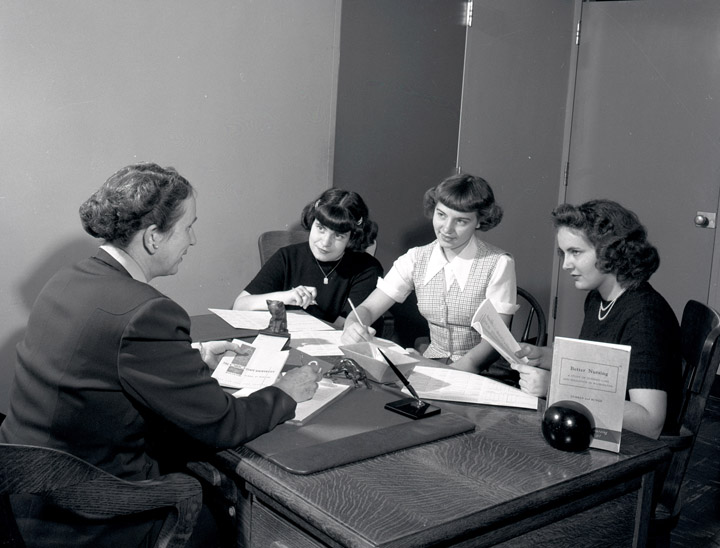
Newton meets with student nurses, 1951

Newton meets with student nurses, 1951

Throughout it all, she continued to teach. One of her passions was the history of the profession, particularly the life of Florence Nightingale, and she conveyed that to generations of students. She also was an avid collector of stamps related to medicine and nursing, and she donated her collection to the Health Center Library shortly before her death. She organized it into four volumes that depict the history of the Red Cross, the history of medicine and nursing, world attempts to eliminate diseases, and individuals’ contributions to health.

Newton Hall, 1983

Newton Hall, 1983

Recognition for her work came in the form of the National League of Nursing’s Adelaide Nutting Award in 1969 and one of Ohio State’s 1970 Centennial Achievement Awards. She was also given emeritus status upon her retirement in 1968.

Her personal legacy was that of a caring mentor who always had an open door and a sense of humor. She was also an advocate of patient rights. In a Nov. 11, 1958 article in The Lantern she identified the following as particularly critical to the nurse-patient relationship: “The patient’s welfare must always come first. Nothing a patient needs to have done is beneath the dignity of a doctor or nurse to perform.” She passed away on July 25, 1972. The School of Nursing’s building was renamed “Mildred E. Newton Hall” in her honor.

Older posts Newer posts