From Woody's Couch

Our Playbook on OSU History

Category: Administration (page 3 of 6)

Women’s History Month: 90 years ago, first woman appointed as Trustee

Alma Paterson, n.d.

Alma Paterson, n.d.

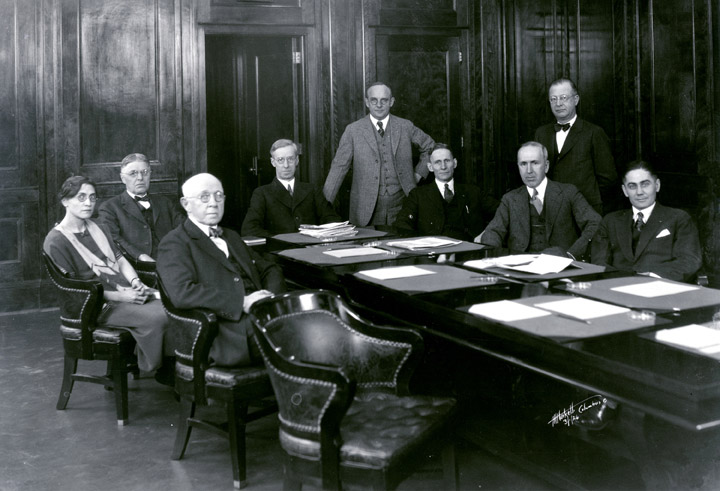
It was 90 years ago today that the first woman was named to Ohio State’s Board of Trustees. Alma W. Paterson was a member of Ohio State’s class of 1904; as an undergraduate, Paterson had been a member of the Browning Dramatic Society and studied science and physical education. She received her bachelor of arts degree in 1904 and went on to serve as an assistant director of physical education for women for three years. In 1910, she married Robert G. Paterson, a 1905 OSU graduate, who was then executive secretary of the Ohio Public Health Association. 

Alma Paterson was appointed to the Board on March 27, 1924, to succeed the late OSU Prof. Thomas Mendenhall. Then-Ohio Gov. A. Victor Donahey had already indicated that the next appointment to the board would be a woman since “the large number of women registered at the University warrants the selection,” according to a Lantern article about her appointment. Paterson was on the board until 1933, serving as vice chairman twice during that time.

1926 board of trustees at conference table, including Alma Wacker Paterson

Paterson with the Board of Trustees, 1926

In 1954, the Board of Trustees named Paterson Hall, then a brand-new dorm for women, after her.

Paterson’s daughter, Ann, followed in her mother’s footsteps, first as a student (BS in Education in 1937 and MS in Education in 1939) and then as a professor of women’s physical education. After 19 years of teaching at OSU, she left the University in 1956 to teach at San Francisco State College.

– Filed by C.N.

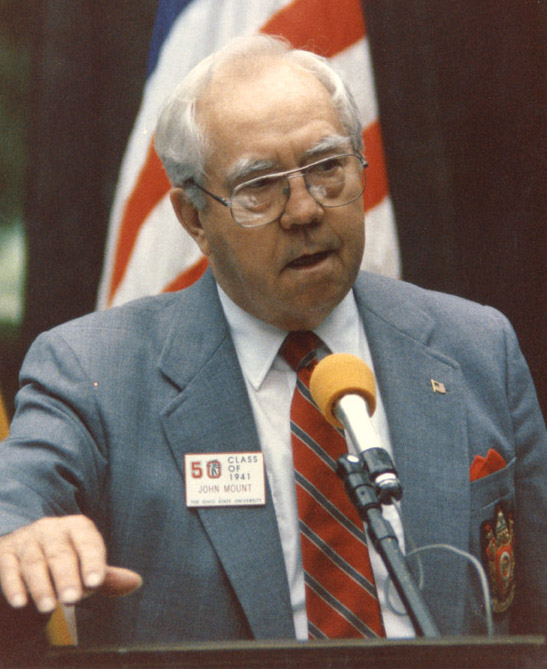
John Mount, a Buckeye through and through

John Mount, 1941 class runion, 1991

John Mount speaks at his 1941 class reunion, 1991

A reporter once wrote that it took a World War to keep John Mount away from Ohio State. And it can honestly be said that John Mount’s stint in the U.S. Navy is the only time in his adult life that he ever left the University for a significant amount of time. Think about this: Mount’s service to the University has spanned roughly seven decades – more than a third of the University’s total history.

Mount, whose association with OSU took him from student to professor to University administrator, died Thursday. He was 95 years old.

John Mount was born on June 10, 1918 in Butler County, Ohio. He attended public schools before coming to Ohio State on scholarship in 1937 to study agriculture. While at the University, he was a member of Sphinx, Gamma Sigma Delta (National Honor Society of Agriculture), the University Livestock Judging Team, and the Townshend Agriculture Education Society. He was President of the College of Agriculture Student Council, as well as the University 4-H Club. He graduated in 1941 with a Bachelor of Science degree in Agriculture. He accepted a job with OSU’s Agricultural Extension Service directly after graduation, then took a leave of absence to join the U.S. Navy, where he fought in the Atlantic, Mediterranean and Pacific theaters. He returned home in 1946 to his alma mater, leaving again briefly to complete his master’s degree at the University of Wisconsin in 1949.

John Mount, (top row, right), with the University 4-H Club, 1940

John Mount, (top row, right), as a student with the University 4-H Club, 1940

After returning to OSU, Mount held almost every job possible within the College of Agriculture and the University administration. He served as assistant 4-H leader, professor, and assistant dean and secretary within the College of Agriculture. In 1957 he became the Administrative Assistant to the President, and the following year became Secretary of the Board of Trustees. In 1960 he was named Vice President of Educational Services.

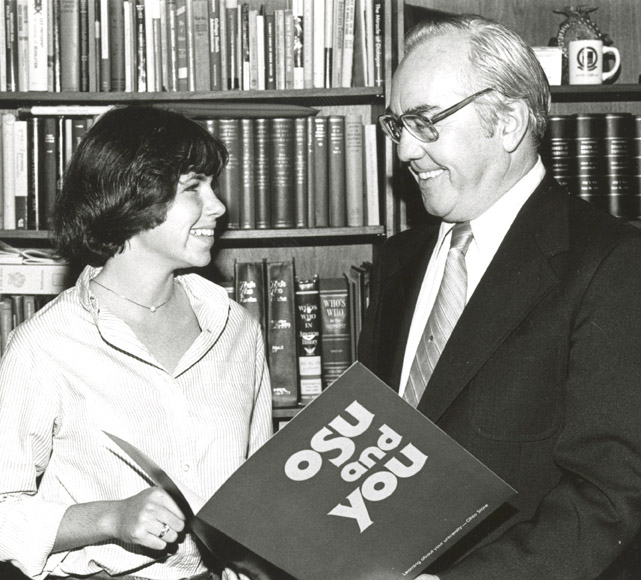
In 1968, Mount was appointed Vice President for Student Affairs, then a new position. It was probably the greatest challenge of his career at OSU, given the turbulent times in which he served. At that time, campuses like OSU’s roiled from sometimes tense and violent demonstrations over the issues of civil rights, women’s rights and the Vietnam War. Mount served as the administration’s liaison with students demanding deep changes in University operations. Mount spent countless hours negotiating with them. During the spring of 1970, an especially contentious period, Mount spent so much time meeting with students that he was admitted to University Hospital for a short period for exhaustion.

Mount with student Tracy Barber, no date

Mount with student Tracy Barber, no date

In 1970 he became the University’s first Dean of University College and Vice President for Regional Campuses. It is from these posts that he retired from in 1983 after 42 years of service.

Even in “retirement” there was no question of his leaving Ohio State. He remained involved in 4-H activities, served as the grand marshal of the 2004 Homecoming parade, and was one of six University professors to teach the OSU History course offered annually. Most recently he held the title of faculty emeritus.
At the Summer 1993 Commencement, Mount was awarded OSU’s Distinguished Service Award, for—at that time—almost 50 years of service. In 1983, the University Board of Trustees officially named the then-University College building after him.

During his retirement, Mount continued to volunteer with Freshman Orientation, saying, “I’ve been paid for the things I really enjoy doing. I don’t mind volunteering my time.”

– Filed by C.N.

OSU snuffed out smoking on campus as early as 1900

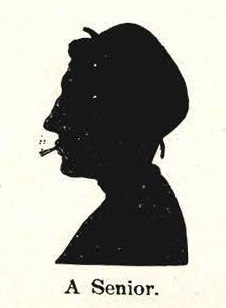
Sketch of a smoking student from the 1895 Makio.

1895 Makio.

Earlier this month, the University’s new tobacco-free policy took effect. It prohibits the use of all types of tobacco products on University-owned property, both inside and outside of buildings. This is the most widespread prohibition on tobacco products on the books yet at OSU. However, the University has banned tobacco on campus, at least to some extent, since 1900.

That year, in an update to the campus by-laws, Section 46 was amended to read: “The use of tobacco in any form in the lecture rooms, halls, corridors, door-ways, stair-ways, laboratories and libraries of the university is prohibited.” Until this time smoking was allowed in hallways, but not classrooms or labs.

There was a push in 1930 to have this rule revoked on the grounds that many campus buildings were fireproof, with an understanding that the ban would still hold for non-fireproof buildings, but it was unsuccessful.

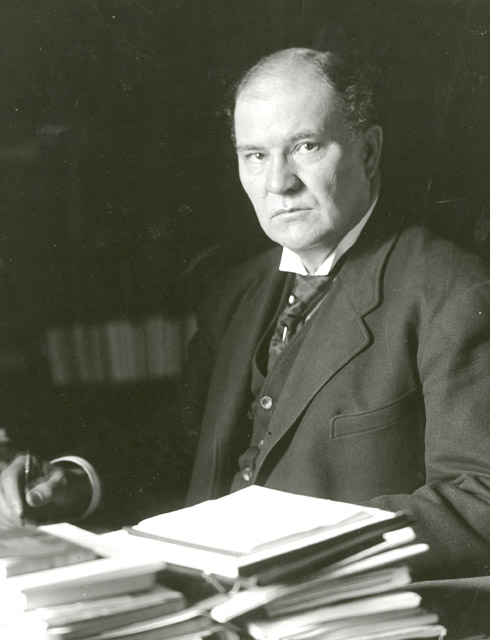
William Oxley Thompson, 1907

President Thompson, 1907

At a Wednesday morning convocation in March 1901, then President William Oxley Thompson spoke out not only against the use of tobacco products but the “use of narcotics or stimulants in any form,” particularly for those men under the age of twenty-five. He argued that stimulants produced “a derangement of the nervous system and such a result cannot but affect any man’s abilities in later life.” Keep in mind that this predates the Surgeon General’s report by 63 years!

Campus interest in controlling tobacco use waned until the 1970s. In 1975 Associate Provost George Crepeau sent a memo to all faculty regarding a lack of enforcement of the 1900 ban. The memo mentions “students (and professors) …smoking in rooms with large red NO SMOKING signs posted.” It also discusses the “damage to floors in some buildings where cigaretts [sic] have been dropped and tiles have been burned.” There were many complaints to the Office of Academic Affairs and the President (then Harold Enarson). In 1977, Enarson announced a new focus on enforcing the no-smoking rules in compliance with a new state law regarding smoking in public places.

Student smoking in classroom, 1976

Student smoking in classroom, 1976

A University committee was formed to review the existing non-smoking policy and issued recommendations in 1986 that included banning the sale of tobacco products on University grounds and offering a smoke-cessation program for OSU employees who smoked.

After much public discussion among the University community regarding the proposed policy, the Board of Trustees approved it effective July 1, 1987. Some small changes were made, specifically that the smoking or non-smoking designation for single-occupant offices that could be enclosed were left up to the inhabitants. The Ohio Public Health Association awarded OSU a silver commendation in 1987 for this policy.

In 1991 OSU put together a new Committee to Review University Non-Smoking Policy. As a result of this committee, a new stricter policy was approved by the Board effective July 1, 1993. The updated policy extended the ban to all indoor areas, including St. John Arena and Ohio Stadium, with the exception of “specifically designated private residential space.” The ban

on the sale of cigarettes on campus was continued, as were smoking cessation services. A policy regarding alcohol and tobaccos advertising was issued in 1999, banning both from public campus spaces.
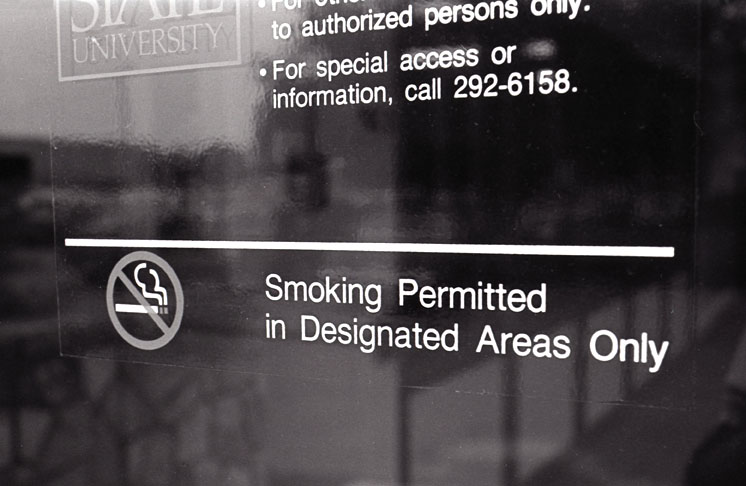
"Smoking permitted in designated areas only" door sticker, 1988

“Smoking permitted in designated areas only” door sticker, 1988

Prior to the current tobacco-free policy, the last major change was in response to the 2006 Smoke Free Workplace Law passed by the state of Ohio. This law prohibited smoking inside buildings or under outside overhands and within 25 feet of doors, windows, and air intakes. This same year, the entire Wexner Medical Center became tobacco free, even in outside spaces. The current policy took effect on January 1, 2014.

 

Older posts Newer posts