From Woody's Couch

Our Playbook on OSU History

Category: Administration (page 2 of 6)

Twelve Days: Harding gave Archives official role in preserving OSU’s history

(In celebration of the University Archives’ upcoming 50th Anniversary in 2015, we bring you “The Twelve Days of Buckeyes”. This is day five in a series of 12 blog posts highlighting the people who were instrumental in the creation and growth of the Archives.)

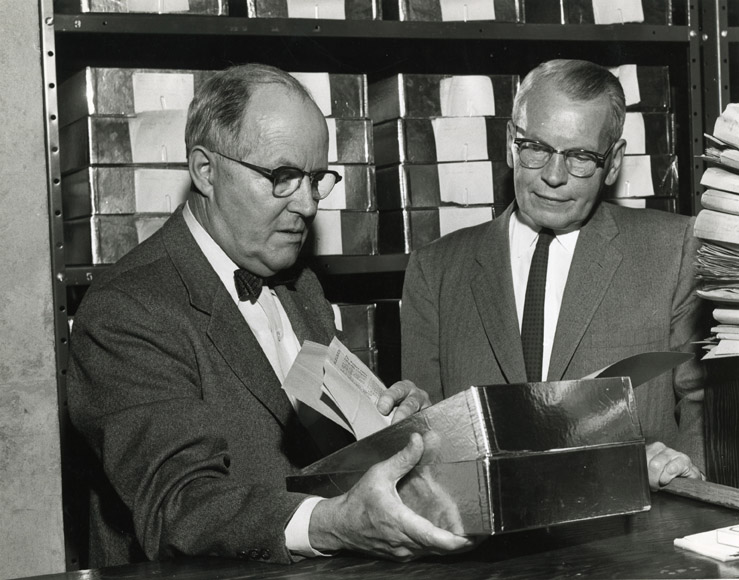
Bruce Harding and an unidentified staff person pose in front of an Archives display, 1965

Harding and an unidentified staff person at the Archives, 1965

You may not know this but the University has an Operating Manual, which is nothing like the owner’s manual you receive with a new car, but instead is a compilation of policies, procedures and guidelines that help determine how OSU conducts business.

Inside, thanks to Bruce Harding, is a section that makes the Archives the official repository of University materials of permanent value, and gives it the authority to decide on the disposition of all of the University’s records.

Sounds pretty cool, huh?

Page from the operating manual

Page from the operating manual

Fine, it might not sound very cool, but it is, in fact, very important. Without that designation and authority, the University’s history might be spread willy-nilly all over campus or, heaven forbid, disposed of without a thought or care. Imagine the first registrar’s book – the only record of the first students who attended OSU – being tossed in the trash. Unthinkable, isn’t it? But without the Archives being the official developer of individual departments’ and other units’ records retention policies, important historical materials might be lost forever.

With its place in the Operating Manual, the Archives has an official role in preserving OSU’s historical record, and it was because of Bruce Harding that it’s there. As the first official archivist appointed to that role in 1965, Harding worked to get guidelines on records disposition into the Operating Manual as early as 1969.

Harding, 1967

Harding, 1967

Harding had been hired in 1965 from Michigan’s state archives, and he had previously worked at the Ohio Historical Society. He was the University’s first professional archivist – he had certificates in archives management and preservation administration from Harvard and American universities, respectively – but he left in 1969, saying the archives was still low on OSU’s priority list and that funds were insufficient. “Of course, the University’s primary responsibility is to teach, and the archives is naturally of far less importance,” he told The Lantern in February 1969.

It couldn’t have helped that while he was archivist, the Archives moved three times, from the top floor of Thompson Library to the law school’s basement and Hitchcock Hall. Harding subsequently worked for the National Archives and Records Service in Chicago as a field regional archivist responsible for much of the Midwest.

Twelve Days: Pollard’s passion for the past helped keep OSU’s history intact

(In celebration of the University Archives’ upcoming 50th Anniversary in 2015, we bring you “The Twelve Days of Buckeyes”. This is day two in a series of 12 blog posts highlighting the people who were instrumental in the creation and growth of the Archives.)

James Pollard, 1959

James Pollard, 1959

Though James Pollard’s main expertise was in journalism, his most important impact on OSU was because of his interest in history. Particularly OSU history, which would make sense since he was a three-time graduate of the University (B.A. 1916, M.A. 1917 and Ph.D. 1939).

Pollard first served as a Political Science teaching assistant from 1920-21, then Director of Ohio State’s News Bureau from 1923-33. He was an Associate Professor of Journalism from 1932-38, and Director and Professor of Journalism from 1938-58. Finally, he served as University Historian from 1958 until his retirement in 1965. After his retirement, however, he continued to work part-time as a consultant for the Office of Educational Services.

Along the way, Pollard wrote many articles and books, but he was especially interested in the history of OSU. In 1952, his book, History of the Ohio State University, 1873-1948 was published. It chronicled the formation of the Ohio Agricultural and Mechanical College, and its growth and development up to 1948. Soon after, Pollard also wrote biographies on former University Presidents Howard Bevis and William Oxley Thompson. By 1959, Pollard published yet another book about the University, this time about the history of athletics. Ohio State Athletics, 1879-1959 discussed how athletics were established at the university as well as how individual sports were developed.

Pollard (right), goes through filing cabinets in the Administration Building's basement, 1960

Pollard (right), goes through files in the Administration Building, 1960

Pollard was not only interested in writing about OSU history, but – and the Archives staff is eternally thankful for this – he was interested in preserving its history. To write his books on OSU history, he had gone through correspondence and other historical documents that were spread all over the University at the time in vaults, basements and attics. Pollard knew that in such places, these unique materials would deteriorate with age. In one basement, in fact, he found records whose boxes had collapsed, and the contents were spilled in a heap on a damp floor. In another, he found a collection of records that had become shredded by the gnawing teeth of rats setting up house in them, according to a September 1960 Alumni Monthly article.

1960

Pollard and Frederic Heimberger, Vice President for Instruction and Research, go through University Records stored at the Main Library, 1960

It took Pollard two years, but he finally convinced the administration to establish an archives where he could store and organize University materials, to be located on the top floor of the Thompson Library. His first task was to go through old file cabinets in the basement of Bricker Hall (then known as the Administration Building). There, he retrieved 24 file drawers of what would become the William Oxley Thompson Papers, now one of the most frequently used collections here at the Archives.

OSU’s 1996 South Africa trip included Mandela speech

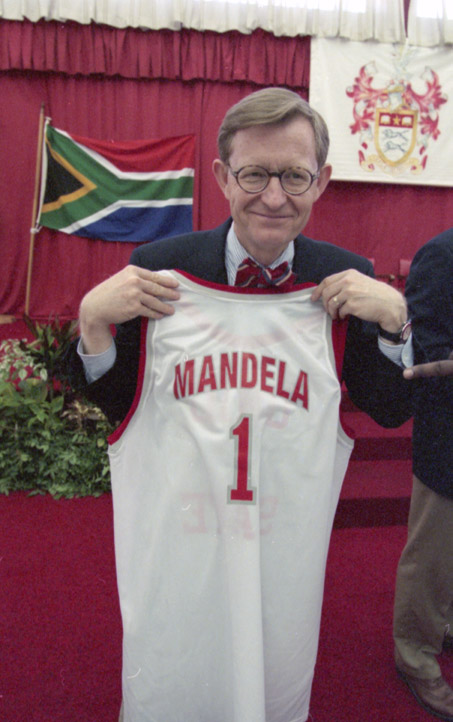
President Gordon Gee holds a Mandela jersey during his trip to South Africa, 1996

President Gordon Gee holds a Mandela jersey during his trip to South Africa, 1996

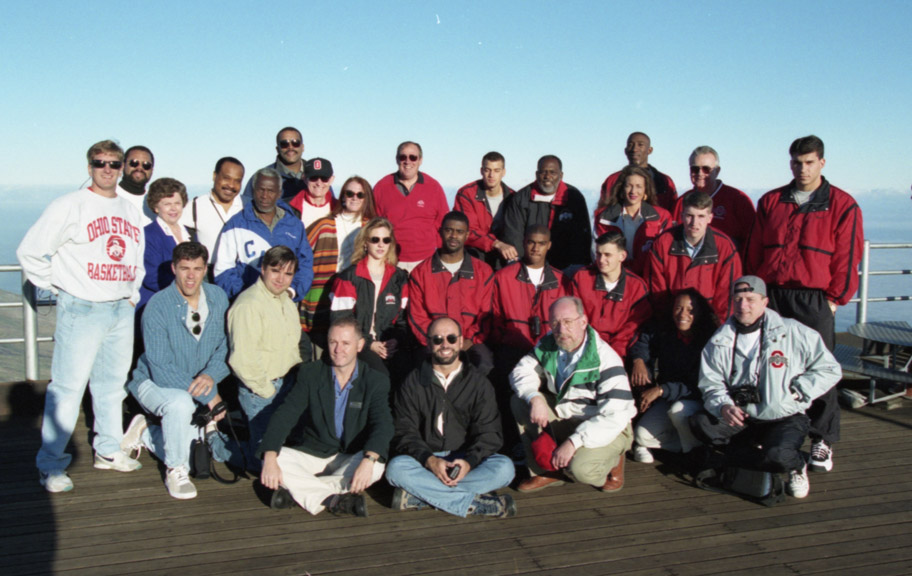
In early June 1996, President E. Gordon Gee, along with 36 Ohio State faculty members and the OSU men’s basketball team, embarked on a two-week trip to South Africa, with the faculty going on to visit Uganda as the basketball team took a detour to Zimbabwe. The timing of the trip was particularly significant: Only two years earlier, South Africa’s apartheid system had been brought down by free elections following violent protests.

The primary purpose of the tour was to foster ties between Ohio State and African universities and to show how Ohio State can make a difference around the globe. One major area of shared interest: agriculture. For years South African students had come to Ohio State to study agriculture before bringing these lessons back to their home country. Some of these students had gone on to become faculty members at the University of Natal in South Africa. Makerere University in Uganda, likewise, had a strong relationship with Ohio State; OSU worked with the Ugandan university to set up a Cooperative Extension Service in Uganda, with the aid of $20 million from the World Bank. In addition to furthering the agricultural relationship, faculty members hoped the 1996 trip would help build collaboration in law, education, nursing and humanities programs with South African universities.

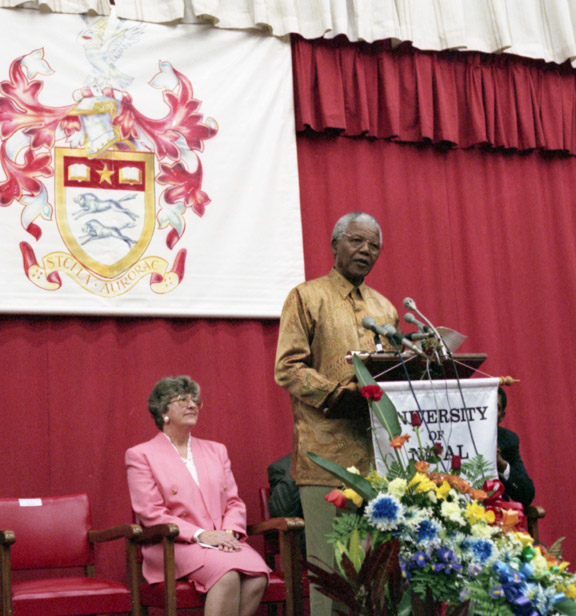
Nelson Mandela speaking during event, 1996

Nelson Mandela speaking during event, 1996

Meanwhile, the men’s basketball team hosted basketball clinics and demonstrations for local residents, both in the major cities and in the countryside. Basketball was seen as a way to bring people across South Africa together and integrate traditionally rugby-playing whites and soccer-playing blacks. At the same time, OSU basketball players learned about the history of modern South Africa and the role that students played in the protests that eventually brought an end to the apartheid regime. At one point, basketball team members attended a Youth Day celebration where they heard then-South Africa President Nelson Mandela speak.

The members of the OSU delegation were thrilled by the success of the trip, Gee said after the return. “We really met and exceeded our expectations,” he said. Gee and others spoke positively of South Africa as a nation, remarking on its determination to become a diverse, integrated country and its optimism and hope for the future. The Ohio State visit also was apparently the first visit by a foreign university’s representatives to the South African countryside.

For information on today’s memorial event for Nelson Mandela in Hale Hall, visit http://aaas.osu.edu/news/%E2%80%9Cnelson-mandela-his-life-times-and-legacy%E2%80%9D

Members of the trip, including athletes from the basketball team, pose for a portrait in S. Africa, 1996

Members of the trip, including athletes from the basketball team, pose for a portrait, 1996

Older posts Newer posts