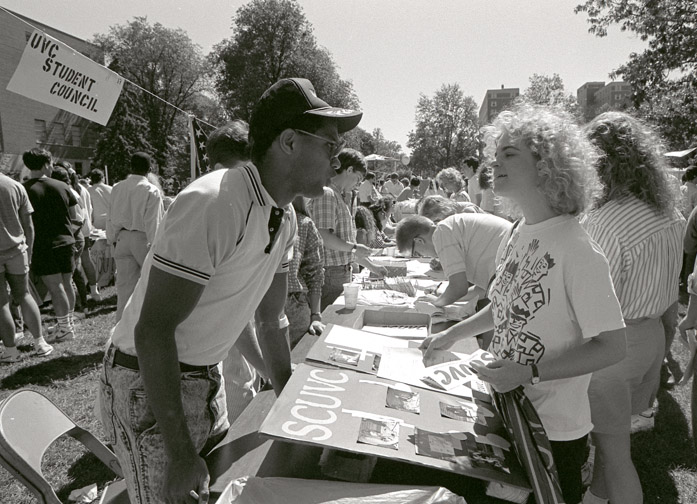
Students discuss their organizations during Welcome Week in 1988
Editor’s Note: At the time of year when many new students are figuring out how to spend their free time, we decided to look at what kinds of clubs used to be available to those who wanted to get involved. Archives Student Assistant Chris Inglin, whose inquisitive nature and love of the absurd, made him a natural to write this post, dug into our collection of student organization files to find the following gems.
“If the club you want doesn’t exist, you can form it!” How often have you heard this refrain? This line is frequently offered by colleges to assure students of the chance to take part in the extracurricular activity of their choice, whether that be rollerskate NERF gun jousting, synchronized Sudoku competitions, or underwater basket weaving (regrettably, none of those are real). Some students, however, have particularly… unusual interests, and when these students and this policy meet, you get clubs like this:
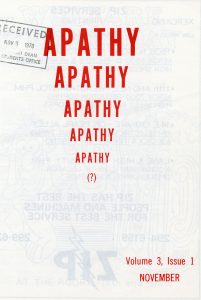 APATHY Magazine: I must confess, the placement of APATHY on this list of bizarre and unusual student organizations is not due to any oddity on its part, but wishful thinking and high – or perhaps low – expectations on mine. APATHY was a student publication, a campus magazine that was published from 1970 to 1972. When I saw its title, my mind was filled with images of a magazine, its cover emblazoned with a man sighing wistfully, a lone line of text reading “What’s the point?” This image of ennui, morosity and lethargy would then be followed by a series of blank pages, because, after all, what WAS the point? But alas, my hopes were not to be fulfilled. Instead, APATHY contained a fairly standard mix of student articles, essays & poetry, advertisements for local businesses, interviews, and updates on local news or social events. (Click the image on the left to see part of the original issue.)
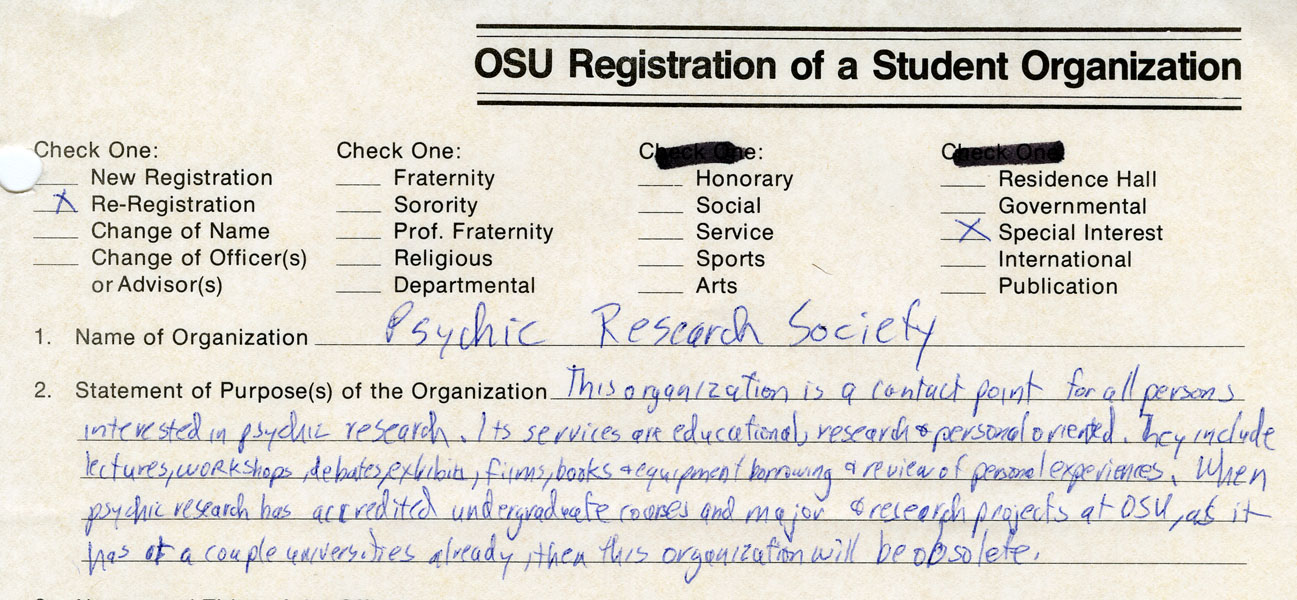
 Psychic Research Society: Formerly the Pyramid of Psychic Research (itself formerly the Pyramid Zen Society), the Psychic Research Society managed something rather unusual for a club of its kind – it survived a change in officers. Parapsychology and other “weirdness-focused” organizations (whether interested in psychic powers, Bigfoot, or UFOs) are often driven by the enthusiasm of one or a few key members, and when those members graduate or lose interest, the organization rapidly grinds to a halt. There’s not much information on what the club’s meetings were like, so I’m forced to conclude that the students alternated between spending time bending spoons and guessing images on a screen a la Ghostbusters and telepathically manipulating their professors into giving them better grades. What I’m more interested in is how their faculty advisor dealt with all of the heckling he must have gotten around the water cooler from fellow professors. I imagine it must have been a constant struggle to resist exploding your co-worker’s heads with your mind. You have no idea how much paperwork you have to deal with after one of those incidents.
Revolutionary Communist Youth Brigade: “Are you now, or have you ever been, a Buckeye?” Pesky Communists were everywhere during the Cold War, even here on campus. We even had our own Revolutionary Communist Youth Brigade (RCYB), which was active from 1975 until its registration was terminated and its privileges were removed in 1980. Among its activities were a protest rally against ‘imperialist wars’ in 1975; a 1977 rally in support of Ashby Leach, a Vietnam veteran who seized the Chessie System railroad offices in Cleveland; and protests against cuts in financial aid. It seemed to be rather obsessed with the horrors of “U.S. imperialism,” about which it sought to educate the student body. Unfortunately, the problem with launching a ‘revolutionary’ crusade against The Man is that you tend to get in trouble with authorities. Specifically, the university authorities. Who have the power to ban your club. Needless the say, the RCYB had a lot of trouble with rules. Their offenses included: throwing paint on a CIA recruiter in 1979, painting slogans on campus buildings, leafleting on campus without permission, gluing posters to displays and other surfaces across campus, and failure to pay fines. (Click here to view a Dispatch article on the Revolutionary Communist Youth Brigade.)
The  Committee to End Pay Toilets in Columbus (CEPTIC): You may scoff at the title, but there were public toilets that charged you for the dubious privilege of using them. The local chapter of the Committee to End Pay Toilets in America (based in Dayton, Ohio), called CEPTIC (pronounced septic – their constitution insists on this fact), said in its constitution that it intended to “seek out and destroy the enemy pay toilet” and “to wait and hope for the day when everyone can stand up and say, ‘I’m free (free of pay toilets)’.” Membership was open to any person in Columbus regardless of “color of eyes, facial complexion, shoe size, or tissue paper brand usage,” but members could not “join just to put another activity membership on their transcript.” Officers were elected upon the “death or graduation or both” of another officer. Officers were required to be students with a grade point average, and were compelled to make a pilgrimage to Dayton, Ohio, “sometime in their lifetime.” Meetings were held whenever the Chairman wanted, “or when enough members complain,” but were not to exceed “the total number of days per quarter.” If there were fewer than one meeting per year, “the Committee shall be considered disbanded for that school year and the officers should try harder next year.” (Click the image on the right to see part of the original issue.)
Ladies and Gentlemen, there is nothing more to say. In my unprofessional estimation, there has never been, and never will be, another student organization like CEPTIC. I cannot imagine any product of our modern imaginations reaching the heights of glory attained by that lost, golden age of 1976. It is my deepest regret that I was not born in time to see it.
Filed by Chris Inglin








Recent Comments