From Woody's Couch

Our Playbook on OSU History

Category: Activities (page 11 of 16)

Korean War Anniversary: Conflict had multiple effects on OSU

Ohio State students in the Marine Reserves were some of the first called to active duty in Korea, 1950

Ohio State students in the Marine Reserves were some of the first called to active duty in Korea, 1950

Last week marked the 60th anniversary of the Korean War, which affected campus measurably, despite the fact it was being played out halfway across the globe.

Students in Company C, 7th Infantry Battalion, left Columbus for Camp Pendleton in September 1950. Within weeks, some of the men were in Korea, Japan and Guam.

Students in the Company C, 7th Infantry Battalion, left Columbus for Camp Pendleton in September 1950. Within weeks, some of the men were in Korea, Japan and Guam.

One of the first developments at OSU, according to a history of OSU Pres. Howard Bevis’ administration, was the appointment in autumn 1950 of a committee on Civil Defense, whose mission was to give Ohio communities the “knowledge and facilities” at the University to help them cope with atomic warfare. By March 1951 University emergency facilities had been inventoried by the campus Civil Defense Council, and local and state authorities had been notified of their availability. A War Emergency Committee was also created.

Because of the threat of atomic warfare, the city made extensive preparations for civil defense against such attacks. (At the time, Columbus was seen as a logical target in Ohio.) In early December 1950, OSU Vice President Bland Stradley announced the University would work both with Columbus and with Franklin County officials in preparing against atomic bombs.

Another effect of the war was a ban by the National Production Board on the construction of buildings for “amusement, recreational or entertainment purposes.” (St. John Arena’s construction did not begin until 1954, after the war ended.)

John F. Archer, 1944

John F. Archer, 1944

One of the biggest effects of the war, of course, was on enrollment. Early on, a University committee was created to coordinate information about the draft and calls to service of faculty and students. Like World War II, OSU faced a considerable dip in enrollment because of the war, so University officials tried to stem off an even further drop through a coordinated campaign to encourage male students to stay in school until they were called up, instead of enlisting. At the beginning of the winter quarter of 1951, Bevis issued a letter to male students, urging them to “stay in school as long as you can and do your work the very best you can! Whatever happens, this will make you of greater service to your country.”

In June 1950, the Alumni Monthly reported that dozens of Ohio State alumni were on the front lines when the war broke out. The first OSU casualty was Lt. John F. Archer, who was killed in action July 29, 1950. He had withdrawn from OSU during World War II to fight in that conflict; in the two years in which he served in World War II he won five battle stars. 

He said what? Match the Commander in Chief to the Commencement speech

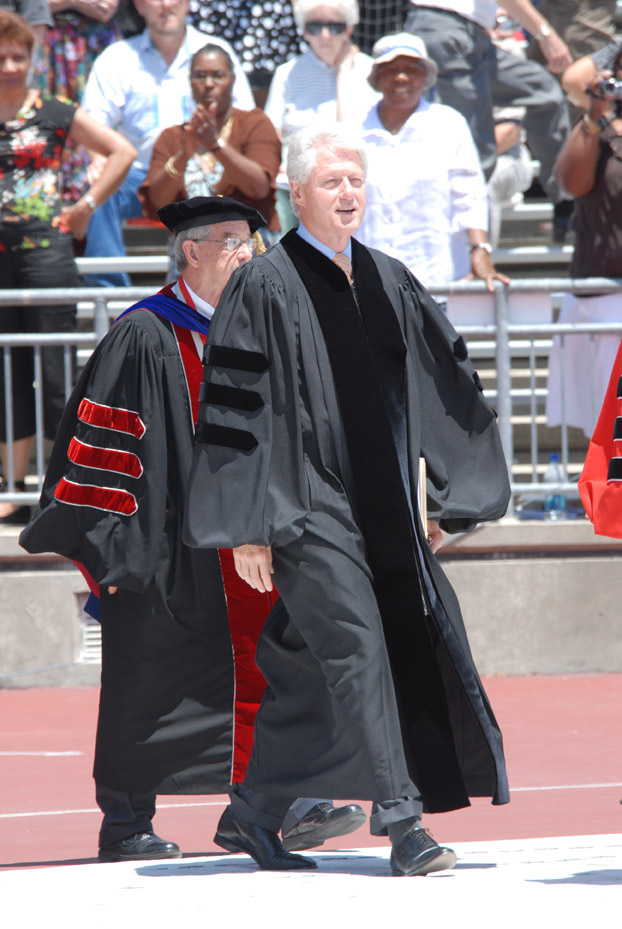
When President Barack Obama steps up to the podium at Commencement on Sunday, he will be the fifth U.S. President to do so. Obama is actually the third sitting U.S. President to speak at an OSU Commencement; he follows Gerald R. Ford and George W. Bush in that role. Other U.S. Presidents have spoken, but not while they were in office. George H.W. Bush spoke while he was still in his first term as Vice President under Ronald Reagan and Bill Clinton spoke seven years after he left office.


Below, we’ve printed short portions of their commencement speech transcripts. See if you can match the speech to the President. Answers are at the bottom of the blog, as is a link to the page on our web site where you can find a list of all our commencement speeches, as well as links to speech transcripts. You may find this exercise harder than it sounds. It turns out commencement speakers often talk about the same things that are perennially important to new graduates: job prospects and the economy in general, their future role in society, and the future of both the nation and the planet. Good luck!


Speech No. 1:

As fellow human beings, we celebrate the rising capacities of the Chinese nation, a people with firm belief in their own destiny. However, as Americans, motivated by free competition, we see a distant challenge. And I believe all Americans welcome that challenge. We must compete internationally not only to maintain the balance of trade in our standard of living, but to offer to the world’s impoverished examples and opportunities of a better life. We should do that for humane and for perhaps even self-interest. … And I am confident that America’s youth will make the difference. You are America’s greatest untapped source of energy. But energy unused is energy wasted. …


 Speech 2:

Some believe [a] lesson in service is fading … Your generation will respond to these skeptics – one way or another. You will determine whether our new ethic of responsibility is the break of a wave, or the rise of a tide. You will determine whether we become a culture of selfishness and look inward – or whether we will embrace a culture of service and look outward. Because this decision is in your hands, I’m confident of the outcome. Your class and your generation understand the need for personal responsibility – so you will make a culture of service a permanent part of American life.


Speech No. 3:

Your most immediate concern is probably the economy. Most of you will be leaving her to go out and look for jobs, and while I can’t promise it will be easy, I can tell you that the overall economic picture looks better than it has in a long time. … All the indications are that this recovery that we’re in the middle of now is strong and will be lasting. … The greatest danger that we as a nation now face is the psychology of fear of retrenchment – that means giving up on the promise of the future, holding tightly to the past, even as it steadily shrinks and dwindles in our grasp.


Speech No. 4:

First, it is necessary to understand the promise and peril of the 21st century world, an age of unprecedented interdependence for good or ill. Interdependence simply means we can’t escape each other. A lot of it is exciting … But interdependence also means we share common vulnerabilities to terror, to weapons of mass destruction, to diseases like avian influenza, to the rampant inequalities in the world, to all the political conflicts rooted in religious and ethnic identities, to climate change … We can’t escape on another’s challenges. … We have to see each other because, in an interdependent world, we really can’t succeed without each other. That will be your great challenge. …


President Ford, 1974

President Ford, 1974

Answers:

Speech 1: Gerald R. Ford spoke at the Summer Commencement ceremony on August 30, 1974 – barely a month after being sworn into nation’s highest office after Richard Nixon resigned. Ford had been to China several months before in his official capacity as then-Vice President.


President Bush, 2002

President Bush, 2002

Speech 2:  George W. Bush spoke at the Spring Commencement ceremony on June 14, 2002 – just three months shy of the first-year anniversary of the Sept. 11, 2001, attacks. At the time, many young people were joining the military, training to become firefighters and police officers, and generally trying to find ways to serve their country in the aftermath of the terrorist attack that killed more than 3,000 people, including Pentagon military personnel, and New York firefighters and police officers.


Bush, 1983

Vice President Bush, 1983


Speech 3: George W. Bush’s father, George H.W., spoke on June 10, 1983, at the Spring Commencement ceremony, while still serving as Vice President under Ronald Reagan. After a two-year recession at the beginning of that decade, the country was experiencing sustained growth at the time Bush spoke and would continue in this pattern until 1990.


Bill Clinton, 2007

Clinton, 2007


Speech 4: Bill Clinton spoke on June 10, 2007, at the Spring Commencement ceremony, seven years after he left office. In 2005, Clinton formed the Clinton Global Initiative to bring together young people who are committed to solving issues of global importance.


Visit our website for a list of commencement addresses with links to transcripts.

Parting thoughts from seniors past

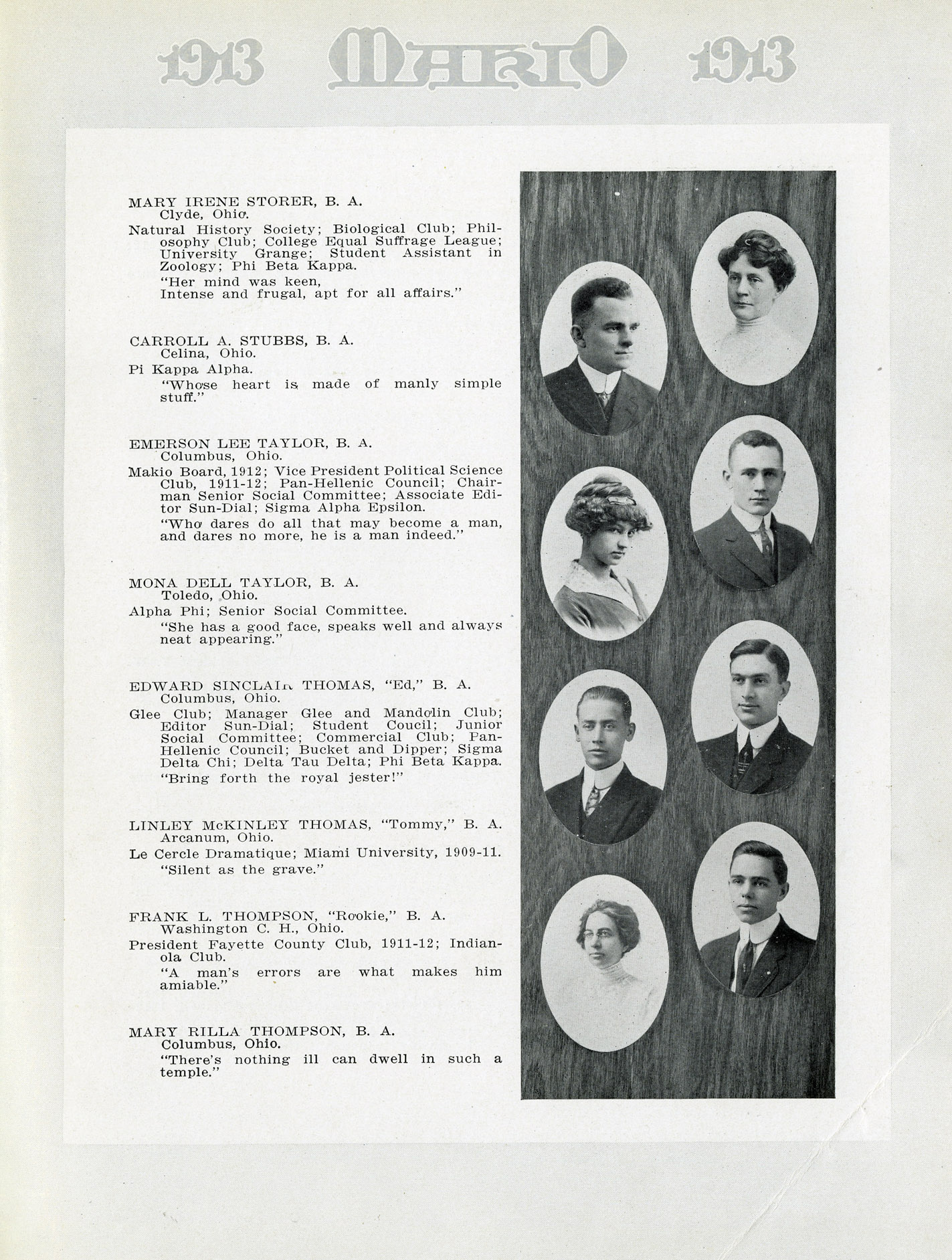
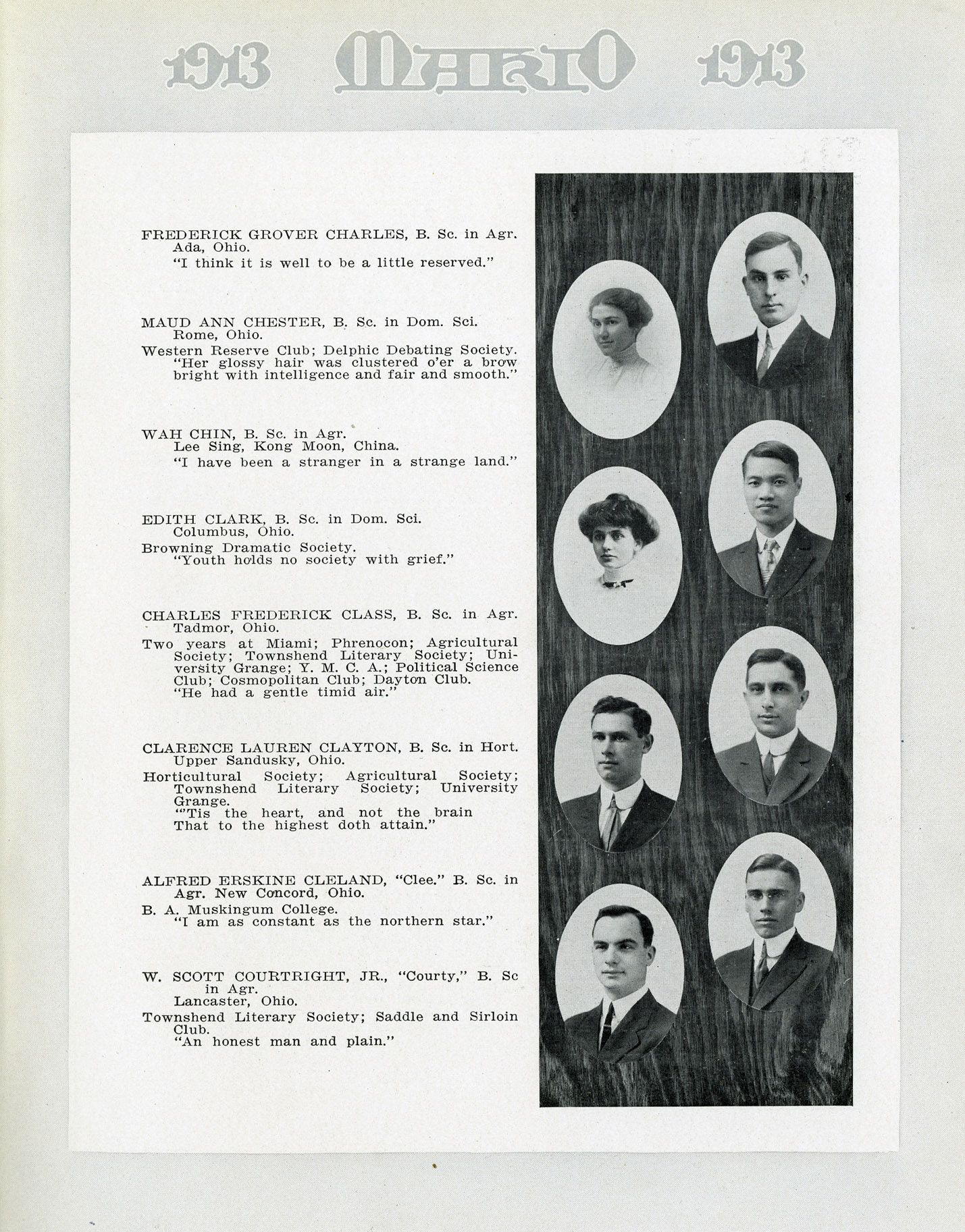
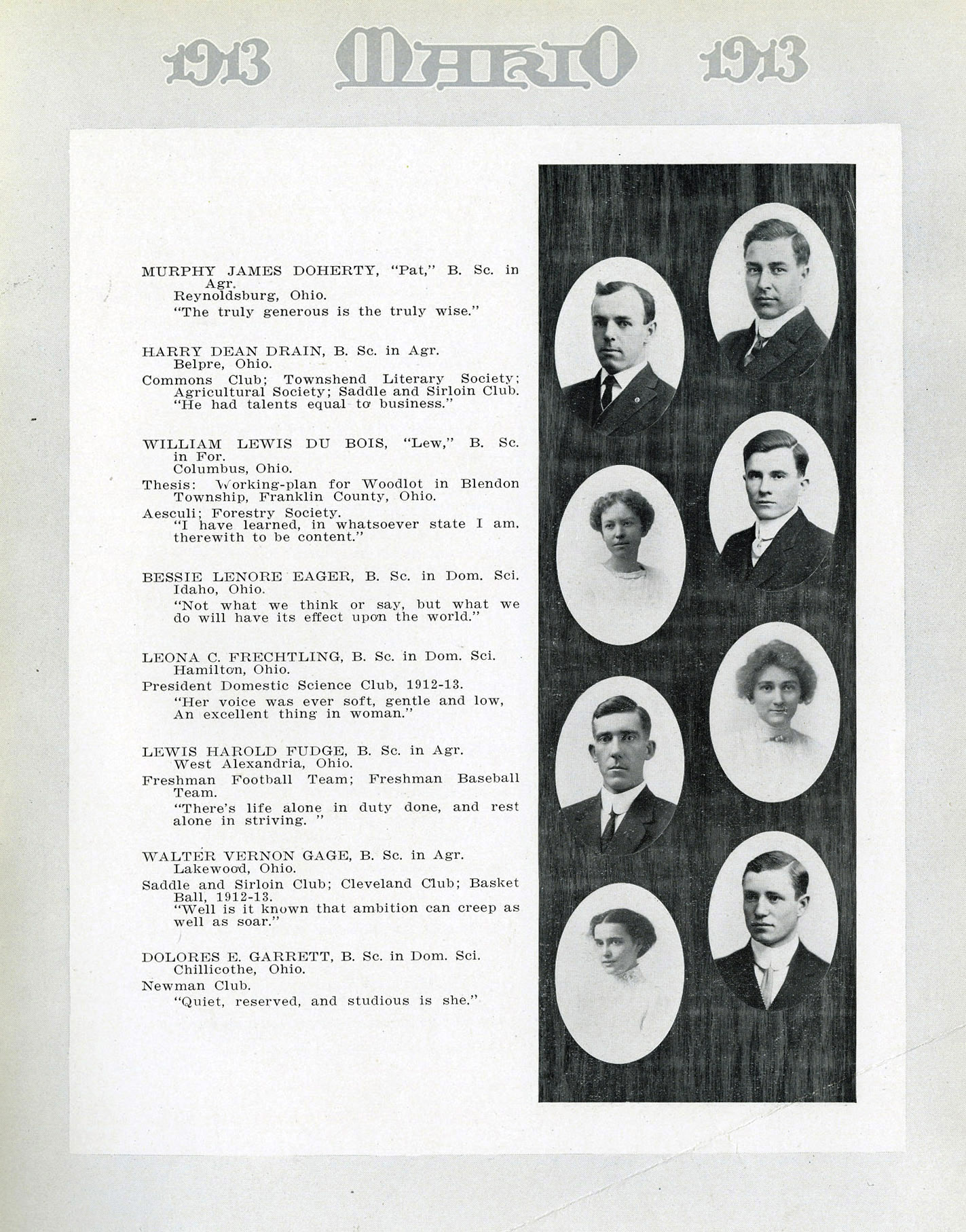
1913 Makio page 177With easy and instant access to various forms of social media, graduating seniors no longer rely on yearbooks to tell the world what they did in college, and how they feel about their impending liberation from it. But our collection of OSU yearbooks, called the Makios, shows how past seniors could share a lot about themselves at this critical juncture in their lives, even in a tiny little space on a yearbook page.  


We chose several pages from the 1913 yearbook to display here, since that was a big year for OSU: The Thompson Library opened; campus faculty, staff and students rallied to help Columbus residents recover from a devastating flood; and both Woody Hayes and Jesse Owens were born.


The first part of each senior’s entry is the same: their degree majors and their hometowns are listed. Then, it gets more interesting when they list the (sometimes) many and diverse activities in which they participated during their college years. It’s a wonder some of these students ever had time to go to class and actually earn the degrees they list.


Finally, the most interesting feature: the quote each senior shares at the end of his or her entry. Some are poetic, nostalgic, or self-reflective, such as this entry from Frank Thompson, an Arts major from Washington Court House: “A man’s errors are what makes him amiable.” Others seem to want to predict the future, such as this entry from Harry Drain, an Agriculture major from Belpre, Ohio: “He had talents equal to business.” And still others sum up quite succinctly the experience of living independently for the first time, often in a place very far from home: “He was a stranger in a strange land,” wrote Wah Chin, an Agriculture major from China.


We hope you enjoy these snippets from yearbooks past. There are plenty more to be browsed in our online Makio archives, which you can access at go.osu.edu/makioarchives.


1913, Makio page 149

Older posts Newer posts