From Woody's Couch

Our Playbook on OSU History

Author: mares.12@osu.edu (page 10 of 14)

Dog tag found in France returns to Ohio Family

p1040002Last spring, the University Archives was contacted by Stephane Renner, a Frenchmen, who said he had discovered an American Soldier’s World War II dog tag while metal detecting in the Rosny sur alfred-l-bowlandSeine forest in northern France.  Renner hoped the Archives could assist him in tracking down the soldier’s family, so the identification tag could be returned to them.  While the Archives staff typically handles only requests that involve the University, the staff felt compelled to help Renner find the soldier’s family.

Attached to Renner’s email was a photo of his find: a rusted dog tag that had weathered almost 75 years underground.  Engraved on the tag was the soldier’s name, “Alfred D. Bowland”, and his emergency contact, which was listed as Howard Bowland (which we later found out was his father).

facebook_-2034363001In an effort to find the family, Archives staff utilized Ancestry.com, and also searched through censuses, war registration cards and city directories.  Staff soon discovered that Alfred Bowland enlisted December 9th, 1941, as a result of Pearl Harbor. Bowland survived the war, got married 1947 and had three children.  He passed away in 1995 at the age of 80.

The Archives staff located Alfred’s son, Roger Bowland, to share the news about the identification tag recovered in France.  Soon after, the men in Ohio and France 953645dsc0044were introduced and connected over the newly discovered dog tag.

Renner sent Bowland the dog tag, along with a coin purse, ammunition and a ration of lemon powder that he also found next to the tag.  In exchange, Bowland sent Renner a photo of his father during his time in the war. Renner keeps the photo on the mantle to remind him of the find.

Veteran’s Day reminds us to thank all military personnel, like Alfred Bowland and his family, for the service and sacrifices they have made for their country.

dscn8594The Archives also is thankful to Stephane Renner and Roger Bowland for keeping us informed on their story and keeping history alive. A special thank you to Stephane Renner for his dedication to returning historical material to its rightful owner.
2nd Time Around for 2nd year students: Dorm Rule in the 60s

Novice Fawcett

Novice Fawcett

The requirement for sophomores to live in dorms went into effect this semester, but it’s not the first time second-year students have been told they have to live on campus.  In early 1965 President
Novice Fawcett enforced a rule stating that “unmarried freshman and sophomores under twenty-one years of age who do not live with their parents or close relatives are required to reside in University-owned residence halls.”  The rule was set to take effect in 1967.

This rule had originally come about in April 1958 when large amounts of money was raised by issuing bonds to pay for a large number of new residence halls.  The sophomore dorm rule was a way to maintain full occupancy in the new residence halls and ensure bond holders their money would be paid back.  Until the recommendation in 1965, the rule had never been enforced, likely due to high rates of occupancy in the residence halls.

Although the number dorm rooms in the mid-’60s met the demands of the current student body, the residence hall capacity was expected to increase.  Vice President Gordon B. Carson stated with these new openings, “it would be wise and prudent to reaffirm the Board of Trustees’ resolution.”

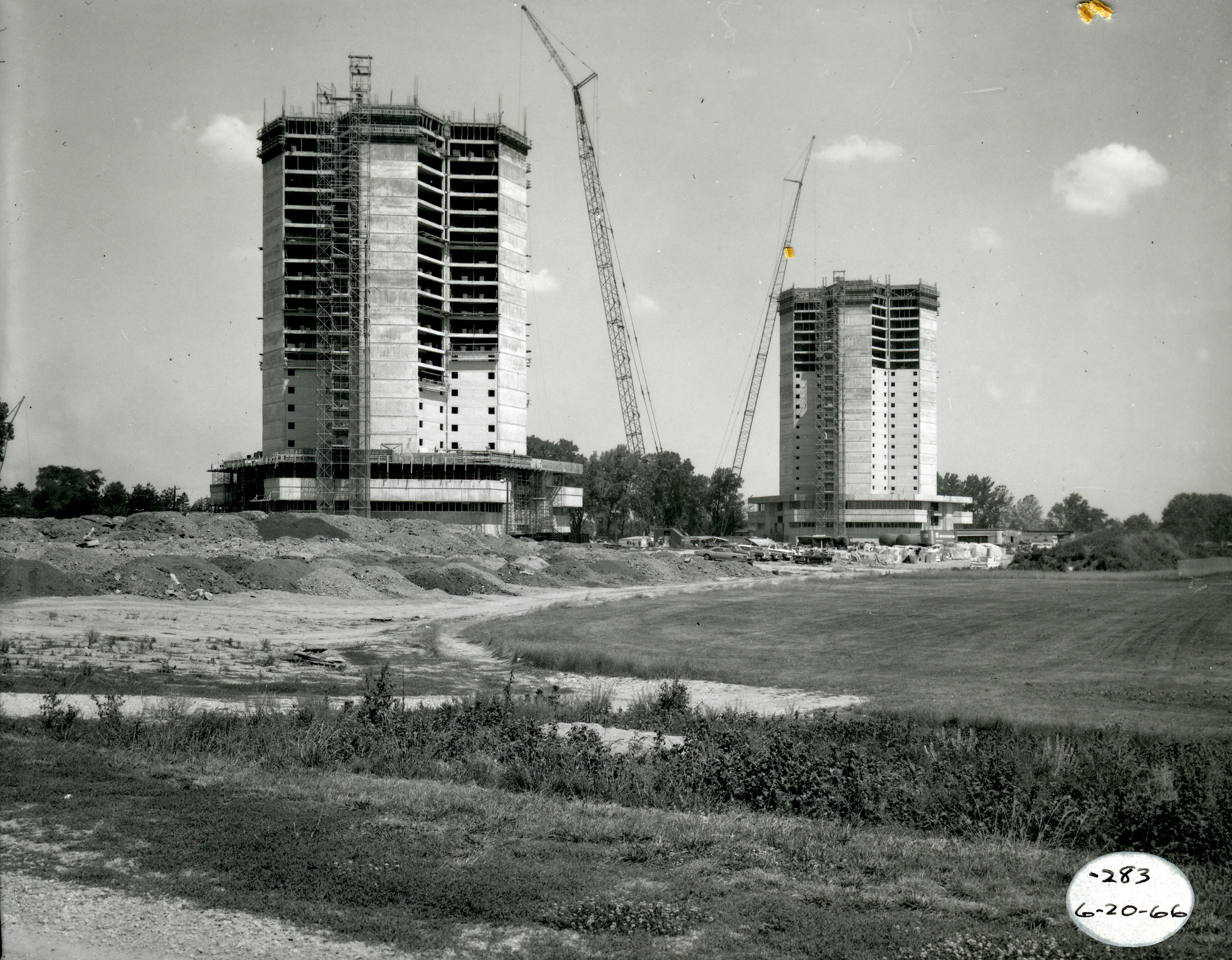
Construction of Towers, 1966

Construction of Towers, 1966

Students and politicians alike opposed the 1965 rule. Adversaries pointed out that there is a greater cost to living in dormitories.  They, including Robert Shaw, a Republican state senator of Ohio, believed that forcing students to remain in dorms for two years would prevent those with insufficient funds from attending the university and was therefore discriminatory.

Students, alumni and community members thought that it was not the job of the university to decide on living quarters; there should be freedom of choice.  Furthermore, students believed the reason for the enactment was a money-making scheme.

Regardless, the rule was enforced in the autumn of 1968 and remained in effect until 1976.  Throughout this period, sophomores could have a waiver signed by their parents allowing them to live off-campus.  The accessibility of the waivers fluctuated throughout

Lantern Headline, 1972

Lantern Headline, 1972

the eight-year period, with the most liberal period toward the end of dorm rule.  Waivers were given out so frequently that sophomores were able to choose if they wanted to live on or off campus and thus made the dorm rule obsolete.

The fight against dorm rule was part of a larger movement on campus led by students to have their voices heard by the administration.  You can learn more about the student movements on our Spring of Dissent exhibit  and Bill Shkurti’s new book The Ohio State University in the Sixties: The Unraveling of the Old Order.

Donors’ dilemmas bring historical treasures to the Archives

When people contact us to donate material to the Archives, they often say something like, “I don’t really know what to do with it, but I just can’t bear to throw it away.” To that, we give a hearty and grateful thank-you. If it weren’t for donors like that – who try their hardest to find a good home for a historical object instead of just pitching it into the trash – the Archives would have far less materialDSC_0071 that documents the history of campus life at OSU.

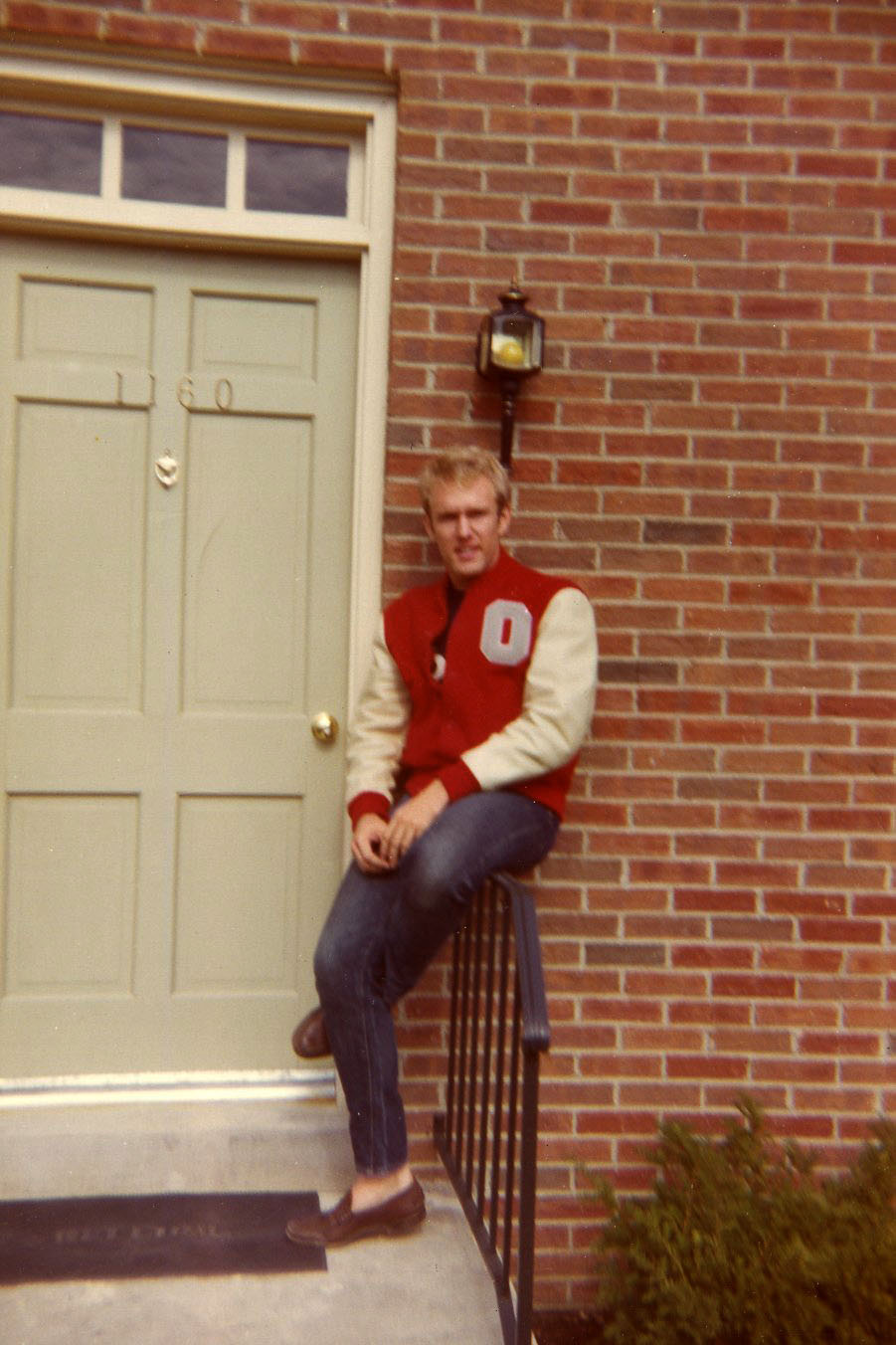
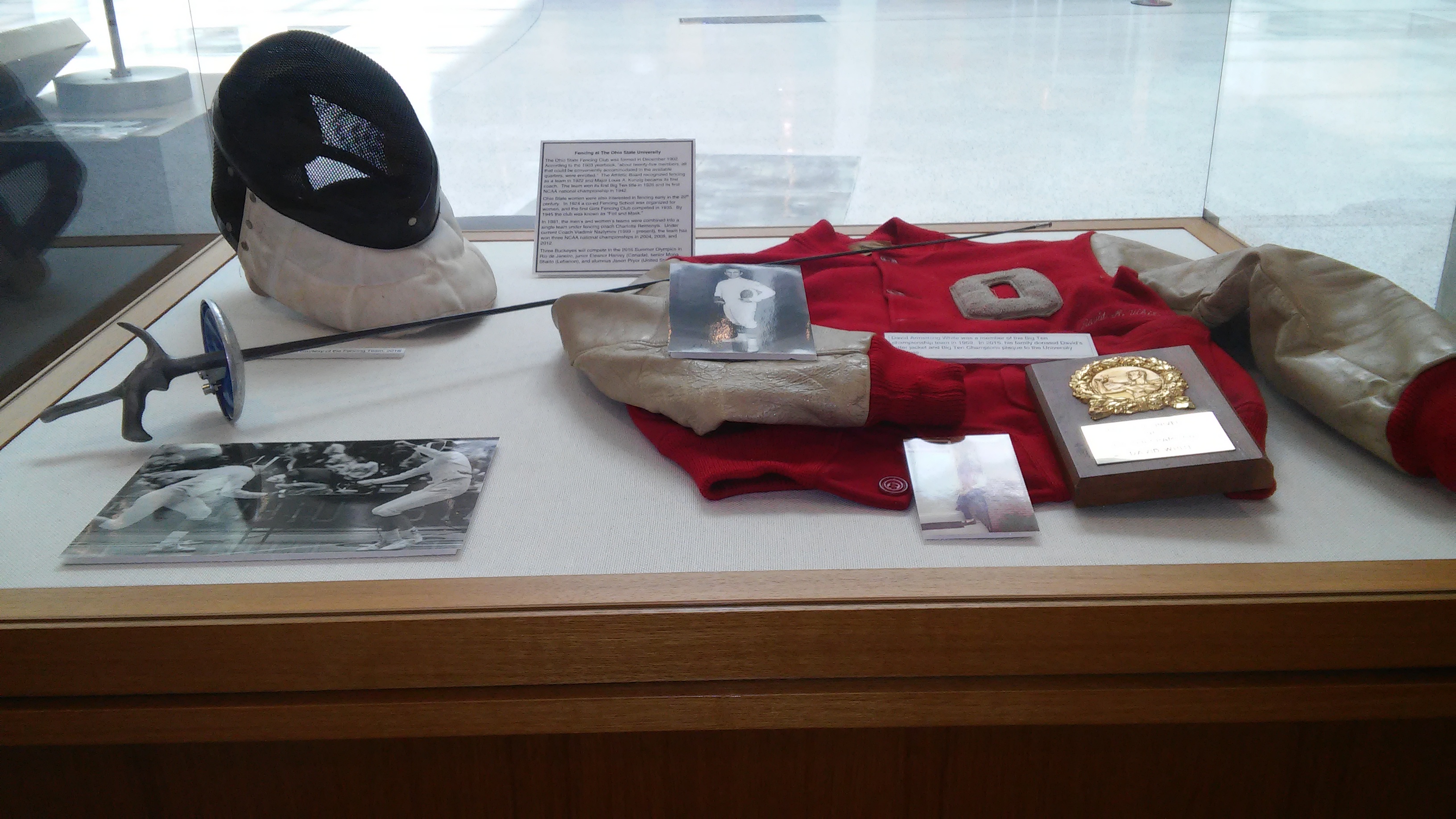
Case in point: In February 2015 Beth White of Gainesville, Ga., offered to donate material from her uncle, David Armstrong White, who had attended OSU from the fall of 1965 to June 1970. He had died in 1999 and had never had children, so there was no one in the next generation to hand down some of his “stuff” from OSU. And what great “stuff” it is! It turns out David White was a member of OSU’s 1969 Big Ten Championship Fencing Team. As such, he was awarded a plaque for being on the team, and since he participated at the Varsity level, he received a Varsity “O” jacket.  Along with these items, Beth White also donated earlier this year a photo of David White in 1971 wearing the jacket, a photo of the team in 1969, and some photos of a team reunion from 1994.

1969, David Armstrong White in letterman

1969, David Armstrong White in letterman

It also turns out that because of Beth White, we know the rest of the story about her uncle. Unless an OSU alum does something that gets him or her onto the pages of The Lantern or the Alumni Magazine after graduation, we usually don’t know the path their lives took after leaving campus. In David White’s case, after earning his bachelor of science degree in Architecture in June 1970, he lived in Columbus for a while, then moved to Atlanta in 1973 where he worked for an architectural firm for several years. He decided to return to school to obtain a degree in child psychology, so he entered George State University where he earned a master’s degree and specialization degree in that field. He was employed by Gwinnett County Public Schools as a staff psychologist until he retired in 1997. He passed away in October 1999.

By the way, David followed in his father’s footsteps when it came to attending OSU. Willard Chandler White Sr. earned a bachelor of arts degree in June 1960 and

followed that with a master of arts degree, specializing in Speech, in March 1962.

1969 Men's Fencing Team

1969 Men’s Fencing Team

To see some of David White’s artifacts and photos and to learn more about the history of fencing, visit the Archives’ exhibit case in the display area of Thompson Library at the east end of the first level, closest to the Oval. The exhibit will be up through early December. And thanks again to Beth White for taking the time and effort to find an appropriate home for her uncle’s pieces of OSU history.


fencing

Older posts Newer posts