From Woody's Couch

Our Playbook on OSU History

Author: mares.12@osu.edu (page 9 of 14)

Poetry brings the war to Ohio State

This blog post is part of a World War I series.  Throughout 2017,  we will be posting student blogs relating to Ohio State and its involvement in the war.

Inspired by the legacies of Homer, Alfred, Lord Tennyson and Walt Whitman, poets of the Great War wrote verse that recorded their experiences on the front. By reading war poems, those who were lucky enough to stay home could understand and imagine the perspectives of the soldiers. Some of these poems were published in The Lantern, coordinating with Professor Joseph Villiers Denney’s research and lectures on the subject.

Featured here are a few of the poems that were published in The Lantern. These poems, as well as the others published in The Lantern, are fairly simple. They have mass appeal and avoid confusing symbols and indulgent imagery. Rather, these poems avoid a complex rhyme scheme, consisting mostly of literal language and including motifs of nationalist symbols. Ohio State Professor of Journalism Osman C. Hooper focused on the songs of the Liberty Bell, appealing to patriotic American readers. Hooper writes to the Liberty Bell, desperate for its song to bring peace and solace to the world. This poem, published in Columbus in 1916, expresses the idealist and isolationist mindset that occupied most Americans. Since these fresh poets did not feel the need to follow traditional expectations or standards, World War I poetry is unorthodox and unique. Lieutenant Colonel John McCrea of the Canadian Expeditionary Forces wrote a poem titled In Flanders’ Fields about the dead lying in open fields. Inspired to write an answer to this poem, a Columbus librarian, C.B. Galbreath, penned a poem of the same name. Galbreath honored those who have fallen in Flanders’ Fields, comforting the Lieutenant Colonel. By interacting with a soldier on the front, Galbreath was able to bring the war home. When these poems were written the United States had yet to join the war so these poems allowed readers to connect with the conflict overseas. This conversational poem is consistent with other WWI poems that transform traditional poetry to more casual and playful. By not following specific rhythm, length or composition requirements, these poems are able to achieve great diversity. This broad range of poems and poets provided Joseph Denney with vast material to use in his upcoming lectures and essays.

After graduating from University of Michigan in 1885 and a short stint as a journalist and high school principal, Joseph Villiers Denney came to Ohio State in 1891 as an associate professor of rhetoric. In three short years, Denney was promoted to full professor. Over the next forty years, Denney made his mark on the university, performing a variety of roles. His position was constantly evolving as he moved from professor to Secretary of the Faculty to, eventually, Dean of the College of Arts, Philosophy and Science. Denney’s experience in a wide array of roles at the university made him well known and beloved by the faculty and students. Much of the work throughout his career was published in a variety of outlets, spreading across the country and occasionally across seas. In 1918, when Denney concluded his research on war poetry, he made the rounds across campus, visiting various clubs and lecturing around the city.

Joseph Denney, 1926

In 1918, Denney published his paper titled “War and Poetry” in The Ohio State University Monthly. He argued that the ideals for which the Great War was fought also made their way into poetry. Great advancements of the 20th century improved lives and inspired people to live more intensely. This new ferocity for life is evident in the poems of the Great War. Not only does their previous life give soldiers something to fight for on the battlefield but it also provides comfort and nostalgia while reminiscing in down time. Professor Denney writes that the War expanded the ordinary man’s senses, augmenting the sensation of life and soldiers captured these phenomena in the verses of the War.

Regardless of the greatness or longevity of the verses, poems of the Great War succeeded in communicating the experiences of war to those left at home. Denney argues that this literature is essential to bonding a nation’s population. This poetry generates understanding and enthusiasm, thus uniting the people of a nation. As the students of the University and people of Columbus were reading these verses and hearing Denney’s lectures, they were certainly bonded over the poetry of the Great War.

Written by Tyler Osborne.

Ohio State prepares for World War I

This blog post is part of a World War I series.  Throughout the month of April we will be posting student blogs relating to Ohio State and its involvement in the war.

The Ohio State University had a large impact upon the war effort for the Great War, (otherwise known as World War I), that is unknown by most.

OSU men in uniform, 1919

In the summer of 1916, President Woodrow Wilson signed The National Defense Act into law, which included the Pomerene-Gard Bill.  The Pomerene-Gard Bill was legislation that created a national training program for students called the “Reserve Officer’s Training Corps”, or the ROTC Program.  The collegiate aspects of this bill can largely be attributed to Ohio State, as administrators and faculty recognized that during emergencies, the government would need to call on colleges for military officers.

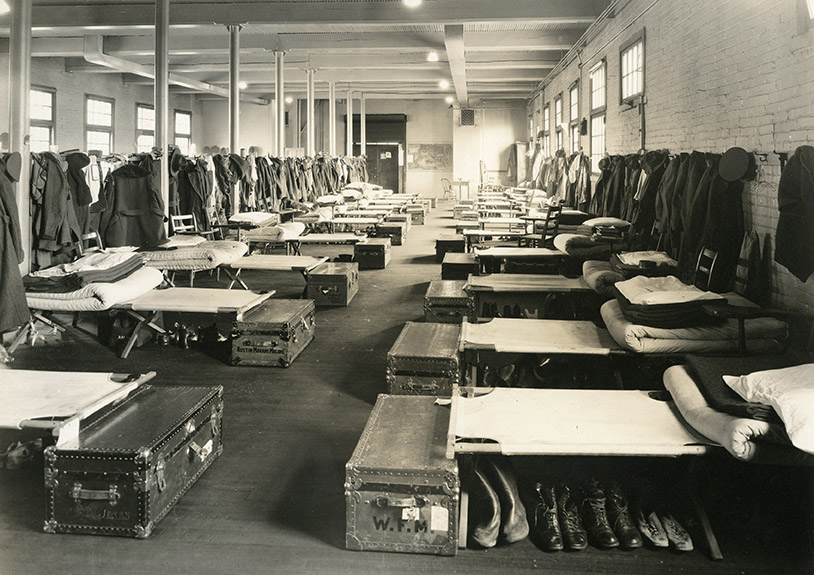
SMA Bunk Room in Hayes Hall, 1917-1918

The ROTC program progressed in universities around the country, including Ohio State, where the military training greatly expanded. By the spring of 1917, the ROTC program began working with theU.S. War Department to build schools of military training and aeronautics at six universities across the US: The Ohio State University, Cornell, MIT, University of Illinois, University of California and the University of Texas. These programs thrived with thousands of men wanting to enter into the service. Here at Ohio State, the School of Aeronautics opened in 1917, and began with 16 cadets. They received intense military training for just over three-week’s time.  After that, up to eight weeks of supplemental technical and theoretical instruction was required.

Ohio Union, 1919

For the ROTC cadets and other students within the military, campus became both their home and training grounds during these years. Many of these students lived in Hayes Hall, which was turned into a bunkroom. The original Ohio Union, (Enarson Hall), became a dining hall to feed most of the troops.  The Ohio Union was also an area for recreation and social enjoyment for many young men in uniform.

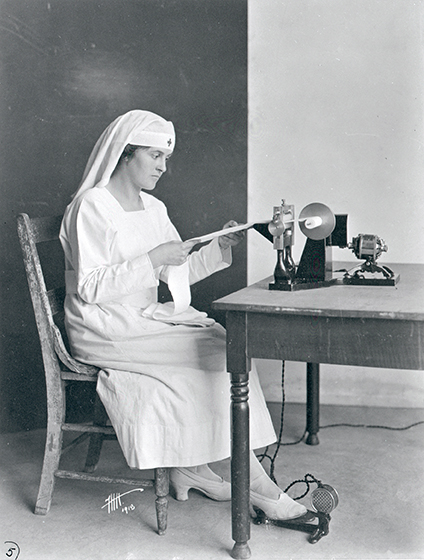
As the men dove into military training, the women on campus also wanted to support the war. Many of them held meetings at the Ohio Union, worked with YMCA & YWCA, spent time making cloth surgical bandages and mended clothing for the Student Army Training Corps.

Red Cross Bandage Rolling, 1918

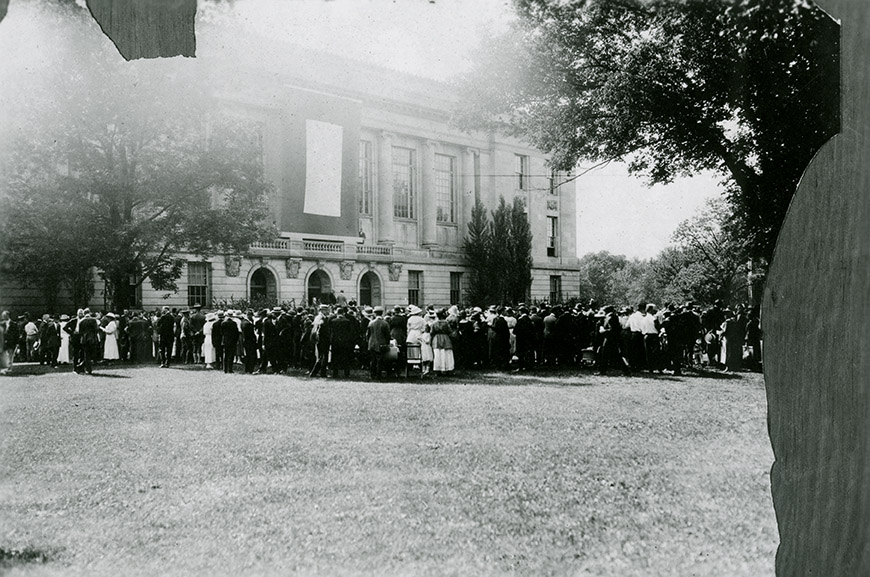
Women on campus also took first aide classes to help men recover from their wounds and injuries as they came home from war.  These were sponsored by the American Red Cross and held at Oxley Hall. They also worked with the Red Cross mending and sewing clothing that would come from Camp Sherman, in Chillicothe, Ohio, where troops were training. Many OSU students worked on mending these for the soldiers in Campbell Hall, the Home Economics building. The women also sewed a large memorial service flag, which contained over 2,640 gold stars. Each star represented a man or woman from the University who contributed to the war effort. The dedication for the flag took place in May 1918.  As part of the ceremony, the flag was hung over Thompson Library.

The University became a place of mobilization for war, specifically in military training and preparedness. The creation and growth of the ROTC program was a large change for many universities and OSU had a large role in encouraging this legislation to make it happen.

Service Flag at Main Library, 1918

Written by Sarah Hammond.

As Woody Hayes would say, fan paid it forward with his love of Buckeyes football

Here at the Archives we come into contact almost on a daily basis – particularly during football season – with devoted Buckeye football fans. Most are looking for photos or statistics or articles about

Woody Hayes commemorative plate

Woody Hayes commemorative plate, 1970

their favorite players or coaches. In fact, we have a whole collection of materials related to Woody Hayes, the head coach with the longest tenure and most wins in the history of the program. We have letters, speeches, photos, artifacts, and lots of other material related to Hayes’ life and career. The collection is open to fans and serious researchers alike.

Now we add a commemorative plate of Coach Hayes to the collection, and while this would not appear to be unusual, the family who donated it – the Pattis of Akron – took the time to contact the Archives and to send the artifact to us in order to preserve the legacy of love that Michael Jerome Patti, who passed away last April at the age of 67, had for Buckeye football for more than 50 years.

Mike came into possession of the donated plate in 2003 at about the time of the Buckeyes’ National Title win over Miami when his nephew, Andy Flores, a resident of Lewis Center and ardent Buckeye fan, gave the plate to him. Andy had found the plate on eBay and chose it for his uncle Mike since he was sure he would treasure it, which he most certainly did, displaying it reverently in his home. When Mike’s son, Keith, wrote to us in September that he would like us to consider adding the plate to our collections, he wrote that “it would mean so much to my family that Ohio State carries on my dad’s legacy of a loyal fan.”

Mike Patti, wearing his OSU cap, and his wife, Lynn, congratulate their son, Keith, at his Air Force graduation in 2009

Mike Patti, wearing his OSU cap, and his
wife, Lynn, congratulate their son, Keith, at his Air
Force graduation in 2009.

And loyal he was. Mike, a native of Akron who never attended OSU, earned his bachelor’s degree in mathematics education from the University of Akron. While attending school with a full course load, he also worked as an assistant manager at a local McDonald’s to finance his education.  He graduated in 1971.

Despite Mike’s time constraints, he always made time to cheer on the Buckeyes, especially during the 1969 Rose Bowl where the team clinched the National Title. Mike also was as steadfast in his devotion during the losses as with the wins. Fast forward to 2000, during the fourth quarter of the game

against South Carolina, when the Patti clan was sitting down to eat. Mike, according to his other nephew, Ben, another loyal Buckeye, would not leave the television “even during what felt like the worst loss in the history of OSU football.”

Ben also recounted a similar story about Mike wanting to share his enthusiasm with the family: “I will never forget him driving me home from his neighborhood one year. I must have been eight, maybe nine years old. I know it was hard for him to not watch the Buckeyes football game, but nevertheless, he was happy to take me home even after a long night of trick-or-treating. I tried so hard to keep my eyes open in the car and listen to the

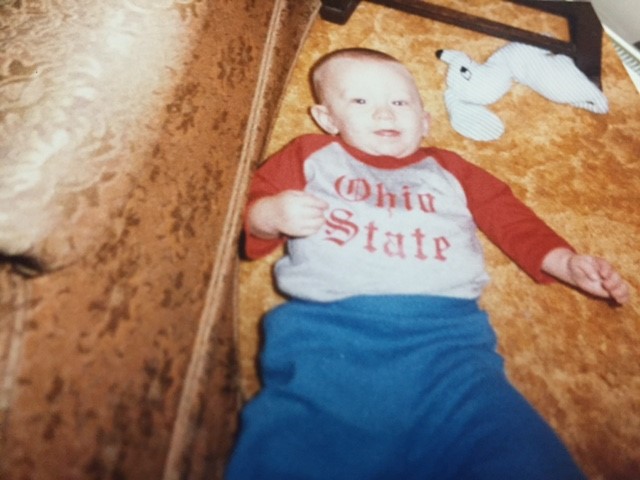
Keith Patti displays an outfit chosen by his father, Mike, in 1984.

Keith Patti displays an outfit chosen by his
father, Mike, in 1984.

game. He was so excited, cheering for every play and cursing at every penalty. Eventually I was awakened by him shaking me and yelling, ‘Ben, wake up – the Buckeyes are going to the Rose Bowl!’ Even in October, he was so optimistic.”

For the three of them – Keith, Ben, and Andy – the inclusion in the Archives of one of their respective father and uncle’s most prized possessions of his Buckeye fandom is very gratifying, since all three carry on Mike’s dedication to the Buckeyes.

An autographed photo from then-coach Jim Tressel.

An autographed photo from then-coach Jim
Tressel.

Over the years, we have received many commemorative artifacts related to OSU football – pins, buttons and even drinking glasses. We are thankful for each of them because they demonstrate in a tangible way the connection that fans have to their treasured team. But we rarely have the opportunity to hear such a wonderful tale of a truly dedicated fan who was so beloved by his family.

When you watch The Game this weekend, think of all the devoted fans who have been there for the Buckeyes through thick and thin, and whose loyalty we help preserve here at the Archives. And of course, Go Bucks!

Older posts Newer posts