From Woody's Couch

Our Playbook on OSU History

Author: John Hooton (page 11 of 12)

Frozen Fridays: ‘D’ is for Denali!

This blog post is part of the Frozen Friday Series, an A-Z journey of the Polar Archives.  Each week, we will feature some aspect of the history of polar exploration with a blog post written by our student authors

cook-ovs-2acrop

Denali, as photographed by Dr. Frederick Cook.

Mount Denali, located in central Alaska, is the highest mountain in North America. First sighted in 1794,
the mountain is in such a remote area that it would not appear on any maps of the area until 1830, and it would not be summited until 1913.

In 1897, gold prospector William Dickey called it Mount McKinley after Ohioan William McKinley, who had just been named the Republican presidential candidate. This officially became the name after McKinley was assassinated a few years later. The mountain was officially called McKinley until 2015, when President Barrack Obama officially returned the mountain to its Athabascan name, Denali, which means “the great one.”

national-park-service-2

Denali is the highest mountain
peak in North America.

The mountain has two distinct peaks: a shorter northern peak which reaches 19,470 feet and a southern peak which tops out at 20,320 feet. At such a height, Mt. Denali is one of the highest mountains in the world based on the traditional measurement, which is the mountain’s height above sea level. Measured from base to peak, however, and Denali becomes the tallest land-based mountain at eighteen thousand feet—much taller than Mt. Everest’s twelve thousand feet.

Denali’s height and location play a monumental role in the mountain’s weather and shape. Because the Earth’s atmosphere curves around the planet unevenly, Denali nearly reaches the edge of the troposphere and comes very close to the jet stream. Under certain conditions, the jet stream can unleash winds of over one hundred miles per hour at the peaks. These winds can triple in velocity while traveling down the mountain. Anything unfortunate enough to be in the wind’s path—climbers, loose rocks, snow—is stripped off the mountain.

national-park-service-1

A modern-day view of Denali.

In addition, because the summit is so close to the lower atmosphere, oxygen levels only reach about sixty percent of the oxygen available at sea level. Added to the perpetual snowfall, frequent avalanches, hidden fissures under the ice, endlessly steep terrain, and a reputation for sudden storms, this makes Denali one of the world’s most difficult mountains to climb.

The first attempt to climb the mountain came in 1903. Five men, led by James Wickersham and aided by numerous locals, tried to scale the Northern Peak but had the misfortune to pick the most challenging route. They turned back after eight thousand feet.

Just a few months later, experienced polar explorer Dr. Frederick Cook decided to make his own attempt at the summit. Cook believed that his knowledge of polar regions—which are remarkably similar to the conditions on the mountain—would give him an edge. This first attempt failed, however, due to Cook’s poorly chosen route, bad planning and an amateur crew. Cook and his party did manage to circumnavigate the mountain, which was a major accomplishment, and would not be repeated for fifty years.

cook34_29-fake-peak

The “summit” of Denali as
photographed by Dr. Cook.
This photo, along with his claim of
reaching the peak,
were proved to be false.

Cook opted to try again three years later. This attempt did not fare much better than his 1903 expedition. Cook had extensive trouble ferrying his men and horses across the streams, passes and swamps of the lower mountain. Realizing in late July that further climbing would be futile, Cook instead prepared for a scheduled big game hunt with a sponsor. When this sponsor did not appear as planned, Cook took the opportunity to return with two men to further explore the mountain. That September, Cook returned claiming to have reached the summit and return in mere twelve days (eight to ascend and four to return). It would not be long before Cook’s claim was contested by those who had attempted to climb the mountain themselves, including members of Cook’s own expeditions.  Yet, at the time, there was no hard evidence to prove otherwise.  Cook returned to the continental U.S. a hero, and quickly turned his attention to the North Pole.  On July 7, 1907, he and a wealthy benefactor set off for Greenland, and a subsequent attempt to reach the North Pole.  Cook would not return to civilization until 1909 – and thus, he was unavailable to answer any questions or respond to any scrutiny about his Mt. McKinley claim.

Meanwhile, doubters tried to repeat Dr. Cook’s route to prove that he had not summited McKinley as he had claimed.  It wasn’t until June 7, 1913, that Walter Harper, Harry Karstens, Hudson Stuck and Robert Tatum achieved the summit.


To learn more about this amazing and beautiful place, visit the National Park Service’s website here.

And to learn more about Dr. Cook and his role in the history of Mt. McKinley, visit our online exhibit about Dr. Cook here.

Finally, for a book that lays out the controversy, including photographic evidence, we recommend The Dishonorable Dr. Cook, by Bradford Washburn.

Written by  Autumn Snellgrove and edited by John Hooton.

Frozen Fridays: ‘C’ is for Cook!

cook34_2a

Dr. Frederick A. Cook in 1908.

This blog post is part of the Frozen Friday Series, an A-Z journey of the Polar Archives.  Each week, we will feature some aspect of the history of polar exploration with a blog post written by our student authors.

During the Antarctic winter of 1898, Dr. Frederick A. Cook found himself trapped on the ship Belgica in the Antarctic with eighteen other men. The dark and damp conditions drove some men insane and brought each man to a state of depression and irritability. Later, his shipmates would recall Cook as “most popular man on the expedition…Upright, honorable, capable and conscientious in the extreme.”[i] History, however, was much harsher. Frederick Cook is typically remembered as the con man that tricked the world into believing that he had scaled Mount McKinley in 1906, and reached the North Pole in 1909.  Both claims would be contested.  As the Reader’s Digest explains, “the enigmatic Dr. Frederick Cook is either one of the greatest explorers of all time or a confidence man of exceptional talent.”[ii]

As a young man, Cook was a doctor with a small medical practice. Business was slow for the new doctor, and in his spare time, Cook began studying the Arctic. This interest led Cook to join Robert Peary’s 1891 expedition to Greenland. With the stated goal of defining the northern limit of Greenland, the expedition, with Cook as a star member, was a resounding success. It was on this trip that Cook demonstrated the resourcefulness and the adaptability that would prove his worth. Besides dealing with general medical problems. Cook set about studying everything he could about the Arctic including how to ski, speak the native language, and finding a solution to scurvy.

cook34_7e

The Belgica on its 1897 expedition to Antarctica.

Like many polar explorers, though, one adventure was not enough. In 1897, Cook joined the crew of the Belgica at the request of Commander de Gerlache. Due to travel delays, the Belgica did not reach Antarctica until January—very late in the exploring season. At the end of February, the ship entered the pack ice and was trapped. The crew found themselves stranded on an unprepared and under-equipped ship for the entirety of an Antarctic winter. Cook kept the crew healthy and in positive spirits, earning their praise. Based on his experience in the Arctic, Cook convinced his companions to eat fresh meat, warding off a plague of debilitating scurvy. Cook also found a solution for the “form of anemia peculiar to the polar regions,”[iii] which could cause insomnia, digestive concerns, and an erratic pulse that attacked the crew as the months without sight of the sun progressed. Deciding that this was due to lack of sunlight, Cook proscribed a “baking treatment”[iv] where the afflicted would lay nude in front of an open fire for several hours. This treatment raised spirits, cured symptoms. and gave the men more energy.

Cook also gave full expression to his improvising talents. He designed and built a light polar sled and a tent which one men could set up in five minutes. Cook’s ingenuity also freed the Belgica from its icy prison. As the polar summer approached, and the ice began to think about thawing, Cook proposed cutting two trenches stretching from the ship to the water. After several fits and starts, the plan worked and the Belgica broke free, making the crew the first to successfully winter in Antarctica.

cook34_17c

Denali (then Mount McKinley) as
photographed by Dr. Cook on one
of his expeditions to the mountain.

In 1903, Cook set out to scale North America’s highest mountain—Mount McKinley (now known as Denali and will be featured in our next post). Along with several others, Cook became the first to circumnavigate the mountain, but failed to reach the peak. Cook tried again in 1906 when he was initially thwarted by the weather and mislaid plans. After his original plans fell through, Cook and his companion Edward Barrill lingered on the mountain, looking for another route. Then, according to Cook, the weather changed and he and Barrill found a line of paths right up to the summit. They then, in only four days, descended from the mountain. When Cook returned from Alaska he received multiple awards and an overflow of praise for this accomplishment.

cook34_31q

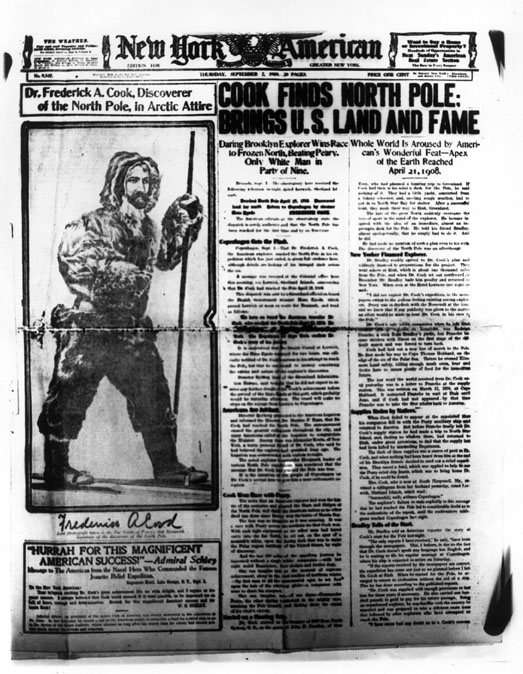
News of Dr. Cook’s “success” in 1907.

Cook’s claim to have reached the summit was questioned almost immediately.  But Cook was off again on another adventure.  In 1907, he set off with sleds and dog harnesses of his own design, to reach the North Pole, something his old friend Peary had been trying and failing to do for years. Cook reached the Pole in late April with two Eskimos, but it took him over a year to return to his base camp and journey home.  In September of 1909, when Cook finally returned, he announced his success to the world. Several days later, Peary contested Cook with his own claim of success. Both men traveled to the pole with only a few companions, none of whom could take the necessary navigational readings to back up either Cook or Peary. Ultimately, neither could provide the necessary positive proof of their achievement. Nevertheless, Peary set out to thoroughly discredit Cook. Cook’s reputation never recovered.

cook34_3f

Dr. Cook in his later years.

In 1917, Dr. Cook was hired by New York Oil to prospect for oil based on his knowledge of geology.  He would eventually form the Petroleum Producer’s Association, which became one of the largest employers in Fort Worth.   This success was short-lived.  Cook was indicted on mail fraud charges in 1923 in relation to his oil business, and served time in Leavenworth.  Upon his release in 1930, he lived a relatively quiet life, until his death from a cerebral hemorrhage in 1940.  Cook received a death bed pardon from President Franklin D. Roosevelt. Cook’s daughter, Helene Cook Vetter, would go on to start the Frederick A. Cook Society to defend her father’s claimed achievements.

The Polar Archives holds the records of the Frederick A. Cook Society.  To learn more about Dr. Cook’s life and achievements, as well as the controversy surrounding him, visit our virtual exhibit : https://library.osu.edu/projects/frederick-cook/.

Text written by Autumn Snellgrove and edited by John Hooton.

[i] Reader’s Digest Antarctica, page 133

[ii] Exploring Polar Frontiers, page 153

[iii] True North, page 125

[iv] True North, page 125


Frozen Fridays: ‘B’ is for Byrd!

byrd7640_4

Richard Byrd had a crucial impact on
Polar exploration.

This blog post is part of the Frozen Friday Series, an A-Z journey of the Polar Archives.  Each week, we will feature some aspect of the history of polar exploration with a blog post written by our student authors.

By the early 1920s, nearly all the great “firsts” were gone from polar exploration. Carsten Borchgrevink had spent the long winter on Antarctic soil 1899-1900. The North Pole had been discovered in 1908.  Roald Amundsen had reached the geographic South Pole in 1911.  Robert Falcon Scott and Ernest Shackleton became household names.  During the latter part of the 1920s, polar exploration would shift from the “heroic age” to the “mechanical age.”  Richard Evelyn Byrd would come to be known as the first explorer to fully realize the value of mechanized exploration.

Beginning his career in the United States Navy, Byrd turned to flight and to the excitement of exploration. He first ventured into the Arctic in 1925, when a broader Navy-run expedition was launched. There he gained a reputation as a good leader and excellent organizer, as well as developing a taste for publicity. Upon his return, after only one trip into the Arctic, Byrd boldly asserted that “Aviation will conquer the Arctic—and the Antarctic, too.”[i] He would make it his life’s work to prove this claim.

byrd7639_3

Byrd as an aviator in the navy.

A year after his first journey, Byrd was back in the Arctic—this time to fly to the North Pole. Byrd was far from the first to envision greatness as the ‘Conqueror of the North Pole’ (a title later given to him by American newspapers). Human footprints had marred the Pole for over a decade and only the year before had the Norwegian explorer, Roald Amundsen, and American sportsman Lincoln Ellsworth tried, unsuccessfully, to fly to the North Pole. As Byrd prepared for his own attempt, Amundsen had returned for a second try. Byrd, however, did not see his efforts just as part of the race to be the first, but rather as a way to prove the usefulness and reliability of airplanes in the air space above the Arctic.

pa-2012-12_493

The ‘Josephine Ford’ in the Antarctic.
More images from Byrd’s Arctic Expedition
of 1926 can be found online here.

After some very skillful fundraising, Byrd arrived at King’s Bay, Spitsbergen on April 29th, 1926, with all the equipment he needed for an attempt at the Pole. His plane, a massive Fokker tri-motor, was named the Josephine Ford in honor of the daughter of one of his chief benefactors, Edsel Ford.    Amundsen, already at King’s Bay, was less than thrilled. Upon arrival, Byrd was unable to dock at the pier, blocked by the Norwegian gunboat Heimdahl, with no place to unload the Josephine Ford.  A creative Byrd had his men cut a path through the ice-choked waters and load his plane onto a make-shift raft crafted from rowboats and wooden planks. It was a rather dangerous, if ultimately successful, endeavor (a phrase applicable to most of Byrd’s adventures).

In his first attempts at flying the Josephine Ford, Byrd broke the skis twice without leaving the ground.  One of Amundsen’s men, Bernt Balchen, suggested repairing the broken skis with oars from Byrd’s ship and taking off at midnight, while the snow would be more firm. On May 9, 1926 Byrd and his pilot, Floyd Bennett set off for the North Pole. Aided by nearly perfect weather and a tailwind, Byrd and Bennett reached the Pole, circled, and returned in sixteen hours. They were greeted by their euphoric friends and rivals. Even Amundsen participated, crying and hugging the returning pilots.

Byrd received the Medal of Honor for this flight.  However, the validity of the achievement was questioned almost immediately, though not vocally until after Byrd’s death in 1957.  Critics say that it was impossible to complete a journey of fifteen-hundred miles in such a short time, even with a tailwind. Balchen,came forward to cast doubt on Byrd’s claim and would eventually publish a rebut of Byrd after the explorer’s death. Balchen also claimed that pilot Floyd Bennett, having died several decades before, had admitted the fraud, although this contradicted Bennett’s own published statements. The controversy continues even today.   Scholars have continued to  study Byrd’s flight diary, discovered amongst the explorer’s papers during the processing of the collection in the 1990s.[ii]

byrd7803_2

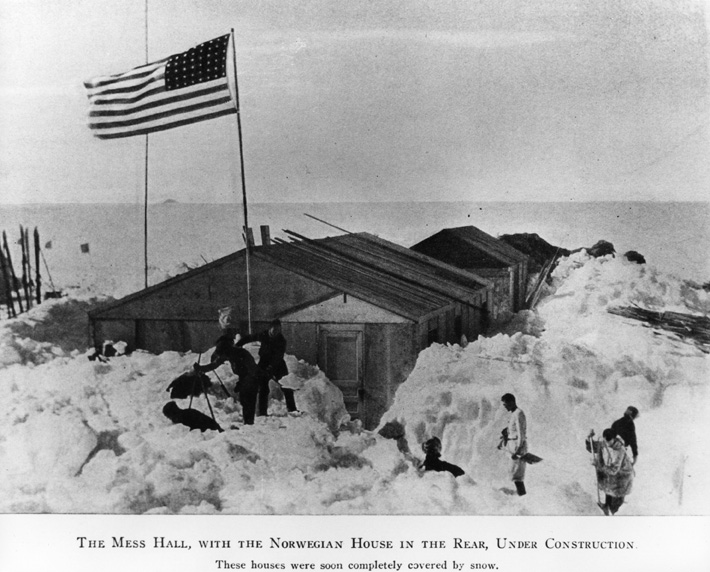
A view of Little America’s mess hall, under construction.

Regardless, Byrd’s reputation does not depend solely on his North Pole flight. In 1928, Byrd led his first expedition to Antarctica.  After establishing the camp Little America, Byrd prepared to take to the air once again. Byrd’s flight to the South Pole became the second successful visit to the pole after Amundsen’s journey on foot in 1911.What took Amundsen over three months, took Byrd a mere sixteen hours in the airplane Floyd Bennett.  (For a man who loved danger and publicity, Byrd’s comment about his trip to the South Pole is rather short and bland: “One gets there and that is about all there is for the telling.”[iii])

byrd7802_2

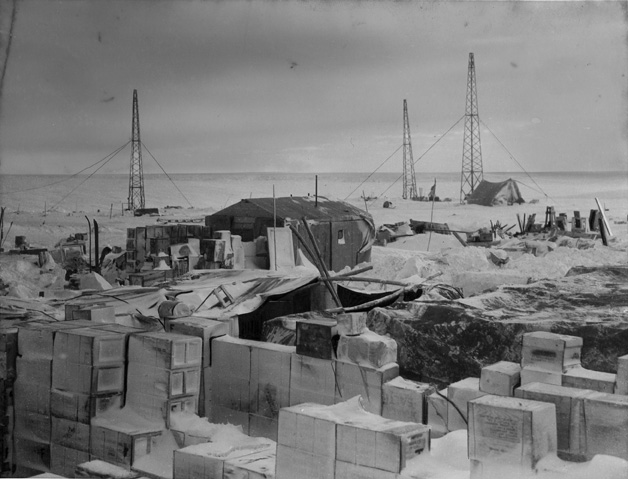
Another view of the iconic ‘Little America’.

Byrd’s desire to advance science fueled his second trip to Antarctica in 1933. This trip would set the bar for scientific research in the polar regions.  Returning to Little America, equipment was set up to study the weather and the upper atmosphere. Many branches of science were represented on this expedition, including biology, forecasting, geology, mapping, and communication via radio. This trip also proved the usefulness of motor vehicles in the polar regions.  The expedition was not without drama, however.  Byrd suffered from carbon monoxide poisoning from his stove and generator during the four months he spent alone at his remote hut Advance Base, one hundred and twenty-three miles from his base camp, Little America.  Though he survived this ordeal, it is believed that the experience weakened his health over the remaining course of his lifetime.

Nick-named the “Mayor of Antarctica,” Byrd would return to the continent 3 more times before his death 1957.  By the time of Byrd’s final expedition, he had seen over 1.5 million square miles of the frozen continent and photographed over sixty percent of the coastline.

The Ohio State University acquired the Papers of Admiral Richard E. Byrd in the mid-1980s in a competitive bid process with several other institutions of higher education.  The University’s Institute of Polar Studies was renamed the Byrd Polar Research Center in 1987 as a permanent tribute to the explorer.  The Polar Archival Program was officially established in 1990, with the Byrd collection as it’s cornerstone.


It is nearly impossible to encompass the life of Richard Byrd into one short blog post.  To learn more about Admiral Byrd and his collection, please visit: https://library.osu.edu/find/collections/byrd-polar-archives/byrd/.


Written by  Autumn Snellgrove and edited by John Hooton.


[i] Explorer, page 99

[ii] For a published version of this incredible document, please see To The Pole: The Diary and Notebook of Richard E. Byrd, 1925-1927.  Edited by Raimund E. Goerler and published In 1998 by the Ohio State University Press, the book is available online here: https://ohiostatepress.org/books/Complete%20PDFs/Byrd%20To/Byrd%20To.htm.

[iii] Reader’s Digest Antarctica, page 243

Older posts Newer posts