From Woody's Couch

Our Playbook on OSU History

Author: drobik.5@osu.edu (page 18 of 62)

Twelve Days: OSU’s ‘Doc G’ pioneered glacial research

Richard Goldthwait next to a glacial map of the U.S., 1958

Richard Goldthwait next to a glacial map of the U.S., 1958

Richard Parker Goldthwait must have had ice in his veins, but not in the way you would think. 

Goldthwait, the founder of OSU’s Institute of Polar Studies (now known as the Byrd Polar Research Center) was born on June 6, 1911, in Hanover, New Hampshire. He became interested in the study of glaciers at a very young age, working as a field assistant for his father, James, a geologist at Dartmouth College. He received his bachelor’s degree in Geology from Dartmouth College, and he earned his master’s degree (1937) and doctoral degree (1939) in Geology from Harvard University.

After working as an instructor and assistant professor of Geology at Brown University, Goldthwait moved to Ohio in 1944 to serve in the U.S. Army Air Force as a materials engineer at then-Wright Field. He started working at Ohio State in 1946 as an associate professor, and served as professor from 1948 until his retirement in 1977.

Goldthwait (right) and Dick Cameron look over a map of Antarctica, 1960

Goldthwait (right) and Dick Cameron look over a map of Antarctica, 1960

At the age of 25, Goldthwait began his own research into glacial geology and glaciology, and the next year, in 1936, he published the results of the first successful seismic sounding through glacier ice.  Much of his career was devoted to the study of the glacial history of Ohio, and he was one of the first to use carbon-14 dating in that study. He also conducted research on glaciers and glacial landscapes in Antarctica, Greenland, New Zealand, and Baffin Island, Alaska. Even after he retired, he continued to do field research, publish papers, edit books and organize sessions at professional meetings.

In 1960 he founded the Institute of Polar Studies at OSU, and he served as its director until 1965. (The center’s name changed in 1987.) There, he was known simply as “Doc G,” though he won numerous awards throughout his career (the Antarctic Medal from the U.S. Congress in 1968, the first Distinguished Career Award from the Geological Society of America  in 1986, to name a few. Mount Goldthwait in Antactica and the Goldthwait Polar Library of the Byrd Polar Research Center also are named for him.

In 1992, Goldthwait died at the age of 81.

Twelve Days: As OSU’s First Lady, Audrey Enarson was a trailblazer

Audrey Enarson, 1970s

Audrey Enarson, 1970s

Until Audrey Enarson, the wives of OSU presidents mainly focused on the social side of the University’s presidency, such as hosting formal gatherings for dignitaries and donors, or arranging casual get-togethers of students and faculty. Their volunteer work was mostly of the fund-raising capacity. Enarson, though, approached her role as First Lady, well, a little differently. 

Audrey Enarson, wife of OSU’s ninth President, Harold Enarson, was born in New Mexico on August 22, 1920. She rode horseback to attend school at a one-room schoolhouse before attending the University of New Mexico, from which she received a degree in education in June 1942. Later that month, she married Harold Enarson.

Enarson talks with a group

Enarson talks with a group

She taught school for several years, eventually leaving the workplace to raise their three daughters. She also served on the school and library boards, and her daughters became involved in Girl Scouts, which led to many years of volunteering long after the girls were grown.

In 1966, Harold Enarson accepted the presidency of a then-new public university, Cleveland State University. Audrey Enarson said in a 2002 oral history interview with the Archives that while she performed the normal duties of a First Lady, like managing the house and organizing parties and other functions, she also volunteered with a group that worked with disabled residents of the city. (Her nephew was developmentally disabled.) It came to an end, though, when she was visiting “this gentleman, and he picked up the coffee table and threw it at me, and just barely missed me,” she recounted.

Top: Enarson walks blindfolded across the Oval with a blind student. Bottom: Woody Hayes is blindfolded for the walk across the Oval, 1973

Top: Enarson walks blindfolded across the Oval with a blind student. Bottom: Woody Hayes is blindfolded for the walk, 1973 (Photos courtesy of the Lantern)

Though she wasn’t able to do such community work anymore, Audrey Enarson continued to advocate for the disabled when her husband became President of OSU in 1972. She made it her mission to make higher education facilities, particularly on the OSU campus, more accessible for those with physical disabilities. In fact, one of her first experiences on campus was to accept the challenge from a student group to experience campus as a blind person. So, along with Coach Woody Hayes, she walked blind-folded with a cane from a certain point on campus to Bricker Hall.

Audrey Enarson approached her role as First Lady a little differently in other ways. During her husband’s presidency, women were often excluded from private lunch clubs and speaker groups. So Enarson and 12 other women created their own organization – the Columbus Metropolitan Club – and recruited members of all races, religions and ages to be members.

She also did things her own way on a much smaller scale: Once, her husband invited representatives of various student groups and their faculty advisors – from the main and regional campuses – to have lunch at the house. Audrey Enarson wasn’t sure what to serve, so she made something from one of her Girl Scout books. (Audrey Enarson had been a Girl Scout, and was an avid supporter of the organization her whole life.) She had decided on cole slaw, so she bought brand-new garbage cans, cleaned and sterilized them, threw all of the slaw ingredients into them and stirred everything – by hand.

Though she disliked the title and the lack of privacy, Audrey Enarson took her role as First Lady in stride. Having grown up on a ranch, Audrey Enarson said of her relationship with Harold at OSU: “… A husband and wife on the ranch worked together.  There is no husband over here and the wife there. And I took that job, as being the wife of a university president, in much the same fashion.  I was by his side as a partner.”

Harold and Audrey Enarson

Harold and Audrey Enarson

To thank her for her work for OSU, Audrey Enarson was awarded with the University’s Distinguished Service Award at Commencement in June 1981. After leaving Ohio State in 1981 the Enarsons retired to Colorado. President Enarson died in 2006 and Audrey Enarson died in 2008, after complications from Alzheimer’s disease.

You can read about Audrey Enarson in her own words, in a transcript of her 2002 oral history interview with the Archives.

– Filed by C.N.

Twelve Days: Bertha Lamme was first female engineering grad

Bertha Lamme at the drawing table, 1892

Bertha Lamme at the drawing table, 1892

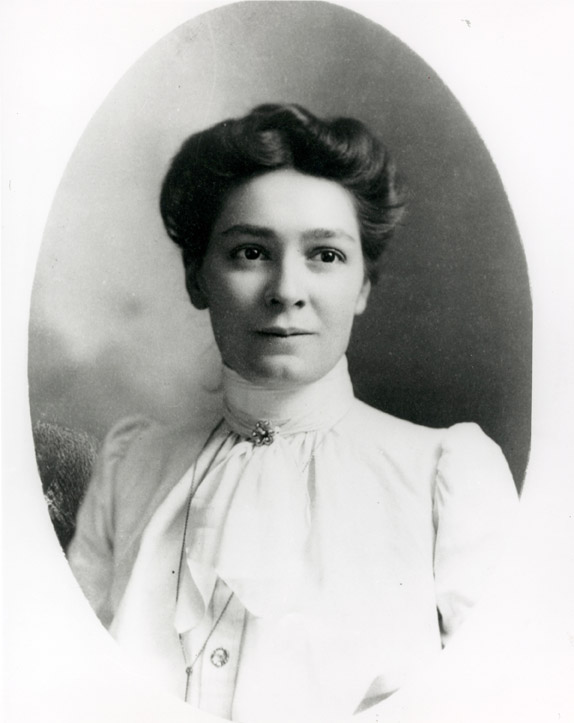
Buckeyes who have attended the College of Engineering may already know the name Lamme, since an annual medal the College bestows for meritorious achievement in engineering bears its name. That honor is named after Benjamin Garver Lamme, who received a degree in 1888 in Mechanical Engineering. However, few may know about his sister, Bertha, who was the first woman to graduate from OSU with an engineering degree.

Bertha Aranelle Lamme was born on December 16, 1869, near Springfield, Ohio. She came to Ohio State to study engineering, possibly influenced by her brother. She received a degree in Mechanical Engineering from the Department of Electrical Engineering, in 1893.

Bertha Lamme, 1892

Lamme, 1892

At Westinghouse, she met Russell Feicht, another OSU graduate (’90) and engineer who displayed a 2000-horsepower motor at the 1904 World’s Fair in St. Louis. They married the next year, and Lamme – now Mrs. Feicht – left the company to become a wife and mother.

Though little is known of Bertha Lamme’s own achievements in engineering, she did inspire at least one other woman to enter the science field: Her daughter, Florence, eventually became a physicist with the U.S. Bureau of Mines. Bertha Lamme Feicht died in November 1943 in Pittsburgh. She was 74.

Older posts Newer posts