From Woody's Couch

Our Playbook on OSU History

Author: drobik.5@osu.edu (page 19 of 62)

Twelve Days: For OSU undergrads, Park served as a constant counselor

Dean Joseph Park (left), with students, 1951

Dean Joseph Park (left), with students, 1951

One of the people Ohio State should never forget is Joseph A. Park, the University’s first Dean of Men. His greatest contribution may have been the Stadium Scholarship Dormitories, which helped thousands of male students attend OSU who otherwise could not have afforded to do so. But his long service as a calm counselor, ready to help in a crisis – or in some cases, get a student out of a jam – is what endeared him to thousands of students and led to his name on one of OSU’s dorms.

Born in Cleveland on October 7, 1893, Park graduated from Cleveland’s West High School before coming to Ohio State in 1914. At OSU, he was active in the YMCA, the fraternity Alpha Tau Omega and Sphinx, the senior men’s honorary. He also served on the staff of the Makio. During his junior year he was drafted to the Army, where he entered officer training. He returned to Ohio State in 1919 as a 1st Lieutenant, graduating in 1920. He married Ruth Vera Webb that June, and they had two daughters, Ruth and Mary.

Park, n.d.

Park, n.d.

As a senior, he had served as secretary for the campus YMCA; he held that position until 1927 when then-OSU President George Rightmire went looking for a position he was calling “student councilor.” Rightmire selected Park, whose job title changed to Dean of Men two years later. A new position at the time, the job changed greatly over the years as the campus grew. But Park didn’t change that much: He was always ready to listen and offer a helping hand or piece of advice.

Though he was responsible for the well-being of thousands of male undergraduates, he always kept a calm demeanor – and a phone at his bedside. Often the late-night calls were the results of normal college stress—or to bail students out of jail. In fact, the writers at the Sundial, OSU’s humor magazine, once said of Park’s position: “Some of the problems would tax a Supreme Court Justice schooled in psychiatry.”
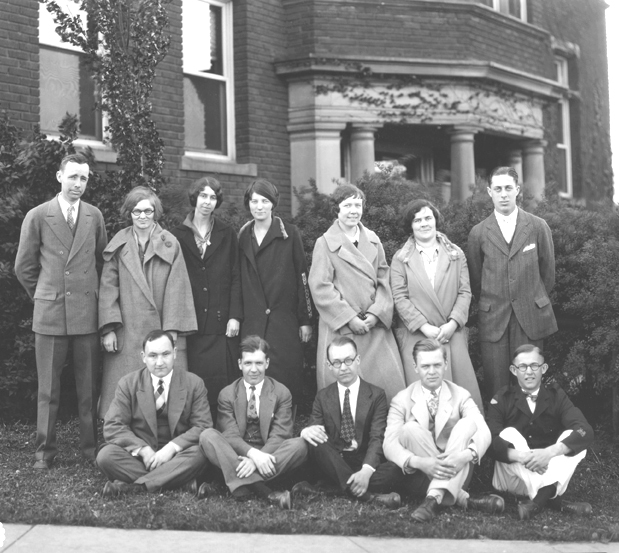
Park with students, 1930

Park with students, 1930

Park didn’t seem to mind, saying once that “the trouble is more than offset by the fun.” Indeed, he gave the bride away at dozens of weddings, and he and his wife chaperoned hundreds of campus dances and parties. On a questionnaire he listed his hobbies as “student life.”

Besides being a counselor and fill-in parent to students, Park also had the opportunity to make some lasting changes to the University structure. In 1927, when he was still a senior and YMCA secretary, Park proposed the creation of an office of director of student affairs and a student court, and the creation of a Student Senate. Eventually, all of these proposals came to fruition.
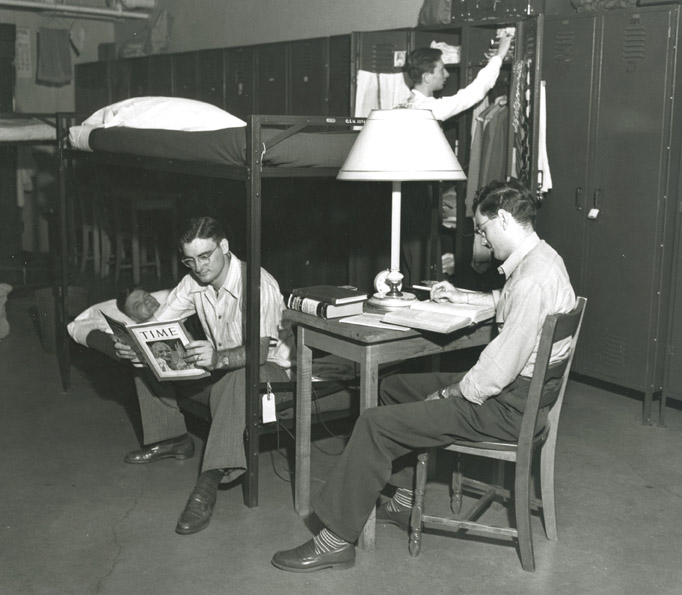
Students in the Stadium Dorm, 1947

Students in the Stadium Dorm, 1947

Park’s most notable contribution, though, was the establishment in 1933 of co-operative housing system in the Stadium for low-income male students. Known as the Stadium Scholarship Dorms, they helped keep students in school by offering affordable housing in exchange for working in the dorms at jobs like cleaning and serving in the dining area. This housing philosophy still exists in the Stadium Scholarship Program.

Park died on April 19, 1952. He was 59. In 1959, Park Hall was one of three then-new dormitories (Stradley and Smith were the others) built to provide more dorm space for men on campus.

– Filed by C.N.

Twelve Days: Bradley took art to the world as the ‘paint-brush ambassador’

Carolyn Bradley, 1940

Carolyn Bradley, 1940

OSU can boast of a number of well-known artists who either studied or taught at the University: George Bellows, James Hopkins, and Roy Lichtenstein, for example. One artist – Carolyn Bradley – drew acclaim not only for her art but for her many travels to bring her artistic passion to the world.

Carolyn Gertrude Bradley was born on September 22, 1898, in Richmond, Indiana. She received her first bachelor’s degree in 1920 from Earlham College in Richmond. She went on to earn another B.A. from John Herron Art School in Indianapolis, as well as degrees from Columbia University, the Traphagen School of Fashion in New York, and a master’s degree in fine arts from Escuela Universitaria de Bellas Artes in San Miguel Allende, Mexico.

1930_bradley_carolyn

Bradley with her artwork, no date

Bradley also was an avid traveler and fluent in Spanish, which earned her a place as an educational ambassador with the U.S. State Department from 1946-1951. Her first state-sponsored trip was as a visiting professor at the University of Chile, the second was a three-month tour of Guatemala, Honduras and Costa Rica. In 1950 she took a part-time teaching position at the Centre d’Art in Haiti, and in 1951 she was a visiting professor at the University of Costa Rica.

On all of these trips she taught and lectured almost every day, to audiences that ranged from university students to primary school children. Due to the economic situation in many places she taught, materials were scarce. Bradley was known to take students up into the hills to dig their own clay to use for paint pigment; she also brought many art supplies with her to donate to her students.

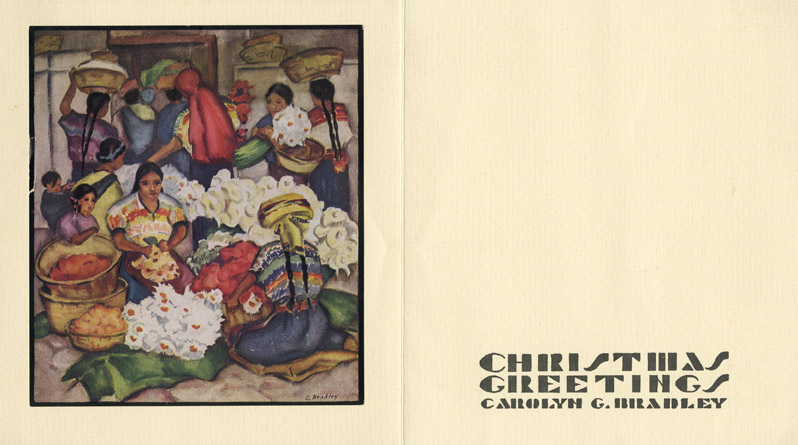
A Christmas card designed by Bradley, 1949

A Christmas card designed by Bradley, 1949

During these sojourns, she found time and plenty of inspiration to work on her art, and she returned with more than 60 of her own paintings, as well as the nickname “the paint-brush ambassador.”

A renowned water color artist in her own right, she studied with many well-known painters, including Henry B. Snell, George Pearce Ennis, James Hopkins, and Carlos Merida. She won 58 awards for her work and authored three books on costume design.

Bradley died on December 8, 1954, after a sudden illness. She was 56. Bradley Hall was dedicated in her honor on December 13, 1954.

In 1994, the OSU Archives received a small collection of handmade holiday greeting cards Bradley sent to friends and family, from 1940 to 1953.

– Filed by C.N.

1940

1940


Twelve Days: 4-H founder helped form better farmers for the future

A.B. Graham, 1911

A.B. Graham, 1911

Before A.B. Graham no one thought to teach children in rural communities in any organized fashion on how to be better farmers when they grew up. Because of Graham, though, the agricultural club system known as “4-H” was born, and has grown to include roughly 7 million young people in more than 50 countries.

Albert Belmont Graham was born on March 13, 1868, near Lena, Ohio. He attended school in a one-room schoolhouse; upon his graduation at the age of 17 he took over the teaching job. His father had died when Graham was young, and his mother supported her family as a seamstress. Graham’s grandmother, a Quaker, lent him money to attend the National Normal School, and after graduation in 1888 he enrolled in OSU. He stayed only one year, though, and returned to teaching. In 1900 he was elected superintendent of schools in Springfield, Ohio.

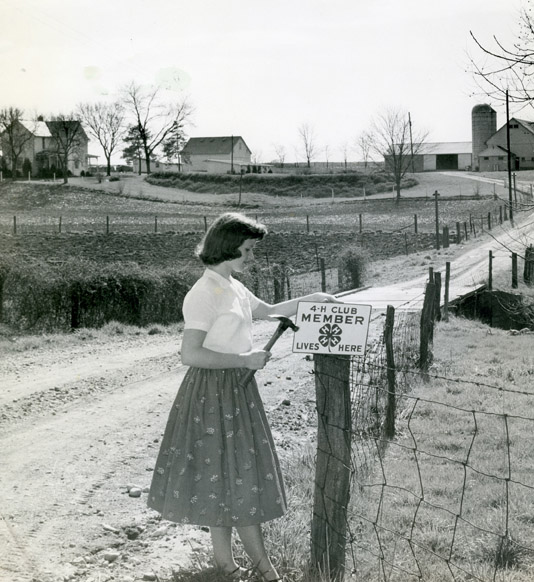
Girl posting 4H sign, no date

Girl posting 4H sign, no date

It was there, on January 15, 1902, that Graham founded the boys’ and girls’ agricultural club – the first of its kind in the United States and what would later become 4-H, which stands for Head, Heart, Hand and Health. The club was designed to supplement the education the children were receiving in school on the scientific study of agriculture.

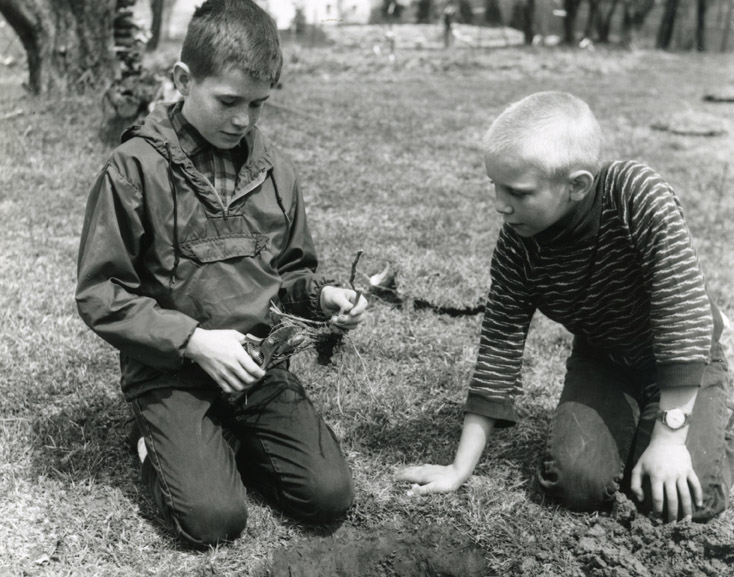
no date, A.B. Graham collection, two boys digging in dirtYoungsters were given seeds and taught how to test soil quality, how to plant and grow the seeds, to take notes and study scientific theory. They were asked to present their findings among their peers, and to conduct group projects. The club also worked with parents, helping to improve the quality of life in rural communities and to encourage good agricultural practices. The first club had 83 members who planted experimental plots of corn, vegetables and flowers, and kept meticulous records of their results.

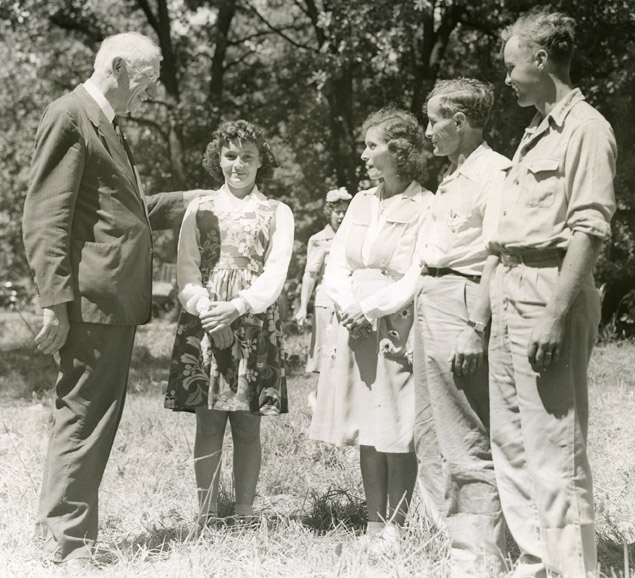
Graham talks with a young girl, 1945

Graham talks with a young girl, 1945

Meanwhile, Graham worked with OSU and the Ohio Agricultural Experiment Station at Wooster to test seed varieties and various agricultural methods. In 1905, OSU created the position of superintendent of agricultural extension for Graham, who by then was known statewide for his work with farming communities. The then-new service focused on what Graham had been doing all along: promoting healthy agricultural practices and encouraging schools to teach agriculture and home economics as part of their curriculum, as well as providing educational resources to students and the public.

Graham served as director at Ohio State until 1914, when he went to the New York State School of Agriculture to start a similar program there. Two years later, he moved to Washington, D.C., to work as chief of agricultural extension specialists for the U.S. Department of Agriculture. When he retired from that position in 1938, he returned to Columbus, staying active in the community and 4-H until his death on January 14, 1960, at the age of 91.

– Filed by C.N.

Older posts Newer posts