From Woody's Couch

Our Playbook on OSU History

Month: March 2013 (page 2 of 2)

Bleeds Scarlet and Gray: Registrar as devoted to alma mater as she was to detail

Edith Cockins, 1910

Edith Cockins, 1910

One of our all-favorite people from the University’s past is Edith Daisy Cockins. So upon this anniversary of her death, we thought we should remember her and her commitment to the University.

Edith Cockins first came to Ohio State as a preparatory student in 1888 at the age of fifteen. Two years later, she officially enrolled as a freshman; some of her activities while she was a student included her work on the Lantern and the Makio. She graduated with a bachelor of arts degree in 1894.

She went on to complete a year of graduate work and joined the University staff in 1896 as a record clerk. The following year, she was appointed to the newly created post of University Registrar. She would retire 47 years later, having overseen the records of over 60,000 students.

Cockins, 1937

Cockins, 1937

However, in that interval of 47 years, Miss Cockins accomplished quite a lot. As registrar, she was responsible for all student records, and in 1914 she first organized diplomas at Commencement according to a system that allows students to receive their official diploma at the ceremony. It is still in use today, even though roughly 9,000 students attend the Commencement ceremony.

In 1911, she and another loyal alumnus, Ralph D. Mershon, undertook reorganizing the Alumni Association. The next year, she oversaw publication of the University’s “Who’s Who,” a guide to former notable alumni. And in 1929 was named director of the newly created Alumni Records division.

Along the way, she also held the titles of secretary of the faculty and University Editor. Cockins also was involved with several outside organizations, including the American Association of Collegiate Registrars, of which she was elected president in 1938.

Cockins retired from Ohio State in 1944 and was named registrar emeritus. She didn’t stray far from her alma mater, though. She stayed active with the alumni association, and she served as housing chairman for the national organization of Kappa Alpha Theta sorority. She also oversaw the publication in 1959 of a biography on Mershon, for whom the Mershon Center for International Security Studies and Mershon Auditorium are named.

She was awarded an honorary degree, a Doctorate of Administration, for dedicating so many years and expressing such commitment to the University.

Cockins passed away on March 15, 1963 at the age of 89. In 1967 the Pharmacy and Microbiology Building was renamed Cockins Hall to honor her. The Edith D. Cockins Memorial Award was also established to honor the University registrar employee who best demonstrates Cockins’ high standards.

Cockins Hall, 1967

Cockins Hall, 1967

Filed by C.N.

For information on other notable women at OSU, see The Women’s Place’s Encyclopedia of Pathbreaking Women at the Ohio State University at http://www.womensplace.osu.edu/assets/files/womenpathbreakers_Final.pdf

Home a hard place to find for past OSU women undergrads

Oxley Hall residents, 1931

Oxley Hall residents, 1931

Women undergraduates who attend OSU today should be thankful for the times in which they live. If they had attended the University during its first 50 years, they would have had to work a lot harder to find a place to live here.

Though women attended OSU from the day it opened its doors in 1873, they did not have a dorm until 1908 when Oxley Hall opened. Even then, Oxley Hall housed only 60 women, and there were 600 women enrolled at that time. So until Oxley Hall, women had the options of living at home – if they were from Columbus – or living in area boardinghouses.

Part of the reason for the dearth of campus housing was financial: At the time Ohio State depended much more greatly on state funding, which was miniscule compared to other state universities. For instance, while the University of Michigan received $274,000, and the University of Wisconsin was given $92,736 from their respective state legislatures for the 1881-1882 academic year, Ohio State received $21,950.

It also was not a top priority for OSU’s first leaders; the university’s first president, Edward Orton Sr. never made such a funding request to state lawmakers, for example. (Granted, he had a lot of other things going on, like starting a university from scratch.)

Mack Hall residents, 1924

Mack Hall residents, 1924

It wasn’t until OSU’s fourth president, James Canfield, that there was a concerted effort to offer campus housing to women, which culminated in the construction of Oxley Hall. Slowly, the campus options increased with the construction of Mack Hall in 1921 and the purchase of Neil Hall in 1925. Women who lived in the dorms were supervised, and did most of the cleaning and other chores in the dorm. They had a curfew and were prohibited from having male visitors except for certain hours on Saturday and family visits on Sunday.

With very limited space at the University, sororities became a very popular choice: Ohio State had 25 sorority houses by 1925. These were considered the next best option for out-of-town students because like the dorms, they were socially acceptable to parents and the University, with each house having a “house mother” and sharing the University standards as to curfew, rules and living conditions. There were also houses supervised by religious entities, such as the Westminster Foundation, which housed a limited number of women students in an off-campus house.

Neil Hall women, 1929

Neil Hall women, 1929

If a student was unable to gain accommodation with family, or in a dorm or sorority, the student still needed a place to stay. Many girls opted to try to work for a family in exchange for room and board. This was not always the best solution; students sometimes would end up exhausted and unable to keep up with schoolwork.

After the appointment of the first Dean of Women in 1912, University staff inspected the rooms that girls rented in private homes to prevent unsafe living conditions. The Office then began keeping a list of boarding houses that could be recommended to students. To be on the list, the home had to pass the University’s inspection, there could be no male boarders in the boarding house and conditions had to be sanitary.

Apparently, some women students lived in conditions so poor that the University left certain campus buildings open, such as the Home Economics Building , so women students could use the bathrooms if their own rooms lacked suitable plumbing. And for all that, women paid as much as $5 a week, while male boarders usually paid $3-4.50 per week.

Filed by C.N.

Much of our information for this blog came from two dissertations on the early history of women at OSU, both of which are available at the Archives:

Sisters and Scholars: Women at the Ohio State University: 1912-1926, by Louise Ann Booth (1987)

Women at the Ohio State University in the First Four Decades: 1873-1912, by Pouneh M. Alcott (1979)

‘Jovial Bob’ aimed to put the fun back into USG elections

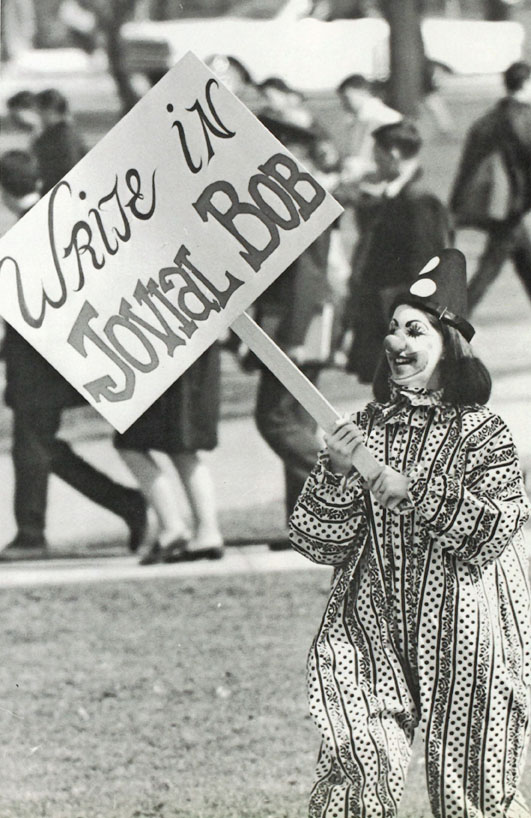
The Makio, 1965

This year’s USG election is the latest in a long line of annual events in which students choose the candidate whom they believe will best represent their interests in Ohio State’s student government. It has sometimes been ugly – depending on how much mud is slung by various candidates – and it sometimes has been plagued by scandal, with accusations of vote-rigging other such charges.

And once, in 1965, it was infused with a healthy dose of humor, thanks to R.L. Stine, who went on to author the popular Goosebumps series of scary books for kids.

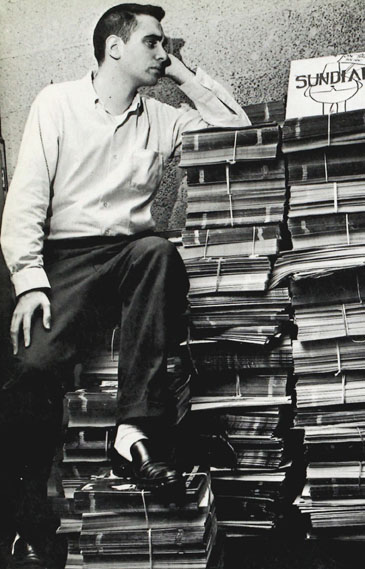
The Makio, 1965

At the time he ran for USG president that year, Stine was also known as Jovial Bob Stine, editor of the Sundial, OSU’s very own humor magazine. He also was a graduating senior and therefore not eligible to actually win the election. But that didn’t stop him from running a full-blown campaign, complete with clowns carrying signs encouraging students to vote for “Jovial Bob.” His campaign promise: If elected he would graduate and be gone for good.

Amazingly, he received 1,200 write-in votes.

After graduating that year, Stine went to New York City where, according to the alumni magazine, he wrote for a humor magazine called “Bananas,” then published his first book, How to Be Funny. He later wrote G.I. Joe and Indiana Jones books.

In the late 1980s, R.L. Stone was asked by a former editor to write a scary children’s book called Blind Date, which became a best-seller. That led to an idea for a series of scary stories for children, which led to Goosebumps. At one point in the early 1990s, the series outsold such other best-selling authors as Stephen King, John Grisham and Michael Crichton.

Coincidentally (or perhaps not?), the year after Jovial Bob ran, there was only one candidate for USG President. Also coincidentally, considering this blog post, this year’s election again features only one candidate – the first time since 1966.


Newer posts