Page 166 of 166

Found in the Collection: Winsor McCay’s “The Tale of the Jungle Imps”

In 2006, a phone call came to the Cartoon Library for curator Lucy Caswell  from a local business woman asking that Lucy take a look at some old cartoon drawings she had found. When the woman arrived the next day with a shabby, portfolio-sized cardboard box, no one could have guessed the magnitude of the discovery she had made in the back of her grandfather’s old shop.
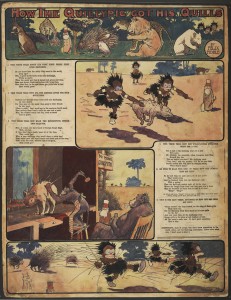
Inside, were eleven large original Winsor McCay drawings of his comic feature The Tale of the Jungle Imps. Unlike the originals from McCay’s other strips, all eleven of the Jungle Imps were fully and beautifully hand-colored with watercolor. This was McCay’s very first color newspaper comic strip–and until the discovery of these eleven pages–no other originals were known to have survived. Over 100 years after the 1903 debut of Jungle Imps in the Cincinnati Enquirer, it’s nothing short of a miracle that these originals would resurface in the one city in America with an academic research library devoted entirely to printed cartoon and comic art.   The Billy Ireland Cartoon Library & Museum acquired five of the eleven originals, which joined the rest of our extensive McCay collection including original Gertie the Dinosaur animation drawings, Little Nemo In Slumberland originals, and newspaper tear sheets of McCay’s comic strips and editorial cartoons.

The Tale of the Jungle Imps was a collaboration between McCay and George Randolph Chester, who wrote the rhymes for each comic under the pseudonym “Felix Fiddle.” The premise was a spoof on Rudyard Kipling’s Just So Stories, published the previous year. In each Jungle Imps episode, we are presented with an origin story about how a particular animal came to acquire its unique characteristic.  Each animal falls prey to the teasing of the three jungle imps: Boo-boo, Gack, and Hickey, until it receives a physical feature that helps it defend itself.

How The Quillypig Got His Quills

In the excerpt highlighted here from How The Quillypig Got His Quills,  the story explains that quillypigs (*porcupines) once had colorful quills made of the most delicious candy. Of course, the imps could not resist chasing the pigs around to pull their candy-quills out and eat them. When the quillypigs could no longer take the torture, Verse 4 “Tells How One Well-Plucked Quillypig Went For A Gun.”  Lucky for our jungle imps, the quillypig ended up before a very clever gunsmith, “Mr. Monkey”, who instead suggested a replacement coat of sharp quills with springs on the end to teach the imps a lesson.
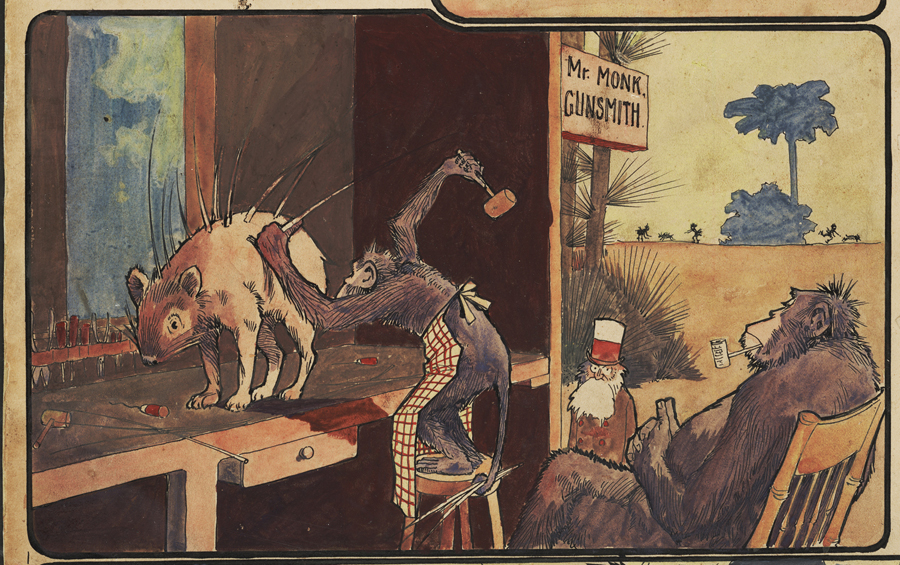
The clever Mr. Monkey watches over, as his assistant replaces the quillypigs candy-quills with sharp ones. In the background is Felix Fiddle, the silent observer who appears in each Jungle Imps tale. (click to enlarge)

To see our complete collection of Winsor McCay’s Jungle Imps in more detail, please check out our Jungle Imps Digital Album!

*Porcupines

*Porcupines (click to enlarge)

Blog Launch, and the Construction of Our New Home in Sullivant Hall

Welcome to The Billy Ireland Cartoon Library & Museum Blog! We’re very excited to join the comics blogosphere, and keep you all informed on what we’re up to. This blog will generally be updated at least twice a week with a smattering of events and activities of the Cartoon Library, highlights from our collection, interviews, and more. We hope you will add us to your feed, and continue to check back for the latest news. Please click the “About Us” tab find out more details about who we are.

For our debut post, I’d like to give a quick background on the history of the collection, culminating in some very exciting news about the move to our new home in 2013.

The Milton Caniff Reading Room opened in 1977  in two renovated classrooms in the Journalism Building of Ohio State University. Caniff [Terry and the Pirates, Steve Canyon] had donated in multiple installments his entire collection to OSU: 696 cubic feet of original art, correspondence, research files, photographs, memorabilia, merchandise, realia, awards, audio/visual material and scrapbooks.

Founding Curator Lucy Shelton Caswell, and Milton Caniff

Although there was no structure for collecting such materials from cartoonists, and few (if any) institutions in America were, Caniff was a proud OSU graduate and felt compelled to leave his legacy material with his beloved Alma mater. Lucy Caswell had worked in the journalism library and was hired to catalog the Caniff collection.  Caswell recognized how precious these materials were and saw that they were under-appreciated in academic institutions and museums at large.   She set out to establish an appropriate home for the collecting and preservation of cartoon art, and nearly 40 years later this altruistic goal has grown into the largest collection of cartoons and comics in the world.

The Cartoon Library in its original 1977 home in the Journalism Building. Note the ancient computer, and telephone cable wired from the ceiling!

Having grown exponentially by the early 1990s, by then containing 200,000 original cartoons and more than 1,000 linear feet of manuscript materials, the library moved into a new temperature and humidity controlled state-of-the-art facility to better house and preserve materials.


Cartoon Library Reading Room.  This space doubles as our exhibition gallery.  (click to enlarge)

A small portion of our art cases for originals, with single-issue comics storage in the background (click to enlarge)


This 6,800 square-foot space has remained our home through today.   As the storage area filled up, the Library was given the opportunity to store some of its materials at a new off-site, high-density remote depository that is shared by all the Ohio State University Libraries.

Offsite Storage (click to enlarge)

Offsite Storage (click to enlarge)


Although it may seem hard to imagine , by 2012 we have almost completely run out of space.  Our current holdings have reached over 300,000 originals, nearly 45,000 books, 67,000 serial titles, 3,000 linear feet of manuscript material, and 2.5 million comic strip clippings and tearsheets– making us the largest comprehensive research collection documenting cartoon art in the world.

This is why we are in the process of building a new facility to house the Billy Ireland Cartoon Library & Museum.  In 2013, we will be moving into a beautiful new home in Sullivant Hall, at the gateway to campus. This new facility will include three exhibition galleries, a large new reading room, a seminar room for educational programming, and much larger office and collection storage facilities. Our square footage will be increased from 6,800 to almost 30,000- a dream come true for a long and lovingly harvested collection that has striven to give the deserved recognition to the underdog medium that is cartoon art.  We are so incredibly thrilled and excited to settle into our new home, and endlessly thankful to those who have made the funding possible. Below, you can enjoy some artist renderings of our soon-to-be home, done by architect George Acock:

North entrance rendering

Gallery Rendering (one of 3 exhibit spaces!)

Please continue to check back here for updates and photos as the construction moves along. We hope you’ll come celebrate with us in 2013!


Newer posts »