Page 150 of 166

RIP: Ray Bradbury (August 22, 1920 – June 5, 2012)

Here at the Cartoon Library, we are deeply saddened by the loss of the all-time master of science fiction, Ray Bradbury. Bradbury was an inspiration for all, and a true friend to cartoonists and lover of the form. His work has been adapted by some of the greatest cartoonists world-over, and in his memory we have provided below a sampling of some of the varying styles that gave vision to his writing.

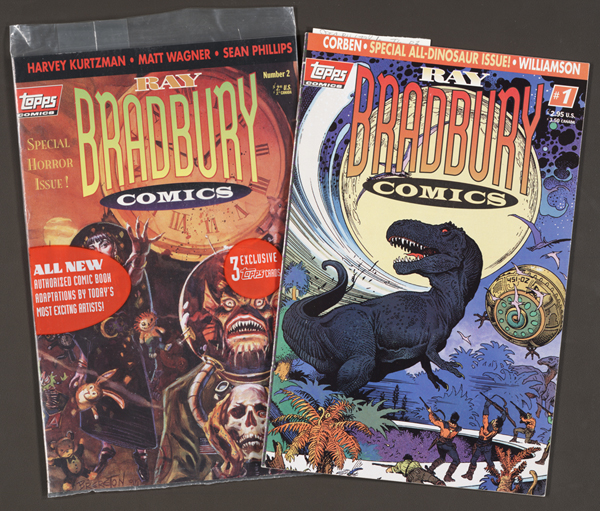
Issues 1 and 2 of the Topps Comics series "Ray Bradbury Comics". From The San Francisco Academy of Comic Art Collection, The Ohio State University Billy Ireland Cartoon Library & Museum
First, an excerpt from Bradbury’s introduction to The Ray Bradbury Chronicles Vol.1, a collection of comic adaptations of his writing that were originally published as Ray Bradbury Comics by Topps Comics (image above).

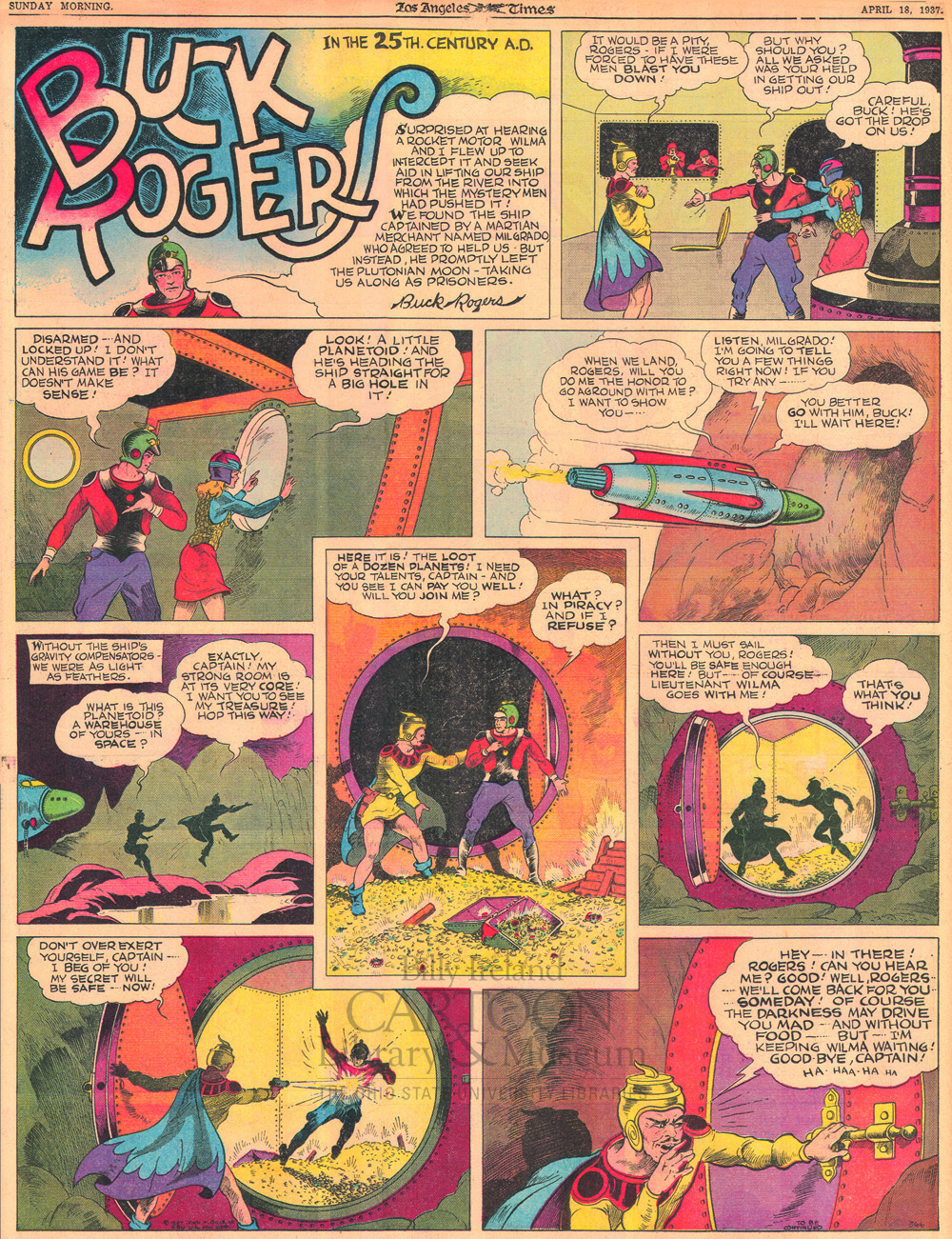
For comic strips, comic books and the creators of comics have filled my life since I was nine years old and “Buck Rogers” exploded before my eyes in the “Waukegan News Sun”. I knew then that I was staring at something that would change my life forever. That one strip, on an October afternoon in 1929, seized me into the future and would not let me return. I learned my first lesson in aesthetic that autumn. I collected Buck Rogers for three months and then when kids in school made fun of me for believing in the future, I tore them up. A week later, I burst into tears. Why am I crying? I asked myself. Who died? The answer was: me. I had listened to those fools who didn’t believe that one day we would arrive on the Moon or visit Mars. I made my most important decision then. I went back to collecting “Buck Rogers”. In all the years since I have not once listened to any so-called friend who made fun of my hobby, my dream, my lifeblood.

Harvey Kurtzman and Matt Wagner's adaptation of Ray Bradbury's "It Burns Me Up!" The Ohio State University Billy Ireland Cartoon Library & Museum (click to enlarge)
Wally Wood's adaptation of Ray Bradbury's "Home To Stay". The Ohio State University Billy Ireland Cartoon Library & Museum (click to enlarge)

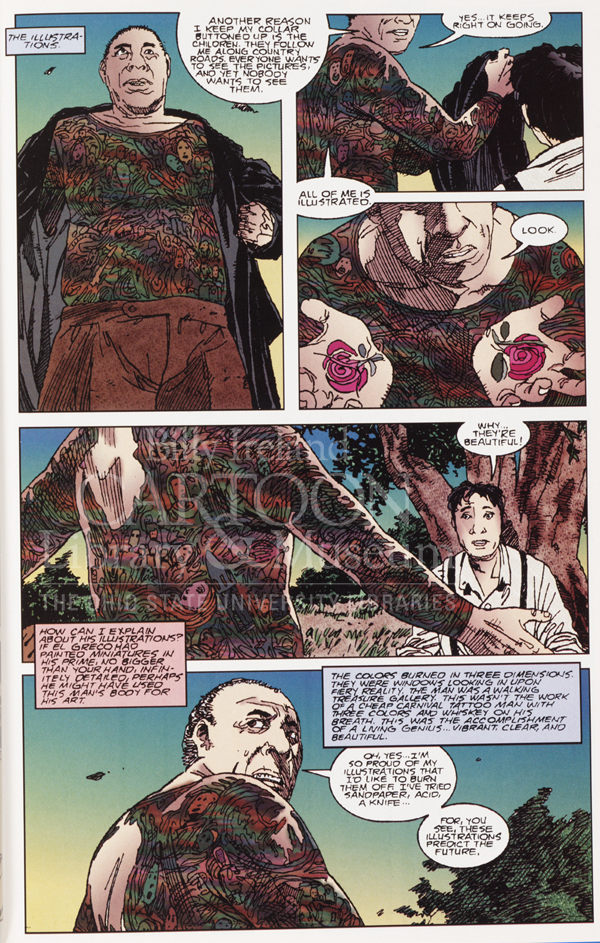
Guy Davis' adaptation of Ray Bradbury's "The Illustrated Man". The Ohio State University Billy Ireland Cartoon Library & Museum (click to enlarge)

Michael Mignola's adaptation of Ray Bradbury's "The City". The Ohio State University Billy Ireland Cartoon Library & Museum (click to enlarge)

Richard Corben's adaptation of Ray Bradbury's "A Sound of Thunder". The Ohio State University Billy Ireland Cartoon Library & Museum (click to enlarge)

Jack Davis adaptation of Ray Bradbury's "The Black Ferris". The Ohio State University Billy Ireland Cartoon Library & Museum (click to enlarge)

Dave Gibbon's adaptation of Ray Bradbury's "Come Into My Cellar". The Ohio State University Billy Ireland Cartoon Library & Museum (click to enlarge)

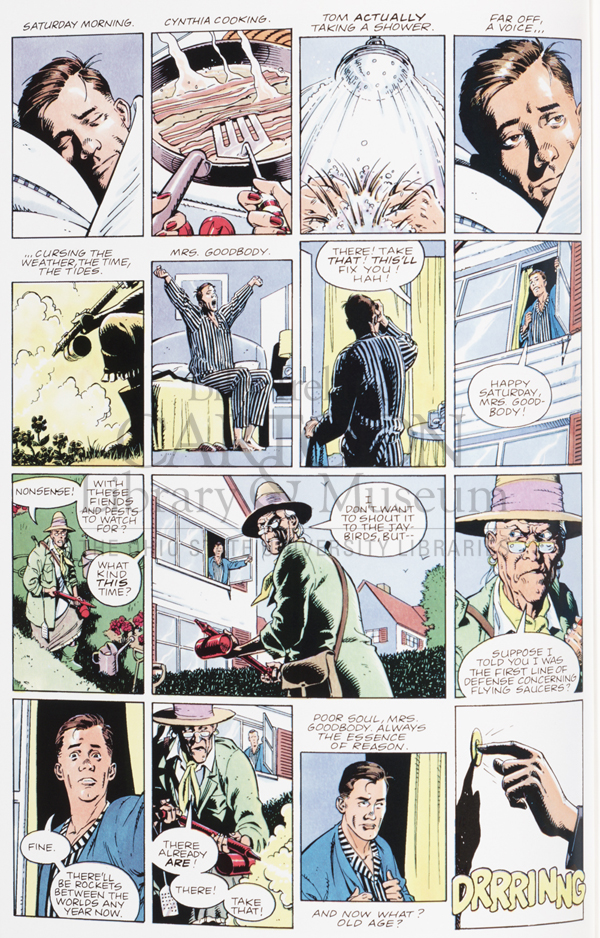
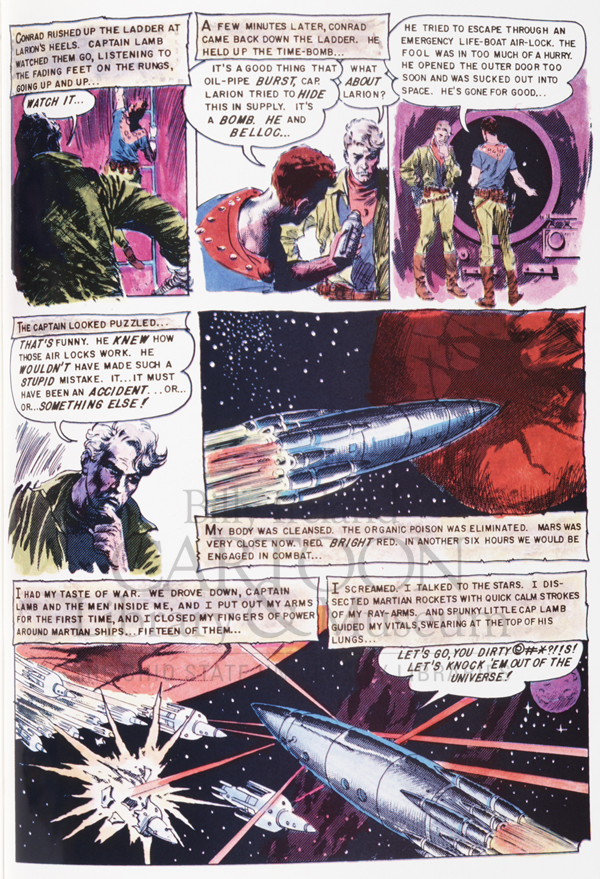
Al Williamson adaptation of Ray Bradbury's "I, Rocket". The Ohio State University Billy Ireland Cartoon Library & Museum (click to enlarge)


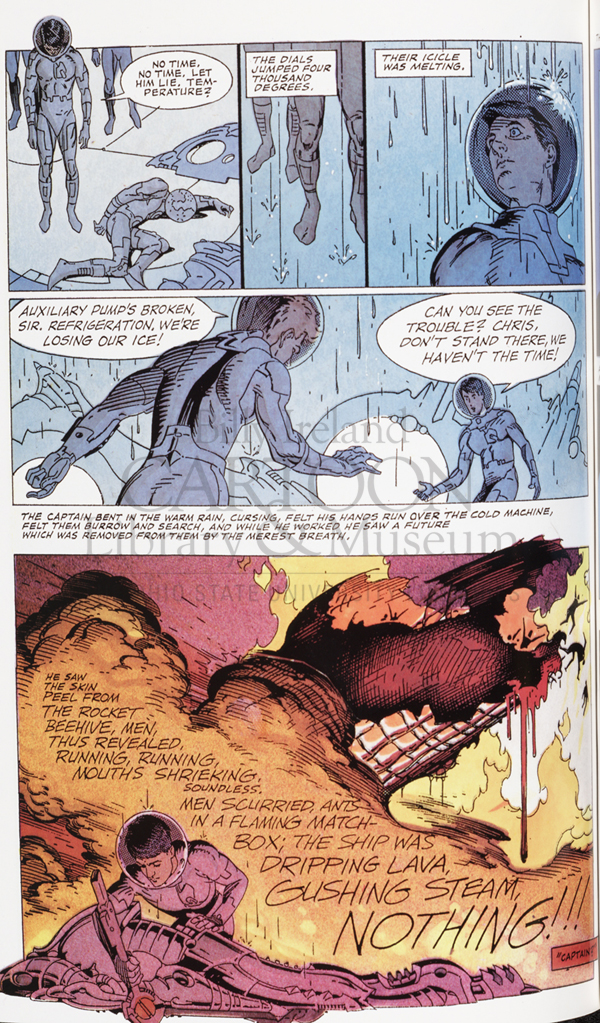
P. Craig Russell adaptation of Ray Bradbury's "The Golden Apples Of The Sun". The Ohio State University Billy Ireland Cartoon Library & Museum (click to enlarge)


For Ray Bradbury:

"Buck Rogers" tearsheet from April 18th, 1937, art by Rick Yager. From The San Francisco Academy of Comic Art Collection, The Ohio State University Billy Ireland Cartoon Library & Museum (click to enlarge)


Found in the Collection: E.G. Lutz (1868-?)

Although you’ve probably never heard of him- cartoonist, animator and author E. G. Lutz is the reason that 19 year old Walt Disney took an interest in pursuing animation. Lutz’s book Animated Cartoons: How They Are Made, Their Origin and Development, is credited time and again for being the book that Disney read that got him to think about starting up a business. However, little to nothing is known about E.G. (Edwin George) Lutz, though the impact of his writing and ideas is obviously tremendous.

Animated Cartoons: How They Are Made, Their Origin and Development, by E.G. Lutz. From The San Francisco Academy of Comic Art Collection, The Ohio State University Billy Ireland Cartoon Library & Museum

One thing we do know for sure about Lutz (and as always, we encourage our readers to contribute their own knowledge!) is that he was also a brilliant newspaper cartoonist, with some of his most interesting work appearing in the gorgeously illustrated Book of Magic, which was the special children’s section of the Seattle Post Intelligencer (where Nell Brinkley’s work frequently appeared as well.) This newspaper supplement featured full-color activities for kids, most commonly illustrated mazes and connect-the-dots featuring some of the favorite newspaper cartoon characters of the time (Happy Hooligan and Ignatz appear often).

E.G. Lutz’s pages typically centered around three basic themes- playing with food, anthropomorphized animals, and early optical toys. As with many of the items in our San Francisco Academy of Comic Art collection here at the Billy Ireland Cartoon Library & Museum that we thank Bill Blackbeard for everyday, these old Book of Magic sections were inherently dispensable enough in their time just by being newsprint, but doubly so because most of the activities in them required cutting up the paper. Particularly those of E.G. Lutz’s, which we are thrilled to have beautiful in-tact copies of here in our collection.

Below are two samples of Lutz’s optical toys- complete with instructions, and a bolded WARNING! that reads “Do not paint or cut out pages until you have looked over the whole book. There may be something on the other side of a page that you will like better.” Which, I would argue is doubtful, as even grown-up librarians like myself find it hard to resist wondering what the illusion would look like in action.

E.G. Lutz newsprint optical toy illustration from The Seattle Intelligencer's Book of Magic, June 4, 1922. From The San Francisco Academy of Comic Art Collection, The Ohio State University Billy Ireland Cartoon Library & Museum (click to enlarge)

A phenakistoscope:

E.G. Lutz newsprint optical toy illustration from The Seattle Intelligencer's Book of Magic, February 12, 1922. From The San Francisco Academy of Comic Art Collection, The Ohio State University Billy Ireland Cartoon Library & Museum (click to enlarge)

E.G. Lutz newsprint optical toy illustration from The Seattle Intelligencer's Book of Magic, April 23, 1922. From The San Francisco Academy of Comic Art Collection, The Ohio State University Billy Ireland Cartoon Library & Museum (click to enlarge)

Below, creative inspiration for food-play, should you be able to find that perfect yam at the market that resembles a baby seal. We are sure that Seattle parents were thrilled with their children’s sudden interest in fruit, but possibly not at the inclusion of orange peels in home decor.

E.G. Lutz newsprint cut-out toy illustration from The Seattle Intelligencer's Book of Magic, May 28th, 1922. From The San Francisco Academy of Comic Art Collection, The Ohio State University Billy Ireland Cartoon Library & Museum (click to enlarge)

E.G. Lutz newsprint cut-out toy illustration from The Seattle Intelligencer's Book of Magic, April 9, 1922. From The San Francisco Academy of Comic Art Collection, The Ohio State University Billy Ireland Cartoon Library & Museum (click to enlarge)

Lutz’s cartoons, typically anthropomorphic cartoons,  appeared in other papers as well, including the New York Herald and Philadelphia Press. We are lucky enough to have one piece of original art in our collection by E.G. Lutz, a fairly terrifying drawing of a cat with a drinking problem that can be seen below, although we have very little  information about it.

Original E.G. Lutz cartoon, circa late 1880s, from the International Museum of Cartoon Art Collection, The Ohio State University Billy Ireland Cartoon Library & Museum (click to enlarge)

The forgotten E.G. Lutz was a jack of all trades, and it is unfortunate that not much is known about him. We strongly encourage any contributions in our comments section with more knowledge about his life and work, and feel he would be a great topic of research from animation to anthropology.

——————————————————————————————————————————————

UPDATE:

Blog reader, cartoonist and comics educator Ryan Claytor was inspired to make an animated gif of E.G. Lutz’s “Tigress and Her Cubs” to find out how it worked after reading our post! Check it out:

« Older posts Newer posts »