Author: Caitlin McGurk (page 18 of 158)

Researcher Spotlight: Eike Exner

Eike Exner was one of two recipients of the 2022 Lucy Shelton Caswell Research Award. Exner received his Ph.D. from the University of Southern California and is now an independent scholar. His revised dissertation, Comics and the Origins of Manga, was recently published by Rutgers University Press. He is currently researching representations of women in pre-war manga for a book chapter in an anthology on women and manga and for a book-length history of modern manga. The following is his report on his time spent at the Billy Ireland Cartoon Library & Museum in Spring of 2022.
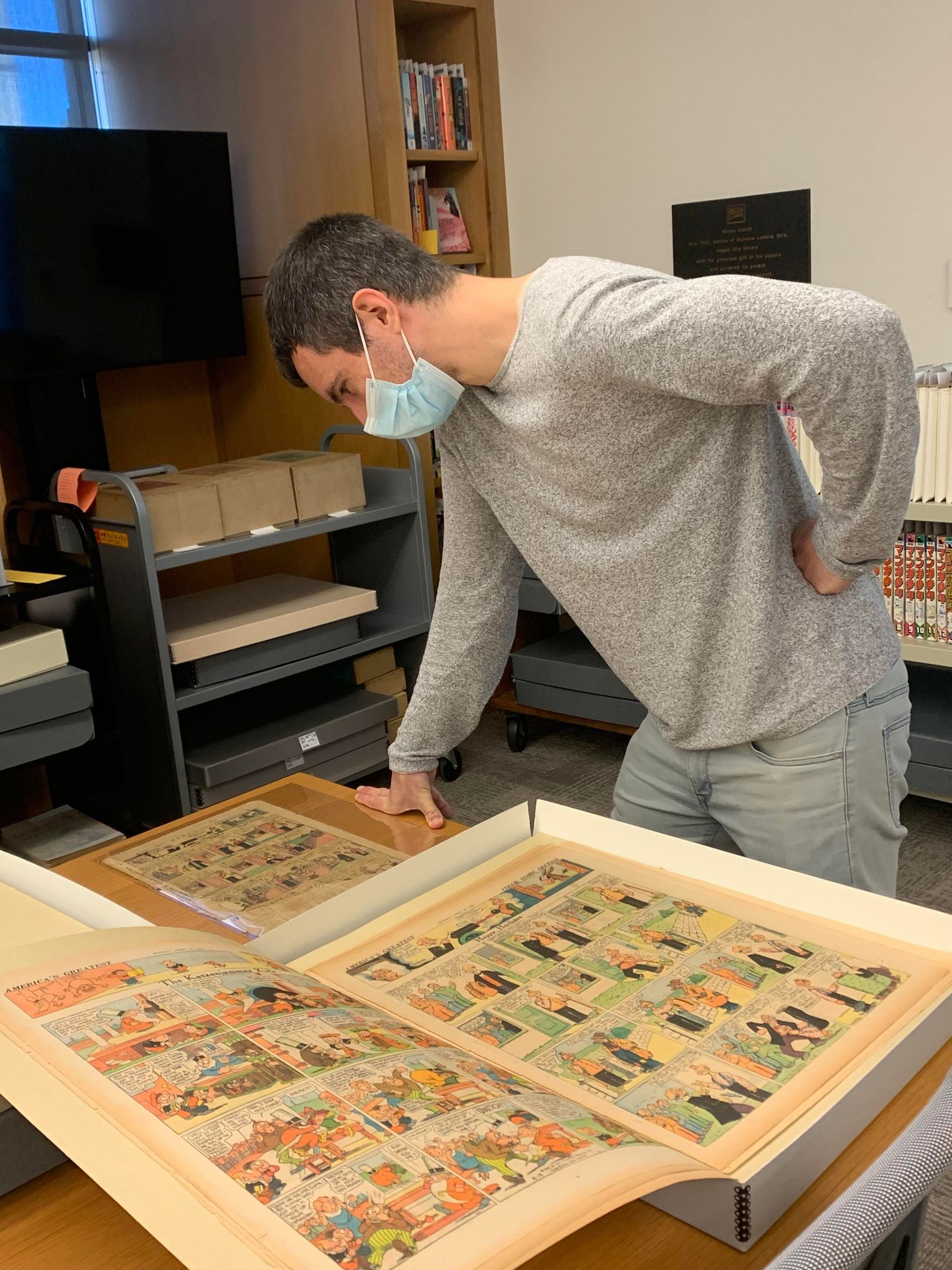
Eike Exner in the Lucy Shelton Caswell Reading Room

I could spend weeks at the Billy Ireland Cartoon Library & Museum (BICLM) just comparing original issues of Happy Hooligan with their translations in the Jiji Shinpo newspaper’s Jiji Manga supplement between 1925 and 1930 (I actually think this would make a great coffee table book). I had never seen both in color next to one another before (BICLM is the only place in the world where this is possible!), and realized for the first time that the coloring of the Japanese version must have been done without being able to reference the colors used in each original episode, since colors often varied wildly.

Fig. 1 Happy Hooligan by Frederick Burr Opper, April 26, 1925

Fig. 2 Happy Hooligan, Japanese edition

I was also able to confirm that panel shapes and speech balloons were altered in translation: Since the drawings are reproduced too precisely to have been traced by hands, this means that panels were likely cut up and rearranged on a new sheet of paper to make room for upward elongations (presumably to accommodate the larger speech balloons in Japanese). These edits must have then been made by hand, probably by pasting white paper over the upper portions of the panels. The edited version was then photographed for printing.

This complicated editing process may have given Kitazawa Rakuten, editor of the Jiji Manga supplement, an idea for an experimental comic: In March 1925, two months after the start of Happy Hooligan’s run in it, Jiji Manga featured a page-long comic strip starring Kitazawa’s character Mr. Teino with panels intentionally placed out of order. An explanatory note in the upper right instructs readers that they should cut up the page and rearrange the panels so that the story makes sense. It seems highly plausible that the process of cutting up (or seeing one of his disciples cut up) a Happy Hooligan episode into individually panels and placing them in the correct order on a new sheet of paper each week gave Kitazawa the idea to draw a comic strip that had to be cut up.

Fig 3. Mazekoze manga from Jiji Manga, March 15, 1925, page 5

The plot of this self-identified “jumbled-up comic” (mazekoze manga) shows Mr. Teino being paid to hide in a fake radio (broadcasting had just started in Japan at the time) and imitate radio broadcasts, so that his employer can sell this ‘radio’ to a client. The plan fails when Teino falls asleep and the fake radio’s new owner attempts to investigate the snoring sounds. As I argue in Comics and the Origins of Manga, the rise of the archetypical form of modern comics (e.g. multiple panels per scene, no narrative text, and characters hearing and reacting to other characters’ speech balloons) in both the United States around 1900 and in Japan in the 1920s was closely tied to the spread of sound-related technologies like the phonograph and the radio, and I’m fascinated by direct intersections between the two such as in this experimental comic strip.

Fig. 4 – Herr Professor Binglespitz and the Phonograph, New York Journal, December 3, 1899
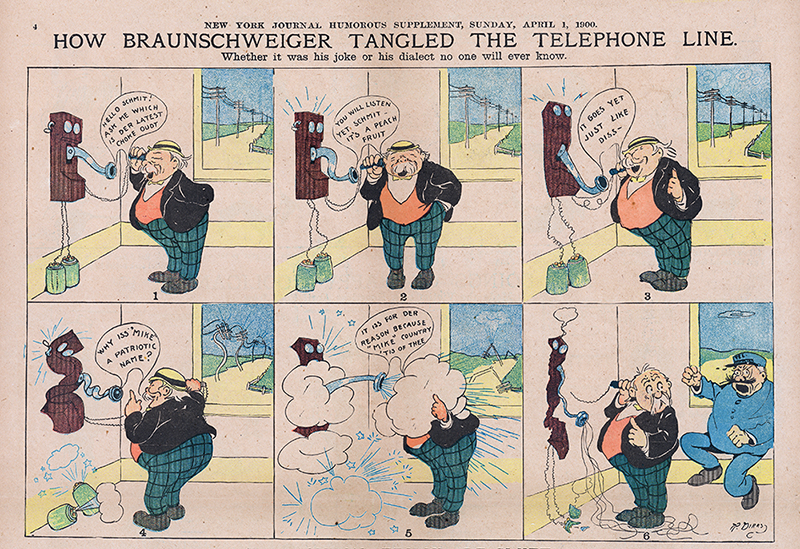
Fig. 5 – How Braunschweiger Tangled the Telephone Line, New York Journal, April 1, 1900

This direct intersection also happened in (well, adjacent to) my favorite discovery during my stay here: a 1906 Japanese adaptation of the Katzenjammer Kids, already in modern comic strip form (the format didn’t become widespread in Japan until 1923). I had previously seen the Katzenjammer Kids appear in Chinese cartoons from the 1900s, but had never seen them in Japanese publications before the 1920s. It is fascinating how ubiquitous accounts that link contemporary manga to traditional Japanese art still are when early American comic strips were known, and adaptations of them published, in Japan as early as 1906. The Katzenjammer Kids adaptation was featured in the cartoon magazine Joto Ponchi, apparently edited by none other than Japanese novelist Kunikida Doppo. This discovery was made even more exciting by the presence of a similar modern comic strip about using a phonograph for language study on the opposite page. This means that people who were interested in visualizing sound on paper even before it had become a common occurrence around them simultaneously showed above-average interest in sound-recording technologies.

Fig. 6 – double page from third issue of Joto Ponchi

I could talk about this stuff all day, but there are two other discoveries I should mention. One of the core points I make in Comics and the Origins of Manga is that World War II represented far less of a rupture in manga history than is sometimes suggested by histories of manga (see the recent Google/Japanese Ministry of Economy, Trade and Industry project). I was previously unaware how obvious the continuity between postwar and prewar narrative manga still was in the late 1940s and early 1950s. The back cover of the first issue (January 1948, though published at the end of 1947) of the influential early postwar manga magazine Manga Shonen, for example, featured an image of famous prewar manga characters like Jiggs, Dankichi, Norakuro, Minnie Mouse, Nonto the “Easygoing Daddy,” Kurosuke, and Popeye playing baseball together, for example. In a later issue Tezuka Osamu himself, in his “Manga Classroom” feature introduced young readers to some of the ‘foreign’ characters he had grown up with, such as Jiggs and Adamson.

Fig. 7 Manga Shonen January 1948
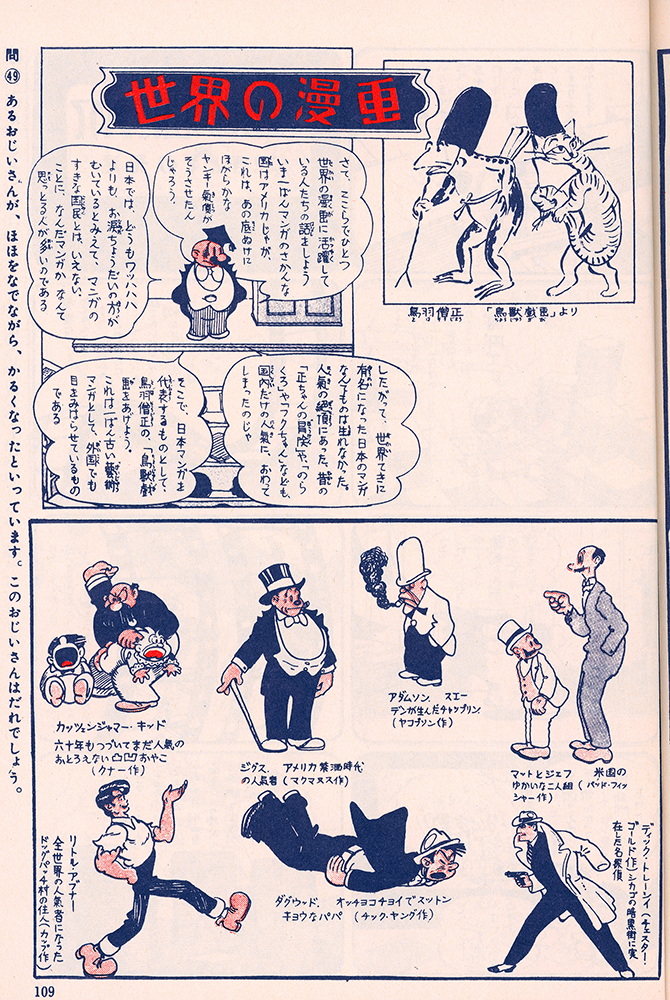
Fig. 8 Manga Classroom Osamu Tezuka, Manga Shonen, June 1953

And speaking of Norakuro, the most popular native-born manga character of the 1930s, I was able to read reprints of the comic strip serialized in the boys’ magazine Shonen Kurabu between 1931-1941, of the ten Norakuro comic books published during the same time period, and of entire Shonen Kurabu issues originally published in the early 1930s. In my writing on manga history, I have previously avoided delving into the question whether the support for Imperial Japanese military conquest shown in Norakuro was simply par for the course at the time or noticeably worse than average. Since my main interest in comics and manga has been as an artform/medium, I had not paid close attention to Norakuro’s *plot* before. Some manga historians have argued that Norakuro was no worse than other manga of the 1930s, but its author, Tagawa Suiho, went far beyond what the totalitarian military government required of cartoonists at the time.

Many cartoonists, including Aso Yutaka and Yokoyama Ryuichi, used their popular manga characters to encourage citizens to buy war bonds and the like, but Tagawa used Norakuro to support the Japanese war effort more extensively than others. For those not familiar with the character: Norakuro was an anthropomorphic canine soldier in the “fierce dog brigade,” an obvious, sometimes explicit stand-in for the Japanese military. In 1932, the year after the Japanese invasion of Manchuria, Norakuro’s friends reenacted a famous Japanese suicide bombing (or embellished accident), with the bomb-carrying dogs commenting on how glad they are to give their lives for their country shortly before exploding. The story ends with Norakuro lamenting that he survived. Fan art published in Shonen Kurabu showed Norakuro shaking hands with the Japanese Minister of the Army, demonstrating that children understood the connection between the fierce dog brigade and the real-life military, and that this connection was encouraged by the magazine (the majority of whose covers in 1932 used pictures of soldiers, warplanes, and other martial imagery). Norakuro likewise taught children about chemical warfare and dismembering anthropomorphic pigs (who Tagawa used as a stand-in for Chinese people) with a Japanese sword (something that some Japanese soldiers infamously did with Chinese prisoners of war).

Fig. 9 + 10 Shonen Kurabu, May 1932 

Fig. 11 Shonen Kurabu August 1932 

Fig. 12 Shonen Kurabu March 1932 

Fig. 13 Shonen Kurabu May 1932 

Fig. 14 Shonen Kurabu August 1932

Not all Norakuro episodes or comic books were propagandistic in nature, many featured harmless slapstick humor. But three of the ten Norakuro books are about brutally conquering “pig” cities easily identifiable as Chinese by their architecture (although these assaults are happening overseas from the dog country, they are a purely defensive measure, Tagawa explains in an author’s statement: the pigs provoked the war and must be completely destroyed, so that they will never be able to rise and threaten the dog country again). Several author’s statements (which were featured at the beginning of each book) remind the child readers that they must play a role in the war effort and be prepared to eventually fight as well.

Fig. 15 Norakuro Soukougeki

The “discovery” I was alluding to was that the 1975 reprints of the Norakuro comic strip do not include any of the more ‘problematic’ episodes, such as the ones showing the dismembering of “pigs” or glorifying dying in war. The reprints do not mention that any episodes have been left out, which may explain why some scholars have underestimated the extent of Norakuro’s role as pro-war propaganda.

In order to end on a more uplifting note, let me conclude with one of the many smaller fascinating things I stumbled across, this avantgardistic comic about “the worlds of newspaper readers” from the November 10, 1924 Jiji Manga.

Fig. 16 Jiji Manga November 10, 1924

Finally, I want to thank everyone at the Billy Ireland Cartoon Library and Museum for all their help and hospitality during my research stay there. 5 out of 5 stars, highly recommend.

Research Spotlight: Kevin Cooley

Dr. Kevin Cooley received the 2020 Lucy Shelton Caswell Research Award in 2020. He holds a Doctorate in English Literature from University of Florida, and is now Professor of Liberal Arts at the Ringling College of Art and Design. Below, Dr. Cooley discusses his fascinating research into the life of cartoonist George O. Frink.  

I found out I had won the 2020 Lucy Shelton Caswell Award while absent-mindedly scrolling through my email in the snowy parking lot of a gas station somewhere in Pennsylvania. I was driving home to visit family in Buffalo for Christmas, and I probably should’ve been enjoying this rare opportunity to neglect my inbox.

For once in my life, I am glad that I was checking my inbox on a day off.

I didn’t know it when I first began the research that would secure me this award, but I was about to be blessed with an opportunity to access the most thorough collection of comics resources in the world, and to make my project come to life. My research on George O. Frink began around 2017, when I started work on a PhD dissertation focused on the production, politics, and history of queer animated cartoons. After reading up on J. Stuart Blackton’s drag performances, Krazy Kat comics, and the frequented drag gimmicks of turn-of-the-century comic strips, I was rapidly arriving at a conclusion that queer cartooning had a much longer history than most writing on the subject was willing to give it credit for.

I doubled down on this conclusion when the folks at the Sequential Art Workshop in Gainesville, FL introduced me to Lucy and Sophie Say Goodbye in the Spring of 2018. This comic strip was a shocking and overtly queer one for 1905, starring two women whose prolonged kisses on the lips wrought chaos on the world around them. I don’t know if you can “triple down” on a conclusion, but I think that’s exactly what I did in the summer of 2019, when I paid an initial visit to the BICLM to investigate the queer origins of cartooning. There, I was introduced to Caitlin McGurk’s article “Lovers, enemies, and friends: The complex and coded early history of lesbian comic strip characters,” which speculated that George Frink was the creator of Lucy and Sophie Say Goodbye.

Rapidly, my research on early queer comics began to triangulate on Frink and his work. It struck me as utterly impossible that Frink’s best-known comic strip, Circus Solly, had not influenced the template mechanics of the classic Warner Bros. style chase cartoon. The strip matched Looney Tunes’ Bugs Bunny/Elmer Fudd gags right down to its nutty and elastic clown of a protagonist, who used drag performances and impossible physics to escape from his pursuers. It was hard to believe that this strip, which ran in many of the local newspapers that the future animators of Warner Bros’ “Termite Terrace” would’ve likely been exposed to as a child, did not influence some of the acrobatic and gendered play of cartooning to come.

The access to these resources that I enjoyed led to some exciting finds I am happy to share here today—finds that I unpack at much greater length in George O. Frink: A Pioneer in Queer Cartooning, which has been released in two parts at The Middle Spaces. My pieces at The Middle Spaces offer not only a point-by-point breakdown of the case for Frink’s creation of Lucy and Sophie Say Goodbye, but a glimpse into the life of this cartoonist whose work connected queer life and cartoonish gimmicks. For those who want the Sparknotes version, though, the most succinct summary of my overall findings follows shortly. Some of these findings were made in my 2019 trip to the BICLM, some of them in my time at the BICLM on the Lucy Shelton Caswell Award, and some of them on late pandemic nights in digital archives.

George O. Frink was born in 1874 in Marion County, Indianapolis, to Erastus O. Frink and Charlotte Frink. Erastus—an inventor, engineer, and patent solicitor—used his talent to design blueprints and sketch out patent designs, as he did when he designed the original Gatling gun. Frink shared his father’s talent for drawing, but used it very differently, and was affiliated with the Sun Publishing company of Indianapolis by the age of 19 (at the latest). He was also affiliated with one Bertha May Hiers at 19, but only very briefly—they married in late 1893, and divorced by early 1896. Frink never remarried, and he began to disappear from public life around 1915. He died in an asylum on November 17th, 1932.

Not long after divorcing Bertha, Frink moved to Chicago and entered the thriving art scene there. Frink began at the Chicago Daily News, where he would create his best-known comic strip, Circus Solly. He would stay at the Chicago Daily News until 1911, where he would bring an obvious copycat of Circus Solly, now rechristened Slim Jim and the Force, to World Color Printing.

During 1904-1905, Frink drew cartoons for The Chicago Tribune as well. These included some Sunday incarnations of Circus Solly, as well as one-offs like Mrs. Clubberly Clubber. Two anonymous comic strips also appeared in The Chicago Tribune at this time that were clearly by the same hand, and looked incredibly similar to Mrs. Clubberly ClubberThe Career of Cholly Cashcaller, and Lucy and Sophie Say Goodbye.

Here and there, these two strips are very scarcely signed with a strange character that at times looks like a “C,” and at other times resembles a “G.” Frink used this C/G character in another volume that can be definitively attributed to him, Peck’s Bad Boy and the Circus. This strange signature (coupled with references to details in these comics pulled straight from Frink’s life, not to mention a unique way of drawing elephants across different media), leaves little doubt in my mind Frink created these two comic strips. Lucy and Sophie Say Goodbye ends with its lovestruck lesbian protagonists being carted off to an insane asylum (just as Frink was later in life), and Frink’s role in its creation is an undoubtedly an important detail to establish.

Frink’s run on Lucy and Sophie Say Goodbye ended abruptly, in a half-finished strip from October of 1905. And yet, he would continue to explore queer themes (only slightly more subtly) in his other comic strips moving forward: from his iconic hobo acrobat character, to obscurities like Sammy Spankem and The Picture Show (which simulated animation, or an animation storyboard).

There is much to be gained, though, from looking closer than the broad strokes. Two fully-funded weeks in the archives at the BICLM gave me the time and the resources to furnish my writing with some absolutely incredible archival finds I’m happy to share here today.

  • I was blown away by the discovery of an arc in Circus Solly where the hobo acrobat is finally given a rival who poses a serious threat to him: an estranged wife. Solly’s wife attempts to trap him into a life of domestic servitude, and she seems to see Solly’s life on the run from the law for what it is: an elaborate game, whose purpose is pleasure and distraction from a heteronormative life as a man and a father. Rather than be trapped in a heterosexual marriage, Solly uses his acrobatic skills to escape from it—and on the same week as Lucy and Sophie Say Goodbye’s termination at The Chicago Tribune.

  • Well after Frink’s tenure on the strip—as artists like Raymond Crawford Ever and Stanley Armstrong took their turns drawing the hobo acrobat—readers did not only seem to expect drag play, they also demanded it. In a rare example of readership statistics from a time period where that information can be sparse, a letter write-in campaign revealed that 200 readers suggested the acrobat’s pursuers, “The Grassville Force,” dress up in drag to seduce Solly into submission. Frink’s choice of gimmick seems to have left an indelible mark on the comic strip as it aged—a mark that rubbed off on the cartoons it influenced, and the people who viewed them.

  • Frink seemed to have learned from Lucy and Sophie Say Goodbye that the occasional one-off strip can get away with ribaldry and taboo that the ongoing strip cannot bank on. In “No Use for Him,” Frink makes an incredibly risqué joke, implying bondage play between a male swimming instructor and his female student, who is using an elaborate harness to learn how to swim. The real kicker is that the cartoon relies on a). the assumed sexual desires of the female student, and b). the audience’s acknowledgement of a man as an object of sexual desire, to generate its humor.

  • George O. Frink created prototypes of both The Career of Cholly Cashcaller (which debuted in the Tribune, and is quasi-anonymous in the same way Lucy and Sophie Say Goodbye is) and Circus Solly as one-offs in his earliest days at the Chicago Daily News, and in completely different styles. “Tumbler Tompkins” uses his acrobatic antics to satisfy id-based desires safe to discuss in the newspaper, like comic hunger. “Cholly Pynehedde” is always trying to be helpful, just as Cholly Cashcaller is, but can never quite seem to help his (largely female) associates.

  • Frink created at least one autobiographical comic strip, giving us a priceless insight into the way that he saw himself and cartooned himself. He draws himself not unlilke how he draws Circus Solly and Cholly Cashcaller: all of them gangly goofballs with a tuft of hair sticking out down the back of the neck.

The trip was, to say the least, filled with its share of surprises. I was blown away to find out during my last three days of research that the Billy Ireland had a yet-to-be-sorted collection of Chicago Daily News issues—a paper that has been difficult for me to track down outside of grainy microfilm prints. I didn’t have enough time left to read these papers thoroughly (and I would have been hesitant to handle them more than absolutely necessary, as they cost only a penny in 1901, and are extremely brittle about one-hundred and twenty years later). The best option, then, was to carefully photograph each of the issues and review my photographs of them in the meantime. I learned a valuable lesson in this task: anyone who thinks archival work is not physical work has never photographed ten years worth of the Chicago Daily News—each page more brittle than the last, and ready to stick to the next—for 18 hours spread over three days. With kindness and brilliance of equal proportions, Susan Liberator rigged together a stand made from cardboard boxes that would allow me to capture the full scope of the images from a higher height—reducing the strain that bending thousands of times at the exact right angle it would take to get my camera to focus on the faded lines of the browning newsprint.

As you can see, the folks at the Billy Ireland were incredibly accommodating, and beyond generous with their time, labor, and considerable skills and knowledge. Miranda Rike, Emma Halm, and Hannah Kramer—who were student assistants in the library at the time of my research—were immensely helpful in both preparing materials for my visit and keeping the (gradually multiplying) materials I requested organized. I went into the library with a clear vision for the materials I would need to see—but naturally, new finds led to new questions, and new questions led to the need to consult more materials. I am still blown away by the speed and efficiency with which the archival staff conjured up sheaf after sheaf of newsprint gold.

I hope I can return to Columbus soon and do it all over again. The Lucy Shelton Caswell Research Award program is an incredible resource, and I encourage anyone working with comics who has an idea to develop, but is lacking the funds to develop it, to apply for it today.

Older posts Newer posts