From Woody's Couch

Our Playbook on OSU History

Page 67 of 105

OSU marks MLK’s legacy with service, celebration

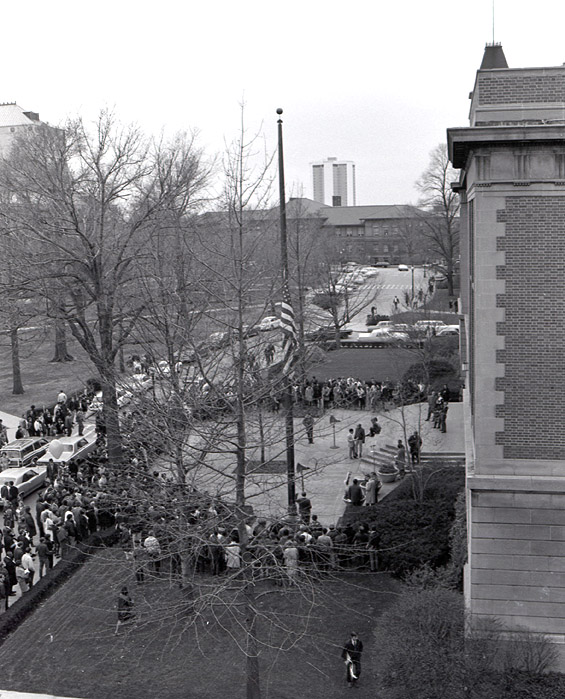
Students hold memorial for Martin Luther King Jr., 1968

Students hold memorial for Martin Luther King Jr., 1968

Martin Luther King Jr.’s assassination on April 4, 1968, sparked immediate reaction from the OSU community. After he was killed, some advocated violence – In The Lantern, one student called for people to pick up their guns – while others carried on his strategy of peaceful protest.

On April 7, a group of about 150 students marched from the Ohio Union to the Ohio State Fairgrounds. According to The Lantern, another group of students removed the American flag flying outside of Bricker Hall and took it to then-Provost John Corbally, saying a flag that represented violence should not hang even at half-mast for a man who stood for nonviolence. On April 9, Novice Fawcett ordered classes cancelled to honor King’s memory.

That year, the May Week Committee and Traditions Board decided that all proceeds made from festivities that week would be used to start a Martin Luther King Jr. Memorial Fund scholarship for incoming students, based on scholastic ability and need. Until then, the profits had gone to the United Appeal fund. The Office of Diversity and Inclusion now administers the Martin Luther King Jr. Memorial Scholarship program.

In 1972, the Office of Diversity and Inclusion (then called the Office of Minority Affairs) began its annual Martin Luther King Celebration, which has included the announcement of the scholarship winners. This year, Danny Glover is the featured speaker. (See more details at http://odi.osu.edu/.)

Students work on a project during the Martin Luther King Jr. Day of Service, 2004

Students work on a project during the Martin Luther King Jr. Day of Service, 2004

In 1990, the College of the Arts teamed up with the Martin Luther King Jr. Center for the Performing and Cultural Arts to provide arts education for minority students. The result was the Martin Luther King Jr. Institute for the Arts. The institute’s mission was to first train minority teachers in the arts. Ohio State provided scholarships to graduate students for training. Classes for students in grades 4-12 in dance, theater, music, and visual arts were also established.

In 1999, Project Community at the Ohio Union started the annual MLK Day of Service at Ohio State. Students, faculty and staff volunteer that day on various community service projects that target children, literacy, senior citizens and the homeless. This year, OSU’s Pay It Forward and  the Frank W. Hale Jr. Black Cultural Center will sponsor the event, which is expected to attract 1,000 volunteers. (For details, see http://ohiounion.osu.edu/get_involved/csls/mlkday.)

Woody Hayes: five fun facts far from the football field

1951_Woody_posed_001

Woody Hayes, 1951


Everyone knows about Woody Hayes’ career as the head coach of the Buckeyes: his 205-61-10 record (the most wins ever by an OSU coach), the 13 Big Ten championships, eight Rose Bowl visits, five national championships, and three Heisman trophies his players won, not to mention the two times he was selected National Coach of the Year.

But Woody had a very diverse and different life off the field.  The following list of five fun facts about Coach Hayes will highlight some of the more interesting aspects of his life you probably don’t know about!


Hayes with President Richard Nixon, n.d.

Hayes with President Richard Nixon, n.d.

  • Hayes graduated from Denison University in 1935 as a double major in history and English and a minor in physical education. He graduated from OSU in 1948 with a master’s degree in educational administration. This was three years before he would be hired as football coach.
  • Hayes was good friends with Presidents Nixon and Ford and also knew Presidents Reagan and Bush. He was very involved in the Ohio Republican party and supported current governor John Kasich early in his political career.
  • Hayes had a wide variety of other notable friends, including Jack Nicklaus, Bob Evans, Milton Caniff, Dave Thomas, Bob Hope, and George Steinbrenner.
  • Hayes was a great admirer of Ralph Waldo Emerson and was invited to give a lecture at Harvard in 1982 on the occasion of the 200th anniversary of Emerson’s death. His signature “Pay Forward” motto was inspired by Emerson’s essay on Compensation.

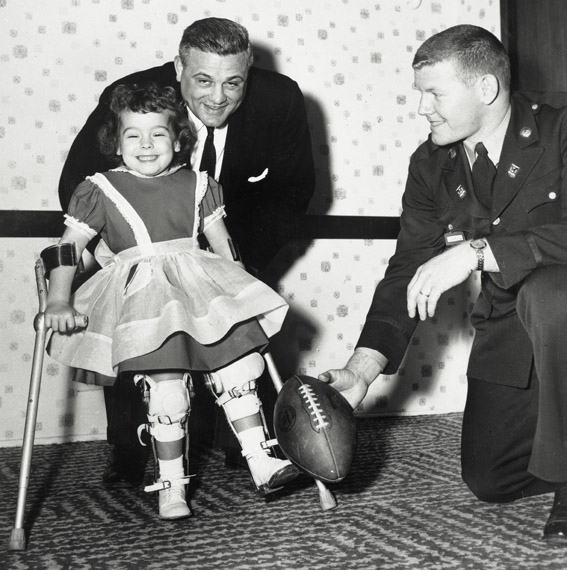
    Hayes with Easter Seal child, 1958

    Hayes with Easter Seal child, 1958

  • Hayes was a dedicated supporter of many charitable organizations, particularly those, like the Easter Seals, that benefitted children. He spent quite a bit of time visiting hospital patients, answering phones at telethons, and speaking at events to raise funds for various causes.


For more information about these and other surprising facts about Coach Hayes, click through to our web exhibit about Hayes or visit our exhibit in Thompson Library between Jan. 7 and Feb. 28.

Jesse Owens exhibit opens at Thompson Library

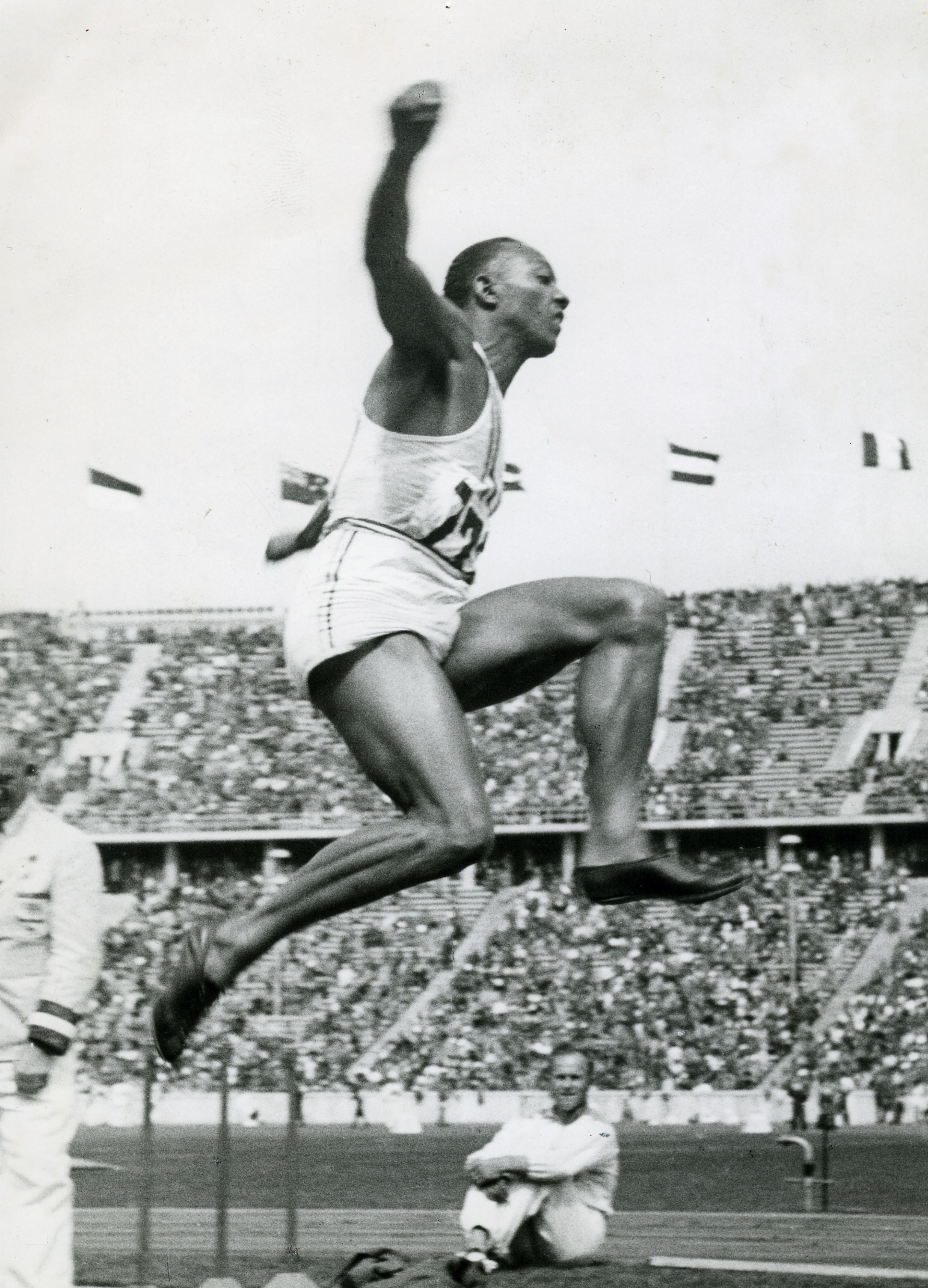
Jesse Owens, Olympics broad jump 1936

Owens competes in the broad jump at the 1936 Olympic Games

“Faster, Higher, Stronger – Jesse Owens: 100 Years of Life and Legacy” opens today in William Oxley Thompson Library Gallery and features material from the University Archives’ Jesse Owens Papers. The exhibit marking the 100th anniversary of Owens’ birth will run through May 5, 2013.

Owens made history at the 1936 Berlin Olympics by winning four gold medals in track and field.  Owens spent much of his later life working with young people and serving as a goodwill ambassador for the Olympic movement and the United States.  His accomplishments are explored in detail throughout the exhibit.  Highlights include Owens’ Olympic gold medals and diary, an Olympic torch from the 1936 Berlin Games, and Owens’ Presidential Medal of Freedom.

The exhibit examines Owens’ legacy after his death in 1980 and explains his connection to today’s Olympic athletes.  Material from the 2012 London Olympics worn by an Ohio State University student-athlete will be included in the exhibit.

Jesse Owen's gold medals, 1936

Owen’s gold medals, 1936

Additional information  about Owens can be found in the Archives’ web exhibit, “Jesse Owens: a lasting legend.”

An opening reception will be held Wednesday, January 23, from 4-6 p.m. in Room 165 at Thompson Library. The public is invited.

The Thompson Library is located at 1858 Neil Avenue Mall at The Ohio State University.  Gallery hours are Monday-Wednesday and Friday, 10 a.m.- 6 p.m.; Thursday, 10 a.m.- 8 p.m.; Saturday and Sunday, noon- 5 p.m.

For more information, please contact Tamar Chute (chute.6@osu.edu; 614-292-3271).

« Older posts Newer posts »