From Woody's Couch

Our Playbook on OSU History

Category: Student organizations (page 6 of 10)

Black History Month: Football player had higher calling than just ‘phys ed’

William Bell

William Bell

William “Big Bill” Bell was a standout tackle for the OSU football team, but his academic career off the field far outshone his performance on it.

Bell played for the Buckeyes from 1929 through 1931, and earned All Big Ten and Honorable Mention All-American honors his final season. But football wasn’t his only activity: He was a member, and Sergeant of Arms, for the African-American social fraternity, Alpha Phi Alpha, and he was a member of Varsity “O,” the Collegiate Council, and the Interracial Council.

His senior year, the Upper Class Cabinet of the OSU chapter of the YMCA tapped Bell to lead a new committee on interracial relations. In doing so, the Cabinet’s president, Wallace Hall, revived a then-dormant policy of allowing African-American members to become a member. In a Lantern article about Bell’s appointment, Hall said “Bell is a good worker, and I see no reason he should not be a member of the cabinet.”

Bell was named Interracial Chairman of the Upper Class Cabinet, 1931 Makio

Bell was named Interracial Chairman of the Upper Class Cabinet, 1931 Makio

After graduating in June 1932, Bell began a long career coaching football at historically African-American colleges, including Claflin College in South Carolina, Florida A&M University, Howard University and finally North Carolina A&T State University. Bell worked more than 20 years at North Carolina A&T in a number of capacities, including athletic director and professor of physical education. (Along the way, Bell received his master’s degree in physical education and his PhD in physical education from Ohio State, in 1937 and 1960, respectively.)

After organizing physical education departments at several universities, Bell ended his career as athletic director of Fayetteville (Alabama) State University where he assisted in the development of Fayetteville’s National Youth Sports Program, a summer organization for disadvantaged youths.

He died at the age of 81 in 1981 in Fayetteville. In Bell’s obituary, a former student of Bell’s at North Carolina said Bell “never said ’phys. ed.’ He always said ‘health and physical education.’ He wanted it to be a profession.”

OSU marks MLK’s legacy with service, celebration

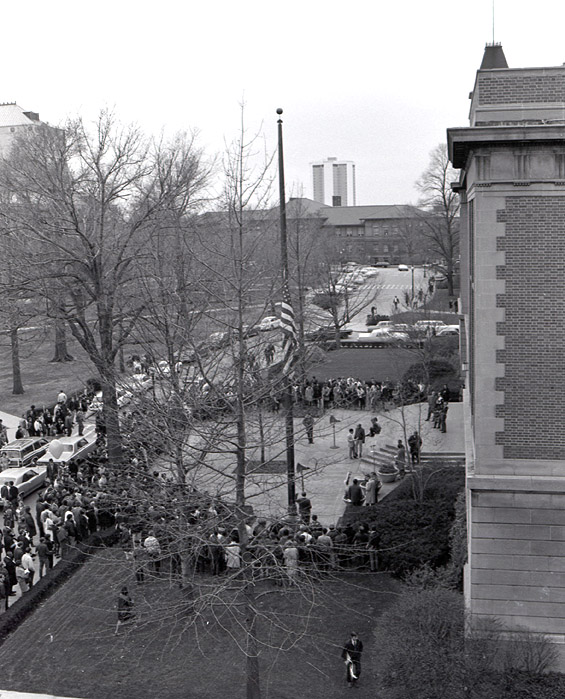
Students hold memorial for Martin Luther King Jr., 1968

Students hold memorial for Martin Luther King Jr., 1968

Martin Luther King Jr.’s assassination on April 4, 1968, sparked immediate reaction from the OSU community. After he was killed, some advocated violence – In The Lantern, one student called for people to pick up their guns – while others carried on his strategy of peaceful protest.

On April 7, a group of about 150 students marched from the Ohio Union to the Ohio State Fairgrounds. According to The Lantern, another group of students removed the American flag flying outside of Bricker Hall and took it to then-Provost John Corbally, saying a flag that represented violence should not hang even at half-mast for a man who stood for nonviolence. On April 9, Novice Fawcett ordered classes cancelled to honor King’s memory.

That year, the May Week Committee and Traditions Board decided that all proceeds made from festivities that week would be used to start a Martin Luther King Jr. Memorial Fund scholarship for incoming students, based on scholastic ability and need. Until then, the profits had gone to the United Appeal fund. The Office of Diversity and Inclusion now administers the Martin Luther King Jr. Memorial Scholarship program.

In 1972, the Office of Diversity and Inclusion (then called the Office of Minority Affairs) began its annual Martin Luther King Celebration, which has included the announcement of the scholarship winners. This year, Danny Glover is the featured speaker. (See more details at http://odi.osu.edu/.)

Students work on a project during the Martin Luther King Jr. Day of Service, 2004

Students work on a project during the Martin Luther King Jr. Day of Service, 2004

In 1990, the College of the Arts teamed up with the Martin Luther King Jr. Center for the Performing and Cultural Arts to provide arts education for minority students. The result was the Martin Luther King Jr. Institute for the Arts. The institute’s mission was to first train minority teachers in the arts. Ohio State provided scholarships to graduate students for training. Classes for students in grades 4-12 in dance, theater, music, and visual arts were also established.

In 1999, Project Community at the Ohio Union started the annual MLK Day of Service at Ohio State. Students, faculty and staff volunteer that day on various community service projects that target children, literacy, senior citizens and the homeless. This year, OSU’s Pay It Forward and  the Frank W. Hale Jr. Black Cultural Center will sponsor the event, which is expected to attract 1,000 volunteers. (For details, see http://ohiounion.osu.edu/get_involved/csls/mlkday.)

Twelve Days of Buckeyes: Six who’ve attended OSU have led as Ohio’s governor, too

John Bricker, 1916

John Bricker, 1916

The list of high achievers who have attended OSU is incredibly long, so today we focus just on those six who have reached the pinnacle in Ohio politics – the governor’s office.

John W. Bricker received his bachelor’s degree in 1916 and his law degree in 1920, demonstrating along the way how active he would later be in politics: He was a member of the political science club, on varsity debating team and baseball team, a member of Varsity “O,” class president his junior year, chairman of the senior memorial committee, YMCA president and a member of the senior honorary, Sphinx.

After he received his law degree, Bricker went into politics. Among the high offices he held were Ohio Attorney General, Ohio Governor (three two-year terms) and two terms as U.S. Senator. He also served as the Republican nominee for Vice President in the 1944 presidential election between Thomas Dewey and Franklin D. Roosevelt.

He was a member of OSU’s Board of Trustees from 1948 to 1969, serving his last year as chairman. Because of his long service to the University, the former Administration Building was renamed for him in 1983.

Thomas J. Herbert didn’t graduate from OSU, but he did attend the University’s Ground School training program during World War I. Before he was elected governor, Herbert served as Ohio Attorney General. After the end of his single-term governorship, President Dwight Eisenhower appointed him chair of the federal government’s Subversive Activities Control Board, an agency formed to hear testimony regarding charges of communism in the U.S.

Though Herbert didn’t receive an academic degree from OSU, his son, John D. Herbert did graduate from OSU in 1949. Another son, David J. Herbert, followed his in his father’s political footsteps and served as state treasurer for three terms.
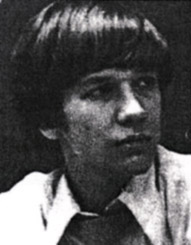
John Kasich

John Kasich

John Kasich, Ohio’s current Republican governor, has had much more success running for state and national offices than he did when he was a student at Ohio State. He ran twice for president of the Undergraduate Student Government, but was defeated both times. He protested the second election, citing voting irregularities, but nothing came of his appeal. He graduated in December 1974 with a bachelor of arts degree in political science.

At age 26, Kasich became the youngest person ever to be elected to the Ohio Senate; he then ran for U.S. Congress and ultimately served nine terms. From 2001 to 2009, Kasich served a number of roles as a private citizen, including as a host of “Heartland with John Kasich” on the Fox News Channel. In 2010, he ran for governor, defeating then-incumbent Ted Strickland.

C. William O’Neill actually began his political career while attending OSU’s College of Law. Before entering law school, he had campaigned for other Republican candidates, but in 1938, he decided to campaign for himself, for a seat in the Ohio House of Representatives. Winning the election made him the youngest General Assembly’s youngest representative, at age 22. A member of Phi Beta Kappa while in school, he earned his law degree in 1942.

During a 40-year political career, O’Neill lost only one race – the gubernatorial election of 1958. But he more than made up for that one loss, ultimately becoming the only person to serve as Ohio’s Supreme Court Chief Justice, Governor, Speaker of the House and Attorney General. He died after a heart attack in 1978 while serving as Chief Justice. At that time, he also was serving on the OSU Alumni Association’s Board of Directors as immediate past president.

Governor Rhodes, 1969

Governor Rhodes, 1969

James Rhodes only briefly attended OSU in the mid-1920s before he had to drop out to help support his family, according to the alumni magazine. His first election victory came as Republican ward committeeman in Columbus, thus beginning a long political career in the state capital. His highest office was as Ohio Governor – for four terms, making him one of the longest-serving governors in U.S. history.

Though Rhodes is remembered for sending the National Guard to quell student protests on various Ohio campuses, including OSU (on May 4, 1970, four students were shot to death by Guardsmen at Kent State University), he is also credited with developing a network of community and technical colleges around the state to increase opportunities for vocational education.

Rhodes also promoted OSU as a major center for medical training and research; in 1976, the Rhodes Hall addition to University Hospitals was named after him.
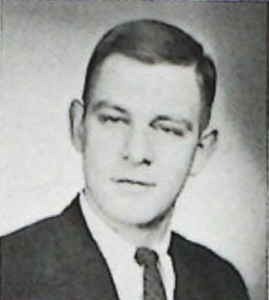
George Voinovich, 1961

George Voinovich, 1961


George Voinovich graduated in 1961 with a law degree from The Ohio State University. He got his start in political leadership roles while still on campus, serving as president of both his class and the campus Young Republicans.

After graduation, Voinovich went on to serve the state of Ohio in a wide variety of offices as a state representative, as Lieutenant Governor under fellow Buckeye James Rhodes, as the Mayor of Cleveland, the Governor, and, most recently, as U.S. Senator. His 2004 Senate victory was won by a landslide with all 88 Ohio counties selecting him to serve.

Older posts Newer posts