From Woody's Couch

Our Playbook on OSU History

Category: Student organizations (page 5 of 10)

Long Gone Campus Traditions: Hats off to the era of freshman beanies!

1940

1940

Perhaps one of the few Ohio State traditions new students may wish to stay buried is the class cap, otherwise known as the ‘beanie.’ Freshmen (men only) used to be strong-armed into wearing caps in the name of creating school spirit and class unity. If by unity the administration meant commiseration, well then they got what they set out to achieve.

The caps and rules were in use from 1912 until the mid-century. Wearing the caps was just one of the rules enforced by “all men of the upper classes;” however, the junior men’s honorary Bucket and Dipper and its members were the only people ever authorized, by the Student Senate and the President of the University, to carry out the traditional punishment: namely, throwing offenders into Mirror Lake. Ironically, if some unauthorized person attempted to chuck a freshman in the lake, Bucket and Dipper members were honor-bound to protect the freshman.

A freshman is tossed into Mirror Lake, 1926

A freshman is tossed into Mirror Lake, 1926

Freshmen men were thus required to wear the caps from Freshman Week at the beginning of the term, until Cap Bonfire on Tradition Day, in June. Students caught without their beanies, or violating one of the freshmen rules, were punished. As one Alumni Monthly article put it, “Irregular meetings of Bucket and Dipper are held when freshmen are chased from the Long Walk and from the steps of University or Derby Hall.” These meetings convened on the edge of Mirror Lake and ended with the offending freshmen taking a swim. Other rules that could earn a dunking: skipping Chapel (which was mandatory until 1926), doing something to offend an upper classman (such as the freshman who posted signs saying “Bucket and Dipper go to Hell” near the Long Walk), or setting foot on the Long Walk.

As for Bucket and Dipper, the 14 members at that time were all junior men and had been chosen for their leadership, scholarship and service. Such greats as Chic Harley and Milt Caniff were members. During their initiation, members were thrown in Mirror Lake, so perhaps they had the prerequisite experience needed.
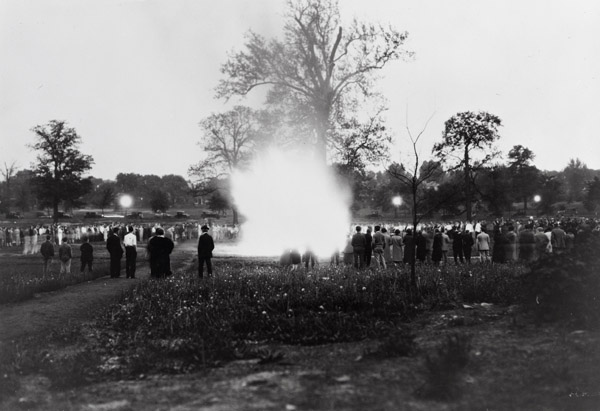
Freshman week cap burning, 1926

Freshman week cap burning, 1926

Thus, in June the freshman waged a two-day war on Bucket and Dipper. The “war” usually consisted on a tug-of-war across Mirror Lake—where the freshman consistently ended up in the lake. That night, students would gather for the Cap Bonfire, when some freshman opted to burn their beanies. (Many freshman did keep their beanies as a memento of their servitude.) Following the bonfire, many freshmen (again, ladies were excluded) went for a walk in their shirttails to cause a ruckus outside the home of then-OSU President William Oxley Thompson.

In 1926 Bucket and Dipper attempted to delay the burning; in the melee that followed, 103 freshman were thrown in the lake and the police were called. Ironically, it was a policeman that gave a freshman a concussion, not a trip into the lake. The following year, then-OSU President George Rightmire forbade Bucket and Dipper from dunking anyone, deserved or not. From then on, it seems the Bucket and Dipper initiates were the only ones to go swimming.

 As for the caps themselves, fashion in hats changed rather rapidly. Some prime examples from Ohio State include the “peanut-shaped skull cap,” “knitted toboggan” cap or “jockey-style” cap, or one with a “rolled brim topped with a scarlet button.”

Filed by C.N.

 To learn more about the tradition of freshmen beanies at OSU and other Big Ten universities, visit our web exhibit, “Beanies of the Big 10” at http://library.osu.edu/projects/beanies/.


Donor reveals the rest of the story for early OSU grads

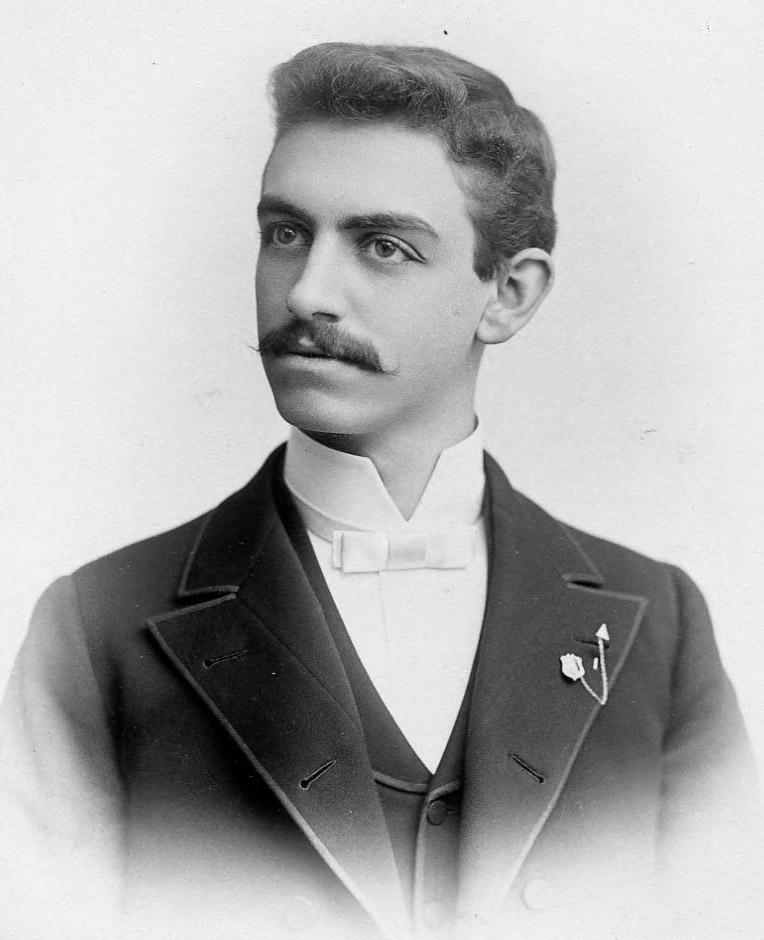
James Wilgus, 1888

James Wilgus, 1888

We recently had the chance to peek at the University’s early student life, thanks to Peggy Wymore, granddaughter of James Alva Wilgus, an early OSU graduate who also taught here briefly before leaving to study at Harvard. Wymore graciously donated a number of items from Wilgus’ time here as a student, including a class tie, some of his class essays, some memorabilia from student groups to which he belonged, and some of the exams he gave undergrads when he was teaching history here.

Our resources on individuals who attended OSU before 1900 are unfortunately slim – student directories, early Makios (which were more like literary magazines back then), and if the person became very famous or successful in his or her field, an obituary. So we never really know what happened to students from this era – what did they do after graduating? Where did they go? What were their lives like?

A tie that belonged to Wilgus

Wilgus’ tie, c1887-1888

Thanks to Peggy Wymore, we not only have mementoes of Wilgus’ time here, but she also was kind enough to fill in a lot of the details of his life after OSU – and that of his wife, Flavia, also an alum.

Wilgus was born on a farm near Conover, Ohio, in 1866. He attended a rural school and worked on his father’s farm until age 16 when he entered Ohio State in 1882 as a preparatory student, which meant, like many students coming to OSU at the time, he had to complete a number of prerequisites before becoming an official freshman. Such prerequisites included Latin, Algebra and Physics. He entered as a freshman in 1884, taking a wide range of classes like Latin, Botany, History and Physical Labor.

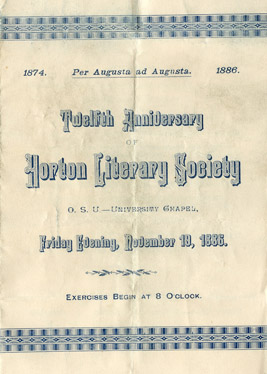
1886_horton_literary_society_front

Brochure for Horton Literary Society event, 1886

 Meanwhile, Flavia McGurer – the future Mrs. Wilgus – entered Ohio State as a Preparatory student in 1887. Her courseload included German, Trigonometry and Physical Geography. According to the 1889 Makio, the Columbus resident had entered OSU as a freshman and was listed as class historian of the Class of ’92. But she never graduated. That’s because she married Wilgus on Christmas Day in 1889, then traveled with him after he earned his master’s degree, to Harvard University where he was a Thayer Scholar from 1891-1892.  He was reappointed at Harvard for a second year, but his failing health prevented him from taking the appointment.

The traveling continued, however: The couple moved to Minnesota in 1894 where Wilgus was hired at the State Normal School in St. Cloud to finish out the term starting in January of that year. In September, OSU President William H. Scott asked Wilgus to do a small amount of teaching in history, and Wilgus returned to Columbus to serve as assistant of History from 1894-95. On January 3, 1895, Wilgus received a telegram from James Chalmers, professor of the Platteville (Wisconsin) Normal School, asking him to “accept the history professorship” there. (The name later changed to the Wisconsin State Teachers’ College – Platteville.)

Wilgus accepted, and the couple moved to Wisconsin, where he spent the rest of his career at the State Teachers’ College as a professor of History and Social Sciences. He taught there until his retirement June 6, 1939. He died in Platteville shortly after that – July 24, 1939.

Flavia McGurer Wilgus, 1888

Flavia McGurer Wilgus, 1888

Upon moving to Platteville in 1895, “Mrs. Wilgus at once identified herself with the Platteville Normal. The Wilgus home became a place where students as well as faculty members spent many happy hours. As the years passed, the family circle became larger. Curtis came, then Dorothea, and finally Wallace . . .  Mrs. Wilgus continued to live in her beautiful, helpful way.” (from the June 23, 1926, issue of The Exponent,” the Platteville State Teachers’ College newspaper).

Flavia also was involved in many activities and societies at her church; she was a member of the Eastern Star as well as other women’s clubs and civic societies. In 1903 she even had a small mail-order business. During World War I she contributed monthly to “The Fatherless Children of France.”

According to Wymore, Flavia was a loving mother, devoted to her children and active in their lives – their studies, play, training, and even in making  many of their clothes: In Dorothea’s letters to home from the University of Wisconsin, she would draw a picture of what she wanted in an outfit, and Flavia would sew it up for her.

On June 21, 1926, 31 years after she and her husband moved to Platteville, Flavia died suddenly and unexpectedly after complications set in from an emergency operation.  In her obituary it stated, “Mrs. Wilgus was a beautiful life. Forgetful of self, . . . writing upon every page of the book of her life . . . All who approached her were received with that simple grace that bespoke the true woman. . .”


We’d like to thank Peggy Wymore most sincerely for not only preserving such important tokens of her grandparents’ lives, but for sharing some of them with us, as well as her grandparents’ stories. Thank you, Peggy!


Horton Literary Society, back of brochure, 1886

Horton Literary Society, back of brochure, 1886

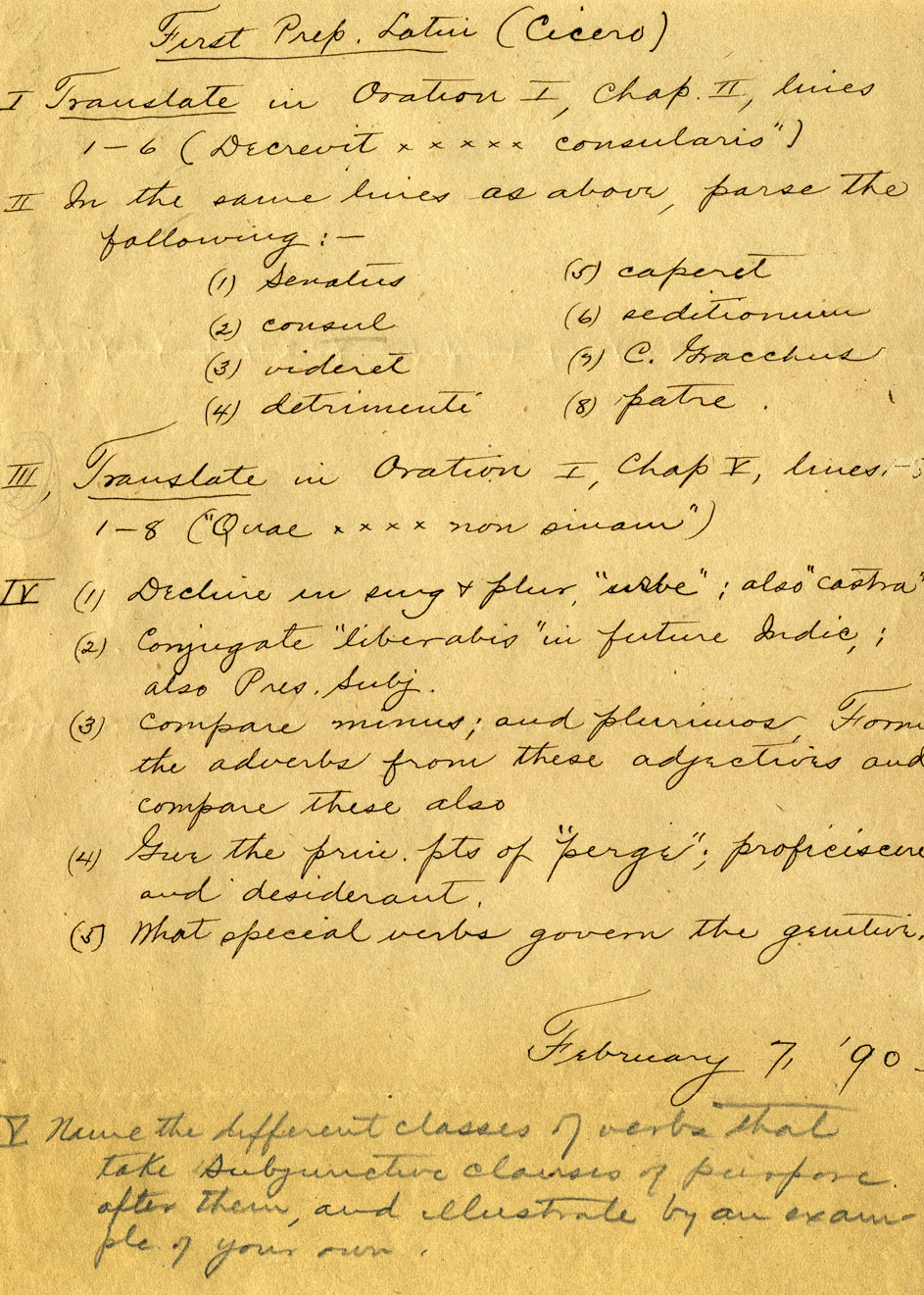
Exam questions from Wilgus' Roman History Class at OSU, 1888

Exam questions from Wilgus’ Roman History Class at OSU, 1888


Bleeds Scarlet and Gray: Athletics Director Larkins hired without applying for job

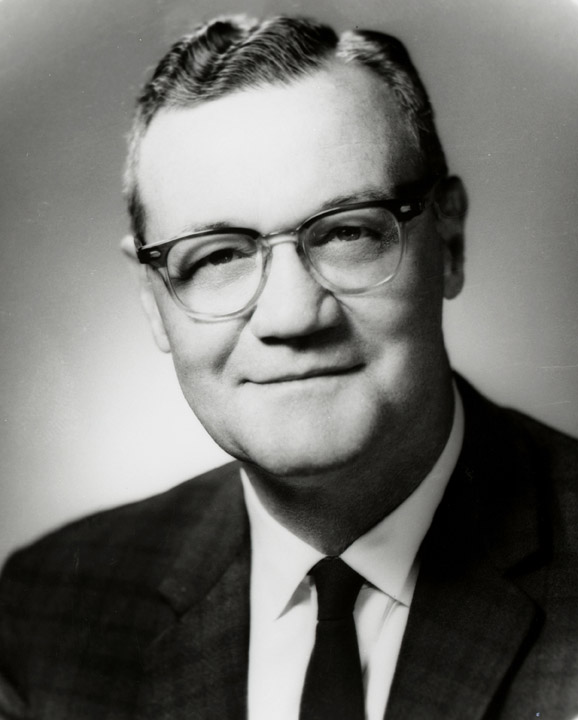
Richard Larkins, 1930

Richard Larkins, 1930

Before the imposing RPAC was the place to work out, there was Larkins Hall. It was much smaller, and by the time it was torn down in 2005, a lot worse for wear. But it had long served the OSU community, much as its namesake, Richard C. Larkins, did, as athletics director for nearly a quarter-century.

Larkins was associated with the University since he came to OSU as a student in the late 1920s. As a student, Dick Larkins played both on the varsity football team and the varsity basketball team, lettering in football from 1928-1930 and in basketball from 1929-1931. He displayed both leadership and smarts from the beginning: He was captain of the basketball team and class president, and he won the Western Conference Medal for scholastic achievement his senior year. Larkins was also a member of the junior honorary, Bucket & Dipper, and the senior honorary, Sphinx.

After earning a bachelor of science degree in Business Administration in 1931, Larkins coached the freshman football team while he worked on his MBA, which he received in 1935. Later that year he left OSU to serve as head coach for the University of Rochester football team.

Larkins, 1966

Larkins, 1966

In 1937 Dick Larkins returned to his alma mater to teach physical education. When the position of Director of Athletics became vacant in 1947, Larkins never actually applied for the job. However, when members of the Athletic Board sat down to discuss possible candidates, Larkins was the only one who had the support of the coaching staff, the physical education department, and retiring Athletic Director Lynn St. John, according to an Alumni Monthly profile.

Larkins’ term as Director of Athletics included the hiring of three head football coaches – the last was Woody Hayes. But his influence on OSU athletics was much broader: Under his leadership, the program expanded to 18 sports, and he oversaw the construction of St. John Arena, French Field House and the adjacent ice rink, as well as an extensive renovation of Ohio Stadium.

In 1976, the Board of Trustees named the recreational facility after Larkins, who had retired in 1970 after 24 years as athletics director. Larkins died April 5, 1977, at the age of 67.

Larkins Hall, 1977

Larkins Hall, 1977

Older posts Newer posts