From Woody's Couch

Our Playbook on OSU History

Category: Student organizations (page 3 of 10)

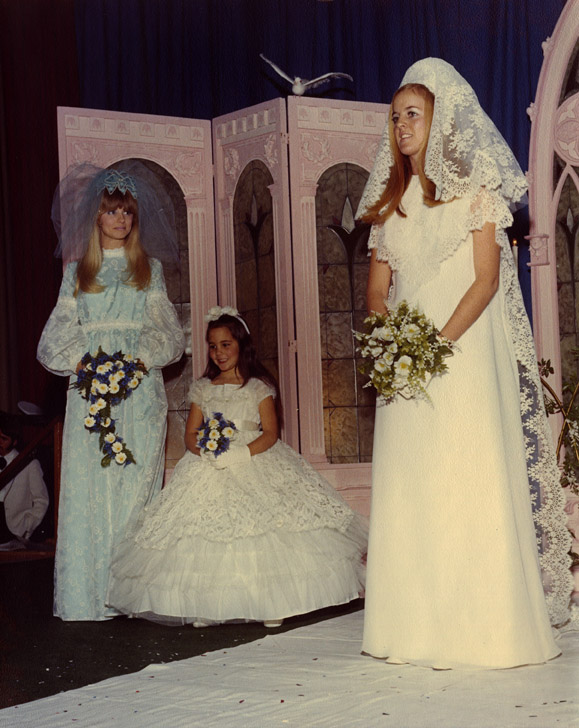
For nearly a decade, OSU women said “I do” to Bridal Fairs

Women pose at the Ohio State University Bridal Fair, 1970s

Women pose at the Ohio State University Bridal Fair, 1970s

These days, couples who don’t have the energy to leave home can scour the Internet and cable TV for ideas on what to wear, eat and even dance at their weddings. Years ago, though, the only way to find out which fashions were in style and what kind of luggage to buy for the honeymoon were at bridal fairs. In the early 1960s, the events were popular on a number of college campuses; OSU held its first fair in 1966.

Sponsored by the Women’s Self Government Association and Bride and Home Magazine, hundreds of mostly hopeful co-eds attended the annual event, held at the Ohio Union. The fairs included displays of silver, china, crystal, linen, flowers, jewelry, cosmetics, men’s clothing, luggage, housewares, photography, gifts, and furniture. There were also usually two fashion shows held where OSU students would model different dresses and tuxedos, ranging from semi-formal to ultra-formal.  Each fair welcomed its attendees with a shopping bag filled with pamphlets regarding the merchants and displays as well as door prizes including a raffle for a honeymoon in New York City.

Crowd at bridal fair, 1972

Crowd at bridal fair, 1972

Each year brought a new theme for the Bridal Fairs, such as “April Showers Bring Wedding Flowers,” “Rings and Romance,” “White Lace and Promises,” and “We’ve Only Just Begun.” (Clearly, lyrics from songs by The Carpenters were helpful in creating these themes.) At the first fair, 650 students showed up, while 1,000 attended the following year. Attendance had hit 2,000 by 1969.

The fashions were always au courant: in 1970, for instance, the “in” look for bridesmaids were pastel culottes (garments that appear like skirts but are actually pants), with the brides wearing matching shades. And the events were definitely geared toward women – one male student who stopped by the Union to see what all the commotion was about told The Lantern he was mortified by all the fuss, and claimed that he decided that marriage was an expensive proposition.

Couple at bridal fair, 1973

Couple at bridal fair, 1973

But the organizers also appeared to ignore the then-widespread feminist movement:  A “mistress” urged girls at the fair to “be as feminine as they can if they want a husband.”  By 1971, though, protests over the event had started to occur. While nearly 4,500 attendants were expected that year, OSU’s Women’s Liberation group handed out pamphlets outside of the fair claiming it was “a tradition that should be dropped,” according to The Lantern. In 1972, more protests ensued, this time involving the Gay Activists Alliance as well as Women’s Liberation. Three women, dressed as a man, a bride and a house wife pushed a cake covered in Monopoly money through the fair.

The Bridal Fair tried to be more progressive, however, by inviting adoption agencies, counseling services, and Planned Parenthood to the events. By 1973, the fair also added a discussion panel about alternative lifestyles. But by 1974, the fair had been dropped. A representative of the Women’s Self Government Association told The Lantern in December 1973 that no event would be held the following spring because attendance had dwindled considerably from 1972, and it was becoming a hassle for WSGA to co-host the event.

– Filed by B.T.

“Wedded Husband” married Chinese culture with English language at OSU

Hong Shen, 1919

Hong Shen, 1919

Nearly 100 years ago, a young man from China studying ceramic engineering at OSU wrote a play in English that was performed in University Hall. It was likely the first-ever English-language play written by a Chinese national to be performed in the U.S.

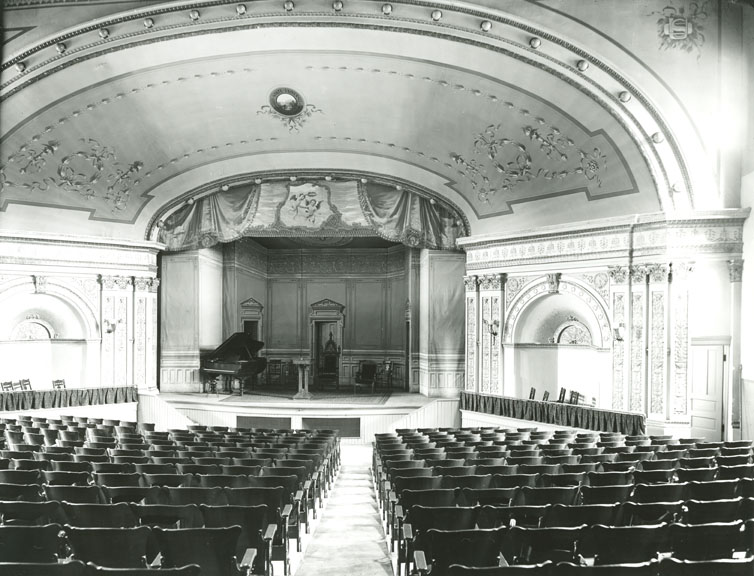
The young man’s name was Hong Shen, the play was called “The Wedded Husband” and it was performed in University Hall Chapel on April 11 and 12 in 1919 before a capacity audience of 1,300.


Shen was studying at OSU on a scholarship paid by the Chinese government. It was his first play written in English; previous works – “Fruit Vendor” and “Which Is It?” had been performed at his alma mater, Tsing Hua College in Beijing.


University Hall Chapel, c1900

University Hall Chapel, c1900

The play was co-sponsored by OSU’s Cosmopolitan Club and the Chinese Students’ Clubs of OSU and Oberlin College, and all of the men’s parts were performed by Chinese students who, like Shen, had been sent to the U.S. by the Chinese government under the provisions of the Boxer indemnity fund.


According to a Lantern article, Shen received a telegram from professors at Goucher College and the Columbia School of Fine Arts to reserve tickets for them. (They were going to be in Columbus for a meeting of the Methodist Centenary Movement.)


The play is about a young woman, Miss Wang, who is arranged to be married to a gentleman named Master Chen. She agrees to the marriage out of filial devotion to her father but during the ceremony, she falls ill. The doctor suspects she is a victim of the plague that is ravaging the city and orders her to be quarantined. Master Chen, however, defies the order to care for his wife. He ends up dying of the plague, while Miss Wang recovers. She is then arranged to be married to Master Yang, but when she hears of how Master Chen risked his life for her, she changes her mind and remains a loyal widow.


Last November, OSU’s Institute for Chinese Studies put on a revival of the play in the Roy Bowen Theatre, in the Drake Union. It was part of a series of events honoring Shen, who left OSU in 1919 to study dramatic arts at Harvard before returning to China where he eventually became an important figure in modern Chinese theater, film and drama. His daughter recently donated a collection of his works to the University.

Without the name, would Buckeyes be so nutty about OSU?

Cluster of buckeyes, ndWhy is our University mascot a poisonous nut? It starts with the nickname for Ohioans in general, obviously:

In the late 1700s, the first court in the then-Northwest Territory was opened near Marietta by Colonel Ebenezer Sproat. A tall man, usually dressed in military uniform and carrying a sword, he apparently impressed the local Native Americans so much that they started calling him “Hetuch,” which translates to “eye of the buck” or “Big Buckeye.” Buckeyes were also associated with Ohio since the first migration to the state, since the trees’ soft wood made it easier for early pioneers to clear land for farming, and fashion such items as bowls and walking sticks.

When William Henry Harrison, a former U.S. Senator of Ohio, was running for President, his campaign featured walking sticks and other carved pieces made of Buckeye wood. Even before the campaign, some members of Congress apparently referred to him as a “Buckeye” as a sign of affection.

Brutus Buckeye, 1965

Brutus Buckeye, 1965

By 1930, there was debate over whether the “Buckeye” should be the University mascot. That year, members of the Student Senate debated over the choice: Edwin Schoenleb of Marysville, stated, “the name ‘Buckeye’ does not indicate aggressiveness.” Alternative choices included sheep, goats, lions, tigers and bears. Ultimately, however Senate members decided on the poisonous nut; it is distinctive, they argued.

In 1950 famous cartoonist and alumnus Milt Caniff drew several designs to be used by the Department of Athletics for logos and uniform details featuring buckeyes and buckeye leaves. Ohio State finally got an actual “Buckeye” mascot when Ray Bourhis and Sally Lanyon created the now-ubiquitous Brutus Buckeye, who made his first appearance at a football game on October 30, 1965.

 Filed by C.N.

Older posts Newer posts