From Woody's Couch

Our Playbook on OSU History

Category: Sports (page 6 of 13)

Bleeds Scarlet and Gray: Athletics Director Larkins hired without applying for job

Richard Larkins, 1930

Richard Larkins, 1930

Before the imposing RPAC was the place to work out, there was Larkins Hall. It was much smaller, and by the time it was torn down in 2005, a lot worse for wear. But it had long served the OSU community, much as its namesake, Richard C. Larkins, did, as athletics director for nearly a quarter-century.

Larkins was associated with the University since he came to OSU as a student in the late 1920s. As a student, Dick Larkins played both on the varsity football team and the varsity basketball team, lettering in football from 1928-1930 and in basketball from 1929-1931. He displayed both leadership and smarts from the beginning: He was captain of the basketball team and class president, and he won the Western Conference Medal for scholastic achievement his senior year. Larkins was also a member of the junior honorary, Bucket & Dipper, and the senior honorary, Sphinx.

After earning a bachelor of science degree in Business Administration in 1931, Larkins coached the freshman football team while he worked on his MBA, which he received in 1935. Later that year he left OSU to serve as head coach for the University of Rochester football team.
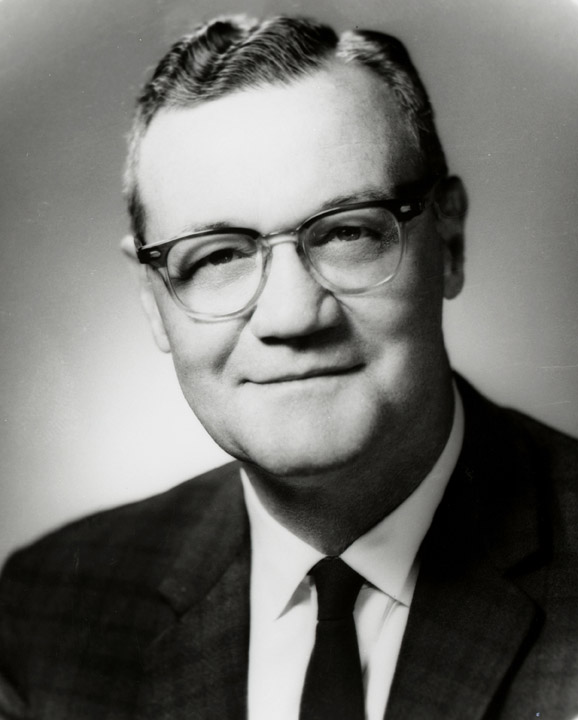
Larkins, 1966

Larkins, 1966

In 1937 Dick Larkins returned to his alma mater to teach physical education. When the position of Director of Athletics became vacant in 1947, Larkins never actually applied for the job. However, when members of the Athletic Board sat down to discuss possible candidates, Larkins was the only one who had the support of the coaching staff, the physical education department, and retiring Athletic Director Lynn St. John, according to an Alumni Monthly profile.

Larkins’ term as Director of Athletics included the hiring of three head football coaches – the last was Woody Hayes. But his influence on OSU athletics was much broader: Under his leadership, the program expanded to 18 sports, and he oversaw the construction of St. John Arena, French Field House and the adjacent ice rink, as well as an extensive renovation of Ohio Stadium.

In 1976, the Board of Trustees named the recreational facility after Larkins, who had retired in 1970 after 24 years as athletics director. Larkins died April 5, 1977, at the age of 67.

Larkins Hall, 1977

Larkins Hall, 1977

When being close really does count: hand-grenade tossing included in track meets

Hand grenade throwing diagram, 1918

Hand grenade throwing diagram, 1918

In an old Department of Athletics collection, we recently found a folder simply entitled “hand grenades.” It contained correspondence and diagrams from 1918 related to a proposed hand-grenade tossing event for track meets. Kind of like the shotput event, only with more damaging consequences.

In early spring 1918, the United States had been fighting in World War I for nearly a year, and the war effort at home was going strong. Here at OSU, the campus was home to a barracks, machine-gun range, and a small hospital. A school for military aeronautics was open for one year (1917-1918), an aviation laboratory opened, and an airplane landing field was installed.

So, naturally, someone came up with the idea of including a hand-grenade tossing competition at track events to prepare student cadets once they hit the front lines in France. The Lantern first reported about it in March 1918:

“The war spirit seems to have affected the athletic department, and the kaiser better keep his eye on Ohio State athletes when they get to France. Yesterday Director [Lynn] St. John brought to the Athletic House a box of hand grenades which will be used by the weight men in practice and may become an established event. They are the regulation size used in war work.”

Charles Hubbard

Charles Hubbard

St. John later explained that the competition would be an individual event. There would be three targets of four feet square (the usual size of a trench). Each man would receive a number of grenades and would take up position in a “box” made out of wood but with mesh sides so the competitor could be seen by judges who (presumably) were sitting a safe distance away. He would be required to make a certain number of hits. Competitors would be judged on speed and form, as well as accuracy.

Track Coach Frank Castleman even visited Camp Sherman in April 1918 in order to receive “first-hand information on the art of bomb throwing, hence being prepared to coach his men in the new field event,” according  to The Lantern.

Later in April at its first track meet, against Ohio Wesleyan, the hand-grenade event went off without a hitch. In fact, Charles Hubbard of Ohio State set the best record, getting five of 10 grenades into the pen. The event continued to be included through the season; it was listed, in fact, among the events in that year’s Big Six Championship, which the Buckeyes won.

The war ended in November 1918, so the event’s inclusion in track meets remains a one-season-only affair.

Filed by C.N.

OSU first intercollegiate tournament ever for women golfers

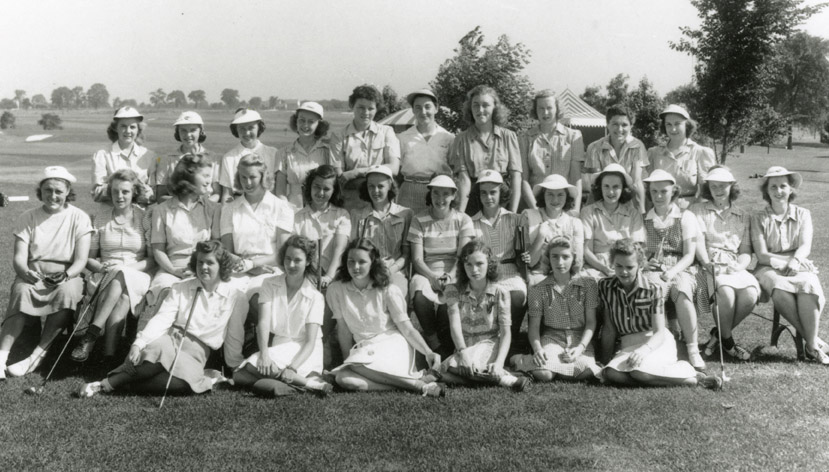
Women golfers, 1941

Women golfers, 1941

In 1941, the OSU Golf Course had just opened the year before, so eight faculty members of the women’s division of the Department of Physical Education decided to hold a tournament there. Few options for competitive games existed at the time for women, and in fact, the very idea of an intercollegiate tournament offended some: The National Association of Directors of Physical Education for College Women deemed national tournaments for women “inadvisable” and claimed that there were better ways to allow women to compete against each other than in such tournaments.

OSU officials pressed on, nonetheless, even though the national association had basically blackballed the tournament. In an unidentified article here at the Archives, former Physical Education Professor Mary Yost remembered waiting for the entries for a tournament that seemed to have so little support.

Mary Yost, 1942

Mary Yost, 1942

“We didn’t have much response for a long time, and we were wondering whether we really would have a tournament. I remember the deadline passed over the Memorial Day weekend,” said Yost, a 45-year faculty member. “I came in after that to get the mail, and we had a whole stack of entries. I cried because we really were going to have a tournament.”

The first tournament, which started on June 30, began with a banquet the evening before the start of play. Delbert Oberteuffer, then the chairman of the men’s division of OSU’s Department of Physical Education, stressed the tournament’s historical significance:

“You young ladies in college playing in this, the first tournament, are going to begin the building of a great tradition of sportsmanship for young women,” he said, in a transcript of his remarks here at the Archives.

The five-day competition also included a picnic at the clubhouse, a tea at the President’s House (then occupied by the Bevises), and a mixed swim at the men’s natatorium. “Escorts will be arranged for any girls who would like to go dancing,” an itinerary said.

Eleanor Dudley of the University of Alabama bested 25 other golfers to win the first championship. With the start of World War II, the tournament was cancelled, but was resumed in 1946. At the time, the individual entrance fee was $5, which included transportation fees to and from the course, and greens fees.

1941 Women's Golf Tournament Group

1941 Women’s Golf Tournament Group

Ohio State continued to host the Women’s Collegiate Golf Tournament until 1953, when it was taken over by the Association for Intercollegiate Athletics for Women (AIAW), at which point colleges and universities took turns hosting the tournament. Ohio State held the tournament in 1966 when it celebrated its 25th anniversary.

In 1981, the National Collegiate Athletic Association established a new program of women’s championships; the AIAW ended its sponsorship of the intercollegiate tournament at about that time.

Filed by C.N.

Older posts Newer posts