From Woody's Couch

Our Playbook on OSU History

Category: Professors (page 5 of 14)

Johnson devoted to rehabilitation for more than a half-century

Ernest W. Johnson, 1958

Ernest W. Johnson, 1958

Dr. Ernest Johnson has been in the business of physical rehabilitation for more than 60 years – since not long after he graduated from the College of Medicine in 1952. However, he’s been associated with the University since 1942 when he first arrived as a freshman at OSU.

Dr. Johnson, known as Ernie or ‘Dr. J’ to many, was drafted to serve in World War II shortly after he enrolled, but he returned to the university four years later, intending to study journalism. He was a voracious reader growing up, had worked for a newspaper since the age of 16 and had served as editor of his Akron high school’s newspaper. However, a conversation with his college roommate apparently changed his career drastically. Johnson said that his roommate told him, “You have four years of free education, why don’t you become a doctor?” So he did.

Johnson used his GI benefits to the utmost by taking 26 credit hours a quarter. He was also working in the cafeteria, where he met his wife, Joanne. He earned his undergraduate degree in 1948 (he and Joanne were married later that year) and his medical degree in 1952. He completed his residency, also at Ohio State, in 1957 and was named an assistant professor in the College of Medicine that year.

Dr. Johnson demonstrating a "wheelie", 1990

Dr. Johnson demonstrating a “wheelie”, 1990

His specialty was physical medicine and rehabilitation. He studied carpel tunnel syndrome, and along the way became a crusader for the rights of the disabled. He was named chairman of his department in 1963, a position he would hold for almost thirty years. In 1974 he led a group that organized a grant project to build Ohio State’s Creative Living Center, a living-learning facility for the physically disabled. It was the first of its kind in the Midwest, and inspired many other similar centers across the country. Johnson also organized the Ohio Wheelchair Athletic Association in 1970.

Both of these projects earned him much recognition, but the awards displayed in his office instead included those for “popping wheelies” (balancing a wheelchair on its back wheels and spinning in either direction). In fact, Johnson required that all of his students (including more than 160 residents) be able to pop a wheelie. He said it made them more aware of what their patients were going through. Under his guidance, the department of physical medicine and rehabilitation became the third-highest ranking program in the country.

– Filed by C.N.

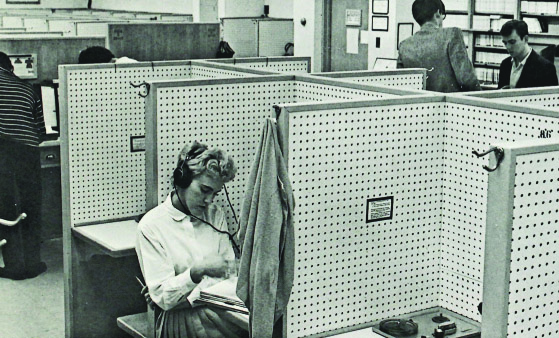
Languages, lectures or light operas – students could hear them all at the Listening Center

Student at the Listening Center, 1964

Student at the Listening Center, 1964

Back in the old days, students who wanted to learn a language or listen to music for class, had to go to one spot on campus – the Listening Center, located in the basement of Denney Hall. Created in 1960, the center held 150 booths with radio-style tuners. Students could tune into 11 “program channels” that were had the required listening assignments for various foreign language and music courses. Two years after its opening, roughly 5,000 language, speech and music students were using the facility each week, more than double the attendance of the year before.

In 1965 the Center premiered a dial-access phone system that allowed 40,000 calls a week to over 90 “channels” for homework and private study use. Other departments, including English, education and military science took advantage of the Center to teach students with recorded lectures and supplemental materials. At the time, students could dial in from an Instructional Material Center in Denney Hall, Cunz Hall, or the West Campus Learning Center.

Later that year, at a cost of $292,000, 118 new private listening booths were added in eight more locations on campus, including the Ohio Union, the Main Library and several dorms. In 1978, the University introduced an updated dial-access system that enabled students to dial directly into the Center from any telephone and listen to classroom assignments.

1963

1963

The Center’s first director was Prof. Paul Pimsleur, who transferred to OSU from the University of California at Los Angeles. Pimsleur was also a professor of Romance languages and taught applied linguistics, with an emphasis on language laboratories. In 1965, he was chosen as a Fulbright Professor of Applied Linguistics to teach at the then-new Speech Cybernetics Research Center at Heidelberg University in Germany. A frequent traveler to Europe, Pimsleur died on a visit to France in 1976.

– Filed by C.N.

Women’s History Month: 90 years ago, first woman appointed as Trustee

Alma Paterson, n.d.

Alma Paterson, n.d.

It was 90 years ago today that the first woman was named to Ohio State’s Board of Trustees. Alma W. Paterson was a member of Ohio State’s class of 1904; as an undergraduate, Paterson had been a member of the Browning Dramatic Society and studied science and physical education. She received her bachelor of arts degree in 1904 and went on to serve as an assistant director of physical education for women for three years. In 1910, she married Robert G. Paterson, a 1905 OSU graduate, who was then executive secretary of the Ohio Public Health Association. 

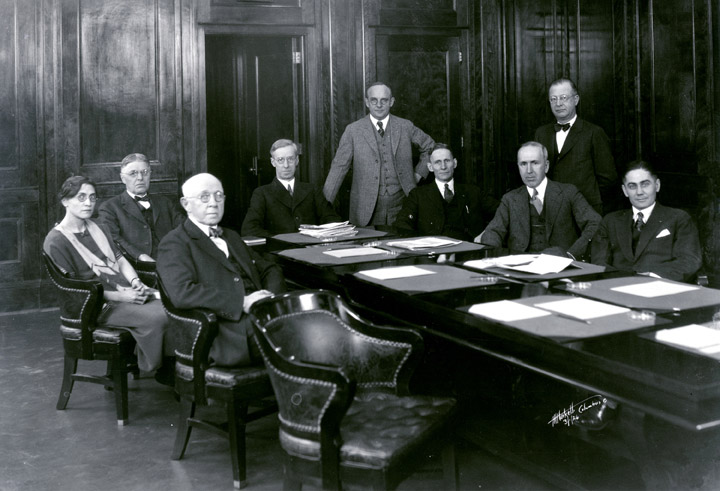
Alma Paterson was appointed to the Board on March 27, 1924, to succeed the late OSU Prof. Thomas Mendenhall. Then-Ohio Gov. A. Victor Donahey had already indicated that the next appointment to the board would be a woman since “the large number of women registered at the University warrants the selection,” according to a Lantern article about her appointment. Paterson was on the board until 1933, serving as vice chairman twice during that time.

1926 board of trustees at conference table, including Alma Wacker Paterson

Paterson with the Board of Trustees, 1926

In 1954, the Board of Trustees named Paterson Hall, then a brand-new dorm for women, after her.

Paterson’s daughter, Ann, followed in her mother’s footsteps, first as a student (BS in Education in 1937 and MS in Education in 1939) and then as a professor of women’s physical education. After 19 years of teaching at OSU, she left the University in 1956 to teach at San Francisco State College.

– Filed by C.N.

Older posts Newer posts