From Woody's Couch

Our Playbook on OSU History

Category: Professors (page 4 of 14)

Dead body + electricity = spooky experiment conducted by first faculty

T.C. Mendenhall, 1874

T.C. Mendenhall, 1874

Since it’s Halloween, we’d like to tell you about Thomas C. Mendenhall, the very first faculty member hired by the then-Ohio Agricultural and Mechanical College in 1873. He was a real Renaissance man when it came to the many and varied interests he pursued – including reanimation of corpses.

Though Mendenhall was a Physics professor, he also had a great interest in electricity (and other subjects, as you will read later). In 1872, while he was a teacher at Central High School – then known as Columbus High School – he decided to test a theory that a dead body could be brought back to life through electric shock. He received approval from the Ohio Penitentiary to transfer the corpse of a recently hanged prisoner to Starling Medical College, located in downtown Columbus and one of the predecessors of Ohio State’s College of Medicine. So, on October 4, 1872, Mendenhall tried, by use of electric shocks, to reanimate the corpse of John Barclay—a man who was hanged for murder that same day.

Starling Medical College

Starling Medical College

According to a history of the Columbus High School, the experiment was performed in front of the judges of the State Supreme Court and other witnesses, including a reporter for the Police Gazette. “In so far as anyone knew,” the history said, “the Judges might have to pass upon the uncanny question of Barclay’s legal status as a living person who had already suffered the death penalty. However, they were spared that embarrassing situation” since the experiment obviously did not succeed.

It was just one of many ways in which Thomas Mendenhall went about satisfying his curiosity on a wide variety of subjects.

In addition to his interest in electricity, Mendenhall dabbled in English literature as well. In 1887, Mendenhall conducted a study on stylometry, the analysis of word length in an author’s work, and particularly pinpointed William Shakespeare in his study. With the help of some diligent counters, Mendenhall counted and classified 400,000 of Shakespeare’s words, most consisting from his famous plays. Mendenhall published his stylometric graphs in The Popular Science Monthly in 1901. They compared Shakespeare’s average word length with other contemporary authors, such as Ben Jonson, Francis Bacon and Christopher Marlowe. Mendenhall’s graph visibly showed that Shakespeare and Marlowe had nearly the exact same word length frequency; Mendenhall concluded that Marlowe’s and Shakespeare’s work were written by the same author.

Overall, Mendenhall had a long and full life. After teaching for five years at Ohio State, Mendenhall, then 36, traveled to teach physics at the Imperial University in Tokyo. In 1881, Mendenhall returned as professor of physics at Ohio State and also became director of the Ohio Meteorological Bureau. By 1884, however, Mendenhall was back at to working with electricity at the U.S. Signal Service in Washington D.C. and then was elected president of Rose Polytechnic Institute in Indiana in 1887. Then in 1889, he was appointed superintendent of the Coast and Geodetic Survey by President Benjamin Harrison, where a few years later a glacier would be named after him. Ohio State named him Professor Emeritus in 1900, and became a board member in 1919. Mendenhall died in 1924, at the age of 82.
Famed OSU botanist left behind captivating photos and career

The Archives recently received a small donation of material that belonged to a former OSU professor who was regarded as “one of the greatest botanists of his day.”

John Henry Schaffner came to the University in 1897 as an assistant in Botany, and served as head of the Department of Botany from 1908 to 1918. Later in his career, he went on to make a radical discovery in in the field of Botany that brought admiration from scientists worldwide. But more about that in a bit.

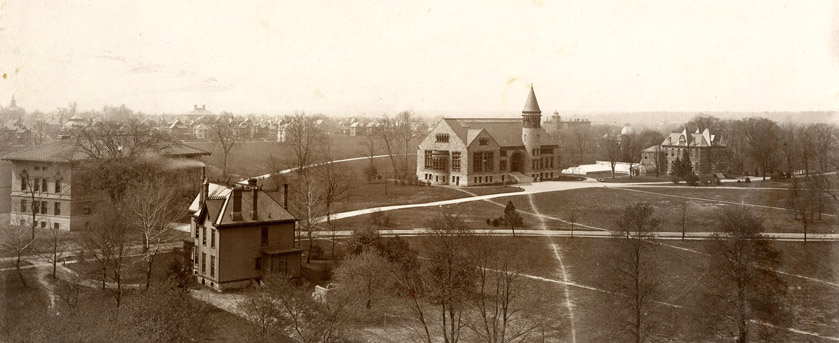
Early on in Schaffner’s tenure at OSU, he took the following photographs, which depict a very different view of campus.

Oval from Armory, 1899

This first photograph was taken from the top of the Armory in 1899. (The Armory was situated at the site where the Wexner Center sits today.) What we now think of the Oval did not quite exist yet, and as you can see, a house sat at the east end. In 1902, the house was moved to the north edge of today’s Mershon Auditorium and became the home to OSU athletics. It was aptly named the “Athletic House.”

To the left of the house is Biological Hall, which was built in 1898 for the departments of Anatomy and Physiology, and Botany and Zoology. The Biology Building was torn down in 1923 to make way for the current Hagerty Hall building.

To the right is Orton Hall, and the old Botanical Hall, which is where Schaffner spent much of his time in teaching and research.

1899_campus_view_from_southeast1

John H. Schaffner, 1900

John H. Schaffner, 1900

This panorama photo shows a view of campus from the southeast end, looking northwest. You can see the back side of Orton Hall towards the right, as well as McMillin Observatory, which was situated on the southwest side of Mirror Lake.  The observatory, which opened in 1896, was torn down in 1976.

But, what are even more interesting than Schaffner’s photographs, are his background and research interests. Schaffner was widely known among scientists for his botanical discoveries, and as a prolific writer of books and scientific papers. He was also renowned for his help in overthrowing the thought that the sex of plants was hereditary.

Yes, you heard right.

An Alumni Monthly article from October 1928 noted that Schaffner’s most important discovery is that the sex of the plant may be changed:

“Professor Schaffner found that by controlling the conditions in which a plant developed he could change the entire sex of the plant. The further development of this discovery will lead to many radical changes in the treatment of plant life.”

Schaffner read his paper describing this discovery in 1926 at a convention of botanists in Ithaca, New York, and it was widely acclaimed by scientists in many countries.

Schaffner died on January 27, 1939.

(Special thanks to Bob Cody, Schaffner’s grandson, who donated the campus photographs to the University Archives.)

WWII hero Don Scott ‘brought great credit to his alma mater’

Don Scott, 1939

Don Scott, 1939

When World War II broke out, many OSU students immediately signed up to join in the fight, suspending their studies for a much greater cause. Probably none of them was more well-known than Don Scott, the archetypical Big Man on Campus.

And here’s why: After entering Ohio State in 1938, Scott participated in baseball, track, basketball, and most notably football. In addition to being on the Players’ All American team for football and the first Big 10 Championship for basketball, Scott was also elected to sophomore, junior and senior Honor Societies as well as being a member of the Phi Delta Theta fraternity.

Don Scott, 1941

Don Scott, 1941

After enlisting, by May 1941, Scott, along with other OSU athletes were stationed in Tulsa, Oklahoma, for Air Corps Training Detachment. By October, Scott had completed training and had advanced to get his wings and commission in the Army Air Corps. He was eventually promoted to a Captain.

Unfortunately, on October 1, 1943, at the age of 23, Scott was killed in a bomber crash over England. This marked the 100th alumnus or former student to give his life in World War II. One week after his death, on October 8, his wife gave birth to their child, Don Sands Scott.

Meanwhile, in the spring of 1942, the U.S. Navy leased Port Columbus to train its pilots. At the time, OSU was using Port Columbus for its own civilian pilot training program, and the Navy’s lease would pretty much have doomed OSU’s program to failure. However, OSU Prof. Karl W. Stinson, a lieutenant in the Air Corps of World War I and a professor in the Department of Mechanical Engineering went to then-OSU Pres. Howard Bevis with an idea: Build an OSU airport.

President Bevis and Carl Steeb, then-University Business Manager, considered the idea, liked it, and found $100,000 for the project. Stinson himself scouted the nearby then-countryside, and found a flat portion of land near what is now Sawmill Road. Ohio State purchased 385 acres (larger than Port Columbus), and set about building a hangar, runways and fences.

Don Scott Field, 1949

Don Scott Field, 1949

Soon after Scott’s death, President Bevis presented a resolution to the Board of Trustees that read, in part:

[Scott] was one of the nation’s great athletes; he was a sportsman in the finest sense of that term; he was a thorough gentleman, beloved by all who knew him; his life brought great credit to his alma mater. … As a fitting commemoration … I desire to propose to this Board that the airfield now owned and operated by the University be designated ‘Don Scott Field.’

The board approved the resolution and the newly named Don Scott Field was used by the Navy until the end of the war, when OSU transferred its focus to a civilian aviation curriculum.

– Filed by B.T.

Older posts Newer posts