From Woody's Couch

Our Playbook on OSU History

Category: Women (page 6 of 8)

Women students dig for gold at annual role-reversal dance

A couple at the Gold Diggers dance, 1949

A couple at the Gold Diggers dance, 1949

While the name is a bit misleading, the Gold Diggers’ Prom is yet another long-gone campus tradition. Beginning in the late 1930s, a dance was held once a year where the ladies and gents essentially reversed roles: The young woman would ask a young man to accompany her to the event, and she would pay for everything, from tickets to corsages.

The night of the dance, she would pick him up– with whatever means of conveyance was feasible – at his dorm, fraternity, or wherever he lived. At the dance, the Queen would crown a King, who would preside over the dance in place of the Queen.

For many years, the contest to be Gold Diggers’ Prom king in the spring was almost as intense as the one held in the fall for Homecoming Queen. According to a 1938 issue of The Lantern, “competition is mounting to a fever pitch as more and more candidates enter the race for King of the Gold Diggers’ Prom. The male of the species is walking around campus these days with a supercilious grin, gloating that ‘at long last’ he is coming into his own.”

Dale Denny, the Gold Digger King of 1958

Dale Denny, the Gold Digger King of 1958

Meanwhile, there was always good-natured teasing and shenanigans attached to the dance: Girls would bring their boyfriends corsages of carrots and beets instead of flowers. A carriage may await the boyfriend instead of an automobile. Boyfriends would make their dates wait, in memory of all the times they spent waiting on the young ladies.

The term ‘gold digger’ originally meant men who went out to California to join the gold rush in the 1840s. Its current meaning was coined in 1915, but did not gain popularity until the 1930s (the time of the dance) when many young women had to support themselves because of the Great Depression; thus, theoretically, they would go looking for rich husbands.

As with many social mores, women’s expectations for marriage and financial security began to change after World War II, and the dance eventually was finally dropped in the 1960s.

The crowning of the Gold Digger King, 1952

The crowning of the Gold Digger King, 1952

On its 100th birthday, we celebrate Thompson Library’s humble beginnings

Olive Jones, 1900

Olive Jones, 1900

It’s hard to imagine what the Oval would be like without Thompson Library towering over its west end, but if the University’s first full-time librarian had had her way, the campus’ main library would have been located away from its apex, near where the Faculty Club now stands. Fortunately, former OSU President James Canfield convinced her otherwise:


 “I was much interested in what Mr. Reeder told me of the proposed library building and in what you write about it: but you must not let it go off campus,” he wrote in a 1908 letter to Olive Branch Jones when he was Librarian of Columbia University. During his 1895-1899 tenure as OSU President, he had proposed putting the library in its current position, since it would be the heart of the University and deserved a central location. 


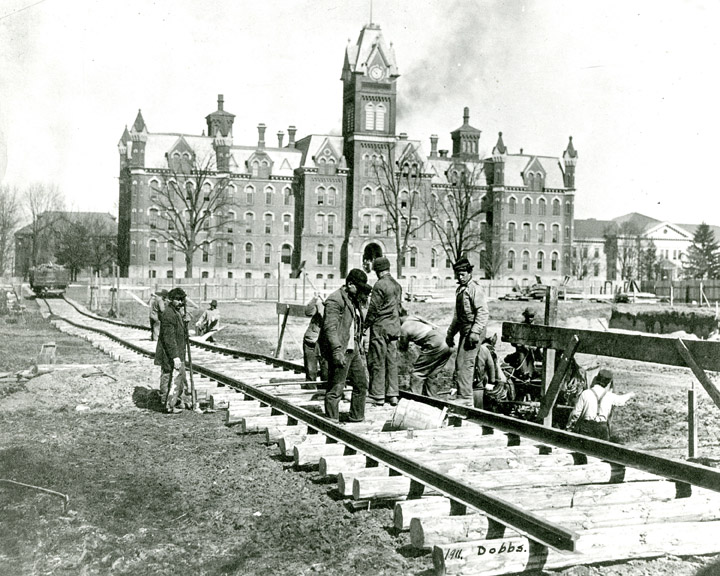
Main Library construction, 1911

Main Library construction, 1911

 The Board of Trustees agreed with him, and in 1913 what was then known as the “New Library” opened. It cost $314,515 to build. To get the heavy stone and other construction materials to the site, the construction company used a railroad spur, which had been built in 1909 from the Hocking Valley Railway to the University’s power plant. It was used to transport coal and other materials to the power plant, first at Brown Hall and later at the McCracken Power Plant. It ran down the middle of what is now Woody Hayes Drive from Olentangy River Road.


 (Today, a median filled with flower beds occupies the space taken by the tracks, which also were used to transport passenger cars for football games, particularly OSU vs. Michigan. The last vestiges of the railroad disappeared in 1970 when the power plant transitioned to natural gas from coal, and the spur was removed as part of the 315 highway construction project, which had originally been the path of the main railroad.)


Library, 1915

Library, 1915

 Before the “New Library” opened – on Jan. 6, 1913 – an ambulance from the Department of Animal Husbandry was used to move about 100,000 books to Thompson from Orton Library, which served up until that point as the main library. When it opened, the library had only three floors, two elevators, and no electric lighting. It was officially named the William Oxley Thompson Memorial Library, in honor of the fifth president of the university, in 1951, when its 11-story stacks were built. The Thompson Library now contains roughly 6 million volumes.


Filed by C.N.

OSU first intercollegiate tournament ever for women golfers

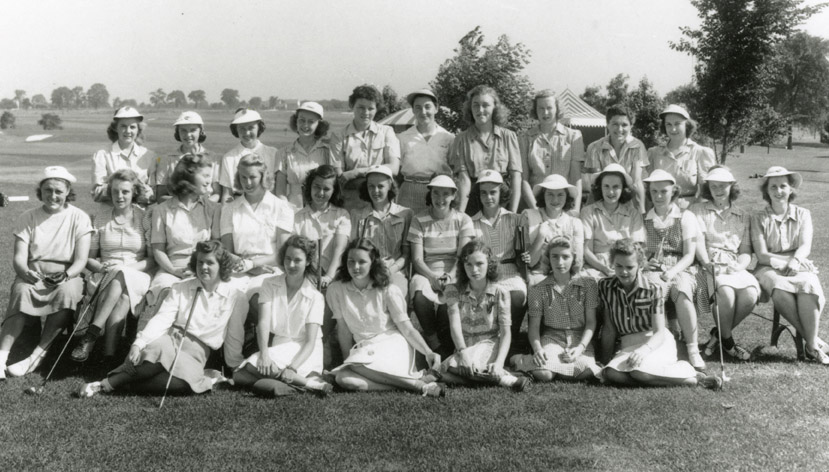
Women golfers, 1941

Women golfers, 1941

In 1941, the OSU Golf Course had just opened the year before, so eight faculty members of the women’s division of the Department of Physical Education decided to hold a tournament there. Few options for competitive games existed at the time for women, and in fact, the very idea of an intercollegiate tournament offended some: The National Association of Directors of Physical Education for College Women deemed national tournaments for women “inadvisable” and claimed that there were better ways to allow women to compete against each other than in such tournaments.

OSU officials pressed on, nonetheless, even though the national association had basically blackballed the tournament. In an unidentified article here at the Archives, former Physical Education Professor Mary Yost remembered waiting for the entries for a tournament that seemed to have so little support.

Mary Yost, 1942

Mary Yost, 1942

“We didn’t have much response for a long time, and we were wondering whether we really would have a tournament. I remember the deadline passed over the Memorial Day weekend,” said Yost, a 45-year faculty member. “I came in after that to get the mail, and we had a whole stack of entries. I cried because we really were going to have a tournament.”

The first tournament, which started on June 30, began with a banquet the evening before the start of play. Delbert Oberteuffer, then the chairman of the men’s division of OSU’s Department of Physical Education, stressed the tournament’s historical significance:

“You young ladies in college playing in this, the first tournament, are going to begin the building of a great tradition of sportsmanship for young women,” he said, in a transcript of his remarks here at the Archives.

The five-day competition also included a picnic at the clubhouse, a tea at the President’s House (then occupied by the Bevises), and a mixed swim at the men’s natatorium. “Escorts will be arranged for any girls who would like to go dancing,” an itinerary said.

Eleanor Dudley of the University of Alabama bested 25 other golfers to win the first championship. With the start of World War II, the tournament was cancelled, but was resumed in 1946. At the time, the individual entrance fee was $5, which included transportation fees to and from the course, and greens fees.

1941 Women's Golf Tournament Group

1941 Women’s Golf Tournament Group

Ohio State continued to host the Women’s Collegiate Golf Tournament until 1953, when it was taken over by the Association for Intercollegiate Athletics for Women (AIAW), at which point colleges and universities took turns hosting the tournament. Ohio State held the tournament in 1966 when it celebrated its 25th anniversary.

In 1981, the National Collegiate Athletic Association established a new program of women’s championships; the AIAW ended its sponsorship of the intercollegiate tournament at about that time.

Filed by C.N.

Older posts Newer posts