From Woody's Couch

Our Playbook on OSU History

Category: Women (page 5 of 8)

Twelve Days: Newton put School of Nursing on the map

Mildred Newton, 1960

Mildred Newton, 1960

Mildred Emily Newton was born on July 3, 1901 in Cedar Fall, Iowa. After receiving degrees in nursing and education from Northwestern, USC and Stanford, Mildred Newton came to Ohio State as director of the School of Nursing in 1951, a position she held until her retirement in 1968. She was credited for making the nursing program at Ohio State what it is today.

Under her supervision the program gained national accreditation, expanded its baccalaureate program and started a graduate program and a program in nursing research. Besides her academic achievements, Ms. Newton was in demand nationally as a volunteer. She worked closely with the Kellogg Foundation, the National League of Nursing as well as working for the U.S. Department of Defense.
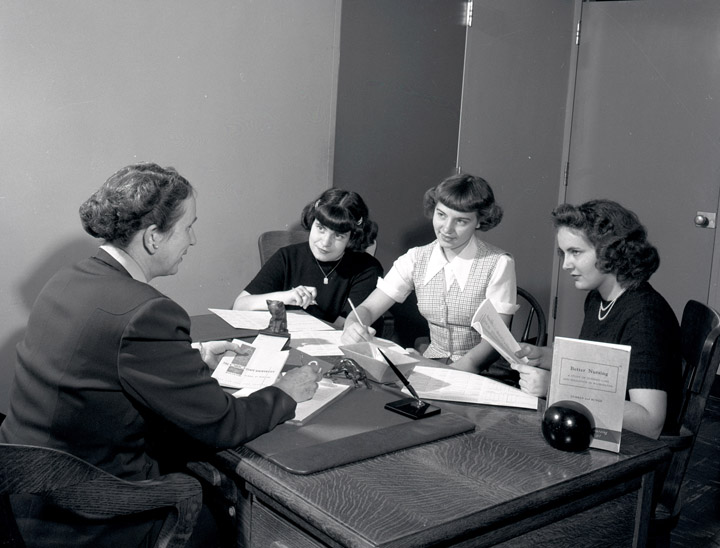
Newton meets with student nurses, 1951

Newton meets with student nurses, 1951

Throughout it all, she continued to teach. One of her passions was the history of the profession, particularly the life of Florence Nightingale, and she conveyed that to generations of students. She also was an avid collector of stamps related to medicine and nursing, and she donated her collection to the Health Center Library shortly before her death. She organized it into four volumes that depict the history of the Red Cross, the history of medicine and nursing, world attempts to eliminate diseases, and individuals’ contributions to health.

Newton Hall, 1983

Newton Hall, 1983

Recognition for her work came in the form of the National League of Nursing’s Adelaide Nutting Award in 1969 and one of Ohio State’s 1970 Centennial Achievement Awards. She was also given emeritus status upon her retirement in 1968.

Her personal legacy was that of a caring mentor who always had an open door and a sense of humor. She was also an advocate of patient rights. In a Nov. 11, 1958 article in The Lantern she identified the following as particularly critical to the nurse-patient relationship: “The patient’s welfare must always come first. Nothing a patient needs to have done is beneath the dignity of a doctor or nurse to perform.” She passed away on July 25, 1972. The School of Nursing’s building was renamed “Mildred E. Newton Hall” in her honor.

Orange and black as school colors? No thanks, we’ll take Scarlet and Gray

Curtis Howard, 1878

Curtis Howard, 1878

When the very first senior class started planning for its commencement in the spring of 1878, members decided the first diplomas issued by The Ohio State University (the Board of Trustees had just changed the name from the original Ohio Agricultural and Mechanical College) should look festive. So the class decided to tie around the diplomas ribbons that featured the school colors.

Being a young university, however, no school colors had yet been chosen. So the senior class appointed a committee of three to choose them: Curtis Howard, who graduated that year, Harwood Poole, who graduated in 1881, and Alice Townshend, an 1880 graduate.

According to a later account by Townshend, the three students went to various dry good stores in the area to sample colors and ended up choosing orange and black. They later learned, however, that these were already the colors of Princeton University.

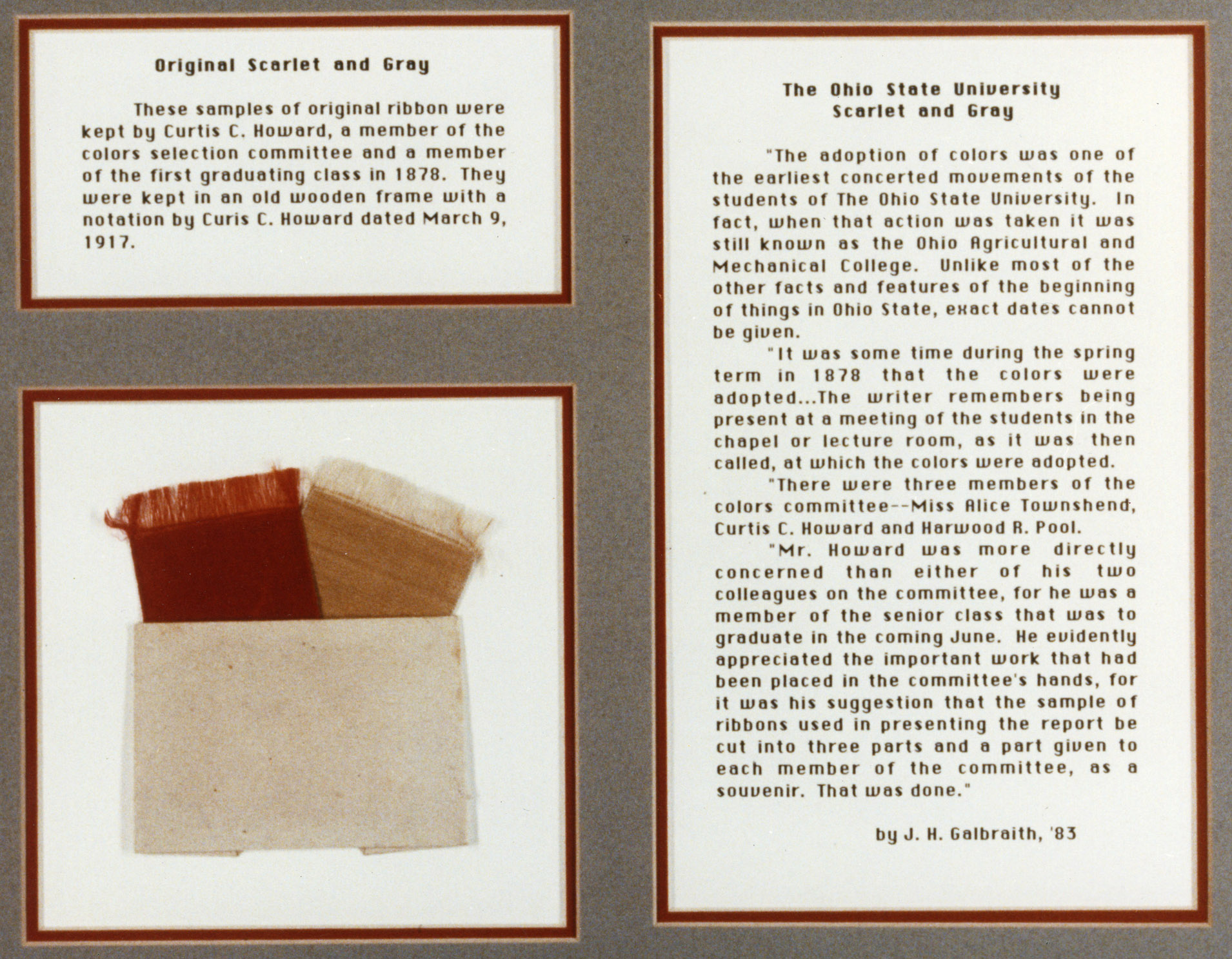
Howard's original ribbons

Howard’s original ribbons

So they tried again and selected scarlet and gray – for no reason other than they liked the two colors together and to their knowledge, no other university or college had them as school colors. After the colors were selected, the original ribbons were cut into three pieces and given to each committee member as souvenirs.

Flash forward to 1917 when Howard is going through his personal effects and finds his souvenir ribbons. (Poole had died by then and Townshend had not kept hers.) Howard wrote to his friend, John Galbraith, that the ribbons were still “wrapped in a paper filter as I had placed the away 39 years ago. These have been in the dark and I am certain have not faded…” He donated them to the university, and according to a 1920 alumni magazine article, they were mounted in a mahogany frame and hung in Sullivant Hall.

John Kleberg poses with the scarlet and gray ribbons, 1989

John Kleberg poses with the scarlet and gray ribbons, 1989

Sometime after that, they disappeared.

Flash forward again to 1989: John Kleberg, then assistant vice president for business and administration, receives a visitor at his office who claims to represent an individual who acquired the ribbons from the resolution of an estate and wishes to remain anonymous. The ribbons were wrapped in porous paper and framed. On the back of the frame was the letter Howard had written to Galbraith.

For a time, Kleberg hung them in his office, but being the good steward of history that he has proven himself to be many times over with the Archives, Kleberg transferred them to the Archives.

Framed scarlet and gray ribbons

Framed scarlet and gray ribbons


Filed by C.N.

Bleeds Scarlet and Gray: Long after death, Failer’s contributions continue

Josephine Failer, 1985

Josephine Failer, 1985

On the anniversary of her birth this week in 1910, we would like to remember Josephine Sitterle Failer, who graduated from Ohio State’s College of Pharmacy in 1939, the same year the OSU Development Fund began the first year she donated to the Fund. She contributed to the fund for the rest of her life, but that wasn’t the only way she showed her support for her alma mater.

From her graduation, Mrs. Failer stayed active with her College’s alumni association. Over the years, she served on numerous boards and committees, including: the Alumni Association’s Board of Directors and Executive Board, the Alumnae Scholarship Houses Advisory Board, the Ohio State Alumni Council, the Friends of OSU Libraries, and the University Hospitals board. For more than 25 years, Failer, who had a passion for antiques, co-sponsored the Greater Columbus Antique Show and Sale, raising more than $105,000 for OSU organizations, including Alumnae Scholarship Housing, the OSU Marching Band, Men’s Glee Club, Naval ROTC, OSU Libraries and student financial aid.

But Jo, as she was known, did more than raise money. She delivered groceries to the elderly, visited hospital rooms, spoke with parents at freshman orientation, and registered participants for Program 60. If there was a job that needed doing, Jo was the woman to do it.

For years, she oversaw that the living conditions at the Alumnae Scholarship Housing residences were up to par, even occasionally hemming curtains while her husband, Jay, replaced fuses or rewired lamps. She and her husband continued to live in the University District, on East 15th Avenue, befriending their student neighbors. She once said she knew she would not find a more interesting place to live anywhere in the city.

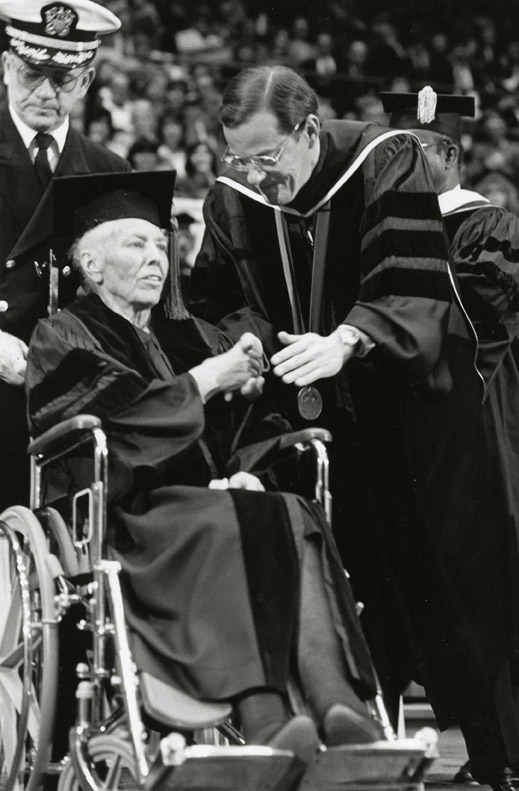
Failer receives her honorary degree, 1987

Failer receives her honorary degree, 1987

It was her love of the University, and her desire to give back to her alma mater that earned her an incredible amount of recognition. This recognition includes the University’s highest honors: the Distinguished Service Award (1964), the Alumni Centennial Recognition Award (1970), the Ralph D. Mershon Alumni Award (1984) and lastly, the honorary Doctorate of Humanities Award presented at the December 1987 Commencement a week before her death. She was 77 years old.

Failer’s dedication to OSU has continued long after her death, in the form of alumni awards and student financial awards in her name, such as the Josephine Sitterle Failer Alumni Award through the College of Pharmacy. The award honors a College alumnus or alumna who has made significant contributions to his or her community. A fund in her name also provides assistance to students in Alumnae Scholarship Housing who have been elected to membership in OSU honoraries. And the OSU Alumni Association established the Josephine Sitterle Failer Award for volunteer service to students. Its most recent recipient was James Miller, senior associate vice president for the Office of Technology Commercialization, whose many contributions include the renovation of a rundown fraternity house into a home for military veterans enrolled at Ohio State. Jo would be very proud.

Filed by C.N.

Older posts Newer posts