From Woody's Couch

Our Playbook on OSU History

Category: Women (page 3 of 8)

Women’s History Month: 90 years ago, first woman appointed as Trustee

Alma Paterson, n.d.

Alma Paterson, n.d.

It was 90 years ago today that the first woman was named to Ohio State’s Board of Trustees. Alma W. Paterson was a member of Ohio State’s class of 1904; as an undergraduate, Paterson had been a member of the Browning Dramatic Society and studied science and physical education. She received her bachelor of arts degree in 1904 and went on to serve as an assistant director of physical education for women for three years. In 1910, she married Robert G. Paterson, a 1905 OSU graduate, who was then executive secretary of the Ohio Public Health Association. 

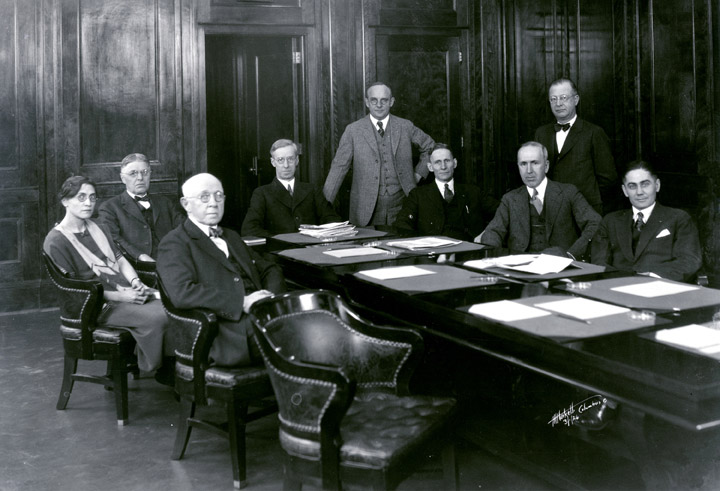
Alma Paterson was appointed to the Board on March 27, 1924, to succeed the late OSU Prof. Thomas Mendenhall. Then-Ohio Gov. A. Victor Donahey had already indicated that the next appointment to the board would be a woman since “the large number of women registered at the University warrants the selection,” according to a Lantern article about her appointment. Paterson was on the board until 1933, serving as vice chairman twice during that time.

1926 board of trustees at conference table, including Alma Wacker Paterson

Paterson with the Board of Trustees, 1926

In 1954, the Board of Trustees named Paterson Hall, then a brand-new dorm for women, after her.

Paterson’s daughter, Ann, followed in her mother’s footsteps, first as a student (BS in Education in 1937 and MS in Education in 1939) and then as a professor of women’s physical education. After 19 years of teaching at OSU, she left the University in 1956 to teach at San Francisco State College.

– Filed by C.N.

First women students were a surprise show but made mark on OSU

The Townshend family, 1884

The Townshend family, 1884

In 1873, when two dozen young people showed up at University Hall to enroll in the then-new Ohio Agricultural and Mechanical College, two were women – in fact, they were the daughters of the first Professor of Agriculture.

Alice and Harriet Townshend were the youngest children of OSU Professor Norton Strange Townshend, who had stepped down from the College’s first Board of Trustees to teach agriculture classes at the new school. He was an advocate for women’s rights, and believed in higher education for all.

The former Townshend home, 1902

The former Townshend home in 1902. The family resided here from 1873 to 1895.

So, on the morning of September 17, 1873, Alice and Harriet, and their older brother, Arthur, walked from their home near 15th Avenue and High Street to sign up for classes, according to an interview with Harriet Townshend published in the October 1948 issue of The Alumni Monthly. In the interview, Harriet Townshend said that College President Edward Orton Sr. “almost fainted” when the two sisters showed up because he was not expecting women to enroll in the new school. He left it to the Trustees to decide, and upon reading the legislative bill passed to establish the College, they determined that women, as well as men, could attend.

While Arthur graduated with the first class in 1878, it took two more years for Alice Townshend to earn her degree; however, Alice was one of the three students on the committee in 1878 who purchased the ribbons that adorned the first diplomas. The colors of those ribbons were scarlet and gray, and Alice helped pick them.

Harriet Townshend from when she was an assistant librarian at OSU in 1900

Harriet Townshend as an assistant librarian at OSU in 1900

Shortly after graduation, Alice married Charles Mayhew Wing; little else is written about her, except for her death on December 1, 1925.

Though Harriet Townshend never graduated, she worked as an OSU Library staff member for more than 30 years, making sure all of the materials had proper binding. Townshend never lived far from the University; her last residence was listed as 53 W. 11th Avenue, which today is across the street from the Moritz College of Law. And she continued to be an advocate of higher education for women until her death at age 92 on April 29, 1950.

– Filed by C.N.

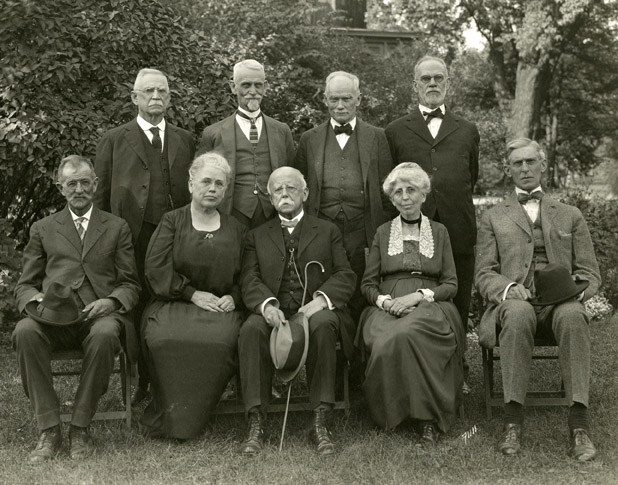
Alice Townshend-Wing (front row, second from left), and Hariett Townshend (front row, second from right), at a class reunion party in 1923

Alice Townshend-Wing (front row, second from left), and Harriet Townshend (front row, second from right), at a class reunion party in 1923

Happy 100th birthday to Rec Sports!

1910s

1910s

Athletic events have been held at Ohio State almost from the beginning, when student groups organized races from High Street to University Hall, tug-of-war contests across Mirror Lake, and informal football games on the grounds west of Neil Avenue. It wasn’t until December 1913, though, that the University decided to get involved and organize an “Intra-Mural Athletic Association.”

Intramural sports owe a debt of gratitude to former Director of Athletics Lynn St. John, both for his vision and his willingness to carry it out. In 1913 the University reorganized the Department of Athletics, appointing former student St. John as its head. J.W. Wilce (namesake of the Wilce Student Health Center) was also appointed as head football coach and director of intramural athletics. Ohio State had joined the Western Conference in 1912, and St. John was committed to providing “competitive athletics for every student.”

Women's track, 1929

Women’s track, 1929

The intramural program was soon a success, with other colleges asking for advice on starting their own programs. In fact, despite a brief interlude during World War I, the program grew from its five original sports (football, baseball, basketball, tennis, and track and field) to about 20 sports (both team and individual) in 1921. These included soccer, swimming, and bowling for team sports, and fencing, cross country, fowl shooting and golf for individual competitors. By 1937, there were 21 sports for men, with 10,000 participants, and 14 sports for women, with more than 1,000 participants.
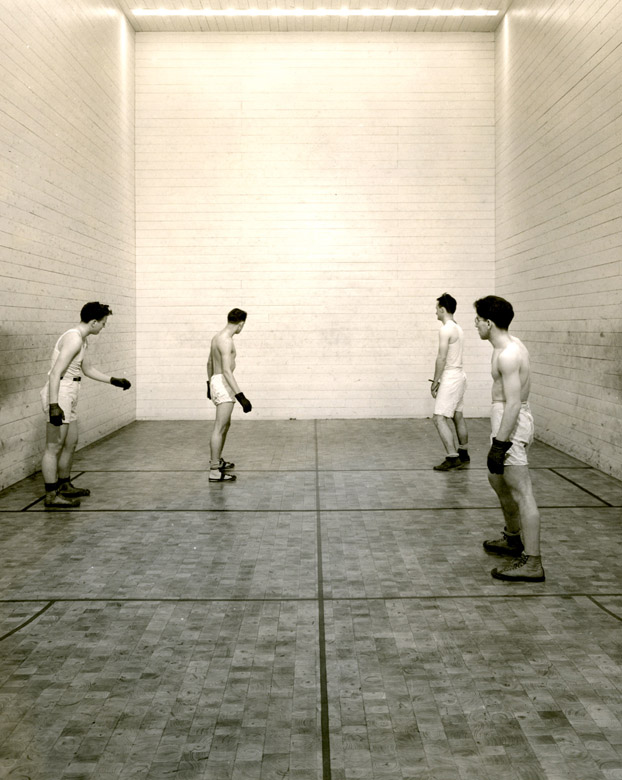
Handball court in Larkins, nd

Men playing handball in Larkins Hall, no date

Many of the men’s indoor sports were played at Larkins Hall, first opened in 1931 as the Men’s Gymnasium and Natatorium, and located just east of where the Recreation and Physical Activity Center (RPAC) now stands. Women’s indoor recreational sports were played at Pomerene Hall, which opened in 1927.

By 1968, however, recreational facilities were deemed insufficient by a University committee charged with evaluating the program. The report found that while the number of students participating in intramurals had tripled since 1945, the number of facilities had decreased slightly. Ohio State, in fact, was far behind other Big Ten universities; for example, while Indiana University had 29 indoor basketball courts at the time, Ohio State had six.
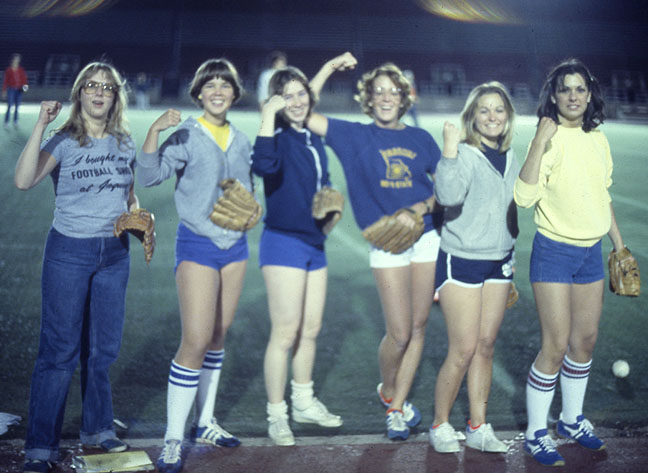
Intramural softball group, 1978

Intramural softball group, 1978

By 1970 OSU’s intramural program was the nation’s largest, encompassing around 30 sports. Today, OSU offers more than 25 different sports throughout the year, ranging from traditional football, basketball and soccer to indoor cricket, chess, “wallyball,” and something called “Battleship” involving canoes and bucket-wielding participants in a pool. It does so at a wide variety of venues, from the Jesse Owens North, South, and West Recreation Centers, which opened in 1976, to the nearly 600,000-square-foot RPAC, which opened in 2005.

So if you are looking for something to do this year, check out the department’s web site. For more on its history, check out its historical timeline.

Filed by C.N.

Older posts Newer posts