From Woody's Couch

Our Playbook on OSU History

Category: Students (page 8 of 32)

For nearly a decade, OSU women said “I do” to Bridal Fairs

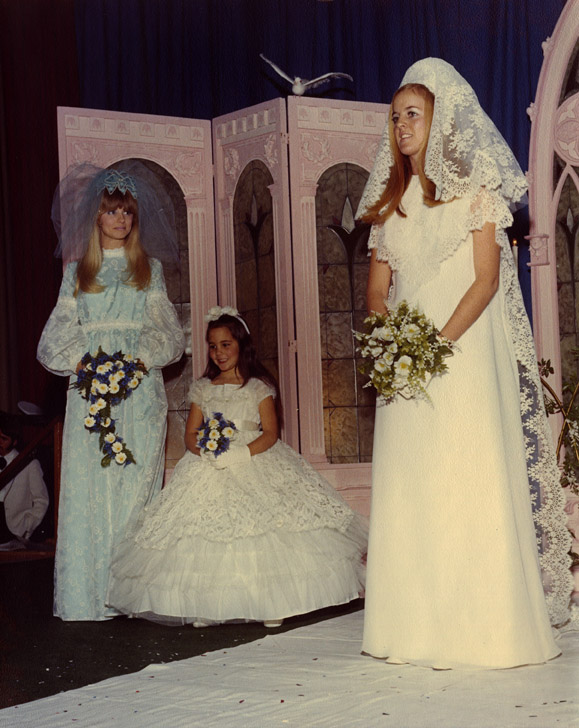
Women pose at the Ohio State University Bridal Fair, 1970s

Women pose at the Ohio State University Bridal Fair, 1970s

These days, couples who don’t have the energy to leave home can scour the Internet and cable TV for ideas on what to wear, eat and even dance at their weddings. Years ago, though, the only way to find out which fashions were in style and what kind of luggage to buy for the honeymoon were at bridal fairs. In the early 1960s, the events were popular on a number of college campuses; OSU held its first fair in 1966.

Sponsored by the Women’s Self Government Association and Bride and Home Magazine, hundreds of mostly hopeful co-eds attended the annual event, held at the Ohio Union. The fairs included displays of silver, china, crystal, linen, flowers, jewelry, cosmetics, men’s clothing, luggage, housewares, photography, gifts, and furniture. There were also usually two fashion shows held where OSU students would model different dresses and tuxedos, ranging from semi-formal to ultra-formal.  Each fair welcomed its attendees with a shopping bag filled with pamphlets regarding the merchants and displays as well as door prizes including a raffle for a honeymoon in New York City.

Crowd at bridal fair, 1972

Crowd at bridal fair, 1972

Each year brought a new theme for the Bridal Fairs, such as “April Showers Bring Wedding Flowers,” “Rings and Romance,” “White Lace and Promises,” and “We’ve Only Just Begun.” (Clearly, lyrics from songs by The Carpenters were helpful in creating these themes.) At the first fair, 650 students showed up, while 1,000 attended the following year. Attendance had hit 2,000 by 1969.

The fashions were always au courant: in 1970, for instance, the “in” look for bridesmaids were pastel culottes (garments that appear like skirts but are actually pants), with the brides wearing matching shades. And the events were definitely geared toward women – one male student who stopped by the Union to see what all the commotion was about told The Lantern he was mortified by all the fuss, and claimed that he decided that marriage was an expensive proposition.

Couple at bridal fair, 1973

Couple at bridal fair, 1973

But the organizers also appeared to ignore the then-widespread feminist movement:  A “mistress” urged girls at the fair to “be as feminine as they can if they want a husband.”  By 1971, though, protests over the event had started to occur. While nearly 4,500 attendants were expected that year, OSU’s Women’s Liberation group handed out pamphlets outside of the fair claiming it was “a tradition that should be dropped,” according to The Lantern. In 1972, more protests ensued, this time involving the Gay Activists Alliance as well as Women’s Liberation. Three women, dressed as a man, a bride and a house wife pushed a cake covered in Monopoly money through the fair.

The Bridal Fair tried to be more progressive, however, by inviting adoption agencies, counseling services, and Planned Parenthood to the events. By 1973, the fair also added a discussion panel about alternative lifestyles. But by 1974, the fair had been dropped. A representative of the Women’s Self Government Association told The Lantern in December 1973 that no event would be held the following spring because attendance had dwindled considerably from 1972, and it was becoming a hassle for WSGA to co-host the event.

– Filed by B.T.

Commencement speakers talk of tough world grads head out to tackle

1968 graduates

1968 graduates

Broadcast journalists and commentators have a national stage from which they share information and sometimes opinions on the world. Some of them have traveled to OSU over the years to give their thoughts on current news and events on a different stage – the one temporarily raised on Ohio Stadium’s football field for Spring Commencement.


The first to visit Ohio State was none other than then CBS News Anchor Walter Cronkite, who spoke at the June 1968 Commencement. It was a dark period in the nation’s history – the Vietnam War was escalating, Martin Luther King Jr. had been assassinated in April of that year, and just three days before Commencement, Robert Kennedy Jr. was shot and killed as well. Not surprisingly, Cronkite’s comments reflected the national mood:


Walter Cronkite, 1968

Walter Cronkite, 1968

“There are a lot of things wrong with this world. We can scarcely stand here in the shadow of the tragedy that has overwhelmed us, without acknowledging that there is a great deal wrong. … Violence and the most cowardly of crimes – assassination – are high on the list. But the list is so long of real or alleged wrongs: …”


He then went on to list a long litany of depressing aspects of the then-current affairs, then shifted to why there was so much student dissent and questioned whether it would have a positive outcome. After all of that, Cronkite, who was speaking to thousands of young people facing an unknown future, apparently decided he should somehow lift their spirits in the end:


“…while the challenges of today seem frightening in their complexity, there is no reason for despair. The more and the greater the challenges, … the more exciting the prospect of the combat and the sweeter the taste of victory.”


Barbara Walters, 1971

Barbara Walters, 1971

In 1971, Barbara Walters, who will retire this month after a 38-year career in broadcast journalism, decided to tackle just one of the many issues Cronkite discussed: women’s rights. “There is work to be done to improve and equalize the status of women in education, occupation, salary, property rights and marital laws. …,” she said. At the time, she determined that the women’s liberation movement had accomplished much of what it set out to do and the need to continue the debate was not that great:


“We are the women in our thirties and forties who are saying, ‘Is that all there is?’ You [the female graduates] are not, need not, and probably will not ever have to ask that question. You can work or not as you wish … marry or not … have children or not… without being condemned in any way by society.”


Of course, forty-plus years later, that debate still rages on. (For example: “Lean In” by Sheryl Sandberg, chief operating officer of Facebook, a manifesto for working women, was met with a great furor when it was published last year.) So it would be interesting to see what the Barbara Walters of today thought about her speech in 1971.


Erin Moriarity, 2004

Erin Moriarty, 2004

In 2004, Erin Moriarty, a CBS News correspondent, also listed the various ills facing the world – it was, after all, only three years after the terrorist attacks of Sept. 11, 2001 – but she told graduates that they could overcome the many obstacles facing them by embracing their “inner Buckeye.” An OSU graduate herself, she listed the many terrifying stories she had covered during her career, but said that the risks were worth taking. Then she did something unexpected: She told graduates to turn off the TV.


“What I mean is don’t live your life as a spectator who changes the scenery with a click of that remote control … Don’t be a ditto head, think for yourself. Here at Ohio State you have learned how to learn. Use those skills to educate yourself. Knowing you have those skills, don’t be afraid to take some risks. … And never forget where you came from.”


Naturally, Moriarty ended her speech with “Go Bucks.” Four years later, NBC News Anchor Brian Williams began his with “O-H.” And his speech was peppered with jokes (mostly about the University of Michigan) and other moments of levity. Like Cronkite fifty years earlier, though, Williams talked about how broken the nation was. “We need you to fix this country,” he said.


He then went on to talk about the then-117 million blogs being written on a regular basis and how most of them were about the people writing them. “And the problem is, we need to start talking about us, all of us. We need to start thinking of us as the collective, the United States we used to know. It is going to require a lot of work.”


He said, though, that the soon-to-be OSU graduates would be up to the task.

“And ladies and gentlemen, members of this graduating class, members of graduate studies, wherever you go, please tell them you’re a Buckeye. There is nothing wrong with America that someone from Ohio State can’t fix.” 


For a list of these and other commencement speeches, and links to their texts, visit:


http://library.osu.edu/find/collections/the-ohio-state-university-archives/buckeye-history/commencement-addresses/

Buckeye Village has always had family atmosphere, international flair

Buckeye Village residents, 1940s

Buckeye Village residents, 1940s

The Buckeye Village’s first permanent housing was built in 1948 as World War II veterans returned to campus under the GI Bill to complete their education – often with a family in tow. (You can find one war veteran’s story of living there here.( http://kb.osu.edu/dspace/handle/1811/58840) 

Soon enough a club sprang up called the Buckeye Village Wives, which – among other activities – held fund-raising bazaars for a child-care center, organized lectures by University professors, and published a mimeographed newspaper called The Villager. (Apparently, a Mrs. Betty Gremillion won a basket of groceries for coming up with the name, according to a 1948 Lantern article.)

Also from the very beginning, Buckeye Village was international in nature: in 1948 the 152 wives living there represented four nations and three continents.

nd_buckeye_village_apartments

Buckeye Village, no date

As early as 1955 Village residents were banding together to make their opinions known to the University: According to a July 27 Lantern article, an “urgent cry’ by residents to paint both the inside and outside of the Village apartments led OSU officials to decide to skip the bidding process for outside vendors and have the University’s service department employees do the job.

Two years later residents were protesting a proposed 21-percent rent hike, even though the year before a Lantern editorial chastised the University for its lack of upkeep on the buildings, calling the Village OSU’s “biggest eyesore.” (It would not be the last time residents united to protest rent hikes.)

Buckeye Village residents, 1993

Buckeye Village residents, 1993

Less than five years later, though, the University had built forty new apartment units, which opened in 1961; the total number of units rose to 400. And in fact, a 1962 Lantern article said residents were content to live in apartments whose rents ranged from $79.50 to $89.50 per month ($4.00 extra for air conditioning), and who could take advantage of a community hall that housed a study library, a pool, ping-pong tables and a nursery school for children. There also was a community garden.

In the mid-1950s the University had dropped the rule that residents must be veterans, but students who lived there still had to be married. By 1986, the majority of residents (80 percent) were international students who were married; the rest were domestic students who were married or single parents. Today, any student can apply to live in Buckeye Village; however, priority still goes to married students and those with children.

Older posts Newer posts