From Woody's Couch

Our Playbook on OSU History

Category: Students (page 7 of 32)

OSU student helped everyone know where to sit at home football games

Floyd Martin, 1923

Floyd Martin, 1923

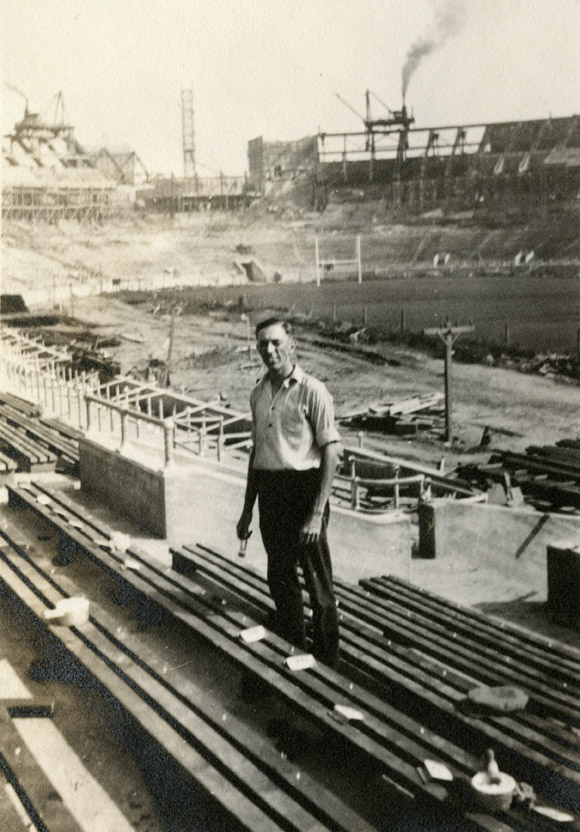
After receiving a scrapbook that belonged to OSU graduate Floyd Marion Martin, we’ve gained more insight on the work that took place during the construction of the Ohio Stadium. Martin graduated in 1923 with a Bachelor’s degree in Electrical Engineering and was involved in Theta Xi and the American Institute of Electrical Engineers, but he also took part in hand-stenciling the seat numbers in the Stadium.

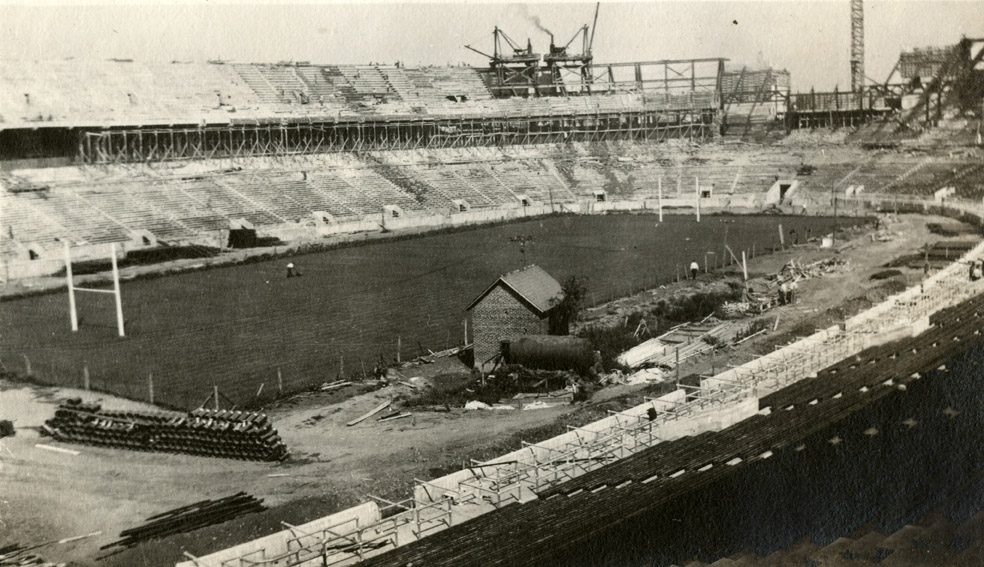
The construction for Ohio Stadium began on August 3, 1921, and by November, the concrete for the first nine rows of seats had been poured by contractors. In all, 75,000 barrels of cement, 22,000 tons of sand, and 45,000 tons of gravel would be used.

Martin's friends paint seat numbers on bleachers, 1922

Martin’s friends paint seat numbers in Ohio Stadium, 1922

Impressive numbers for an impressive edifice, the first of its kind for a college stadium. But fans needed a way to determine where they were going to sit on those concrete rows. By the next September, the football stadium was ready for seat numbers. Enter Martin and his friends, who were employed to put on the finishing touches.

The original seats that Martin and others worked on were three long strips of wood that ran thirty inches in width and seventeen inches in height. One photo, dated September 15, 1922, shows Martin at work with his friends, Pete, Baird, and Shug. They called themselves “The Royal Order of Stalling Stadium Stencilers”.

By October 7, 1922, the Buckeyes played their first game in the new Ohio Stadium against Ohio Wesleyan, winning the game 5-0.

(Below are a few more photographs from Martin’s album.)
1922

1922
1922

1922


1922

1922

– Filed by B.T.
WWII hero Don Scott ‘brought great credit to his alma mater’

Don Scott, 1939

Don Scott, 1939

When World War II broke out, many OSU students immediately signed up to join in the fight, suspending their studies for a much greater cause. Probably none of them was more well-known than Don Scott, the archetypical Big Man on Campus.

And here’s why: After entering Ohio State in 1938, Scott participated in baseball, track, basketball, and most notably football. In addition to being on the Players’ All American team for football and the first Big 10 Championship for basketball, Scott was also elected to sophomore, junior and senior Honor Societies as well as being a member of the Phi Delta Theta fraternity.

Don Scott, 1941

Don Scott, 1941

After enlisting, by May 1941, Scott, along with other OSU athletes were stationed in Tulsa, Oklahoma, for Air Corps Training Detachment. By October, Scott had completed training and had advanced to get his wings and commission in the Army Air Corps. He was eventually promoted to a Captain.

Unfortunately, on October 1, 1943, at the age of 23, Scott was killed in a bomber crash over England. This marked the 100th alumnus or former student to give his life in World War II. One week after his death, on October 8, his wife gave birth to their child, Don Sands Scott.

Meanwhile, in the spring of 1942, the U.S. Navy leased Port Columbus to train its pilots. At the time, OSU was using Port Columbus for its own civilian pilot training program, and the Navy’s lease would pretty much have doomed OSU’s program to failure. However, OSU Prof. Karl W. Stinson, a lieutenant in the Air Corps of World War I and a professor in the Department of Mechanical Engineering went to then-OSU Pres. Howard Bevis with an idea: Build an OSU airport.

President Bevis and Carl Steeb, then-University Business Manager, considered the idea, liked it, and found $100,000 for the project. Stinson himself scouted the nearby then-countryside, and found a flat portion of land near what is now Sawmill Road. Ohio State purchased 385 acres (larger than Port Columbus), and set about building a hangar, runways and fences.

Don Scott Field, 1949

Don Scott Field, 1949

Soon after Scott’s death, President Bevis presented a resolution to the Board of Trustees that read, in part:

[Scott] was one of the nation’s great athletes; he was a sportsman in the finest sense of that term; he was a thorough gentleman, beloved by all who knew him; his life brought great credit to his alma mater. … As a fitting commemoration … I desire to propose to this Board that the airfield now owned and operated by the University be designated ‘Don Scott Field.’

The board approved the resolution and the newly named Don Scott Field was used by the Navy until the end of the war, when OSU transferred its focus to a civilian aviation curriculum.

– Filed by B.T.

Johnson devoted to rehabilitation for more than a half-century

Ernest W. Johnson, 1958

Ernest W. Johnson, 1958

Dr. Ernest Johnson has been in the business of physical rehabilitation for more than 60 years – since not long after he graduated from the College of Medicine in 1952. However, he’s been associated with the University since 1942 when he first arrived as a freshman at OSU.

Dr. Johnson, known as Ernie or ‘Dr. J’ to many, was drafted to serve in World War II shortly after he enrolled, but he returned to the university four years later, intending to study journalism. He was a voracious reader growing up, had worked for a newspaper since the age of 16 and had served as editor of his Akron high school’s newspaper. However, a conversation with his college roommate apparently changed his career drastically. Johnson said that his roommate told him, “You have four years of free education, why don’t you become a doctor?” So he did.

Johnson used his GI benefits to the utmost by taking 26 credit hours a quarter. He was also working in the cafeteria, where he met his wife, Joanne. He earned his undergraduate degree in 1948 (he and Joanne were married later that year) and his medical degree in 1952. He completed his residency, also at Ohio State, in 1957 and was named an assistant professor in the College of Medicine that year.

Dr. Johnson demonstrating a "wheelie", 1990

Dr. Johnson demonstrating a “wheelie”, 1990

His specialty was physical medicine and rehabilitation. He studied carpel tunnel syndrome, and along the way became a crusader for the rights of the disabled. He was named chairman of his department in 1963, a position he would hold for almost thirty years. In 1974 he led a group that organized a grant project to build Ohio State’s Creative Living Center, a living-learning facility for the physically disabled. It was the first of its kind in the Midwest, and inspired many other similar centers across the country. Johnson also organized the Ohio Wheelchair Athletic Association in 1970.

Both of these projects earned him much recognition, but the awards displayed in his office instead included those for “popping wheelies” (balancing a wheelchair on its back wheels and spinning in either direction). In fact, Johnson required that all of his students (including more than 160 residents) be able to pop a wheelie. He said it made them more aware of what their patients were going through. Under his guidance, the department of physical medicine and rehabilitation became the third-highest ranking program in the country.

– Filed by C.N.

Older posts Newer posts