From Woody's Couch

Our Playbook on OSU History

Category: Presidents (page 4 of 8)

2 X Gee = many firsts for OSU

President Gee, 1990

President Gee, 1990

On September 1, 1990 – E. Gordon Gee’s first day as president of OSU – there was no such thing as a Pelotonia to raise money for the James (the Arthur G. James Cancer Hospital) since the hospital was only two months old. Back then, the Stadium had about 15,000 fewer seats (86,000), and the plans to renovate the Thompson Library, then known as the Main Library, were nearly 10 years away from being approved. Meanwhile, High Street on the south side of campus was still just one long row of broken-down bars.

When E. Gordon Gee became president that day, he began what would become his first term, and he accomplished much during those seven years:

·         The University renamed the College of Business after Max M. Fisher, a 1930 alumnus whose generous contribution helped build a new business school.

·         The University’s community development arm, Campus Partners, was founded to help redevelop the University District, particularly south end of campus along High Street.

·         Designed by Philip Johnson, known as the father of modern architecture in the United States, the Science and Engineering Library opened. (It is now known as the 18th Avenue Library.)

·         The University Staff Advisory Council, an advocacy group for OSU staff, was established.

·         Gee appointed a task force to create an advocacy group for women faculty and staff, eventually known as The Women’s Place.

·         The annual State of Ohio Tour – a week-long bus tour in which the OSU President visits various counties to connect the University to past alumni and future Buckeyes where they live – was created.
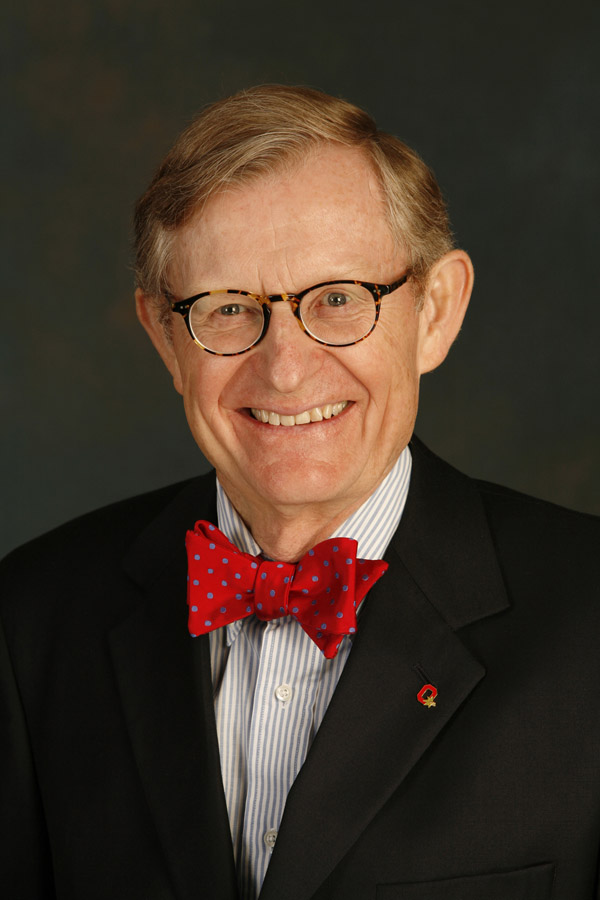
 

President Gee, 2007

President Gee, 2007

On October 1, 2007 – ten years after leaving office – Gee started his second term, and there were more milestones:

·         At a cost of about $120 million, a newly renovated Main Library – now known as the William Oxley Thompson Memorial Library – re-opened.

·         A new Ohio Union, the campus’ third student union since 1912 and its largest, opened.

·         The OSU Medical Center was renamed the Wexner Medical Center and began a $1 billion expansion project for the James Cancer Hospital and Solve Research Institute. Meanwhile, the Pelotonia, an annual bike ride through which all proceeds go to OSU cancer research, was established.

·         The University opened International Gateway offices in China and Brazil, to better handle the transition of international students from their home countries to the Ohio State campus.

·         A $2.5 billion fund-raising campaign, “But for Ohio State,” began.

·         Campus Partners opened the South Campus Gateway, a $152-million mixed-use project with retail, entertainment, apartments, office space along High Street.

·         The University signed a $483 million parking lease with CampusParc, a private vendor, in order to raise money to fund academic programs, student scholarships and bus service.

Like everyone else on campus, we will miss President Gee. We’re lucky, though, because the presidential papers from his first term are here, and we expect a collection from his second term to arrive sometime in the future. The first-term collection is available to the public, and if you’re interested in seeing any of the materials, please contact us. (http://library.osu.edu/find/collections/the-ohio-state-university-archives

Gee's welcome at Bricker Hall, 1990

Gee’s welcome at Bricker Hall, 1990

Gee's tour of southeast Ohio, 1991

Gee’s tour of southeast Ohio, 1991


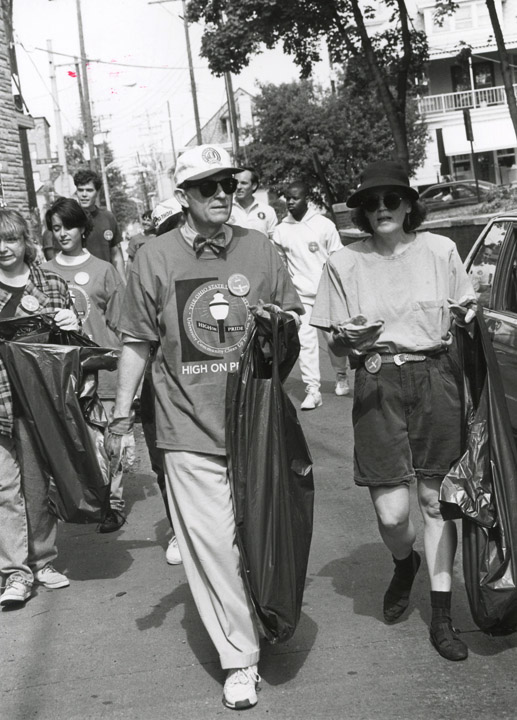
Gee participating in a campus cleanup project, 1994
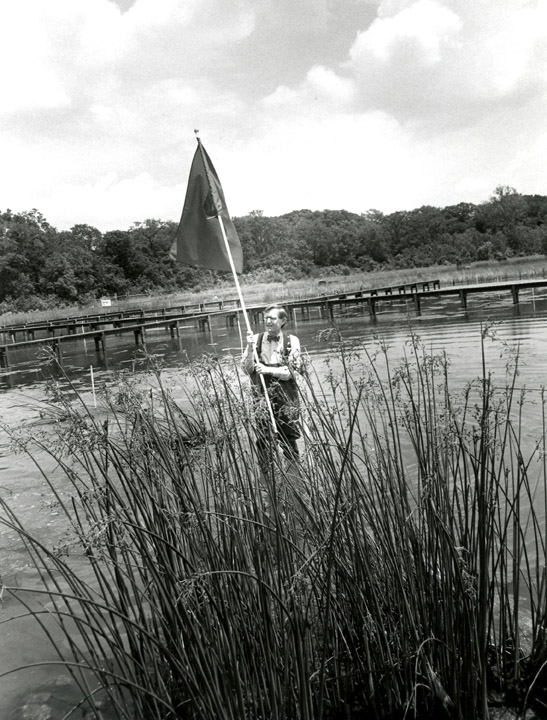
Participating in a campus cleanup project, 1994

President Gee wades in the water during the Wetlands dedication, 1995

Gee wading in the water during the Wetlands dedication, 1995


2007

2007

Long Gone Campus Traditions: Cut-throat competition for the cane

1919 Cane Rush

1919 Cane Rush

(“Long Gone Campus Traditions” is a continuing series of posts where we explore some of the more unusual, sensational and even violent student traditions that have been obsolete from OSU’s campus for quite some time.)

The Cane Rush was undoubtedly one of the most brutal student traditions to ever taken place on OSU’s campus.  In fact, some have described the event as a mixture of rugby, football and WWF wrestling.

The Cane Rush, which originated in the 1880s, was a contest between classes of undergraduate men.  The object of the game was to find and obtain the rival’s walking cane and move it across the opponent’s goal line.  The teams, which often numbered in the hundreds, could be quite brutal.  Students tackled each other, wrestled one another on the ground, and tore each others clothes, all in an effort to obtain the cane.

The Cane Rush in 1894 was so violent that one Lantern reporter wrote:

“If our young men are to do that for which in the ordinary walks of life they would have to answer to the law of the land, it is high time that the iron hand of discipline be imposed. University history should not be blotted by the record of many such affairs as occurred last Thursday.”

The first presidents of the university and many of the faculty agreed that the Cane Rush disrupted classroom activities.  The competition was normally an unplanned event and the early rushes had few rules or authority figures involved.  One Cane Rush in 1889 reportedly lasted for an hour and a half.

President Thompson holds the cane, 1920

President Thompson holds the cane, 1920

However, when William Oxley Thompson became president in 1899, he confronted the controversy of the Cane Rush head-on.  Rather than waiting for the event to begin spontaneously, Thompson organized the event himself.  The President said that as long as the students conducted the event in an orderly manner, he would allow it to continue. Under his direction, the competition had official rules, a specific date and location, and a set time of 20 minutes.    

The Cane Rush became a beloved student tradition under Thompson’s administration and in 1908 it reportedly drew some 10,000 spectators.  Because of its reputation, students even began charging admission to the event.

The popularity of the Cane Rush began to decline in the late 1920s and by 1932 the event was no long held. Lack of interest, the shift away from class as the focus of student life, and the fact that Thompson retired, were some of the reasons that caused the demise of the Cane Rush.  There were efforts to revive it in the 1930s and 40s, but those efforts never took off.

Cane Rush on the Oval, 1891

Cane Rush on the Oval, 1891


Students pose with cane in front of University Hall, 1894

Students pose with cane in front of University Hall, 1894


1919 Cane Rush

1919 Cane Rush

Home Ec students fight against exclusion

Wilhelmina Styles, 1932

Wilhelmina Styles, 1932

In 1921, the Department of Home Economics established a Home Management House to teach women students how to run an efficient home, as well as life skills, such as finances, nutrition, and child care. Students received credit for instruction in the laboratory center, where they lived together for roughly six weeks in a staged home environment.

Ten years later, Wilhelmina J. Styles, an African-American student, requested permission in May 1931 to seek admittance for practical training in the House for the autumn quarter. She was refused admission. (Although there was no set rule barring African-American students from campus housing, they instead lived in boarding houses or private homes.) Despite protests from local officials, business leaders and religious organizations, then-OSU President George Rightmire supported the decision; Styles was asked to substitute another Home Ec course for the home-management graduation requirement.

Doris Weaver, 1933

Doris Weaver, 1933

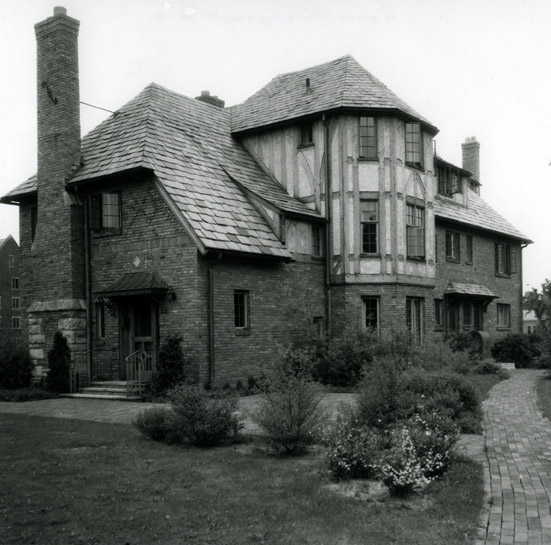
Home Management House, 1937

Home Management House, 1937

In May 1932, Doris Weaver applied for a reservation in the House and was accepted for the autumn quarter. Subsequently, after learning Weaver was African-American, the department withdrew Weaver’s confirmation for participation in the House.

Then, Ohio Rep. Chester K. Gillespie, the only African American in the Ohio General Assembly at the time, intervened on Weaver’s behalf with a series of letters to Rightmire. He also asked that the state legislature begin an investigation for possible discrimination. Shortly after, the OSU Interracial Council – made up of student representatives of the YMCA, YWCA, International Club and Council of Women, among others – filed a protest in support of Gillespie’s charges discrimination based on race.

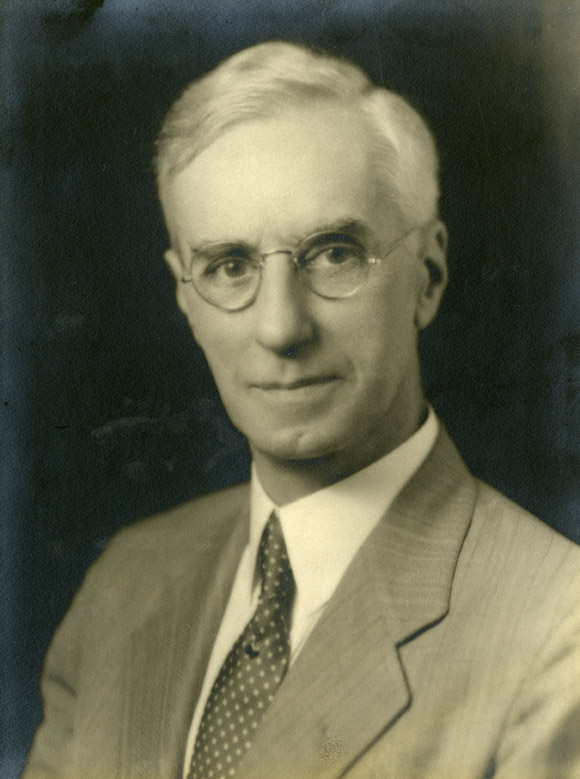
President Rightmire, 1932

President Rightmire, 1932

At a subsequent hearing before a House committee, Rightmire denied barring Weaver from the House because of her race. He said she had been offered exclusive use of part of the house but had refused the offer.

Gillespie then threatened to revoke funding to OSU because African-American students were not allowed to participate equally in the House program. Eventually, Weaver’s case went to the Ohio Supreme Court, which supported Rightmire’s assertion that Weaver was not being denied equal opportunity since she and other African-American students were offered exclusive use of certain sections of the house.

The ruling did not deter Weaver from continuing her studies; she received a bachelor’s degree in Home Economics in March 1933 and went on to earn a master’s degree in 1936. According to a 1981 interview, she taught at Wilberforce University for seven years – along with Wilhelmina Styles – in that university’s Department of Home Economics.

For more information on these women and other African-American students’ experiences at OSU, please see Pamela Pritchard’s 1982 dissertation: “The Negro Experience at the Ohio State University in the First Sixty-Five Years, 1873:1938, with Special Emphasis on Negroes in the College of Education.”


Older posts Newer posts