From Woody's Couch

Our Playbook on OSU History

Category: People (page 40 of 52)

One Book to Rule Them All: Students’ Rules and Regulations, 1906-69

President William Oxley Thompson’s foreword to the 1906 edition of Students’ Rules and Regulations reads as follows:

This little book is printed for the convenience of student in order that they may know the rules and regulations in which they are interested as a matter of guidance.  The book will be published annually with such revisions as are made from time to time.  Students are requested to keep this as a matter of reference.  Its intelligent use will save the time of the student and of the University officers.

This “little book” does indeed contain many guidelines for students at the time.  Many are similar to current policies, as evidenced by the following rule from the 1906 edition:

Although smoking was prohibited indoors, it was okay on a cannon.

Use of Tobacco Prohibited

The use of tobacco in any form in the lecture rooms, halls, corridors, doorways, stairways, laboratories and libraries of the University is prohibited.

But many reflect the changes that have taken place on campus in the past century. For example, the University has grown considerably since 1906, when the student population barely topped 2,000 and the President had considerably more interaction with individual students:

Living Arrangements

The President shall have authority to supervise the living arrangements of students not residents of the City of Columbus, and to order the immediate withdrawal of any student from any boarding or lodging house in which he deems the surrounding are undesirable.

Excuses for Absence:
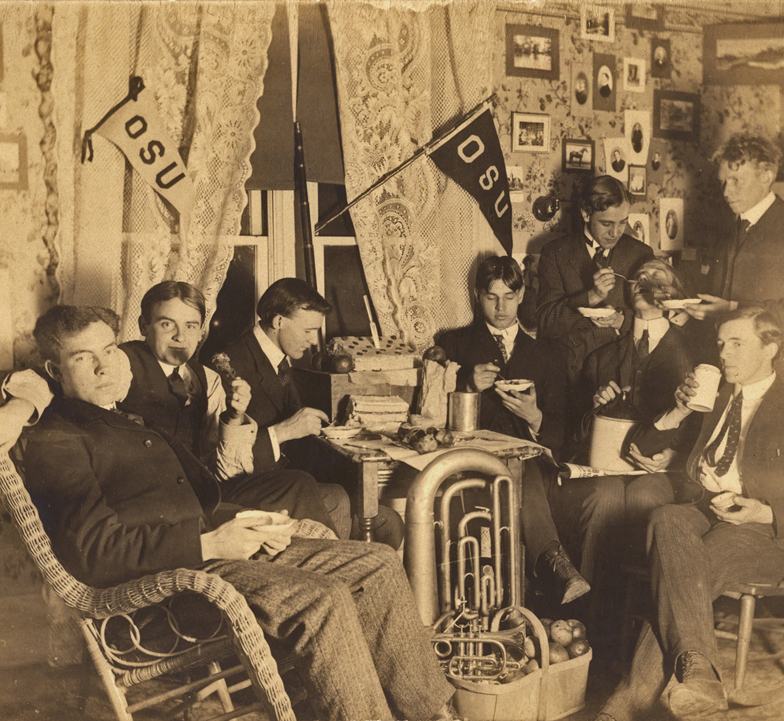
“Banquet” on Woodruff Avenue, 1900s

All absences of individual students from the city, for any purpose, involving absence from college exercises, must be accounted for to the President; and in all possible cases permission must be previously obtained.

Excuses will not be granted for absences of more than two weeks’ standing, unless the absence has been continuous.

Another significant difference in rules from years past is the role of the Department of Military Science. The Morrill Act of 1862, the legislation that paved the way for land grant colleges like The Ohio Agricultural and Mechanical College, decreed that “the leading objects [of these schools] shall be, without excluding other scientific and classical studies, and including military tactics, to teach such branches of learning as are related to agriculture and the mechanic arts.” According to the 1906 Rules:

All able bodied male students under 25 years of age at date of first entrance into the University or of any re-entrance after one year’s attendance at, and one or more years’ absence from, the University shall be required to report to the Military Department for service at the first regular drill hour. Each student will be required to drill three hours per week for two years, during the first two years of his attendance at the University.

In our next blog post, we’ll show you some of the revisions that were made over the years and reflect the changing times on campus.


Jaywalker’s jailing prompts campus chaos

From time to time we receive inquiries from patrons about an incident involving a jay-walking OSU student that eventually led to some serious rioting.

It all started in December 1963, when Marjorie Cocoziello, an OSU student from Paterson, New Jersey, and her friend each received a citation for jaywalking. By February, Cocoziello still had not paid her $5 ticket. So Columbus Police officers showed up with a paddy wagon at her sorority house and arrested her. This was apparently all the incentive that students – including Cocoziello – needed to engineer mass chaos.

The “jaywalking riot”, 1964

According to reports, after the paddy wagon left at about 5 p.m. to take Cocoziello downtown, students who had gathered at the scene migrated to the intersection of 15th and High, the spot where Cocoziello had received her citation. Students then proceeded to hold up traffic for seven hours by playing the game of Red Rover across High Street; chanting and participating in vandalism, such as cutting trolley cables; and climbing atop buses and setting a bonfire in the middle of High Street. The demonstration disrupted bus routes and the commute home for many people before police were able to re-route traffic.

Meanwhile, another 200 students paraded Downtown to protest at the police station. Seven students – in addition to Cocoziello – were

arrested for disorderly conduct. Two were later suspended from school and five were given probation. Cocoziello was released after 90 minutes in a jail cell and a call to her sorority house. Her bond was set at $13.

1964

The media covering the event then became part of the story. Cocoziello made statements to The Lantern that she was strip-searched at the jail, locked in a darkened cell, and that the jail matron was “cruel.” Later, though, the Chief of Police explained the procedure for booking jaywalking offenders, and refuted Cocoziello’s account that she had been strip-searched. He went on to say that the light had indeed burned out in her cell but was quickly replaced, and the jail matron was one of the nicest ladies you would ever meet. After the investigation, The Columbus Dispatch reproached The Lantern for its account of Cocoziello’s story.

Ultimately, Cocoziello had her day in court, much to the amusement of the onlookers and Franklin County Municipal Court Judge Alan E. Schwarzwalder, who heard her case. He was reported to have said, “After all you’ve been through, I’m not going to charge you a penny” and suspended her sentence, even though he declared her guilty of jaywalking.

To review The Lantern’s coverage of the incident, go to The Lantern Online Archives, which you can find as a link on our home page at go.osu.edu/archives.

Filed by C.N.


Summer School: Who needs to be in a classroom to learn?

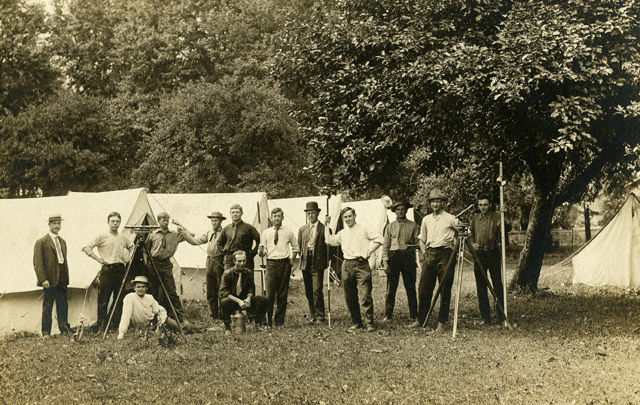
During the warmer months of the year, especially, learning doesn’t have to take place in a classroom. For OSU’s civil engineering students, in particular, fieldwork has long been a part of their studies.

In June 1888, some of these students went to camp – sort of – led by OSU Prof. Charles N. Brown – future Dean of the College of Engineering. He and seven students headed about sixty miles southeast of Columbus to prepare a “reconnaissance, preliminary and location survey for a proposed electric railway 2 ½ miles long.” Maps were made and earthwork was partially computed. (We’re pretty certain their idea of “computing” was different from ours.) It wasn’t really our idea of camp, either: The group stayed in a local hotel.

There was then a hiatus from such summer trips until 1900, when Brown again took students off-campus, and this time it really was to a “camp.” (Brown apparently grew up traipsing through the woods with his father, a surveyor in Brown County.)

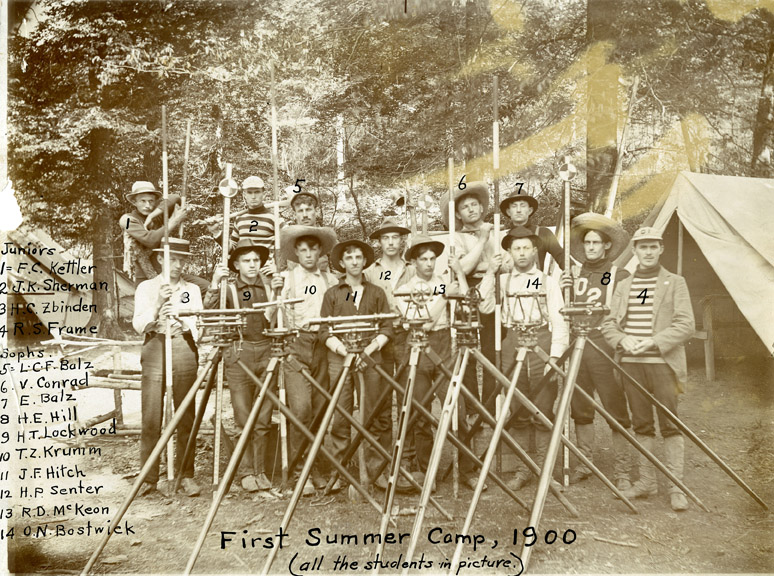
Nelsonville, 1900


Students on the 1900 trip to the Nelsonville area stayed in tents, two to four students per tent. A tent was set up where a cook prepared the meals; Brown, as camp director, purchased the groceries locally. The camp lasted for four weeks, and cost $20 per student. In that time, students worked on railroad-related projects, “running 12 miles of reconnaissance, 9.2 miles of preliminary line, 5.7 miles of location and taking 4 miles of topography;” in addition, students practiced cross sectioning, computing and drafting.


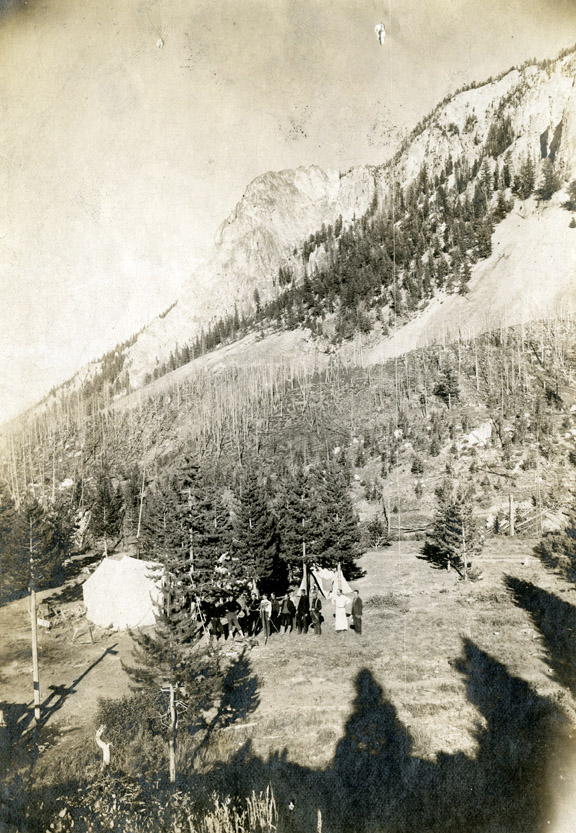
Yellowstone, 1905

This camp marked the first of many formal summer camps for engineering students, all of which took place in Ohio, with the notable exception of the 1905 trip to Yellowstone National Park in Wyoming. In 1905 the group entered into a six-week contract with the U.S. Engineering Officer, Major Hiram Chittenden, in charge of the improvement plan for Yellowstone Park. The U.S. government furnished the camp equipment, and all food and transportation within the park for their stay. All members of the group were also given a four-day. all-expense-paid journey through the park. In exchange, the students located 45 miles of “stage road” through surveying and mapping. Topography was taken 500-600 feet on each side of the road and prepared an atlas.

The last outdoor “camp” took place in 1946, after which all camps “went under roof.” The last “contract camp,” in which students and professors were under contract to do work, was in 1941. The last record of a civil engineering camp was in 1952.


Older posts Newer posts