From Woody's Couch

Our Playbook on OSU History

Category: People (page 31 of 52)

Bleeds Scarlet and Gray: Athletics Director Larkins hired without applying for job

Richard Larkins, 1930

Richard Larkins, 1930

Before the imposing RPAC was the place to work out, there was Larkins Hall. It was much smaller, and by the time it was torn down in 2005, a lot worse for wear. But it had long served the OSU community, much as its namesake, Richard C. Larkins, did, as athletics director for nearly a quarter-century.

Larkins was associated with the University since he came to OSU as a student in the late 1920s. As a student, Dick Larkins played both on the varsity football team and the varsity basketball team, lettering in football from 1928-1930 and in basketball from 1929-1931. He displayed both leadership and smarts from the beginning: He was captain of the basketball team and class president, and he won the Western Conference Medal for scholastic achievement his senior year. Larkins was also a member of the junior honorary, Bucket & Dipper, and the senior honorary, Sphinx.

After earning a bachelor of science degree in Business Administration in 1931, Larkins coached the freshman football team while he worked on his MBA, which he received in 1935. Later that year he left OSU to serve as head coach for the University of Rochester football team.
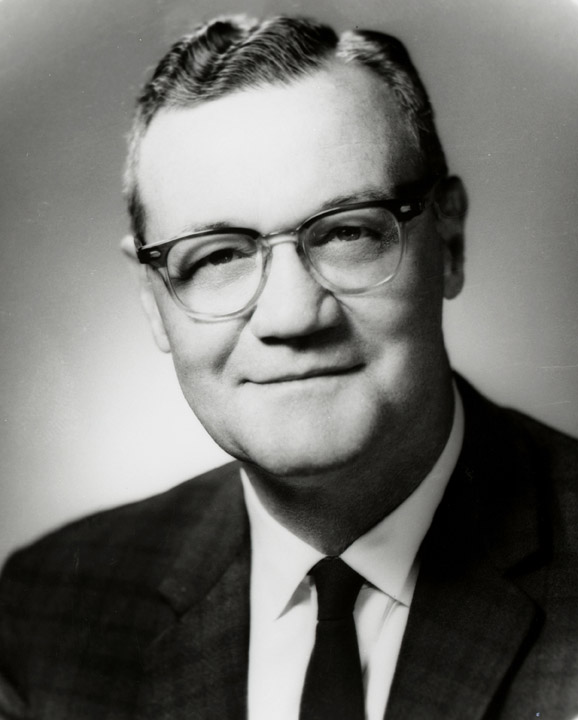
Larkins, 1966

Larkins, 1966

In 1937 Dick Larkins returned to his alma mater to teach physical education. When the position of Director of Athletics became vacant in 1947, Larkins never actually applied for the job. However, when members of the Athletic Board sat down to discuss possible candidates, Larkins was the only one who had the support of the coaching staff, the physical education department, and retiring Athletic Director Lynn St. John, according to an Alumni Monthly profile.

Larkins’ term as Director of Athletics included the hiring of three head football coaches – the last was Woody Hayes. But his influence on OSU athletics was much broader: Under his leadership, the program expanded to 18 sports, and he oversaw the construction of St. John Arena, French Field House and the adjacent ice rink, as well as an extensive renovation of Ohio Stadium.

In 1976, the Board of Trustees named the recreational facility after Larkins, who had retired in 1970 after 24 years as athletics director. Larkins died April 5, 1977, at the age of 67.

Larkins Hall, 1977

Larkins Hall, 1977

When being close really does count: hand-grenade tossing included in track meets

Hand grenade throwing diagram, 1918

Hand grenade throwing diagram, 1918

In an old Department of Athletics collection, we recently found a folder simply entitled “hand grenades.” It contained correspondence and diagrams from 1918 related to a proposed hand-grenade tossing event for track meets. Kind of like the shotput event, only with more damaging consequences.

In early spring 1918, the United States had been fighting in World War I for nearly a year, and the war effort at home was going strong. Here at OSU, the campus was home to a barracks, machine-gun range, and a small hospital. A school for military aeronautics was open for one year (1917-1918), an aviation laboratory opened, and an airplane landing field was installed.

So, naturally, someone came up with the idea of including a hand-grenade tossing competition at track events to prepare student cadets once they hit the front lines in France. The Lantern first reported about it in March 1918:

“The war spirit seems to have affected the athletic department, and the kaiser better keep his eye on Ohio State athletes when they get to France. Yesterday Director [Lynn] St. John brought to the Athletic House a box of hand grenades which will be used by the weight men in practice and may become an established event. They are the regulation size used in war work.”

Charles Hubbard

Charles Hubbard

St. John later explained that the competition would be an individual event. There would be three targets of four feet square (the usual size of a trench). Each man would receive a number of grenades and would take up position in a “box” made out of wood but with mesh sides so the competitor could be seen by judges who (presumably) were sitting a safe distance away. He would be required to make a certain number of hits. Competitors would be judged on speed and form, as well as accuracy.

Track Coach Frank Castleman even visited Camp Sherman in April 1918 in order to receive “first-hand information on the art of bomb throwing, hence being prepared to coach his men in the new field event,” according  to The Lantern.

Later in April at its first track meet, against Ohio Wesleyan, the hand-grenade event went off without a hitch. In fact, Charles Hubbard of Ohio State set the best record, getting five of 10 grenades into the pen. The event continued to be included through the season; it was listed, in fact, among the events in that year’s Big Six Championship, which the Buckeyes won.

The war ended in November 1918, so the event’s inclusion in track meets remains a one-season-only affair.

Filed by C.N.

Stranger than Fiction

Herbert Atkinson, c1920

Atkinson, c1920

This April Fool’s Day, we bring you some bits of OSU history you’ll have to read about to believe!

Herbert Atkinson

Alumnus and Board of Trustee member Herbert Atkinson was so tied to the OSU campus that he requested Bricker Hall as his final resting place, and got his wish! Read more about it in a past blog post.


1981

1981

Marie the Elephant

Students often threaten to run off and join the circus, but how often do animals leave the circus for OSU? Well, Marie the elephant did. In 1981 she took ill and was transferred to the College of Veterinary Medicine’s clinic where she later died. The story just gets stranger after that! Read more about it in the transcript from then Physical Plant director Dean Ramsey’s oral history and our web exhibit for the 40th anniversary of the University Archives.


Home Ec baby, 1946

Home Ec baby, 1946

Home Ec Babies

You think your classes were stressful? Well, Home Ec students of the past were tasked with the care of a human infant, with all the responsibilities that come along with it! Read more about it in a recent blog post.


Maudine, 1926

Maudine, 1926

Queen Maudine

Perhaps one of the best pieces of OSU lore is Maudine Ormsby, the 1926 Homecoming Queen. And yes, she is the one with the spots. How did OSU end up with a cow as its Homecoming Queen? Simple: election fraud. In 1926 OSU’s student enrollment was less than 10,000, and for the election only 3,000 ballots were printed. However 12,000 votes for Homecoming Queen were submitted. Hmmmm…

Unfortunately, Maudine was unable to attend the Homecoming festivities; she was declared “too valuable” to risk an appearance. The Homecoming Committee had to settle for two boys in a cow costume.


Hand Grenades

Sneak preview: You’ll have to wait a few days to find out what hand grenades (but, alas, not horseshoes) had to do with track meets of old, but we think it’s worth the wait!

Filed by C.N. and L.S.

Older posts Newer posts