From Woody's Couch

Our Playbook on OSU History

Category: Football (page 2 of 9)

Twelve Days: For Woody Hayes and others, the Archives aims to ‘pay it forward’

(In celebration of the University Archives’ upcoming 50th Anniversary in 2015, we bring you “The Twelve Days of Buckeyes.” This is the last of a series of 12 blog posts highlighting the people who were instrumental in the creation and growth of the Archives. Stay tuned for more posts and other announcements related to our anniversary celebration next year.)

Woody Hayes, 1963

Woody Hayes, 1963

It’s been nearly 30 years since Woody Hayes’ death, yet his legacy is still very much alive for many people. Even OSU students who hadn’t yet been born when he died in 1987 know about Hayes. And although many these days can’t name many details – such as the fact that he still has the most national championships of any OSU football coach – they almost invariably can recall that he was some kind of an important figure at the University.

We would like to think that the Archives contributes a little to this continuing legacy.

The Archives has housed the Woody Hayes Papers since 1990, when his widow, Anne, donated them to the University. The collection includes papers, books, awards, memorabilia, photos and other effects.

Anne Hayes, n.d.

Anne Hayes, n.d.

Though it is larger than most, the collection of roughly 75 boxes is very similar to the dozens of faculty and staff collections housed here. Each collection’s materials document the careers of the people who have worked at OSU. Like many of these collections, though, Hayes’ goes beyond mere documentation of a career. His materials reflect a person whose job title was coach, but whose contributions to the University and community went far beyond that. Consider:

– Photos from his own U.S. Navy service during World War II. In these, Hayes is incredibly young but already shows leadership skills that would he would use for 27 years as OSU football coach. (He achieved the rank of Lt. Commander and was in charge of both a patrol boat in the Palau Islands and a destroyer escort.)

Hayes, (center), with two unidentified men, n.d.

Hayes, (center), with two unidentified men during WWII

– A wooden clock with a plate inscribed “Bryant-Foust Crippled Children’s Day Award presented to Woody Hayes…,” given to him in 1986. Hayes was a big supporter of charities that involved children and regularly visited patients at Columbus’ Children’s Hospital.

Letter from Richard Nixon, 1979

Letter from Richard Nixon, 1979

Correspondence with VIPs that include the likes of Bob Hope and Richard Nixon, both of whom Hayes considered friends. Nixon even gave the eulogy at Hayes’ funeral.

Hayes at 1986 commencement

Hayes at 1986 commencement

– A videotape of Hayes’ speech at the 1986 Winter Commencement ceremony, just a year before he died. It shows a frail, elderly but grateful man who was still spurring people to “pay it forward.”

As Hayes’ encouraged, we at the Archives hope we can “pay it forward” to the community by not only preserving such materials but making them available to researchers, classes and the community for years to come.

To learn more about Woody Hayes, please see our web exhibit commemorating the anniversary of his 100th birthday

You can also read a transcript of his Commencement speech.
 

Twelve Days: Archives donors deliver the goods – in so many ways

(In celebration of the University Archives’ upcoming 50th Anniversary in 2015, we bring you “The Twelve Days of Buckeyes.” This is day 9 in a series of 12 blog posts highlighting the people who were instrumental in the creation and growth of the Archives.)

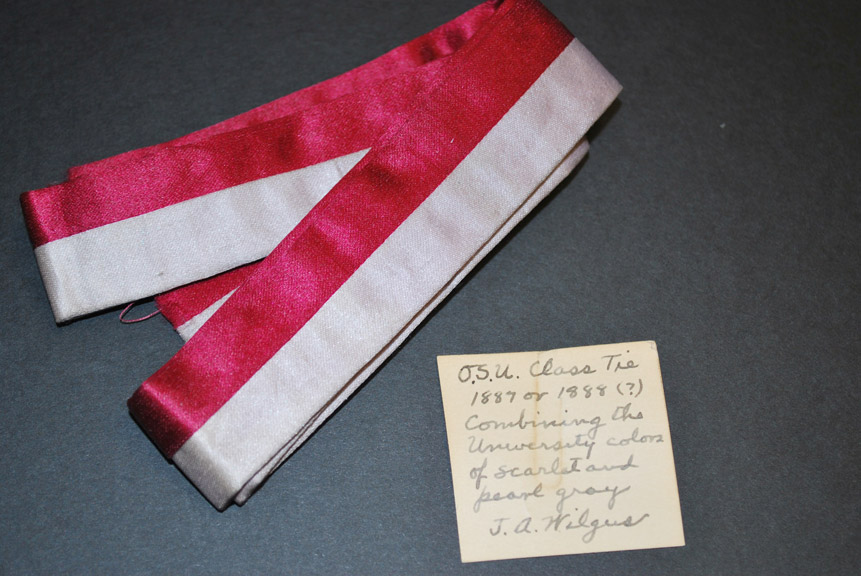
Wilgus' tie, c1887-1888

Wilgus’ tie, c1887-1888

We’d like to focus today on the unsung heroes of Archives everywhere: those individuals who decide the “old stuff” in their lives needs a more permanent home. So they take on the sometimes herculean task of finding just the right place and sending the materials there.

Take, for instance, Peggy Wymore. She has absolutely nothing to do with OSU, except for the important fact that her grandfather, James Alva Wilgus, earned his bachelor’s and master’s degree from OSU (1888 and 1889, respectively). He then spent many years in education, retiring from the State Teachers’ College in Wisconsin in June 1939 as a professor of History and Social Sciences. He died two months later.

Peggy Wymore, donor of Wilgus material

Peggy Wymore

So his OSU materials – the coolest thing is his scarlet-and-gray class tie –survived nearly 75 years, thanks to the Wilgus family, including Peggy, who was the last one to have these items in her possession and who contacted the Archives to see if we would want his things. We sure did. And, in fact, we were so thrilled, we wrote a blog about him.

Luckily for the Archives, there are many people like Ms. Wymore who can’t bear to discard such items as the class tie – an item we had never seen before – and they do the legwork to track down the Archives to ask if we want the materials. They carefully pack these items, often providing much-appreciated detailed explanations, then ship them to the Archives, often at their own expense, from all over the country.

Naddy's ROTC uniform

Naddy’s ROTC uniform

It is the explanation of an ROTC unifom that makes this particular donation stand out. In 2006, John Naddy donated the jacket, pants and hat he wore while he was in ROTC at OSU in the early 1940s. Back then, all male students had to take military science classes; however, at this particular time their training took on extra meaning since war was imminent. For Naddy, as with many young men of his generation, he recounted his story very matter-of-factly in a letter that is so priceless in its charm, and what it divulges about that time period, that we urge you to read it for yourself.

Then, there are the donors for whom it’s a no-brainer on where their precious keepsakes should end up permanently. Arthur “Jerry” Grundies was one such donor. Grundies was a varsity tackle who played OSU football under Coach Francis Schmidt from 1938 to 1940.

Grundie's football uniform

Grundies’ football uniform

Grundies at a 2008 football game

Grundies at a 2008 football game

Grundies didn’t play professionally after college; he went to war instead, serving in the U.S. Army in Italy and North Africa, and earning a Purple Heart and Bronze Star along the way. After the war, he became a sales representative for various oil companies in the region until his retirement. In 2002, Grundies donated his football uniform to the Archives – it’s the earliest version we have and one of the most often displayed items in our collection. He had a strong connection to OSU, so strong that the Archives received holiday cards from him until his death in 2010.

No matter why people donate materials to the Archives, we are extremely grateful that they do. Such artifacts are so helpful in helping us demonstrate through exhibits and tours the history of Ohio State, and we look forward to sharing them with our patrons and visitors for many years to come.

WWII hero Don Scott ‘brought great credit to his alma mater’

Don Scott, 1939

Don Scott, 1939

When World War II broke out, many OSU students immediately signed up to join in the fight, suspending their studies for a much greater cause. Probably none of them was more well-known than Don Scott, the archetypical Big Man on Campus.

And here’s why: After entering Ohio State in 1938, Scott participated in baseball, track, basketball, and most notably football. In addition to being on the Players’ All American team for football and the first Big 10 Championship for basketball, Scott was also elected to sophomore, junior and senior Honor Societies as well as being a member of the Phi Delta Theta fraternity.

Don Scott, 1941

Don Scott, 1941

After enlisting, by May 1941, Scott, along with other OSU athletes were stationed in Tulsa, Oklahoma, for Air Corps Training Detachment. By October, Scott had completed training and had advanced to get his wings and commission in the Army Air Corps. He was eventually promoted to a Captain.

Unfortunately, on October 1, 1943, at the age of 23, Scott was killed in a bomber crash over England. This marked the 100th alumnus or former student to give his life in World War II. One week after his death, on October 8, his wife gave birth to their child, Don Sands Scott.

Meanwhile, in the spring of 1942, the U.S. Navy leased Port Columbus to train its pilots. At the time, OSU was using Port Columbus for its own civilian pilot training program, and the Navy’s lease would pretty much have doomed OSU’s program to failure. However, OSU Prof. Karl W. Stinson, a lieutenant in the Air Corps of World War I and a professor in the Department of Mechanical Engineering went to then-OSU Pres. Howard Bevis with an idea: Build an OSU airport.

President Bevis and Carl Steeb, then-University Business Manager, considered the idea, liked it, and found $100,000 for the project. Stinson himself scouted the nearby then-countryside, and found a flat portion of land near what is now Sawmill Road. Ohio State purchased 385 acres (larger than Port Columbus), and set about building a hangar, runways and fences.

Don Scott Field, 1949

Don Scott Field, 1949

Soon after Scott’s death, President Bevis presented a resolution to the Board of Trustees that read, in part:

[Scott] was one of the nation’s great athletes; he was a sportsman in the finest sense of that term; he was a thorough gentleman, beloved by all who knew him; his life brought great credit to his alma mater. … As a fitting commemoration … I desire to propose to this Board that the airfield now owned and operated by the University be designated ‘Don Scott Field.’

The board approved the resolution and the newly named Don Scott Field was used by the Navy until the end of the war, when OSU transferred its focus to a civilian aviation curriculum.

– Filed by B.T.

Older posts Newer posts