When President Barack Obama steps up to the podium at Commencement on Sunday, he will be the fifth U.S. President to do so. Obama is actually the third sitting U.S. President to speak at an OSU Commencement; he follows Gerald R. Ford and George W. Bush in that role. Other U.S. Presidents have spoken, but not while they were in office. George H.W. Bush spoke while he was still in his first term as Vice President under Ronald Reagan and Bill Clinton spoke seven years after he left office.
Below, we’ve printed short portions of their commencement speech transcripts. See if you can match the speech to the President. Answers are at the bottom of the blog, as is a link to the page on our web site where you can find a list of all our commencement speeches, as well as links to speech transcripts. You may find this exercise harder than it sounds. It turns out commencement speakers often talk about the same things that are perennially important to new graduates: job prospects and the economy in general, their future role in society, and the future of both the nation and the planet. Good luck!
Speech No. 1:
As fellow human beings, we celebrate the rising capacities of the Chinese nation, a people with firm belief in their own destiny. However, as Americans, motivated by free competition, we see a distant challenge. And I believe all Americans welcome that challenge. We must compete internationally not only to maintain the balance of trade in our standard of living, but to offer to the world’s impoverished examples and opportunities of a better life. We should do that for humane and for perhaps even self-interest. … And I am confident that America’s youth will make the difference. You are America’s greatest untapped source of energy. But energy unused is energy wasted. …
Speech 2:
Some believe [a] lesson in service is fading … Your generation will respond to these skeptics – one way or another. You will determine whether our new ethic of responsibility is the break of a wave, or the rise of a tide. You will determine whether we become a culture of selfishness and look inward – or whether we will embrace a culture of service and look outward. Because this decision is in your hands, I’m confident of the outcome. Your class and your generation understand the need for personal responsibility – so you will make a culture of service a permanent part of American life.
Speech No. 3:
Your most immediate concern is probably the economy. Most of you will be leaving her to go out and look for jobs, and while I can’t promise it will be easy, I can tell you that the overall economic picture looks better than it has in a long time. … All the indications are that this recovery that we’re in the middle of now is strong and will be lasting. … The greatest danger that we as a nation now face is the psychology of fear of retrenchment – that means giving up on the promise of the future, holding tightly to the past, even as it steadily shrinks and dwindles in our grasp.
Speech No. 4:
First, it is necessary to understand the promise and peril of the 21st century world, an age of unprecedented interdependence for good or ill. Interdependence simply means we can’t escape each other. A lot of it is exciting … But interdependence also means we share common vulnerabilities to terror, to weapons of mass destruction, to diseases like avian influenza, to the rampant inequalities in the world, to all the political conflicts rooted in religious and ethnic identities, to climate change … We can’t escape on another’s challenges. … We have to see each other because, in an interdependent world, we really can’t succeed without each other. That will be your great challenge. …

President Ford, 1974
Answers:
Speech 1: Gerald R. Ford spoke at the Summer Commencement ceremony on August 30, 1974 – barely a month after being sworn into nation’s highest office after Richard Nixon resigned. Ford had been to China several months before in his official capacity as then-Vice President.

President Bush, 2002
Speech 2: George W. Bush spoke at the Spring Commencement ceremony on June 14, 2002 – just three months shy of the first-year anniversary of the Sept. 11, 2001, attacks. At the time, many young people were joining the military, training to become firefighters and police officers, and generally trying to find ways to serve their country in the aftermath of the terrorist attack that killed more than 3,000 people, including Pentagon military personnel, and New York firefighters and police officers.

Vice President Bush, 1983
Speech 3: George W. Bush’s father, George H.W., spoke on June 10, 1983, at the Spring Commencement ceremony, while still serving as Vice President under Ronald Reagan. After a two-year recession at the beginning of that decade, the country was experiencing sustained growth at the time Bush spoke and would continue in this pattern until 1990.

Clinton, 2007
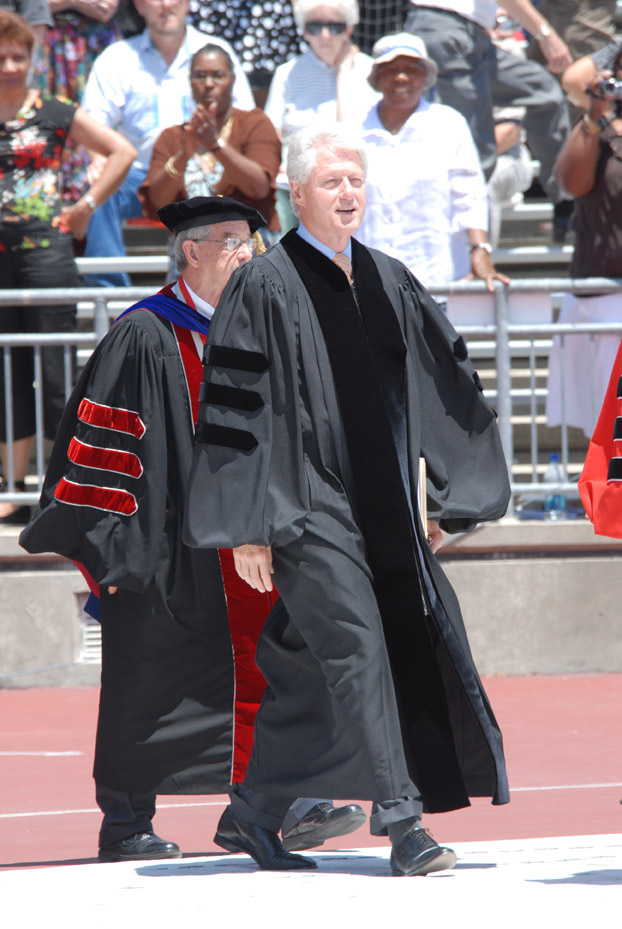
Speech 4: Bill Clinton spoke on June 10, 2007, at the Spring Commencement ceremony, seven years after he left office. In 2005, Clinton formed the Clinton Global Initiative to bring together young people who are committed to solving issues of global importance.
Visit our website for a list of commencement addresses with links to transcripts.


 We recently received from the School of Music a scrapbook of sorts kept by former Music Prof. Theron R. McClure, who started a series of free performances of chamber music in the Hopkins Hall Gallery he called “rug concerts.” The first concert was held in April 1974 – on the rug of the Gallery – and it featured lutes. No chairs were provided for concert-goers; they had to sit on the rug, which is another reason McClure came up with the name. When the weather warmed up, the concerts migrated outside to the Oval, and when the weather got cold again, the concerts returned to the indoor venue.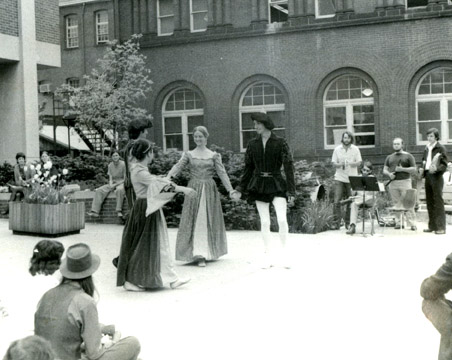





Recent Comments