Editor’s Note: Recently, Peggy Knight graciously donated the Varsity “O” sweater her father, Arthur Gordon Knight, earned as a member of the OSU Track and Field Team in 1938. It turns out that while Knight had the legs of a racehorse, as it were, he also had the heart of a poet: In 1949 the then-married student, who had interrupted his studies to serve in World War II, won a short-story contest for “The Shovel.” His own story seemed intriguing, so we asked Peggy to tell us more about her father. Below is his story, which we have edited for length.

1938 men’s track team. Knight is in the second row, fourth from the right
The son of immigrants, Knight was born in 1917 and grew up in Lakewood, Ohio. One of Peggy’s first stories about her father was when he was about eight years old. His older sister had diabetes, and there were no insulin shots at the time to help regulate her blood sugar. He kept an eye on her, though, so he could prevent an “episode.” As Peggy says, “One time… as they walked together he saw she was shaking and sweating profusely. Knowing she had little time before collapsing, he reached in his pockets hoping to find a bit of candy that he normally carried for her. He did not have any but he also knew the best thing for her was a glass of orange juice. He had no money and there were no stores about, so he ducked into a neighborhood bar. The bartender tried to run him out thinking he was a mischievous neighborhood scamp, but he quickly explained the situation and the bartender was happy to provide the juice. Even then, my dad showed great compassion and sense of responsibility.”
Knight was extremely curious about the world, so he decided after he graduated from high school to do some exploring. He spent six months traveling around Mexico, including doing some digging in the ruins of Oaxaca. When he returned home, he decided to attend OSU, thinking at the time he would become a Geology major. After arriving on campus in the fall of 1936, however, he switched majors to English Literature, in the hopes it would better prepare him for a career that would allow him to explore and write about the world.
Knight was also interested in sports, and he decided to participate in either OSU’s football or track program. After spending time in a few football practices, he realized he was not going to excel and would probably spend most of his later life nursing old injuries from the game. He focused then on track and field, helping the OSU team establish new team records in the mile-relay event in 1938. He was good enough to earn a Varsity “O” sweater that year, and he started dreaming of going to the 1940 Olympics.

Knight’s Varsity “O” sweater and a photo of the 1938 team
However, his dream was never fulfilled because of World War II, which also interrupted his studies. Early in 1941, he and Peggy’s mother, Betty, eloped, and in June, he enlisted in the Army. According to Peggy, her father did not talk much about the war, but he did share several anecdotes with her, one of which was about being an ordinance officer with “a knack for bombs. He became the local go-to-guy for bombs that fell but did not go off. He was called out to defuse bombs as needed and, as a child, I saw many gold-toned flaming bomb pins in his dresser drawer that he was given after each bomb was unarmed. He told me he was very happy he was a smoker because his matchbook was his biggest weapon against difficult bombs. He used the flap to prevent contact between the pin and the explosives.”
When his four years of service were up, the war wasn’t over yet, so he decided to re-enlist, this time in the Air Force. It was during these three years of service – he reached the rank of Second Lieutenant – that he hatched the idea for his future award-winning short story.
A year after returning home and to Ohio State in 1948, Knight enrolled in a short story class, English 507, where he wrote “The Shovel.” It was submitted to the Columbus Chapter of the National Society of Arts and Letters, and won first prize. The story, about a British woman in the days just before D-Day, was described by one judge as “a very profound story,” according to a Lantern article. In the article, Knight said he planned to be a creative writer after he graduated that June.
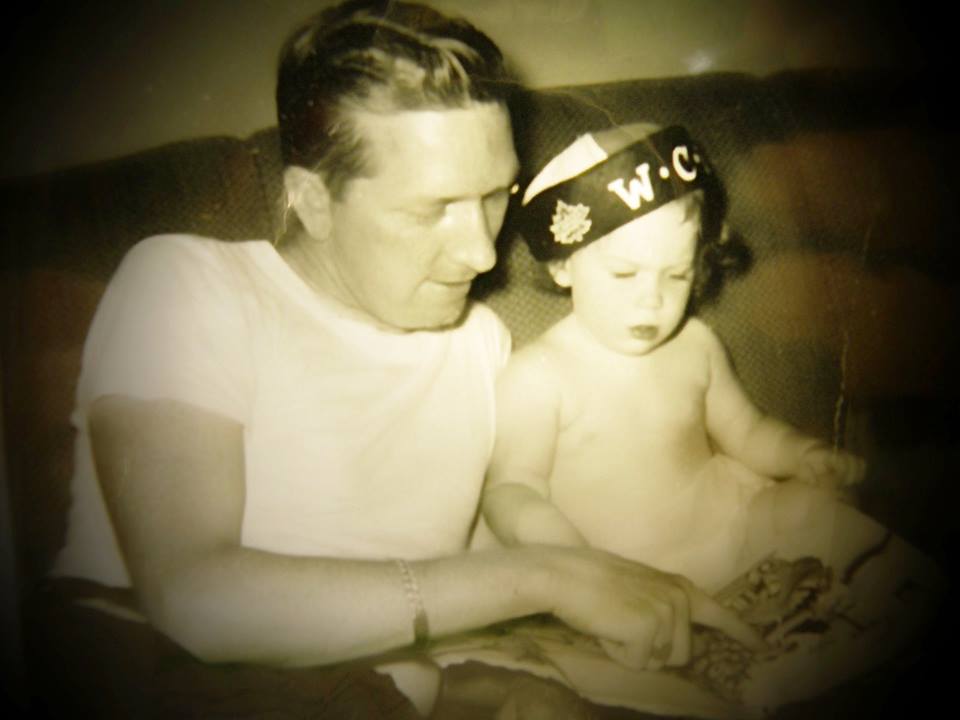
Knight, sharing a book with his daughter, Peggy
But Knight had a family to support (Peggy was adopted in 1953) and he began working in his father’s insurance agency. He and his family eventually moved to Galveston, Texas, though, where he became vice president of the American National Insurance Company. Because of a heart condition, Knight decided to retire early, and that’s when he was really able to satisfy his curiosity about the world and his passion for writing.
In 1970, he opened a rare and antique book dealership, and at about the same time, he became a columnist for the Galveston Daily News. “Now, his life was everything he hoped for in a career,” Peggy says, “he bought and sold rare books, 13th-century manuscripts and other types of writing, and spent hours reading them before selling them. He was filling additional hours with writing his editorial columns. And on occasion, he locked himself in his home office where I could hear his ‘new and modern’ electric typewriter clacking away with determination.”
His career as a Galveston columnist came to an abrupt end when he submitted a column about the “Johnson Memorial.” It was about a pull-chain toilet affectionately known by that name at the Rowfant Club in Cleveland (a literary society of which Knight was a long-standing member). According to Peggy, “no matter how good the article was or what the history of the water closet was, the publishers of the paper felt that the cultured ladies of Galveston society would not be pleased with talk of toilets, even in the modern age of the ’70s. My father refused to be censored and pulled out of the ‘editorial comment’ business.”
After a flood destroyed much of their home – including many of Knight’s books and other life treasures – he and Betty moved to Ocala, Florida, where he died in 1987 at the age of 70 from melanoma. Peggy concludes:
“In his effects, I found nine unpublished and unfinished novels on which he’d been working.
He was a great man to many, an enemy to none. He was a hero to me.”
We would like to thank Peggy for her wonderful donations, and we say donations because she not only provided us with a beautiful Varsity “O” sweater, but also a wonderful recounting of her father’s life. Our records focus mostly on him being an OSU athlete, so we appreciate her taking the time to show that his own story was much more than that.


 Last spring, the University Archives was contacted by Stephane Renner, a Frenchmen, who said he had discovered an American Soldier’s World War II dog tag while metal detecting in the Rosny sur
  Seine forest in northern France. Renner hoped the Archives could assist him in tracking down the soldier’s family, so the identification tag could be returned to them. While the Archives staff typically handles only requests that involve the University, the staff felt compelled to help Renner find the soldier’s family.
 In an effort to find the family, Archives staff utilized Ancestry.com, and also searched through censuses, war registration cards and city directories. Staff soon discovered that Alfred Bowland enlisted December 9th, 1941, as a result of Pearl Harbor. Bowland survived the war, got married 1947 and had three children. He passed away in 1995 at the age of 80.
 were introduced and connected over the newly discovered dog tag.
 The Archives also is thankful to Stephane Renner and Roger Bowland for keeping us informed on their story and keeping history alive. A special thank you to Stephane Renner for his dedication to returning historical material to its rightful owner.





Recent Comments