From Woody's Couch

Our Playbook on OSU History

Category: Early University history (page 5 of 14)

Twelve Days: Kleberg’s true colors shine through as a donor

(In celebration of the University Archives’ upcoming 50th Anniversary in 2015, we bring you “The Twelve Days of Buckeyes.” This is day 10 in a series of 12 blog posts highlighting the people who were instrumental in the creation and growth of the Archives.)
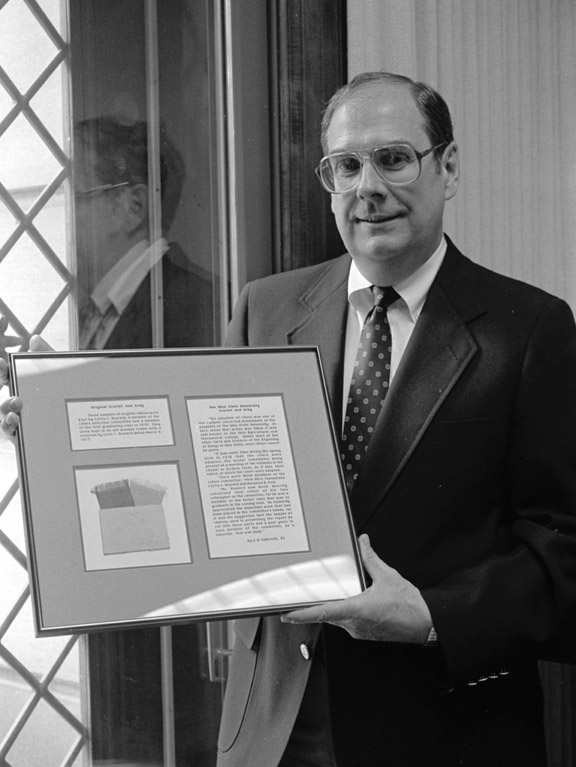
John Kleberg with the scarlet and gray ribbons, 1989

John Kleberg with the scarlet and gray ribbons, 1989

There is nothing more synonymous with being a Buckeye than the colors Scarlet and Gray. And the person Buckeyes can thank for preserving the earliest beginnings of those OSU colors is John Kleberg.

First, a little background on Kleberg: He came to OSU in 1973 as associate director of Public Safety, taking charge of the operations side of the Campus Police unit. In 1981, he was appointed as director of the University’s internal audit unit in the Office of Business and Finance.

Although his background is in law enforcement, he has been heavily involved in preserving OSU history since his retirement in 2000 as assistant vice president of Business and Finance. (He returned in 2001 as Special Assistant to the Vice President of Student Affairs.) For instance, he’s served on the committee that coordinated the program to record, preserve and restore works of art on campus. He’s also spent much of his university-related time after retirement in raising money and awareness for the historic Cooke Castle on Gibraltar Island in Put-in-Bay.

Cooke Castle was built by Jay Cooke, the Civil War financier who bought Gibraltar Island in 1864. There, the family entertained such dignitaries as Supreme Court Chief Justice Salmon P. Chase, President Rutherford B. Hayes and General William Tecumseh Sherman. In 1925, Cooke’s daughter, Laura Barney, sold Gibraltar Island to then-OSU Board of Trustees member, Julius Stone, who immediately donated the property to the University to house a lake research facility that would become Stone Lab.

Cooke Castle, 2001

Cooke Castle, 2001

Kleberg has worked tirelessly to restore the historic Cooke Castle, and in fact, with his help, the first floor of the Castle, which had been closed for a number of years, is now open to the public at certain times. The Archives also has benefited from Kleberg’s interest in Cooke Castle; three years ago, he gave us a number of materials he’d gathered on Jay Cooke.

Kleberg has given a myriad of items to the Archives over the years. They often represent the more mundane history of a large educational institution – an old class microscope he picked up at a University surplus auction or two police badges from the Department of Public Safety.

Then, there was the truly one-of-a-kind historical artifact he donated that makes him a standout among donors: the original scarlet-and-gray ribbons that adorned the diplomas of the first graduating class in 1878.
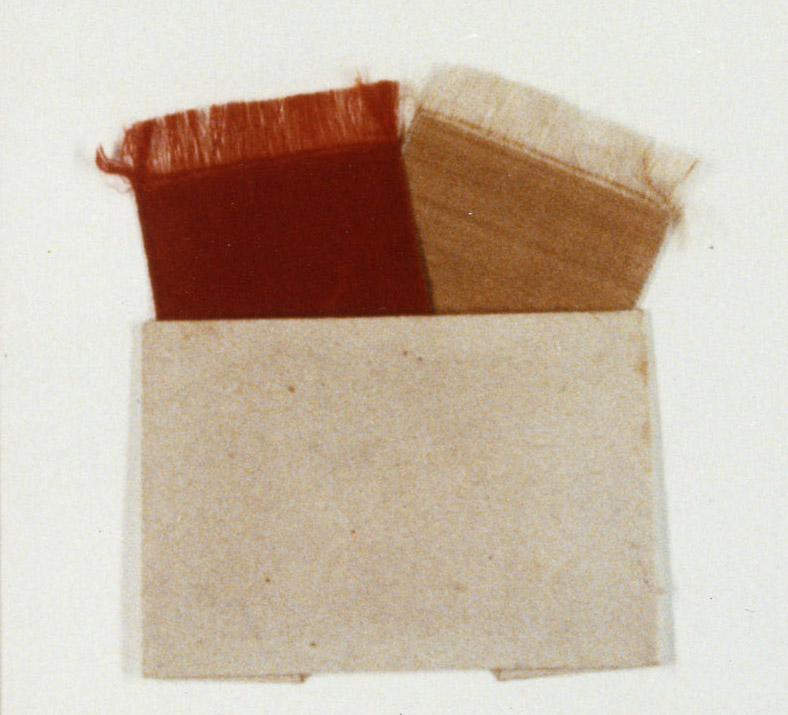
Original scarlet and gray ribbons

The original scarlet and gray ribbons

When it was almost time for Commencement that year, the class assigned a committee of three to pick out a pair of sample ribbons to determine which color of ribbons would be tied around the diplomas. The original pair of scarlet-and-gray ribbons they chose were cut into three parts, and a section was given to each committee member as a memento. Years later, one of the members – Curtis Howard – found his and presented them to the University in a frame with a letter attached to the back explaining their significance. They were hung in Sullivant Hall, but as sometimes unfortunately happens, the framed ribbons went missing at one point.

In the late 1980s, a gentleman identifying himself only as an attorney representing an estate in Florida, showed up in Kleberg’s office with the ribbons and some documentation. Kleberg did some subsequent research and determined they were most probably part of the original ribbons. And then, he made sure they made it to the Archives.

Without his dedication to preserving OSU history, those ribbons may have ended up in Kleberg’s wastepaper basket, and Buckeyes would not have these priceless reminders of how we became so devoted to Scarlet and Gray. So for all his contributions to OSU, we give him a hearty thanks from the Archives!

Twelve Days: Bradford had picture-perfect dedication to University photographs

(In celebration of the University Archives’ upcoming 50th Anniversary in 2015, we bring you “The Twelve Days of Buckeyes”. This is day three in a series of 12 blog posts highlighting the people who were instrumental in the creation and growth of the Archives.)

Joseph Bradford, c1883

Joseph Bradford, c1883

When University officials first asked Joseph Bradford to join the faculty, he turned them down. Thank goodness they named him an instructor anyway, or the Archives might not now have photos of the University from its early days.

Bradford was actually a graduate of OSU, earning a degree in Mechanical Engineering in 1883. He was a draftsman with the Pennsylvania Railroad when he was asked by the College of Engineering to organize a course in engineering drawing. Having no interest in being an instructor, he declined the offer. Nevertheless, the Board of Trustees named him an instructor in mechanical and freehand drawing in 1885, with a salary of $1,000 a year.

As a member of the faculty, he taught engineering drawing and architecture, and pioneered instruction in photography, with the first course in “picture-making” offered in the United States in 1890. By 1903 he had published “Photographic Notes for Students in the Ohio State University,” which explained the technical aspects of photography and gave helpful hints on how to be a better photographer.

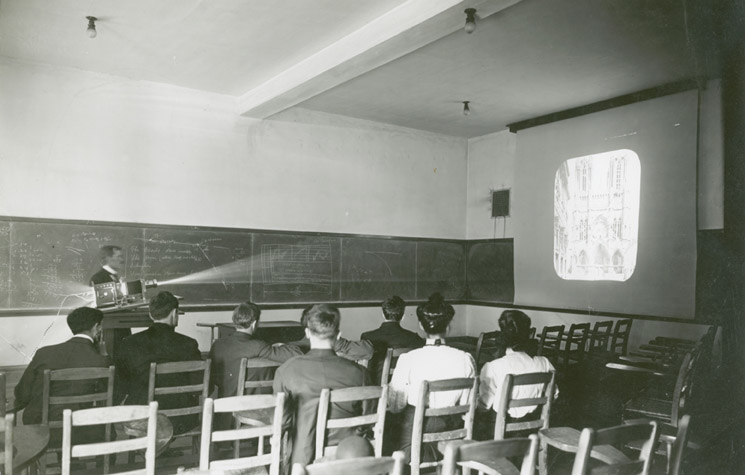
Bradford is shown here teaching a History of Architecture Class using the first electrical lantern slide projector at OSU. This class was held in Hayes Hall in 1895.

Bradford is shown here teaching a History of Architecture Class using the first electrical lantern slide projector at OSU. This class was held in Hayes Hall in 1895.

In 1911, Bradford was named University Architect, and he built an impressive portfolio in that area, designing 40 buildings on campus. His work includes such landmarks as Derby Hall, Jennings Hall (then the Botany and Zoology Building), the Kuhn Honors and Scholars building (then the president’s residence), Starling-Loving Hospital, and Sullivant Hall.

But his love of photography is what makes him special to the Archives.

F.W. Davis, Chair of the Department of Photography, and Joseph Bradford in the Photo History Vault in Brown Hall, 1940

F.W. Davis and Joseph Bradford in the Photo History Vault, 1940

In 1931, Bradford received approval from the Board of Trustees to start a Photographic History Unit in the Department of Photography. The unit’s purpose was to “make a complete photographic pictorial record of the progress of the University, its departments, and changes in its personnel,” according to a February 1931 Alumni Monthly article.

Bradford, who had been associated with the University since 1877 when he matriculated as a freshman, was made Emeritus Professor in 1932 and at that point took full charge of the Photo History Division. Bradford worked tirelessly organizing, filing and cataloging historical University photographs. He collected the earliest images from local photographers while also soliciting photographs from University staff and former students. By 1935, Bradford had accumulating about 16,000 prints and negatives. This collection was to eventually become the beginning of the University Archives’ photographs collection.

A hand-colored glass slide from Bradford's collection.

A hand-colored glass slide from Bradford’s collection.

Bradford also used his own campus photographs, even coloring some of them by hand. He was well known for giving his “Campus Memories” presentation, a Lantern slide show, which highlighted the early history of the University and included photos of buildings, geography, athletics, events, faculty and classrooms. You can see a sampling of the images from his Campus Memories slide show on the Archives’ Flickr gallery.

Bradford died in 1944. However, the Department of Photography continued to add to the collection he had worked so hard to build, photographing the buildings, faculty and grounds of the University.

In 1972 the photographic archives became part of the University Archives and now contains more than two million photographs depicting the history of the University from 1870 to the present time. Because of Bradford’s love of photography and his obvious dedication to the University, we can witness the enormous growth of a campus through his extensive collection of photos that are housed here at the Archives.

Twelve Days: Without Reuben Cannon, there might not be a Buckeye Nation

(In celebration of the University Archives’ upcoming 50th Anniversary in 2015, we bring you “The Twelve Days of Buckeyes”. This is day one in a series of 12 blog posts highlighting the people who were instrumental in the creation and growth of the Archives.)

Reuben P. Cannon, 1870

Reuben P. Cannon, 1870

When Congress passed a law in 1862 establishing the nation’s land-grant university system, it didn’t mean it was a done deal that there would be such a college in Ohio. The law allowed states to sell federal land out west to create endowment funds that would be used for university instruction in agriculture, mechanical arts (now known as engineering) and military science. But the whole thing was voluntary, so after the law passed, legislators in individual states began arguing over whether to take up the feds’ offer.

It was a long debate in Ohio, because there was much to consider. One of the biggest questions was, if Ohio sold the land and raised the money, would it be used for a new school or go to one currently in existence? After all, there were a number of colleges, such as Ohio and Miami universities, that would gladly use the money for instruction in agriculture and mechanical arts.

Enter Reuben Cannon.

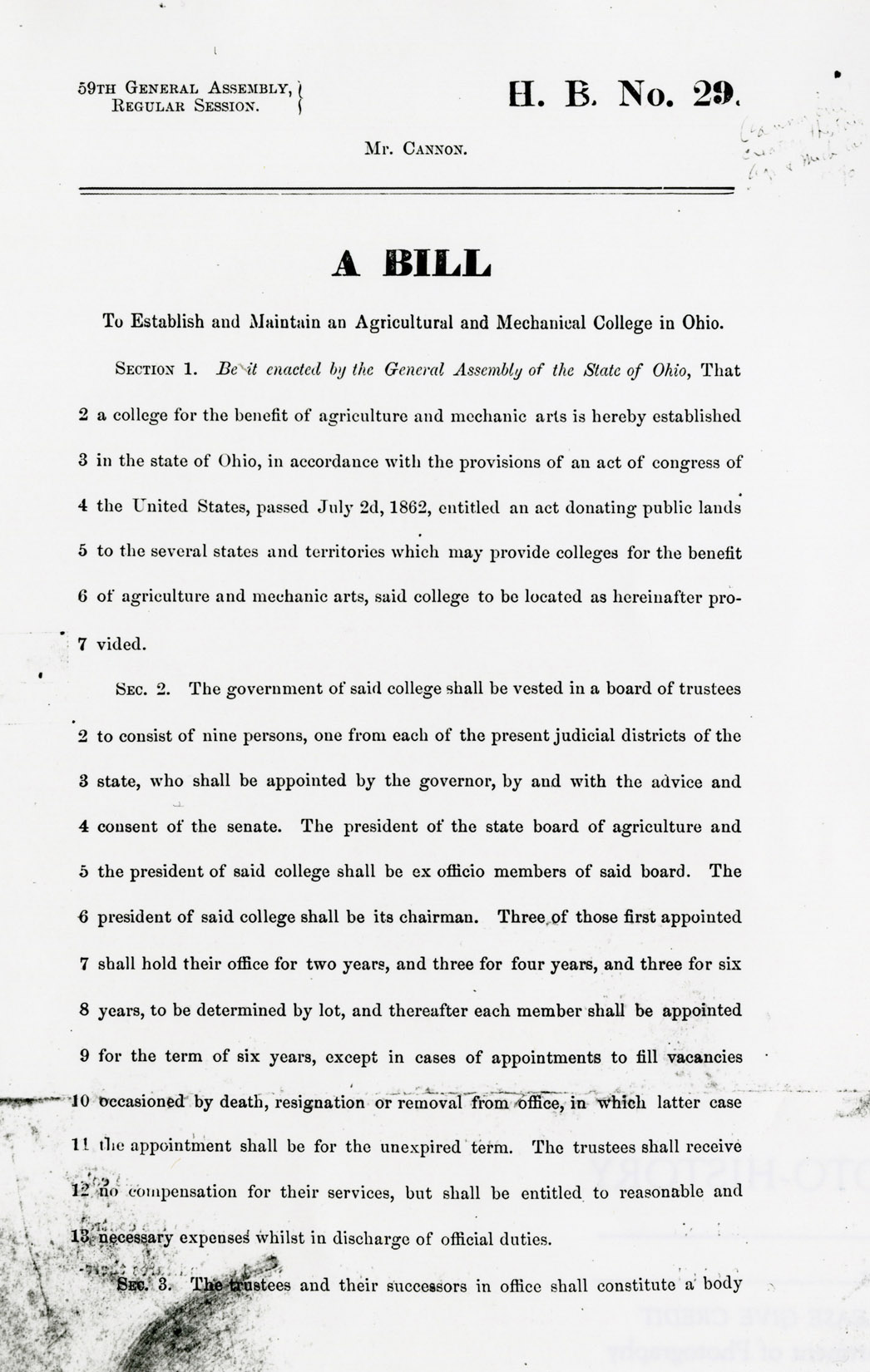
The Cannon Act

The Cannon Act

In 1870, Cannon, a General Assembly member from Portage County, proposed a bill to establish a brand-new university: the Ohio Agricultural and Mechanical College.

The Cannon Act of March 22, 1870, proposed a board of trustees of 19 members—one from each congressional district in Ohio—who would make decisions regarding this institution. These decisions included its curriculum, faculty, administration, and location.

Some specifics that the trustees implemented were that the location must not be less than 100 acres; it had to be in the center of the state, and it had to be accessible by railroad from parts of Ohio. This new college would have to be open to those over 14 years old, and it would have to have, at the very least, four departments: agriculture, mechanic arts, military science, and literature. Neil Farm, between Olentangy and Worthington Road, was chosen for the new campus.

In September 17, 1873, the Ohio Agricultural and Mechanical College would open its doors to 24 of its 40 applicants, including two women, from eleven counties.

Cannon is now known as the “father of Ohio State,” for without him, we may not be here at all!

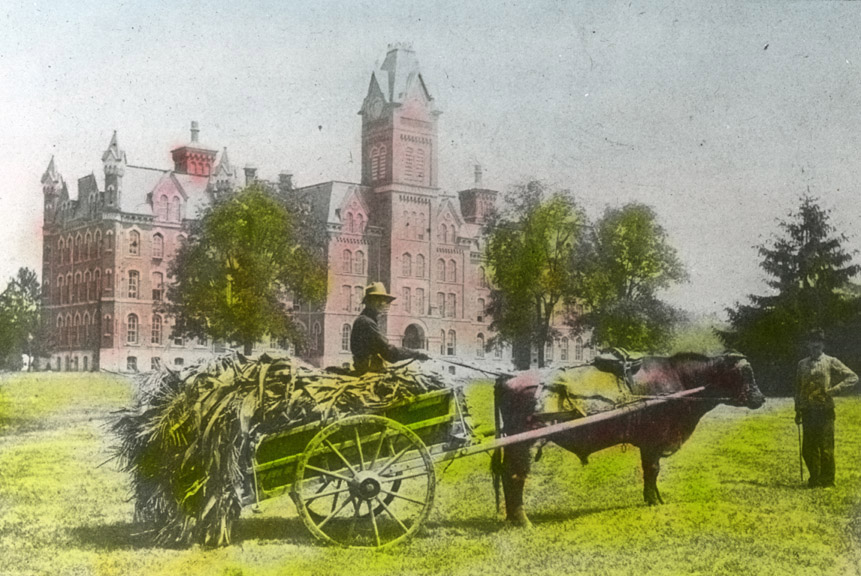
1873

1873

Older posts Newer posts