From Woody's Couch

Our Playbook on OSU History

Author: drobik.5@osu.edu (page 7 of 62)

Twelve Days: From production to preservation, film pioneer left his mark on Archives

(In celebration of the University Archives’ upcoming 50th Anniversary in 2015, we bring you “The Twelve Days of Buckeyes.” This is day 8 in a series of 12 blog posts highlighting the people who were instrumental in the creation and growth of the Archives.)

Robert Wagner, 1961

Robert Wagner, 1961

The University Archives was in its infancy when Robert W. Wagner became Chair of the Department of Photography and Cinema in 1966. But Wagner’s leadership in the development of using motion picture film as an effective tool in communication and teaching, would ultimately lead to enriching the Archives’ audiovisual collections to what they are today.

First, a little background: Wagner came to Ohio State as an undergraduate and received three degrees from the University: his bachelor’s in 1940, a master’s in 1941 and a PhD in 1953. He began his career at Ohio State in 1941, as an assistant in the former Bureau of Educational Research.  He became a faculty member of photography in 1946, and then chaired the Department of Photography and Cinema from 1966 to 1974.

Wagner was noted as a “film-television educator whose contributions to curriculum, technique and professionalism have been recognized throughout the world.” Not only were hundreds of educational films – now housed in the Archives – produced under his chairmanship, Wagner also had an intense interest in the work archivists did in preserving photographs and motion picture film.

In 1968, Wagner presented a paper at a meeting of the Society of American Archivists regarding preservation concerns and dangers of nitrate-based films. (Nitrate film, produced from the 1880s to the 1950s on 35mm film, was made with a cellulose nitrate base, which is highly flammable and sometimes explosive under certain circumstances.)

“Today, at this moment, the record of a whole field of human effort is on fire: yet so few people are concerned that the remains are likely to crumble to a foul-smelling brown dust before the holocaust can be made public, let alone put out or even controlled….If we fail to plan for the future as well as the past, we shall perpetuate and accelerate the loss of our film and television heritage”.

Wagner’s compelling and persuasive presentation must have given archivists of the time a lot to think about.

1983

1983

Though his numerous achievements in teaching, film production and research throughout his career could have made for a comfortable retirement, Wagner’s story did not end there. Far from it.

Wagner gained the title of “emeritus professor” in 1984 and continued his quest of film education, believing that every film, video or photography studio or study center in major universities should include a course or seminar on the topic of the preservation of media. He pursued this topic, teaching film preservation workshops to graduate students and to librarians.

More than a decade after retirement, Wagner became a volunteer for the University Archives and the Byrd Polar Research Center Archival Program. He spent many hours hunched over a small manual film viewer, watching and describing early color film shot during Admiral Richard E. Byrd’s Expedition in Antarctica in the 1930s. Consequently, he later assisted the Polar Curator in secure a grant to preserve the expedition films.
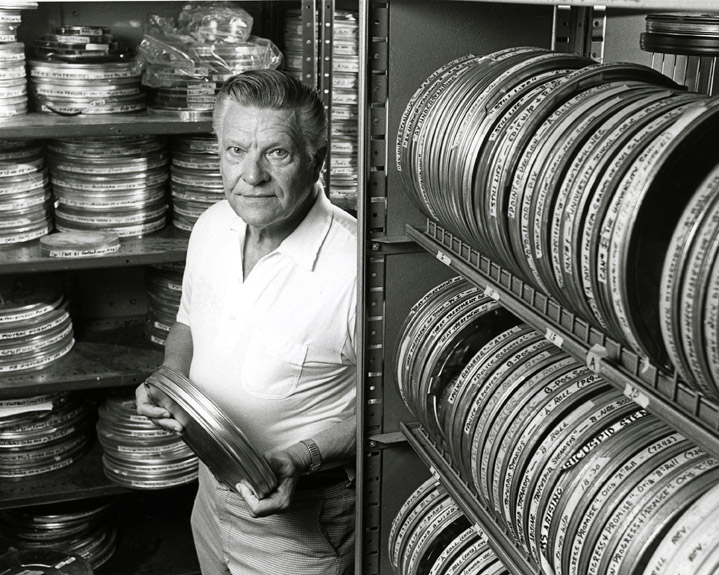
1987

1987

He also worked with the University Archives’ collection of Photography and Cinema motion picture films, describing and transcribing them so that they would be more accessible to researchers. Working tirelessly to document the physical condition of the film in the Archives, he passed this information along to staff to continue the legacy. He also frequently served as the Archives’ consultant on audiovisual resources, and often visited the Archives to work with patrons interested in film.

On many occasions, Wagner served as mentor to Archives staff members, educating them on the identification, handling, and preservation of film. In a memorable display of hands-on teaching, he showed an Archives staff member how quickly a small piece of nitrate film could burst into flames (in the Archives parking lot, of course).

The Archives staff is eternally grateful for the contributions made from this great film pioneer. We leave you with one of his quotes:

“The worthy though unrewarding task is to protect and perpetuate our motion picture heritage – a form of human communication, creating expression and historic documentation so unique to the United States that cinema has almost become our second “language.” The job is to preserve this heritage on film, this visual literature for our time and for the future.” – Robert W. Wagner, The American Archivist, 1969

We could not have said it better.

Wagner died on February 7, 2011.

You can find several films from the Department of Photography and Cinema on the Libraries Knowledge Bank.
Twelve Days: Jesse Owens’ legacy lives on at the Archives

(In celebration of the University Archives’ upcoming 50th Anniversary in 2015, we bring you “The Twelve Days of Buckeyes”. This is day seven in a series of 12 blog posts highlighting the people who were instrumental in the creation and growth of the Archives.)

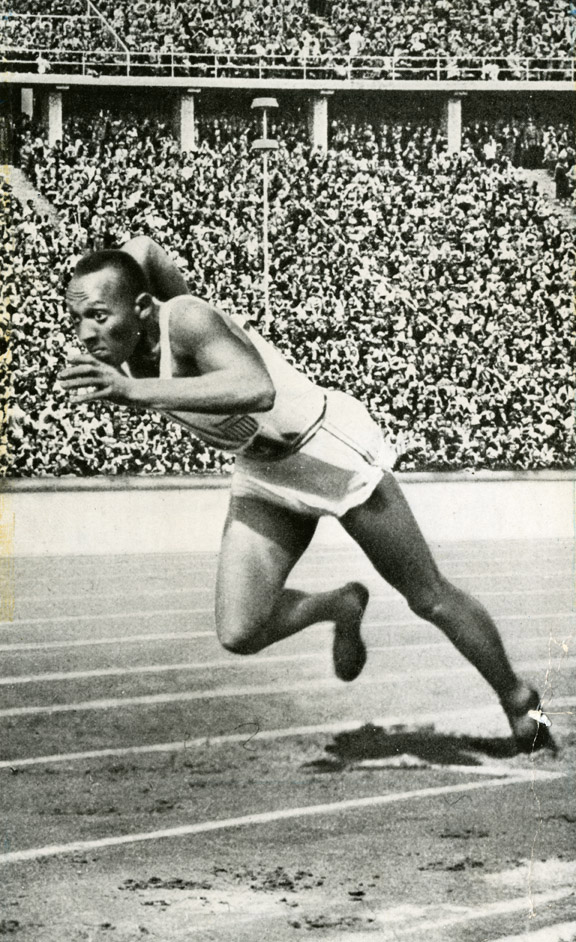
Owens competing in the 200 meter dash at the Berlin Olympics, 1936

Owens competes at the 1936 Olympics

Though Jesse Owens’ most famous accomplishment happened more than 75 years ago, many people today still remember what it was – winning four gold medals in track at the 1936 Berlin Olympics – and what it meant – an African-American man showing the Adolph Hitler that his propaganda about the superiority of the Aryan race was bunk.

Fewer people may remember, however, that Owens attended OSU before going on to make history at the Olympics. That doesn’t mean, though, that his collection of papers, photos and artifacts housed here at the University Archives is ignored. Far from it.

The Archives acquired the bulk of collection from Owens’ widow, Ruth, from 1987 to 1990. Additions were subsequently made by the Owens family, particularly Marlene Owens Rankin, one of Owens’ daughters. Most of the collection is composed of materials from when he started attending OSU in 1933 to his death in 1980. The roughly 100 cubic feet of materials include many artifacts such as his Olympic gold medals. But there are also other items that signify his later roles in life, such as a tankard given to him in 1955 for his role as sports ambassador to India, an appointment made by then-Pres. Dwight D. Eisenhower.

Former University Archivist Rai Goerler looks through collection material with Ruth Owens, 1987

Former University Archivist Rai Goerler looks through collection material with Ruth Owens, 1987

Owens' Olympic gold medals

Owens’ Olympic gold medals

Since acquiring the collection and to this day, the Archives has helped many people from all walks of life learn more about Owens. The staff regularly receives requests from filmmakers, documentary makers and book writers for help on their projects to tell Owens’ story. Classes here at OSU will often visit the Archives to look through his materials as part of their research on all kinds of topics, from sports history to English rhetoric.

And the staff always knows when National History Day comes around because every year, without fail, we receive requests from elementary school students from around the country who want to know more about Owens for their projects. Their enthusiasm and curiosity about Owens are an annual delight. In fact, it is always our pleasure and honor to help patrons connect with Owens who, 35 years after his death, can still inspire people from around the world to learn about his life and his legacy.

To learn more about Jesse Owens, see the Archives’ online exhibit about him.  And, check out the Owens’ photographic collection on the Libraries Knowledge Bank.

Twelve Days: Thanks to Studer, Archives finds a permanent home

(In celebration of the University Archives’ upcoming 50th Anniversary in 2015, we bring you “The Twelve Days of Buckeyes”. This is day six in a series of 12 blog posts highlighting the people who were instrumental in the creation and growth of the Archives.)

William Studer, 1986

William Studer, 1986

Until 1978, the Archives did not have a department or unit on campus to call its own. When Bruce Harding, the first professional archivist, was hired in 1965, he reported to the Secretary of the Board of Trustees, then to the Vice President of Educational Services.

In 1978, though, the Archives was reassigned to the Libraries, which was then led by William Studer, director from 1977 to 1999. It made sense: Both entities held a mission of acquiring, preserving and making available information. That year, the Archives joined the Special Collections section of the Libraries.

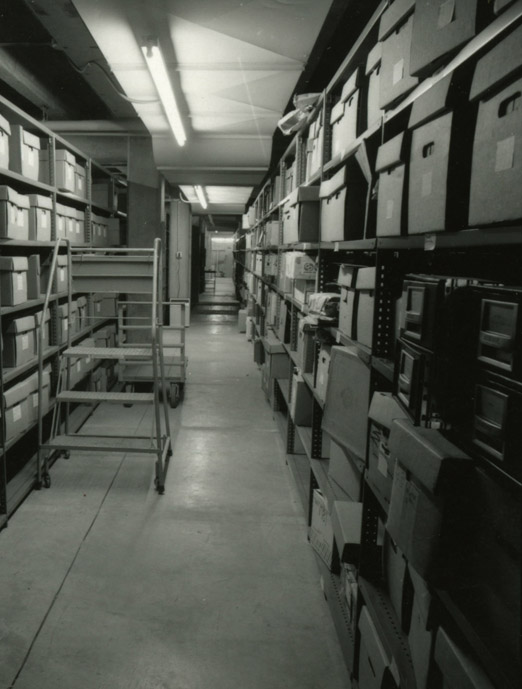
Archives stacks in Converse Hall, 1980s

The Archives stacks in Converse Hall, 1980s

It turns out that Studer had been a long-time fan of special collections like the Archives, understanding the importance they have in any academic library setting. In a 2011 oral history interview, he said “Special collections, in my view, significantly define a research library and its mission to support research and scholarship.”

(The University Archives is not the only collection added to the Libraries under Studer’s leadership; the Billy Ireland Cartoon Library and Museum was founded in 1977, and the Byrd Polar Research Center Archival Program became part of the Libraries’ special collections in 1985.)

As part of the Libraries, the Archives could be protected in times of fiscal leanness, but it would also benefit from more robust budgets, such as in 1980 when the Libraries doubled the Archives’ operating budget and added an assistant archivist.

University Archives/Library Book Depository Building, 1996

University Archives/Library Book Depository Building, 1996

Depository stacks, 1996

Depository stacks, 1996

A key turning point was when the Archives moved in 1995 to the Book Depository on Kenny Road. The Archives had been housed in makeshift facilities, located most recently in Converse Hall, where the ROTC program is housed. (One of the Archives’ reference rooms sat next to a shooting range, not exactly a winning combination.)

Under Studer’s leadership, the plans were adjusted for the building so that reference rooms and office space could be added for the Archives, while its collections shared warehouse space in back of the building with the Book Depository materials.

“I was obviously committed to the University Archives and wanted to make something of it, without realizing fully what it could and would become, wanted to make it something much more than it was. And part of this involved adequate housing,” he said in the oral history interview.

Older posts Newer posts