From Woody's Couch

Our Playbook on OSU History

Author: drobik.5@osu.edu (page 43 of 62)

Jaywalker’s jailing prompts campus chaos

From time to time we receive inquiries from patrons about an incident involving a jay-walking OSU student that eventually led to some serious rioting.

It all started in December 1963, when Marjorie Cocoziello, an OSU student from Paterson, New Jersey, and her friend each received a citation for jaywalking. By February, Cocoziello still had not paid her $5 ticket. So Columbus Police officers showed up with a paddy wagon at her sorority house and arrested her. This was apparently all the incentive that students – including Cocoziello – needed to engineer mass chaos.

The “jaywalking riot”, 1964

According to reports, after the paddy wagon left at about 5 p.m. to take Cocoziello downtown, students who had gathered at the scene migrated to the intersection of 15th and High, the spot where Cocoziello had received her citation. Students then proceeded to hold up traffic for seven hours by playing the game of Red Rover across High Street; chanting and participating in vandalism, such as cutting trolley cables; and climbing atop buses and setting a bonfire in the middle of High Street. The demonstration disrupted bus routes and the commute home for many people before police were able to re-route traffic.

Meanwhile, another 200 students paraded Downtown to protest at the police station. Seven students – in addition to Cocoziello – were

arrested for disorderly conduct. Two were later suspended from school and five were given probation. Cocoziello was released after 90 minutes in a jail cell and a call to her sorority house. Her bond was set at $13.

1964

The media covering the event then became part of the story. Cocoziello made statements to The Lantern that she was strip-searched at the jail, locked in a darkened cell, and that the jail matron was “cruel.” Later, though, the Chief of Police explained the procedure for booking jaywalking offenders, and refuted Cocoziello’s account that she had been strip-searched. He went on to say that the light had indeed burned out in her cell but was quickly replaced, and the jail matron was one of the nicest ladies you would ever meet. After the investigation, The Columbus Dispatch reproached The Lantern for its account of Cocoziello’s story.

Ultimately, Cocoziello had her day in court, much to the amusement of the onlookers and Franklin County Municipal Court Judge Alan E. Schwarzwalder, who heard her case. He was reported to have said, “After all you’ve been through, I’m not going to charge you a penny” and suspended her sentence, even though he declared her guilty of jaywalking.

To review The Lantern’s coverage of the incident, go to The Lantern Online Archives, which you can find as a link on our home page at go.osu.edu/archives.

Filed by C.N.


Gold-en Days of Summer Olympics past: Part 3

Peter George, 1955

Although the sport of weightlifting has never achieved varsity status at OSU – students have been able to participate through intramurals and clubs – two former Buckeyes not only made it to the Olympics, but won medals. And they’re brothers, to boot.

James George, 1963

Peter and James George, both students of dentistry at OSU, were also competitive weightlifters. In fact, at the age of 14, Peter had won the U.S. Junior Championship and by 17 he won the World Championship. Entering as a middleweight, Peter won silver at the 1948 London Olympic Games. In 1952 he enrolled at OSU and earned a spot on the U.S. team competing at the Helsinki Olympic Games. There, he won gold. Four years later he won a silver medal at the Melbourne games.

His brother, James, joined Peter in Melbourne, competing in the light heavyweight category. He won a bronze medal. In 1960 James returned to the Olympic Games in Rome and won a silver medal. After returning to the United States, James received his DDS degree in 1963.

Once again, we received much assistance from Rusty Wilson’s “The Ohio State University at the Olympics,” an amazing resource for anyone who wants to know more about the University’s connection to the Olympic Games.

Gold-en Days of Summer Olympics past: Part 2

In 1930 Coach Mike Peppe introduced varsity swimming to The Ohio State University, and the sport has produced numerous champions ever since. Under Peppe the swim team earned 12 Big Ten Championships, 11 NCAA National Championships, and 10 AAU National Championships. Along with those accomplishments Peppe coached 312 individual champions, countless world record holders, and sent nine of the 25-member swim team to the 1952 Summer Olympics. The three Buckeyes who have earned gold medals in swimming are Ford Hiroshi Konno, Yoshinobu “Yoshi” Oyakawa, and William “Bill” Melving Smith, who all trained under Coach Peppe.

With much assistance from Rusty Wilson’s “The Ohio State University at the Olympics,” an amazing resource for anyone who wants to know more about the University’s connection to the Olympic Games, we can tell you more about these athletes:

Ford Konno, 1952

The son of Japanese immigrants, Ford Hiroshi Konno was named by his father, an auto mechanic, after the Model-T Ford. At age nine, Konno joined his first swimming class in Hawaii, and by high school he was setting world records.

In 1950 former OSU Olympian Bill Smith saw Konno swim in Hawaii and began recruiting him to join The Ohio State University swim team. At OSU, Konno and Peppe devised a new training program that included shining a beam of light onto the water to help Konno maintain his pace. In 1952 Konno and several other Buckeyes traveled to the Helsinki Olympic Games. There, Konno won two gold medals – one in the 1500-meter freestyle race and another in the 4×200-meter freestyle relay – and a silver medal in the 400-meter freestyle race. After returning from the games, Konno married his high school sweetheart and fellow Olympian, Evelyn Kawamoto. Four years later, at the 1956 Olympic Games in Melbourne, Konno won a silver medal in the 4×200-meter relay.

In 1957, Konno entered the U.S. Army and was stationed in Hawaii, where he coached and developed the Schofield Sharks Swim Club. By 1959 Konno had received his bachelor of science degree in Education, and had earned the most individual titles – 31 – of any OSU athlete at the time. In 1977 Konno was selected for The Ohio State University Athletic Hall of Fame.

Yoshi Oyakawa, n.d.

It took only three years for Yoshinobu “Yoshi” Oyakawa, another native Hawaiian, to go from the beginning of his swimming career – at age 16 – to winning gold at the Olympics. In 1952 Oyakawa, whom Peppe recruited at a Seattle swim meet to attend The Ohio State University, traveled with Konno and several other Buckeyes to the Helsinki Olympic Games. There, he won the gold medal in the 100-meter backstroke. While at OSU Oyakawa won six Big Ten titles, seven NCAA championships, and nine National AAU championships.

In March 1956 Oyakawa received his bachelor of science degree in Education and enlisted in the U.S. Air Force.  In 1978 Oyakawa was selected for The Ohio State University Athletic Hall of Fame.

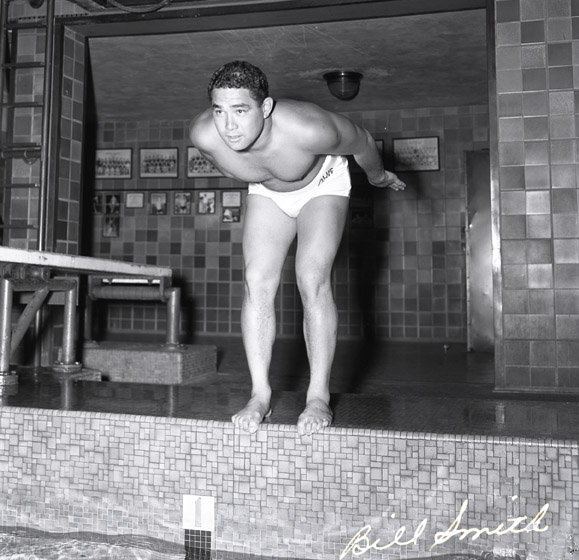
Suffering from typhoid at age 11, William “Bill” Melvin Smith first started swimming when his father brought him to the beach to help him recover. In 1942, Smith enrolled at Ohio State, and though he was not eligible to participate in NCAA sports as a freshman, he still managed to set seven world records and two American records at AAU events. While at OSU, his teammates called him “The Whale” because of his size. (He weighed 215 pounds.)

Bill Smith, 1948


Smith’s swimming career at OSU was cut short by World War II; Smith entered the U.S. Navy where he served for four years. When he returned to OSU, many wondered how well he would swim, given the long absence from the water. In 1948, though, Smith traveled to the 1948 London Olympic Games, where he won gold medals in the 400-meter freestyle race and the 4×200-meter freestyle relay. After his victories, University of Michigan Swim Coach Matt Mann was quoted as saying “Some guys can swim the greatest race of his life but ‘Smitty’ will always do just a little better.”

By the time Smith earned his bachelor of science degree in Education in 1950, he had captured seven NCAA titles and 15 AAU Championships. Smith was selected for The Ohio State University Athletic Hall of Fame in 1977 and named The Ohio State University Swimmer of the Century in 2001.


Older posts Newer posts