From Woody's Couch

Our Playbook on OSU History

Author: drobik.5@osu.edu (page 44 of 62)

Gold-en Days of Summer Olympics past: Part I

Today marks the beginning of the Summer Olympic Games in London and the start of our series on past OSU Olympic medalists. Overall, OSU’s involvement in the Games over the years has been substantial: Since the 1904 Olympics in St. Louis, OSU has sent nearly 400 representatives to the Games as Olympians, alternates, coaches, trainers and other participants. Buckeye athletes have won roughly 100 medals, participated in more than two dozen sports, and represented dozens of countries. Over the next few weeks, we’ll highlight Buckeyes who have won gold medals. We can attribute much of our information in this blog to Rusty Wilson’s “The Ohio State University at the Olympics,” an amazing resource for anyone who wants to know more about the University’s connection to the Olympic Games.

Coach Mike Peppe

Today, we focus on the sport of diving where OSU has long had success, beginning with Mike Peppe, Ohio State’s swimming and diving coach from 1931-1963. He coached divers to 137 major championships, 44 NCAA titles, and two gold, five silver, and three bronze medals at the Olympic Games. The two gold medalists who trained with Peppe were Bruce Harlan and Robert Clotworthy.

Bruce Harlan, 1948

Harlan did not come to diving until he was an adult. (The closest he came when he was a kid, according to Wilson, was when he entertained friends by standing on his head on the railing of a 300-foot-high bridge near his home in the Philadelphia area.) In high school, Harlan participated in pole vaulting and wrestling, but did not begin diving until his time in the U.S. Navy during World War II. During his service, Harlan trained with award-winning divers and won a national championship and an Amateur Athletic Union (AAU) title.

After his service, Harlan enrolled at Ohio State where he won three NCAA championships. Harlan was selected for the U.S. squad at the 1948 London Olympics, where he won a gold medal in the three-meter springboard and a silver medal in the ten-meter platform.  Following the Olympics, Harlan returned to the OSU diving team and competed on the trampoline with the gymnastics team.

After earning a Bachelor of Science degree in Education in 1950 from OSU, Harlan coached at Stanford University, Sequoia Union High School in the San Francisco area and served as the first diving coach at the University of Michigan. Harlan was selected posthumously for The Ohio State University Athletic Hall of Fame in 1979.

Robert Clotworthy, 1951

Mike Peppe was the reason Robert Clotworthy, OSU’s other gold medalist in diving, came to Ohio State, according to Wilson. Clotworthy began to perfect his diving while attending Westfield High School in New Jersey and enrolled at OSU after graduation because of the reputation and ranking of the diving team under Peppe. During his time at OSU, Clotworthy won five AAU national championships in the one- and three-meter springboard.

In 1952 Clotworthy competed at the Helsinki Olympic Games, winning bronze in the three-meter spring board. Two years later, Clotworthy earned a Bachelor of Science degree in Health, Physical Education, and Recreation, and then served two years in the U.S. Army. At the 1955 Pan American games held in Mexico City, Clotworthy won a bronze in the three-meter springboard, silver in the ten-meter platform, and most importantly, according to Wilson, he met his future wife, Cynthia Gill, a swimmer.

In 1956 Clotworthy once again competed in the Summer Olympics, in Melbourne. There, he won a gold medal in the three-meter springboard.

Jennifer Chandler-Jones, 1977

After retirement from competitive diving, Clotworthy went on to coach at many institutions, including West Point, Dartmouth, Princeton, Arizona State, the University of Texas, and the University of Wisconsin-Eau Claire.  Clotworthy was selected for The Ohio State University Athletic Hall of Fame in 1980, and in 2002 carried the Olympic torch.

OSU can also claim another Olympic gold medalist in diving, although she didn’t attend OSU until after she had competed. Jennifer Chandler-Jones, an OSU student from 1977-1978, won a gold medal at the 1976 Montréal Olympics in the three-meter springboard.  Four years before that, she won the title of best woman athlete in any sport during the 1972 Junior Olympics at age twelve, and won the AAU national indoor three-meter springboard championship at age fourteen. Back injuries forced Chandler to retire from the sport at age 21.


Summer School: Failure, brought to you by the letter “E”

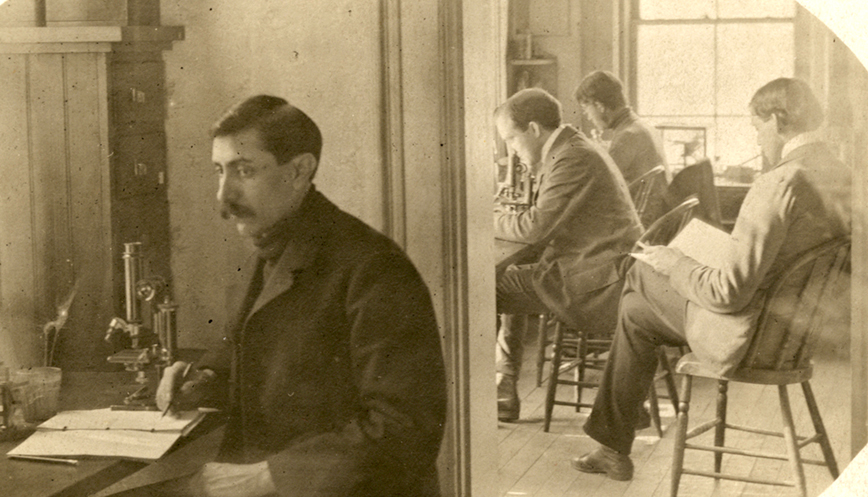
By the time this Botany class was held in the early 1900s, students would have still been receiving an “M” for passed with merit through an “F” for failed.

Recently, a patron asked us why in the world OSU issues an “E” instead of an “F” for a failing grade in a class. So we investigated, and here is what we discovered:

When the university opened its doors in 1873, the marking system for classes was “Pass,” “Fail,” “Conditional,” or “Passed with merit.” This continued until 1894 when the Office of the Registrar added “Absent” as an additional mark.

Around 1890 the first individual permanent academic record cards were kept for students and the grading system was changed. Students then received “M” for passed with merit, “Cr” for credit, “P” for passed, “C” for condition, and “F” for failed. This grading system continued with few changes until 1914 when the system incorporated “G” for good and “A” for average, and removed “Cr.”

A more traditional grading system, “A-E,” was adopted July 1, 1922, when the University switched its academic calendar to quarters. In 1955 the university added, among others, the marks of “F” for filed absent, “I” for incomplete, and “P” for progress.

While researching the grading system, we came across an article in the April 1923 Ohio State University Alumni Monthly explaining the university’s decision to incorporate a point system with the grades given to students. According to an excerpt entitled “Incentive to Scholarship” faculty wished to “stimulate a higher grade of scholarship through a more exacting requirement for a degree.” It seems many students were doing the minimum amount of work needed to pass a class, and by changing to a point system faculty could place a more exact, numeric value on the output of each student. This would allow for the university to deny diplomas to those whom the faculty felt did not deserve such an achievement.

The excerpt ended by stating “The superior student should be given an opportunity to reach his goal unhindered by the drag of mediocrity in his classmates.” Indeed.


Summer School: Who needs to be in a classroom to learn?

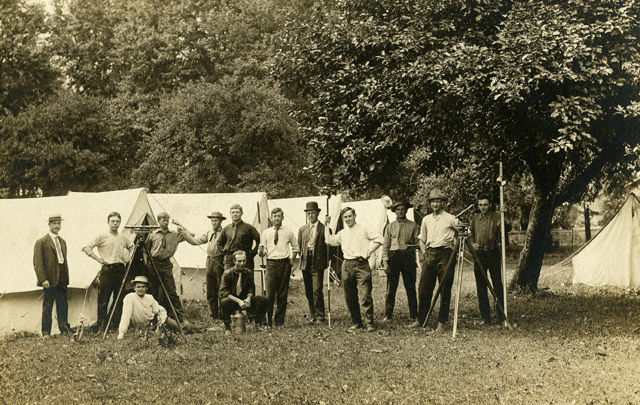
During the warmer months of the year, especially, learning doesn’t have to take place in a classroom. For OSU’s civil engineering students, in particular, fieldwork has long been a part of their studies.

In June 1888, some of these students went to camp – sort of – led by OSU Prof. Charles N. Brown – future Dean of the College of Engineering. He and seven students headed about sixty miles southeast of Columbus to prepare a “reconnaissance, preliminary and location survey for a proposed electric railway 2 ½ miles long.” Maps were made and earthwork was partially computed. (We’re pretty certain their idea of “computing” was different from ours.) It wasn’t really our idea of camp, either: The group stayed in a local hotel.

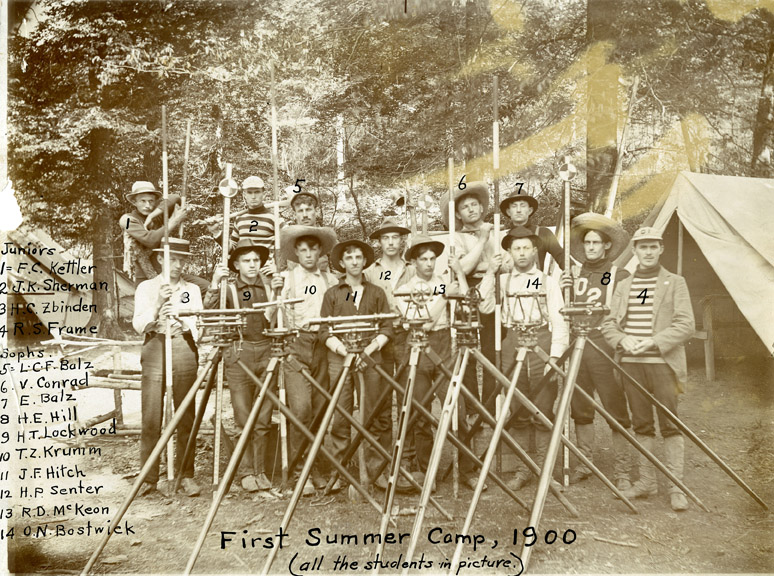
There was then a hiatus from such summer trips until 1900, when Brown again took students off-campus, and this time it really was to a “camp.” (Brown apparently grew up traipsing through the woods with his father, a surveyor in Brown County.)

Nelsonville, 1900


Students on the 1900 trip to the Nelsonville area stayed in tents, two to four students per tent. A tent was set up where a cook prepared the meals; Brown, as camp director, purchased the groceries locally. The camp lasted for four weeks, and cost $20 per student. In that time, students worked on railroad-related projects, “running 12 miles of reconnaissance, 9.2 miles of preliminary line, 5.7 miles of location and taking 4 miles of topography;” in addition, students practiced cross sectioning, computing and drafting.


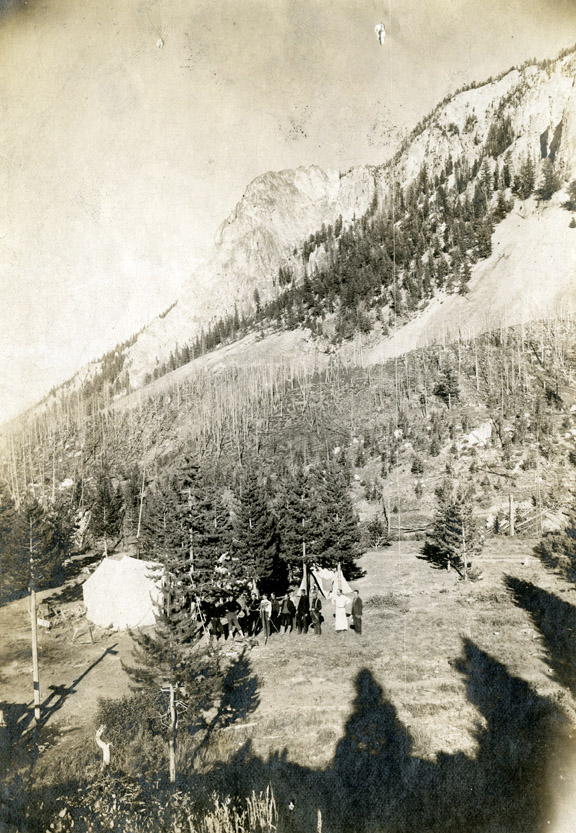
Yellowstone, 1905

This camp marked the first of many formal summer camps for engineering students, all of which took place in Ohio, with the notable exception of the 1905 trip to Yellowstone National Park in Wyoming. In 1905 the group entered into a six-week contract with the U.S. Engineering Officer, Major Hiram Chittenden, in charge of the improvement plan for Yellowstone Park. The U.S. government furnished the camp equipment, and all food and transportation within the park for their stay. All members of the group were also given a four-day. all-expense-paid journey through the park. In exchange, the students located 45 miles of “stage road” through surveying and mapping. Topography was taken 500-600 feet on each side of the road and prepared an atlas.

The last outdoor “camp” took place in 1946, after which all camps “went under roof.” The last “contract camp,” in which students and professors were under contract to do work, was in 1941. The last record of a civil engineering camp was in 1952.


Older posts Newer posts