From Woody's Couch

Our Playbook on OSU History

Author: drobik.5@osu.edu (page 42 of 62)

A River Runs Through It: The Olentangy’s place in campus history

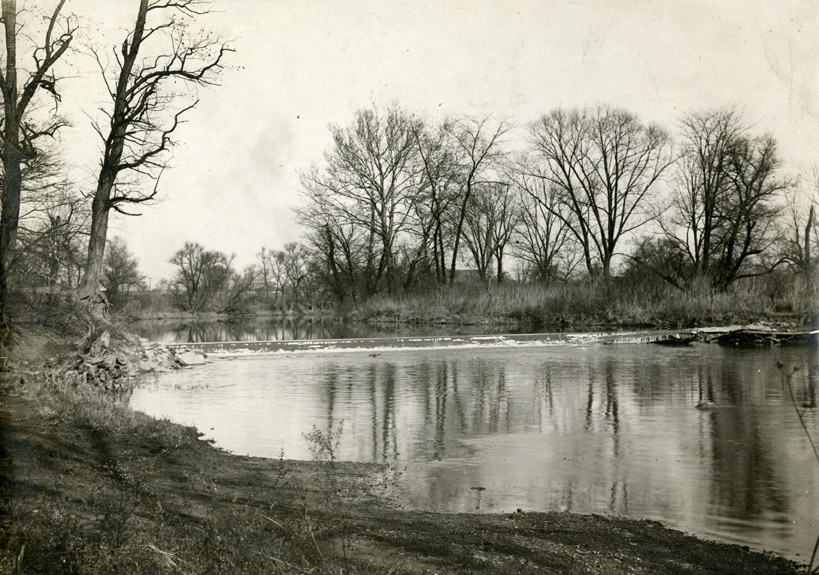
Olentangy River, 1913

The waterway we know as the Olentangy was called the Whetstone River by early settlers, and the Delaware Indians had a permanent camp just north of the present campus on its floodplains.

At the time the Board of Trustees purchased the Neil Farm in 1870 for the future site of campus, the Olentangy had a significantly different pattern; in fact, it flowed right through the area now occupied by Ohio Stadium. There was also a marsh, measuring about six acres, in the southwest section of the University’s original land purchase.

Much of the land on either side of the river was a natural flood plain, which supplied nutrients to the farmland, but could prove dangerous for people and livestock after heavy rains. Because of such flooding, the University and the State of Ohio have made a number of significant changes to the area around the river.

As early as 1884, the Board of Trustees set aside funds to repair a damaged levee. In 1879 the University drew up plans for “improving” the river; the plan included a dam north of campus, but the University did not own the land—yet. The University spent $607 to purchase about 12 acres; the Ohio General Assembly then gave a further $1,500 for the river project.  The dam was then built.

In March 1913, however, much of the west side of Columbus, and vast portions of the University’s farmland were flooded. Nearly 500 people lost their lives, and 100,000 lost their homes to the floods. No one on campus was hurt, and no livestock was lost, but the University was still affected.
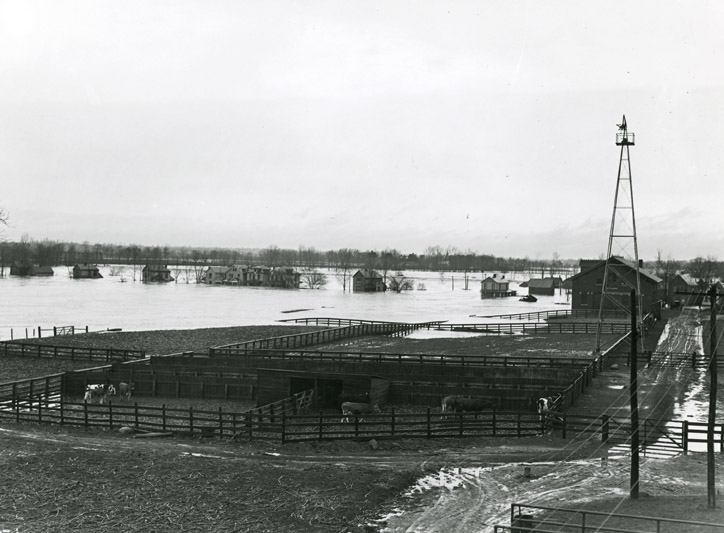
Flooding on campus, March 1913

Just before the flood, most students had gone home for Easter, returned to campus Monday, and flooding began on Tuesday. On Wednesday, classes were cancelled, and for the next few days professors took their classes all over the city to assist in relief efforts. Students in home-economics classes prepared meals, residents of the women’s dorms sorted clothing and served meals.  OSU President William Oxley Thompson and Commandant George Converse volunteered male students in the University’s military science courses to assist the Ohio National Guard Troops throughout the city. Others helped with the clean-up. Damages on campus were said to have been close to $10,000, plus the $3,000 cost of keeping the power plant operating.

The University attempted to fix the recurrent flooding problem by rerouting the river, which then created a spot to build the Ohio Stadium. But the problem of flooding was far from over: significant floods occurred again in 1922, prompting the creation of a dike in 1923 along the river (along where Cannon Drive now runs). The river was also widened, as part of a WPA project. The result is what you see today—but not for long.

Flooding in 1922

Dike being built next to Olentangy, 1923


The Olentangy River restoration project, part of the One University Framework Plan, is set to restore the river to its natural flow and reconstruct some of the wetlands on the west bank. To accomplish this, the 5th Avenue dam, which was originally built to serve the University Power Plant, will be removed.

Filed by C.N.

One Book to Rule Them All: Students’ Rules and Regulations, 1906-69 (Part 2)

Women students moving into the Alumnae Cooperative House, 1938

In 1906, the University published its first Students’ Rules and Regulations. As promised by then-OSU President William Oxley Thompson, revisions were made from time to time and reveal an ever-changing campus. The following excerpts reflect some of the more notable inclusions

Intelligence Tests

Beginning with the academic year 1920-21 all students entering the University are required to take an intelligence test under the direction of the Department of Psychology.

Students’ Rules and Regulations, 1920

Living Arrangements

All undergraduate women students, not living with their parents or guardians, are required to secure their rooms through the Office of the Dean of Women. Those Sophomores, Juniors, and Seniors, who are sorority members are allowed to live in their chapter houses.  Other students live in dormitories and approved houses.

Students’ Rules and Regulations, 1929

Regulations Governing Student Social Events

The following rules for the regulation of student social events have been passed by the Council on Student Affairs:

Students arriving at a dance, circa 1938

(1)    All student dances must close at 12:00 midnight except as noted below.  Girls must register in at 12:45.

(2)    Only two one o’clock parties may be held during any academic year by each social group.

(3)    To maintain uniformity, all house dances are to close at 12:00.

(4)    Combinations of groups will be regarded as so many individual parties.

(5)    Permission for any two o’clock parties must be obtained from the Council on Student Affairs. (This is expected to care for the Homecoming, Junior Prom, etc.)

(6)    All parties must be held within the limits of Franklin County.

Students’ Rules and Regulations, 1936

Use of University Rooms

No rehearsal rooms will be available on Sundays, whether for music or dramatics.

No assembly rooms for motion pictures, lectures, or discussions unless it be of religious nature will be available on Sundays.

Students’ Rules and Regulations, 1952

The Use of Loudspeakers

Loudspeakers, either moving or stationary, can be used for advertising on campus only from 11:48 a.m. to 12:00 noon and from 12:48 p.m. to 1:00 p.m.

Students’ Rules and Regulations, 1960

“Can we see your ID please?” (from the 1969 Makio)

Drinking and Possession of Alcoholic Beverages

Alcoholic beverages in any form shall not be permitted nor possessed on University property nor in University living units nor on the premises.  This shall include all University Residence Halls without exception, all social fraternity and sorority houses without exception, and off-campus and/or undergraduate residences of all types including rooming houses and apartments except for student living off campus in categories as follows:

  1. Commuting students who reside with their parents or guardians.
  2. Married students who reside in their own homes, single or multiple living units or apartments, but not in rooming houses where students under age 21 reside.
  3. Students, age 21 or over, who reside in their own homes, single or multiple living unites or apartments, but not in rooming houses where students under 21 years of age reside.

Students’ Rules and Regulations, 1968


One Book to Rule Them All: Students’ Rules and Regulations, 1906-69

President William Oxley Thompson’s foreword to the 1906 edition of Students’ Rules and Regulations reads as follows:

This little book is printed for the convenience of student in order that they may know the rules and regulations in which they are interested as a matter of guidance.  The book will be published annually with such revisions as are made from time to time.  Students are requested to keep this as a matter of reference.  Its intelligent use will save the time of the student and of the University officers.

This “little book” does indeed contain many guidelines for students at the time.  Many are similar to current policies, as evidenced by the following rule from the 1906 edition:

Although smoking was prohibited indoors, it was okay on a cannon.

Use of Tobacco Prohibited

The use of tobacco in any form in the lecture rooms, halls, corridors, doorways, stairways, laboratories and libraries of the University is prohibited.

But many reflect the changes that have taken place on campus in the past century. For example, the University has grown considerably since 1906, when the student population barely topped 2,000 and the President had considerably more interaction with individual students:

Living Arrangements

The President shall have authority to supervise the living arrangements of students not residents of the City of Columbus, and to order the immediate withdrawal of any student from any boarding or lodging house in which he deems the surrounding are undesirable.

Excuses for Absence:

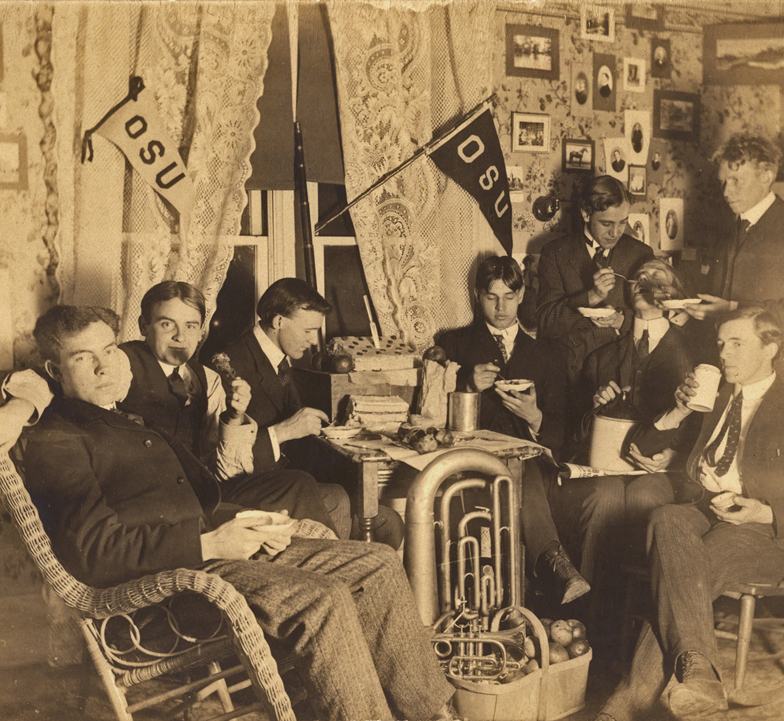
“Banquet” on Woodruff Avenue, 1900s

All absences of individual students from the city, for any purpose, involving absence from college exercises, must be accounted for to the President; and in all possible cases permission must be previously obtained.

Excuses will not be granted for absences of more than two weeks’ standing, unless the absence has been continuous.

Another significant difference in rules from years past is the role of the Department of Military Science. The Morrill Act of 1862, the legislation that paved the way for land grant colleges like The Ohio Agricultural and Mechanical College, decreed that “the leading objects [of these schools] shall be, without excluding other scientific and classical studies, and including military tactics, to teach such branches of learning as are related to agriculture and the mechanic arts.” According to the 1906 Rules:

All able bodied male students under 25 years of age at date of first entrance into the University or of any re-entrance after one year’s attendance at, and one or more years’ absence from, the University shall be required to report to the Military Department for service at the first regular drill hour. Each student will be required to drill three hours per week for two years, during the first two years of his attendance at the University.

In our next blog post, we’ll show you some of the revisions that were made over the years and reflect the changing times on campus.


Older posts Newer posts