From Woody's Couch

Our Playbook on OSU History

Author: drobik.5@osu.edu (page 22 of 62)

Avoiding a cold at OSU: Drink plenty of fluids, get fresh air and … don’t wear sweaters indoors?

A student being examined in the student health clinic, 1948

A student being examined in the student health clinic, 1948

Nowadays, OSU students hoping to avoid catching colds might check out the web site for the Centers for Disease Control for advice. Back in the early 20th century, before the Internet, they went instead to the Student Health Service to pick up a handy Form 453, called “To Avoid Colds,” which was part of the health service’s personal hygiene series.

Some of advice is still recommended today, such as: drink plenty of fluids, get fresh air, dress according to the weather, and avoid stress and anxiety. There were some strategies, however, that were just kind of odd:

·         “Don’t wear too heavy clothing indoors. Wearing sweaters indoors is one of the most common causes of ‘colds’ among students.”

·         High, tight collars and neck bands induce congestion and sore throat.
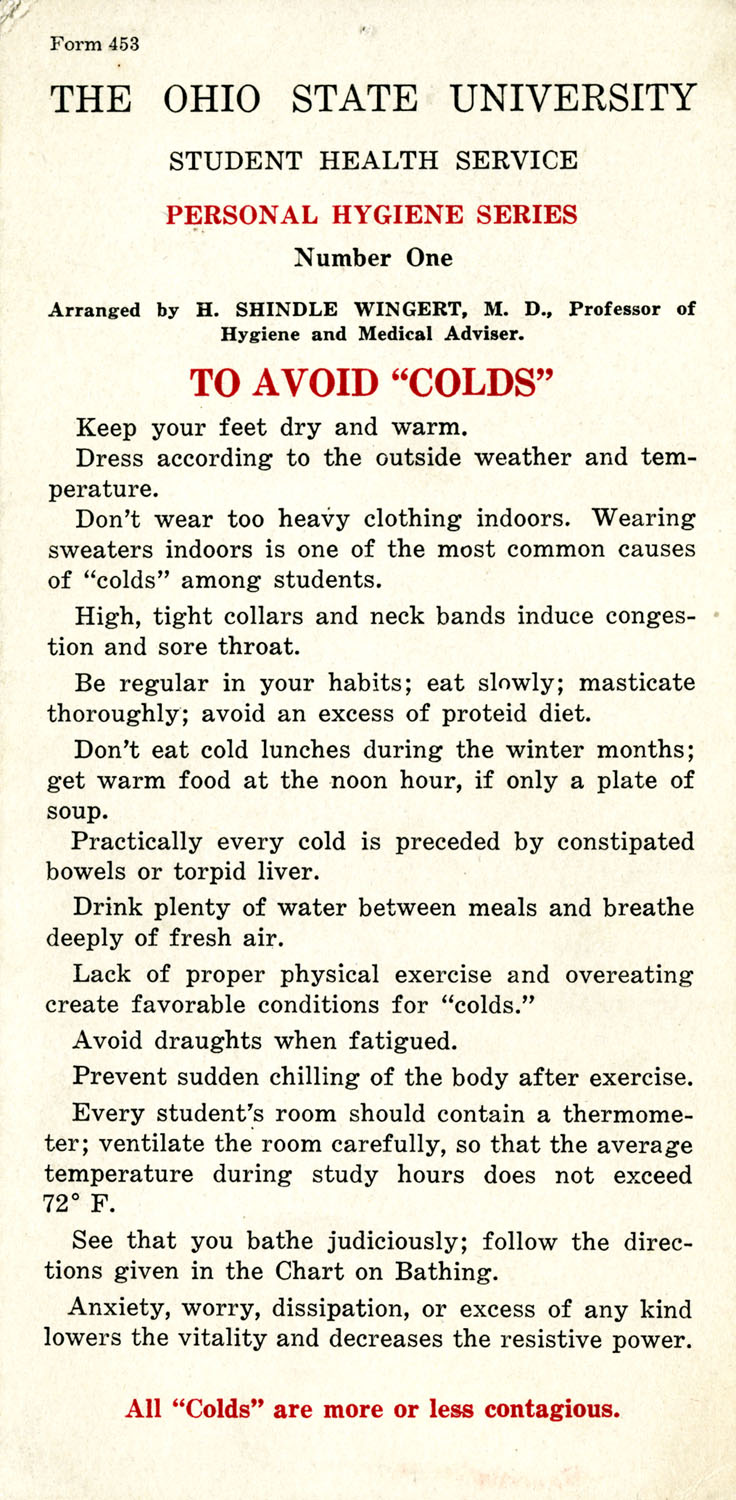
Student Health Service pamphlet

Student Health Service pamphlet

·         Be regular in your habits; eat slowly; masticate thoroughly; avoid an excess of protein diet.

·         See that you bathe judiciously; follow the directions given in the Chart on Bathing. (Unfortunately, the Archives does not have a copy of that likely helpful pamphlet.)

·         Practically every cold is preceded by constipated bowels or torpid liver.”

Those torpid livers, they are never up to any good.

In any case, as was mentioned, the list of advice on avoiding colds was just part of a series of health tips issued by the Student Health Service, which began in the Department of Physical Education during the 1912-13 academic year. Headed by Dr. H. Shindle Wingert, the service grew rapidly in popularity from its first year when 851 visits were recorded; by 1920, roughly 10,000 students a year were visiting the service, which had been made a separate stand-alone unit in 1915.

As it grew over the years, it changed locations: Hayes Hall, Baker Hall and the first Ohio Union (now Hale Hall) were some of its homes. In November 1969, the Wilce Student Health Center opened. It was named after Dr. John W. Wilce, who had been director of the Student Health Service for 24 years, head football coach for 16 years, and a member of the faculty for 45 years.

For some modern medical advice, see the CDC’s webpage:  http://www.cdc.gov/flu/about/season/flu-season-2013-2014.htm

Filed by C. N.
Now in a new home, Cartoon Library owes much to Milton Caniff

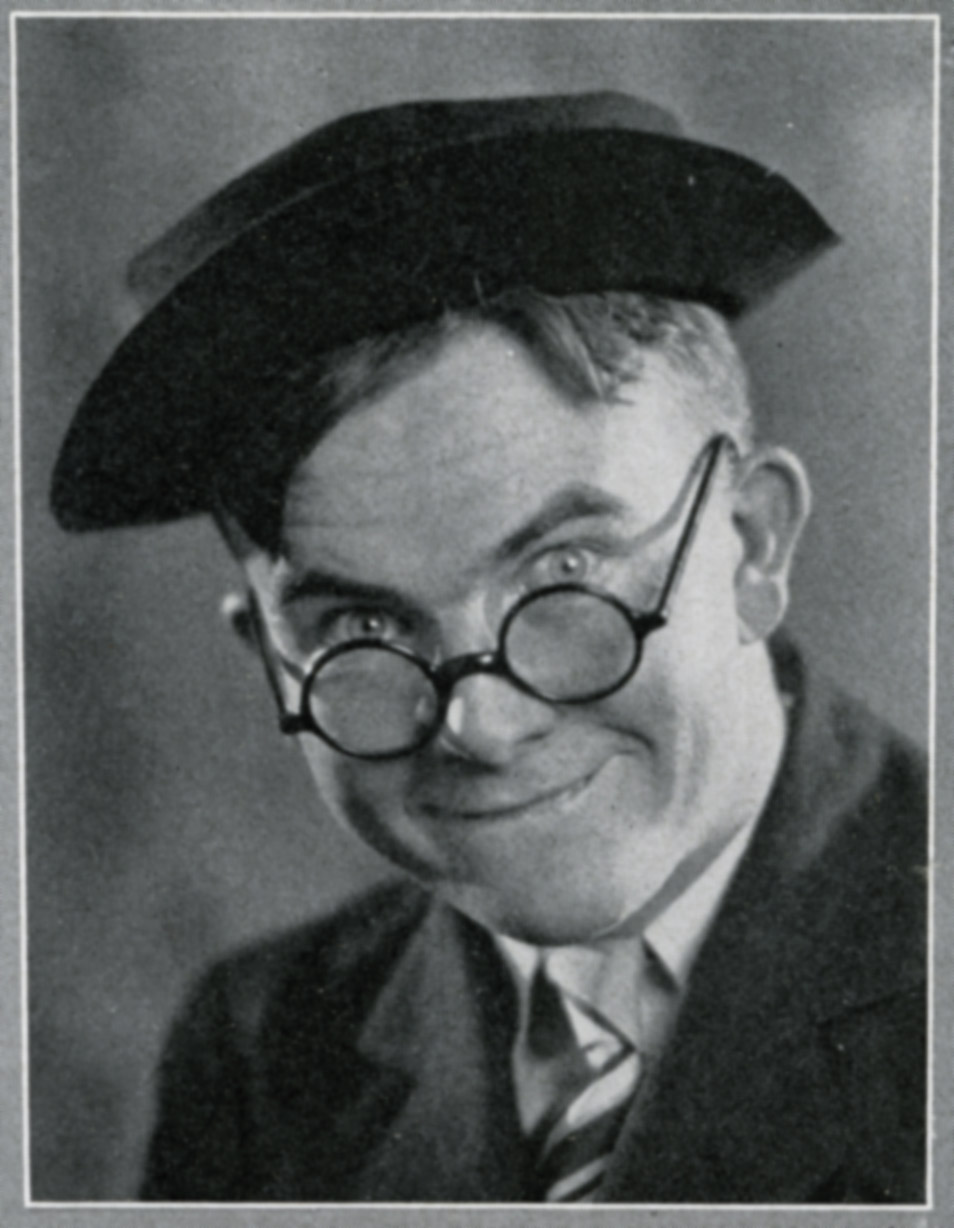
Milton Caniff, 1927

Milton Caniff, 1927

This week the Billy Ireland Cartoon Library and Museum re-opens in its new location at Sullivant Hall, after several weeks of moving its collections from its former location at the Wexner Center. Its first home, though, was in the Journalism Building, and might never have been created, if not for OSU alum Milton Caniff.

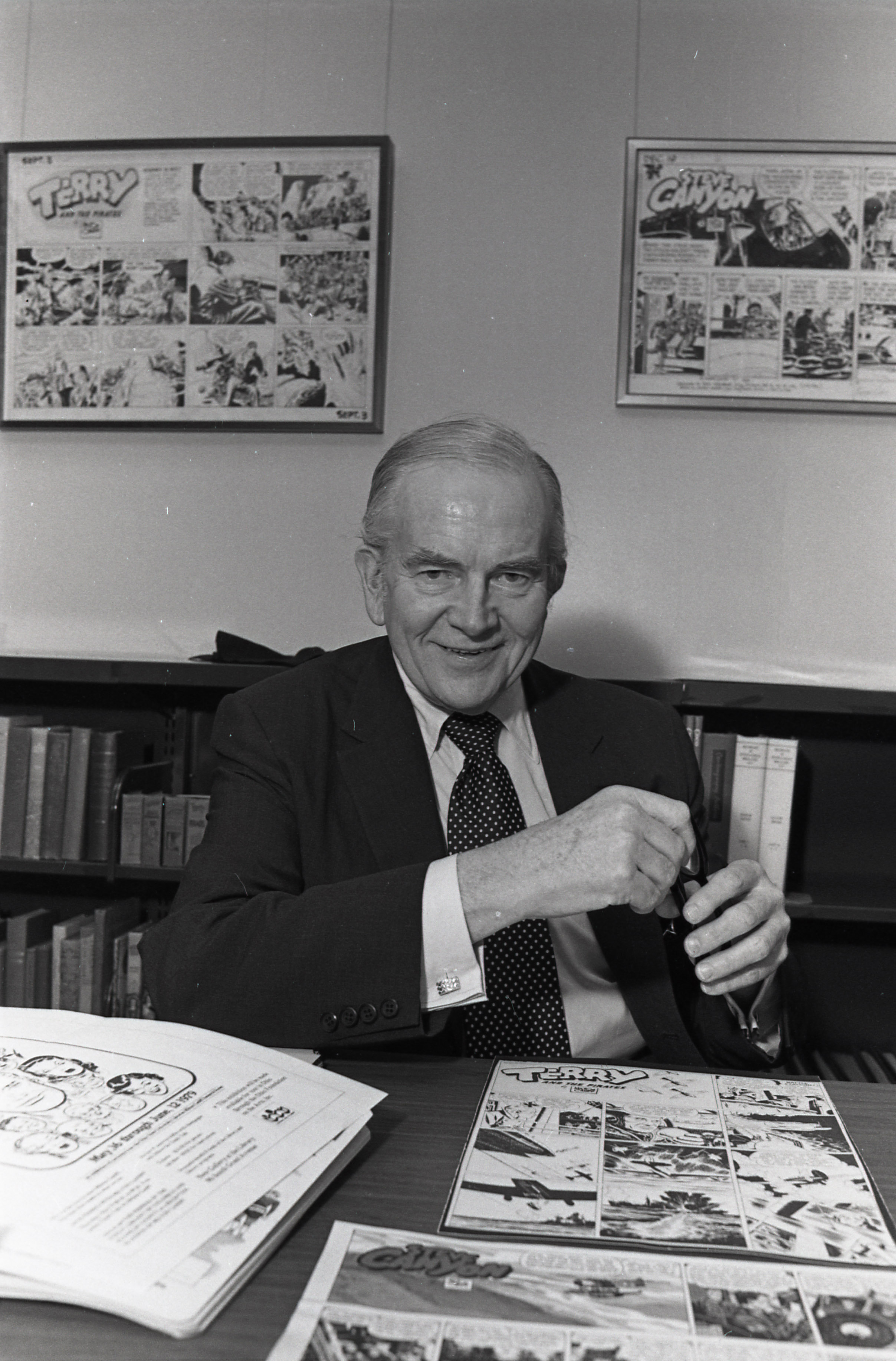
 Caniff, as you may know, went to OSU in the late 1920s. During that time he also served as art director of the Makio and the Sundial, an OSU student humor magazine. He graduated in 1930 with a bachelor’s degree in journalism. He later went on to draw “Terry and the Pirates” and later “Steve Canyon,” probably his most famous comic strip. That strip ran for more than 40 years.

Caniff in the former Caniff research room, 1979

M. Caniff in the former Caniff research room, 1979

Caniff donated his papers and collected works to the University in 1977 to establish the Caniff Research Room in two converted classrooms of the Journalism Building. On May 19, 1979, the the official dedication ceremony was presided over by OSU President Harold Enarson, with many dignitaries attending, including New York Times columnist Jimmy Reston and  retired CBS president Frank Stanton. The original collection also included props, such as model airplanes, guns, and army uniforms that Caniff used to draw from, and his personal correspondence. The rest of the collection was given to the University after Caniff’s death in 1988.

 In the years that followed, a number of other artists bequeathed their work to the room as well, including L.D. Warren of the Cincinnati Enquirer, Ray Osrin and Pulitzer Prize-winner Edward D. Kuekes, both from the Cleveland Plain Dealer.

Students using the collection, 1979

Students using the collection, 1979

In 1990, the then-Cartoon, Graphic and Photographic Arts Research Library moved to the basement of the Wexner Center. Over the years, its collections of original art and manuscripts have been built primarily through gifts-in-kind, and the Billy Ireland Cartoon Library & Museum (re-named in 2009) is now the largest and most comprehensive academic research facility documenting printed cartoon art. 

The Cartoon Library is celebrating its grand opening at Sullivant Hall during the 2013 Festival of Cartoon Art. For information, go to:  http://cartoons.osu.edu/.

– Filed by C.N.

Orange and black as school colors? No thanks, we’ll take Scarlet and Gray

Curtis Howard, 1878

Curtis Howard, 1878

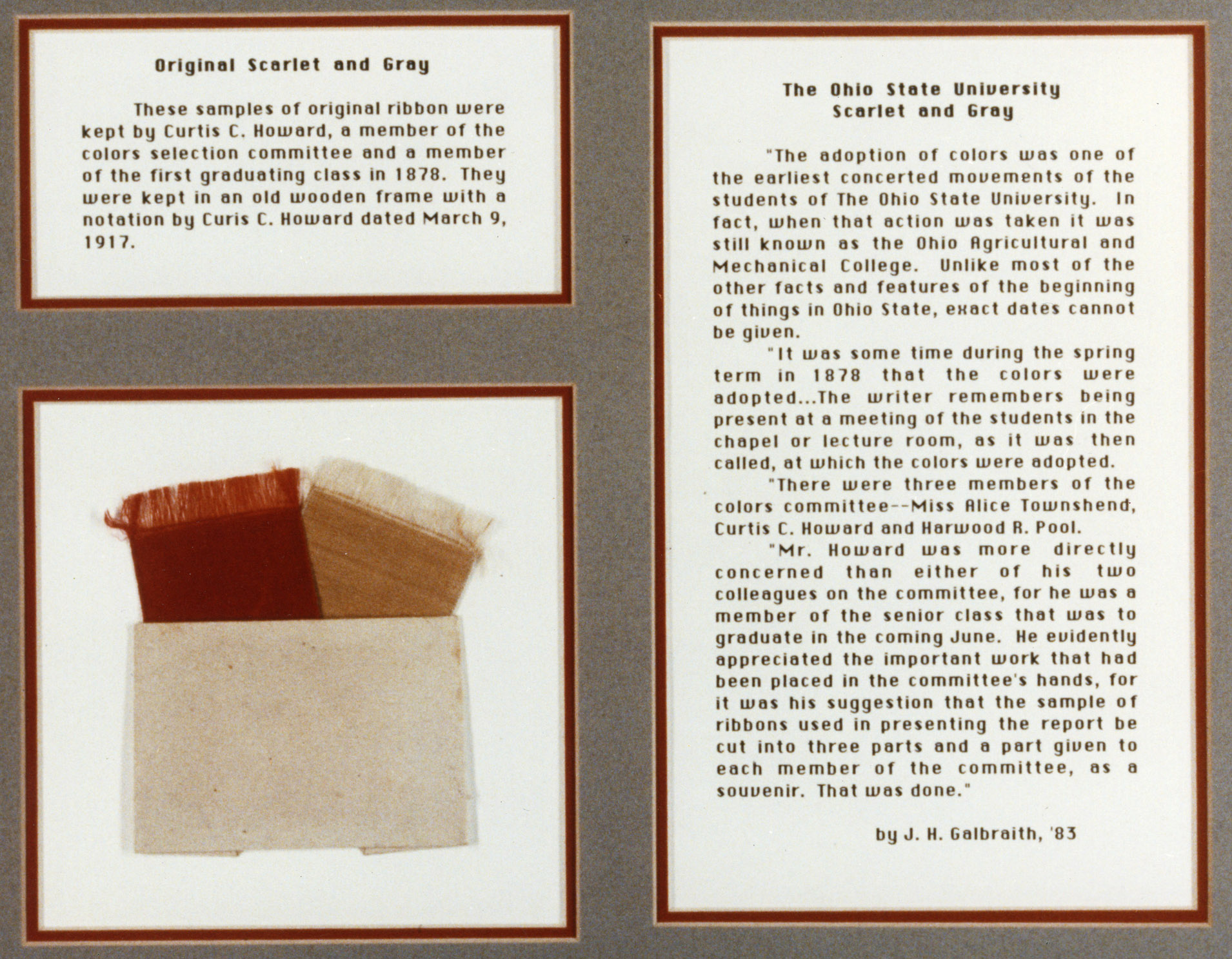
When the very first senior class started planning for its commencement in the spring of 1878, members decided the first diplomas issued by The Ohio State University (the Board of Trustees had just changed the name from the original Ohio Agricultural and Mechanical College) should look festive. So the class decided to tie around the diplomas ribbons that featured the school colors.

Being a young university, however, no school colors had yet been chosen. So the senior class appointed a committee of three to choose them: Curtis Howard, who graduated that year, Harwood Poole, who graduated in 1881, and Alice Townshend, an 1880 graduate.

According to a later account by Townshend, the three students went to various dry good stores in the area to sample colors and ended up choosing orange and black. They later learned, however, that these were already the colors of Princeton University.

Howard's original ribbons

Howard’s original ribbons

So they tried again and selected scarlet and gray – for no reason other than they liked the two colors together and to their knowledge, no other university or college had them as school colors. After the colors were selected, the original ribbons were cut into three pieces and given to each committee member as souvenirs.

Flash forward to 1917 when Howard is going through his personal effects and finds his souvenir ribbons. (Poole had died by then and Townshend had not kept hers.) Howard wrote to his friend, John Galbraith, that the ribbons were still “wrapped in a paper filter as I had placed the away 39 years ago. These have been in the dark and I am certain have not faded…” He donated them to the university, and according to a 1920 alumni magazine article, they were mounted in a mahogany frame and hung in Sullivant Hall.

John Kleberg poses with the scarlet and gray ribbons, 1989

John Kleberg poses with the scarlet and gray ribbons, 1989

Sometime after that, they disappeared.

Flash forward again to 1989: John Kleberg, then assistant vice president for business and administration, receives a visitor at his office who claims to represent an individual who acquired the ribbons from the resolution of an estate and wishes to remain anonymous. The ribbons were wrapped in porous paper and framed. On the back of the frame was the letter Howard had written to Galbraith.

For a time, Kleberg hung them in his office, but being the good steward of history that he has proven himself to be many times over with the Archives, Kleberg transferred them to the Archives.

Framed scarlet and gray ribbons

Framed scarlet and gray ribbons


Filed by C.N.

Older posts Newer posts