From Woody's Couch

Our Playbook on OSU History

Page 45 of 105

Women’s History Month: 90 years ago, first woman appointed as Trustee

Alma Paterson, n.d.

Alma Paterson, n.d.

It was 90 years ago today that the first woman was named to Ohio State’s Board of Trustees. Alma W. Paterson was a member of Ohio State’s class of 1904; as an undergraduate, Paterson had been a member of the Browning Dramatic Society and studied science and physical education. She received her bachelor of arts degree in 1904 and went on to serve as an assistant director of physical education for women for three years. In 1910, she married Robert G. Paterson, a 1905 OSU graduate, who was then executive secretary of the Ohio Public Health Association. 

Alma Paterson was appointed to the Board on March 27, 1924, to succeed the late OSU Prof. Thomas Mendenhall. Then-Ohio Gov. A. Victor Donahey had already indicated that the next appointment to the board would be a woman since “the large number of women registered at the University warrants the selection,” according to a Lantern article about her appointment. Paterson was on the board until 1933, serving as vice chairman twice during that time.
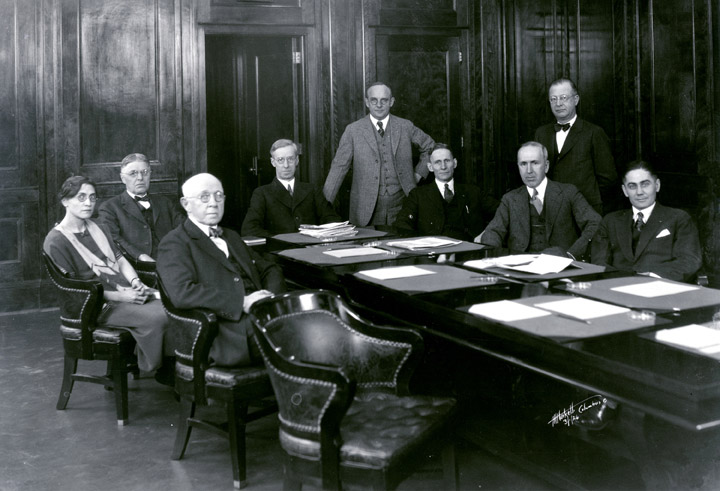
1926 board of trustees at conference table, including Alma Wacker Paterson

Paterson with the Board of Trustees, 1926

In 1954, the Board of Trustees named Paterson Hall, then a brand-new dorm for women, after her.

Paterson’s daughter, Ann, followed in her mother’s footsteps, first as a student (BS in Education in 1937 and MS in Education in 1939) and then as a professor of women’s physical education. After 19 years of teaching at OSU, she left the University in 1956 to teach at San Francisco State College.

– Filed by C.N.

First women students were a surprise show but made mark on OSU

The Townshend family, 1884

The Townshend family, 1884

In 1873, when two dozen young people showed up at University Hall to enroll in the then-new Ohio Agricultural and Mechanical College, two were women – in fact, they were the daughters of the first Professor of Agriculture.

Alice and Harriet Townshend were the youngest children of OSU Professor Norton Strange Townshend, who had stepped down from the College’s first Board of Trustees to teach agriculture classes at the new school. He was an advocate for women’s rights, and believed in higher education for all.

The former Townshend home, 1902

The former Townshend home in 1902. The family resided here from 1873 to 1895.

So, on the morning of September 17, 1873, Alice and Harriet, and their older brother, Arthur, walked from their home near 15th Avenue and High Street to sign up for classes, according to an interview with Harriet Townshend published in the October 1948 issue of The Alumni Monthly. In the interview, Harriet Townshend said that College President Edward Orton Sr. “almost fainted” when the two sisters showed up because he was not expecting women to enroll in the new school. He left it to the Trustees to decide, and upon reading the legislative bill passed to establish the College, they determined that women, as well as men, could attend.

While Arthur graduated with the first class in 1878, it took two more years for Alice Townshend to earn her degree; however, Alice was one of the three students on the committee in 1878 who purchased the ribbons that adorned the first diplomas. The colors of those ribbons were scarlet and gray, and Alice helped pick them.

Harriet Townshend from when she was an assistant librarian at OSU in 1900

Harriet Townshend as an assistant librarian at OSU in 1900

Shortly after graduation, Alice married Charles Mayhew Wing; little else is written about her, except for her death on December 1, 1925.

Though Harriet Townshend never graduated, she worked as an OSU Library staff member for more than 30 years, making sure all of the materials had proper binding. Townshend never lived far from the University; her last residence was listed as 53 W. 11th Avenue, which today is across the street from the Moritz College of Law. And she continued to be an advocate of higher education for women until her death at age 92 on April 29, 1950.

– Filed by C.N.

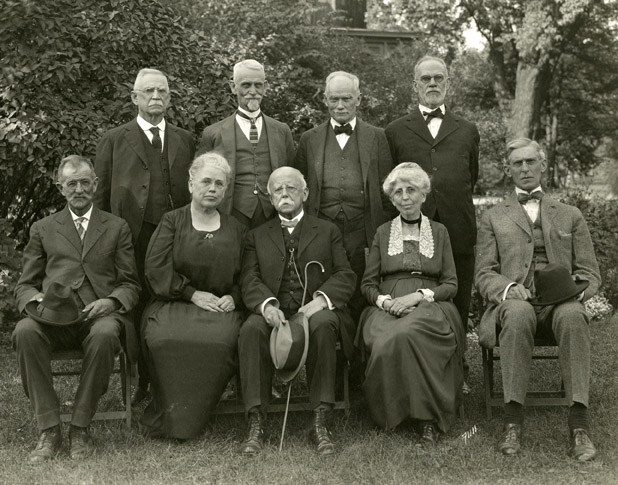
Alice Townshend-Wing (front row, second from left), and Hariett Townshend (front row, second from right), at a class reunion party in 1923

Alice Townshend-Wing (front row, second from left), and Harriet Townshend (front row, second from right), at a class reunion party in 1923

OSU linguist ‘went the extra mile’ for students, University

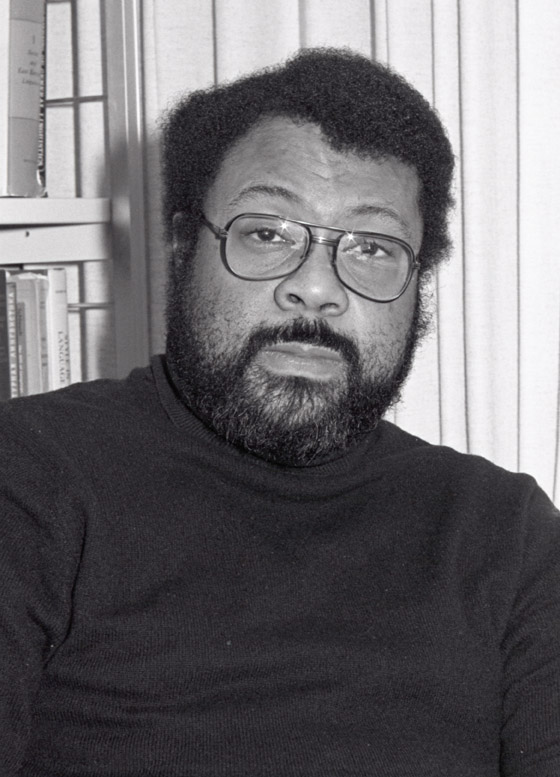
Kenneth Naylor, 1975

Kenneth Naylor, 1975

Kenneth E. Naylor was a professor whose research was world-renowned but spent much of his time, too, as an adviser and mentor to students. Consider this: During his 26-year career at Ohio State, Naylor supervised seven Ph.D. dissertations and was adviser to 31 master’s degree recipients. He served on more than 30 University committees, both at the College department levels. In a Lantern article published after Naylor’s 1992 death, David Patton, assistant director of the Center for Slavic and Eastern European Studies, said: “He always went the extra mile, and that’s how he’ll be remembered by students and colleagues.” 

Naylor, who was born in 1937 in Philadelphia, was first and foremost an expert on Slavic languages and culture. He received his bachelor’s degree in 1958 from Cornell University and his master’s degree in 1960 from Indiana University. From there, he studied at the University of Chicago, taking a year off to study at the University of Novi Sad in Yugoslavia with renowned linguist Pavle Ivic. He returned to complete his dissertation on Yugoslav linguistics at the University of Chicago and was awarded his Ph.D. in 1966.

He came to Ohio State as a Professor of Slavic Linguistics, later becoming a specialist in Slavic and Balkan Linguistics and Culture. He was known for his knowledge of the area, both at home and abroad. In 1984 he received the “Jubilee Medal 1300 Years of Bulgaria” from the People’s Republic of Bulgaria and in 1989 the “Order of Yugoslav Flag with Gold Wreath” from the Republic of Yugoslavia for his study of the Serbo-Croatian language and Yugoslav literature, as well as supporting cultural ties between Yugoslavia and the U.S.

In 1990, Naylor was called to testify before the U.S. House of Representatives, Foreign Affairs Committee on the ethnic rivalry in Yugoslavia and the development of a Serbo-Croatian language. He was commended by those he met in Washington for his clear testimony and demeanor, as well as his knowledge of the area and the people.

Dr. Naylor continued to teach at Ohio State until his death on March 10, 1992.

« Older posts Newer posts »