From Woody's Couch

Our Playbook on OSU History

Page 46 of 105

John Mount, a Buckeye through and through

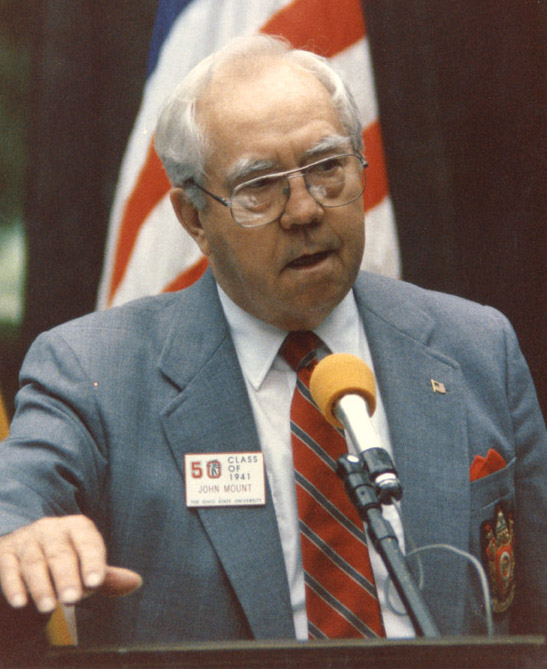
John Mount, 1941 class runion, 1991

John Mount speaks at his 1941 class reunion, 1991

A reporter once wrote that it took a World War to keep John Mount away from Ohio State. And it can honestly be said that John Mount’s stint in the U.S. Navy is the only time in his adult life that he ever left the University for a significant amount of time. Think about this: Mount’s service to the University has spanned roughly seven decades – more than a third of the University’s total history.

Mount, whose association with OSU took him from student to professor to University administrator, died Thursday. He was 95 years old.

John Mount was born on June 10, 1918 in Butler County, Ohio. He attended public schools before coming to Ohio State on scholarship in 1937 to study agriculture. While at the University, he was a member of Sphinx, Gamma Sigma Delta (National Honor Society of Agriculture), the University Livestock Judging Team, and the Townshend Agriculture Education Society. He was President of the College of Agriculture Student Council, as well as the University 4-H Club. He graduated in 1941 with a Bachelor of Science degree in Agriculture. He accepted a job with OSU’s Agricultural Extension Service directly after graduation, then took a leave of absence to join the U.S. Navy, where he fought in the Atlantic, Mediterranean and Pacific theaters. He returned home in 1946 to his alma mater, leaving again briefly to complete his master’s degree at the University of Wisconsin in 1949.

John Mount, (top row, right), with the University 4-H Club, 1940

John Mount, (top row, right), as a student with the University 4-H Club, 1940

After returning to OSU, Mount held almost every job possible within the College of Agriculture and the University administration. He served as assistant 4-H leader, professor, and assistant dean and secretary within the College of Agriculture. In 1957 he became the Administrative Assistant to the President, and the following year became Secretary of the Board of Trustees. In 1960 he was named Vice President of Educational Services.

In 1968, Mount was appointed Vice President for Student Affairs, then a new position. It was probably the greatest challenge of his career at OSU, given the turbulent times in which he served. At that time, campuses like OSU’s roiled from sometimes tense and violent demonstrations over the issues of civil rights, women’s rights and the Vietnam War. Mount served as the administration’s liaison with students demanding deep changes in University operations. Mount spent countless hours negotiating with them. During the spring of 1970, an especially contentious period, Mount spent so much time meeting with students that he was admitted to University Hospital for a short period for exhaustion.
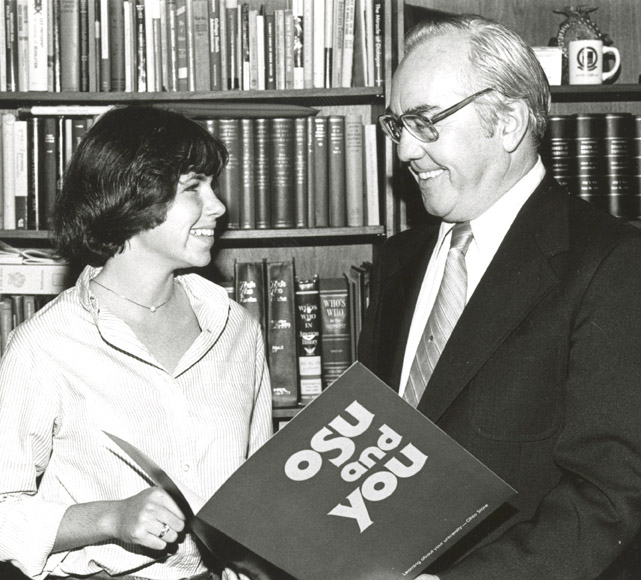
Mount with student Tracy Barber, no date

Mount with student Tracy Barber, no date

In 1970 he became the University’s first Dean of University College and Vice President for Regional Campuses. It is from these posts that he retired from in 1983 after 42 years of service.

Even in “retirement” there was no question of his leaving Ohio State. He remained involved in 4-H activities, served as the grand marshal of the 2004 Homecoming parade, and was one of six University professors to teach the OSU History course offered annually. Most recently he held the title of faculty emeritus.
At the Summer 1993 Commencement, Mount was awarded OSU’s Distinguished Service Award, for—at that time—almost 50 years of service. In 1983, the University Board of Trustees officially named the then-University College building after him.

During his retirement, Mount continued to volunteer with Freshman Orientation, saying, “I’ve been paid for the things I really enjoy doing. I don’t mind volunteering my time.”

– Filed by C.N.

Elzy’s voice took her from OSU to Broadway and beyond

Ruby Elzy, 1930

Ruby Elzy, 1930

When Ruby Elzy showed up at OSU as a freshman in 1927, she “couldn’t read one [musical] note from another,” she told the Lantern in 1937. By 1936, though, she was playing “Serena” in “Porgy and Bess” on Broadway.

It was actually a chance encounter with an OSU professor in her home state of Mississippi that began her journey to stardom. Growing up, Elzy traveled with her three siblings around Mississipi as their mother made trips to various schools in rural districts. Elzy was responsible for her younger siblings when her mother was at work and was taught basic schooling by her mother. When Elzy was 11 years old, her mother got her a job washing tablecloths at a local women’s center associated with Rust College in Holly Springs, Mississippi. When Elzy was old enough, she attended Rust College.

Royal D. Hughes, 1926

Royal D. Hughes, 1926

One day, OSU Education Prof. Charles C. McCracken was visiting with the president of Rust College in the president’s office. Since it was summer in Mississippi, all the windows were open, and their meeting was interrupted by singing from a nearby building. McCracken insisted on hearing a performance of the singer – Elzy – and convinced her to study music at Ohio State. So Elzy came to Ohio State in autumn 1927, after the school of music had awarded her with the Presser Foundation Music Scholarship. Since she couldn’t read music, then-School of Music director Royal Hughes taught her himself.

Music Building (formerly the President's home), 1922

Music Building (formerly the President’s home), 1922

After her graduation from Ohio State in 1930, she received the Rosenwald Scholarship to Julliard School of Music in New York. She was “discovered” again while singing in a choir in New

York that had been recruited to sing in the movie “Emperor Jones.” The director liked her dialect and knowledge of African-American spirituals, so he made her a supporting character, to none other than Paul Robeson.

In 1936, George Gershwin chose her to play “Serena” in his opera, “Porgy and Bess.” She sang the world premiere of that opera, and the following year received an invitation to perform at the White House. She also performed on national radio. She died unexpectedly on June 26, 1943, in Detroit after complications from surgery.

“Wedded Husband” married Chinese culture with English language at OSU

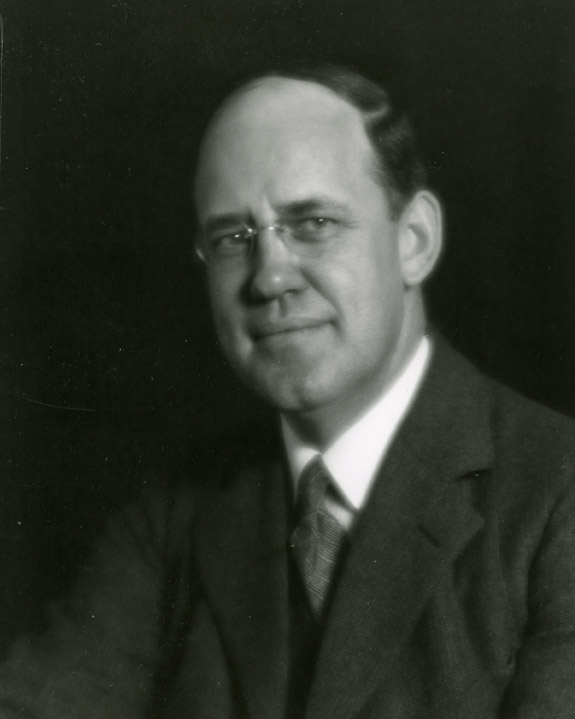
Hong Shen, 1919

Hong Shen, 1919

Nearly 100 years ago, a young man from China studying ceramic engineering at OSU wrote a play in English that was performed in University Hall. It was likely the first-ever English-language play written by a Chinese national to be performed in the U.S.

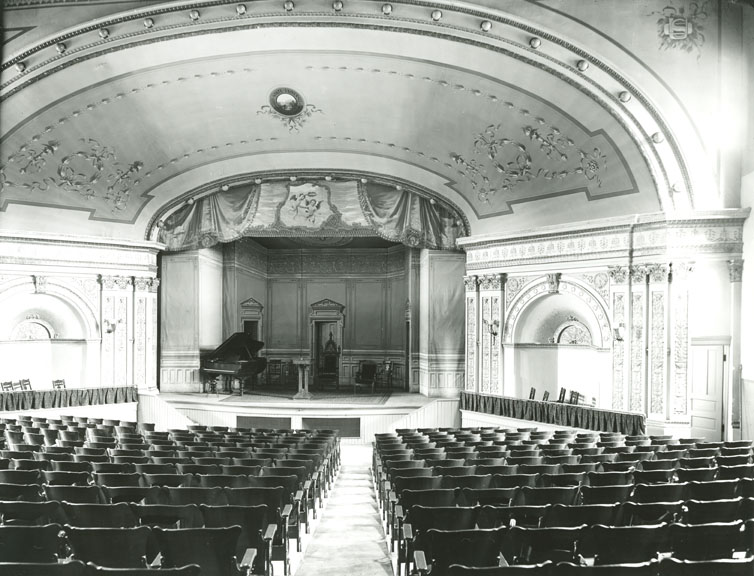
The young man’s name was Hong Shen, the play was called “The Wedded Husband” and it was performed in University Hall Chapel on April 11 and 12 in 1919 before a capacity audience of 1,300.


Shen was studying at OSU on a scholarship paid by the Chinese government. It was his first play written in English; previous works – “Fruit Vendor” and “Which Is It?” had been performed at his alma mater, Tsing Hua College in Beijing.


University Hall Chapel, c1900

University Hall Chapel, c1900

The play was co-sponsored by OSU’s Cosmopolitan Club and the Chinese Students’ Clubs of OSU and Oberlin College, and all of the men’s parts were performed by Chinese students who, like Shen, had been sent to the U.S. by the Chinese government under the provisions of the Boxer indemnity fund.


According to a Lantern article, Shen received a telegram from professors at Goucher College and the Columbia School of Fine Arts to reserve tickets for them. (They were going to be in Columbus for a meeting of the Methodist Centenary Movement.)


The play is about a young woman, Miss Wang, who is arranged to be married to a gentleman named Master Chen. She agrees to the marriage out of filial devotion to her father but during the ceremony, she falls ill. The doctor suspects she is a victim of the plague that is ravaging the city and orders her to be quarantined. Master Chen, however, defies the order to care for his wife. He ends up dying of the plague, while Miss Wang recovers. She is then arranged to be married to Master Yang, but when she hears of how Master Chen risked his life for her, she changes her mind and remains a loyal widow.


Last November, OSU’s Institute for Chinese Studies put on a revival of the play in the Roy Bowen Theatre, in the Drake Union. It was part of a series of events honoring Shen, who left OSU in 1919 to study dramatic arts at Harvard before returning to China where he eventually became an important figure in modern Chinese theater, film and drama. His daughter recently donated a collection of his works to the University.

« Older posts Newer posts »