From Woody's Couch

Our Playbook on OSU History

Category: Early University history (page 6 of 14)

Dead body + electricity = spooky experiment conducted by first faculty

T.C. Mendenhall, 1874

T.C. Mendenhall, 1874

Since it’s Halloween, we’d like to tell you about Thomas C. Mendenhall, the very first faculty member hired by the then-Ohio Agricultural and Mechanical College in 1873. He was a real Renaissance man when it came to the many and varied interests he pursued – including reanimation of corpses.

Though Mendenhall was a Physics professor, he also had a great interest in electricity (and other subjects, as you will read later). In 1872, while he was a teacher at Central High School – then known as Columbus High School – he decided to test a theory that a dead body could be brought back to life through electric shock. He received approval from the Ohio Penitentiary to transfer the corpse of a recently hanged prisoner to Starling Medical College, located in downtown Columbus and one of the predecessors of Ohio State’s College of Medicine. So, on October 4, 1872, Mendenhall tried, by use of electric shocks, to reanimate the corpse of John Barclay—a man who was hanged for murder that same day.

Starling Medical College

Starling Medical College

According to a history of the Columbus High School, the experiment was performed in front of the judges of the State Supreme Court and other witnesses, including a reporter for the Police Gazette. “In so far as anyone knew,” the history said, “the Judges might have to pass upon the uncanny question of Barclay’s legal status as a living person who had already suffered the death penalty. However, they were spared that embarrassing situation” since the experiment obviously did not succeed.

It was just one of many ways in which Thomas Mendenhall went about satisfying his curiosity on a wide variety of subjects.

In addition to his interest in electricity, Mendenhall dabbled in English literature as well. In 1887, Mendenhall conducted a study on stylometry, the analysis of word length in an author’s work, and particularly pinpointed William Shakespeare in his study. With the help of some diligent counters, Mendenhall counted and classified 400,000 of Shakespeare’s words, most consisting from his famous plays. Mendenhall published his stylometric graphs in The Popular Science Monthly in 1901. They compared Shakespeare’s average word length with other contemporary authors, such as Ben Jonson, Francis Bacon and Christopher Marlowe. Mendenhall’s graph visibly showed that Shakespeare and Marlowe had nearly the exact same word length frequency; Mendenhall concluded that Marlowe’s and Shakespeare’s work were written by the same author.

Overall, Mendenhall had a long and full life. After teaching for five years at Ohio State, Mendenhall, then 36, traveled to teach physics at the Imperial University in Tokyo. In 1881, Mendenhall returned as professor of physics at Ohio State and also became director of the Ohio Meteorological Bureau. By 1884, however, Mendenhall was back at to working with electricity at the U.S. Signal Service in Washington D.C. and then was elected president of Rose Polytechnic Institute in Indiana in 1887. Then in 1889, he was appointed superintendent of the Coast and Geodetic Survey by President Benjamin Harrison, where a few years later a glacier would be named after him. Ohio State named him Professor Emeritus in 1900, and became a board member in 1919. Mendenhall died in 1924, at the age of 82.
Famed OSU botanist left behind captivating photos and career

The Archives recently received a small donation of material that belonged to a former OSU professor who was regarded as “one of the greatest botanists of his day.”

John Henry Schaffner came to the University in 1897 as an assistant in Botany, and served as head of the Department of Botany from 1908 to 1918. Later in his career, he went on to make a radical discovery in in the field of Botany that brought admiration from scientists worldwide. But more about that in a bit.

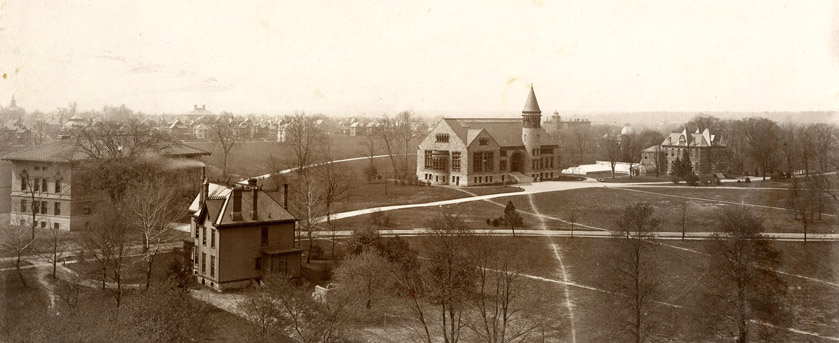
Early on in Schaffner’s tenure at OSU, he took the following photographs, which depict a very different view of campus.

Oval from Armory, 1899

This first photograph was taken from the top of the Armory in 1899. (The Armory was situated at the site where the Wexner Center sits today.) What we now think of the Oval did not quite exist yet, and as you can see, a house sat at the east end. In 1902, the house was moved to the north edge of today’s Mershon Auditorium and became the home to OSU athletics. It was aptly named the “Athletic House.”

To the left of the house is Biological Hall, which was built in 1898 for the departments of Anatomy and Physiology, and Botany and Zoology. The Biology Building was torn down in 1923 to make way for the current Hagerty Hall building.

To the right is Orton Hall, and the old Botanical Hall, which is where Schaffner spent much of his time in teaching and research.

1899_campus_view_from_southeast1

John H. Schaffner, 1900

John H. Schaffner, 1900

This panorama photo shows a view of campus from the southeast end, looking northwest. You can see the back side of Orton Hall towards the right, as well as McMillin Observatory, which was situated on the southwest side of Mirror Lake.  The observatory, which opened in 1896, was torn down in 1976.

But, what are even more interesting than Schaffner’s photographs, are his background and research interests. Schaffner was widely known among scientists for his botanical discoveries, and as a prolific writer of books and scientific papers. He was also renowned for his help in overthrowing the thought that the sex of plants was hereditary.

Yes, you heard right.

An Alumni Monthly article from October 1928 noted that Schaffner’s most important discovery is that the sex of the plant may be changed:

“Professor Schaffner found that by controlling the conditions in which a plant developed he could change the entire sex of the plant. The further development of this discovery will lead to many radical changes in the treatment of plant life.”

Schaffner read his paper describing this discovery in 1926 at a convention of botanists in Ithaca, New York, and it was widely acclaimed by scientists in many countries.

Schaffner died on January 27, 1939.

(Special thanks to Bob Cody, Schaffner’s grandson, who donated the campus photographs to the University Archives.)

OSU Extension celebrates 100 years of agricultural outreach


Original farm plots of the Agricultural Experiment Station.  This field was located north of the original University Hall, 1880s

This photo shows one of the original farm plots of the Agricultural Experiment Station in the 1880s. This field was located north of the original University Hall.

In 1914, Congress passed a law that created a system of cooperative extension services to be run through land-grant institutions like OSU. Enacted on May 8, 1914, it was called the Smith-Lever Act, and it aimed to inform people about current developments in agriculture, home economics and related subjects. Officially, OSU’s Ohio Cooperative Extension Service was founded when the law went into effect, but OSU had been reaching out to the state’s residents long before that time with useful research and information.

In 1881, the University became the home of the Agricultural Experiment Station (now known as OARDC in Wooster), where faculty conducted research and studied methods that would be passed onto the state’s agriculture community. Then, in 1895, students at Ohio State formed the Agricultural Students Union, tasked with encouraging cooperative research and demonstrations of new technology for the public.

A.B. Graham, 1911

A.B. Graham, 1911

In 1902, OSU alumnus A.B. Graham founded the first 4-H Club in Springfield. At that time, he also was working with OSU and the Ohio Agricultural Experiment Station at Wooster to test seed varieties and various agricultural methods. In 1905, OSU created the position of superintendent of agricultural extension for Graham, nearly ten years before the federal law was enacted establishing cooperative extension services.

This postman prepares seeds to be mailed to agricultural clubs in Ohio, (1906).  This project was initiated by A.B. Graham and utilized the Agricultural Extension Service.

This postman prepares seeds to be mailed to agricultural clubs in Ohio, 1906. This project was initiated by A.B. Graham and utilized the Agricultural Extension Service.

In 1912, OSU’s extension service took to the rails by making a 100-day tour on the New York Central Railroad. The aim was to reach small farming communities. There were multiple train cars, one for lectures and at least one other for demonstrations involving crops or livestock. They also distributed seeds and literature. At this time there were also extension agents in place in each of the counties, running youth programs, giving farm demonstrations, and providing information back to the University regarding problems with crop health and possible solutions.

An Ag. Extension Agent works talks with a farmer, 1976

An Ag. Extension Agent talks with a farmer, 1976

Now known as the OSU Extension Service, the program has changed over the years. Originally a key resource for farmers, it still plays a big role within the agricultural community but now aims some of its services at more urban targets. Need gardening advice on which plants to use, which varieties of vegetables to plant, or how to can the vegetables once harvested? The extension service can help. Have a problem with rogue geese or other wildlife? The extension service can offer some tips. The extension also helps support such programs as 4-H, and has formed coalitions with urban gardening organizations, as well as the energy and agricultural industries to support new farming technologies and improve the environmental impact of such industries.

For more information on OSU Extension go to: http://extension.osu.edu/.

Older posts Newer posts