From Woody's Couch

Our Playbook on OSU History

Category: Notable events (page 3 of 4)

OSU’s 1996 South Africa trip included Mandela speech

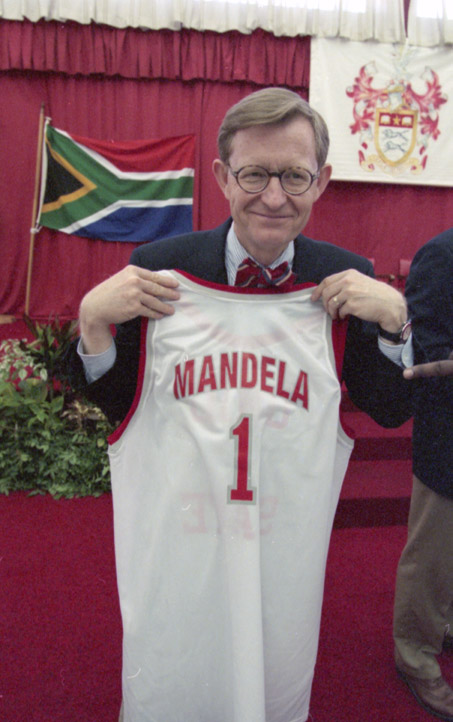
President Gordon Gee holds a Mandela jersey during his trip to South Africa, 1996

President Gordon Gee holds a Mandela jersey during his trip to South Africa, 1996

In early June 1996, President E. Gordon Gee, along with 36 Ohio State faculty members and the OSU men’s basketball team, embarked on a two-week trip to South Africa, with the faculty going on to visit Uganda as the basketball team took a detour to Zimbabwe. The timing of the trip was particularly significant: Only two years earlier, South Africa’s apartheid system had been brought down by free elections following violent protests.

The primary purpose of the tour was to foster ties between Ohio State and African universities and to show how Ohio State can make a difference around the globe. One major area of shared interest: agriculture. For years South African students had come to Ohio State to study agriculture before bringing these lessons back to their home country. Some of these students had gone on to become faculty members at the University of Natal in South Africa. Makerere University in Uganda, likewise, had a strong relationship with Ohio State; OSU worked with the Ugandan university to set up a Cooperative Extension Service in Uganda, with the aid of $20 million from the World Bank. In addition to furthering the agricultural relationship, faculty members hoped the 1996 trip would help build collaboration in law, education, nursing and humanities programs with South African universities.
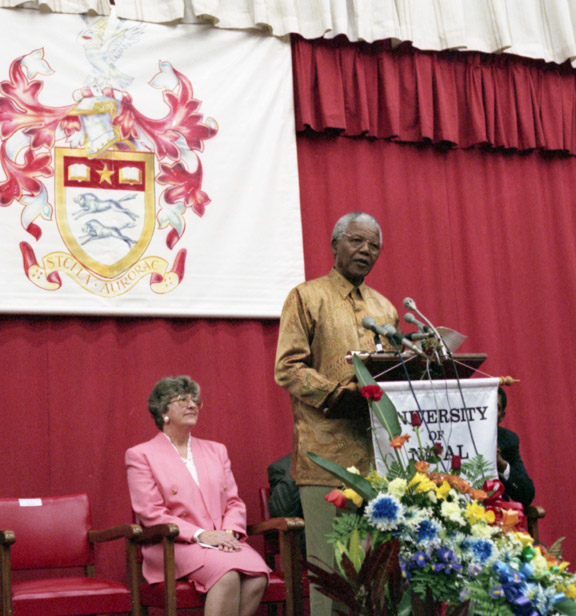
Nelson Mandela speaking during event, 1996

Nelson Mandela speaking during event, 1996

Meanwhile, the men’s basketball team hosted basketball clinics and demonstrations for local residents, both in the major cities and in the countryside. Basketball was seen as a way to bring people across South Africa together and integrate traditionally rugby-playing whites and soccer-playing blacks. At the same time, OSU basketball players learned about the history of modern South Africa and the role that students played in the protests that eventually brought an end to the apartheid regime. At one point, basketball team members attended a Youth Day celebration where they heard then-South Africa President Nelson Mandela speak.

The members of the OSU delegation were thrilled by the success of the trip, Gee said after the return. “We really met and exceeded our expectations,” he said. Gee and others spoke positively of South Africa as a nation, remarking on its determination to become a diverse, integrated country and its optimism and hope for the future. The Ohio State visit also was apparently the first visit by a foreign university’s representatives to the South African countryside.

For information on today’s memorial event for Nelson Mandela in Hale Hall, visit http://aaas.osu.edu/news/%E2%80%9Cnelson-mandela-his-life-times-and-legacy%E2%80%9D
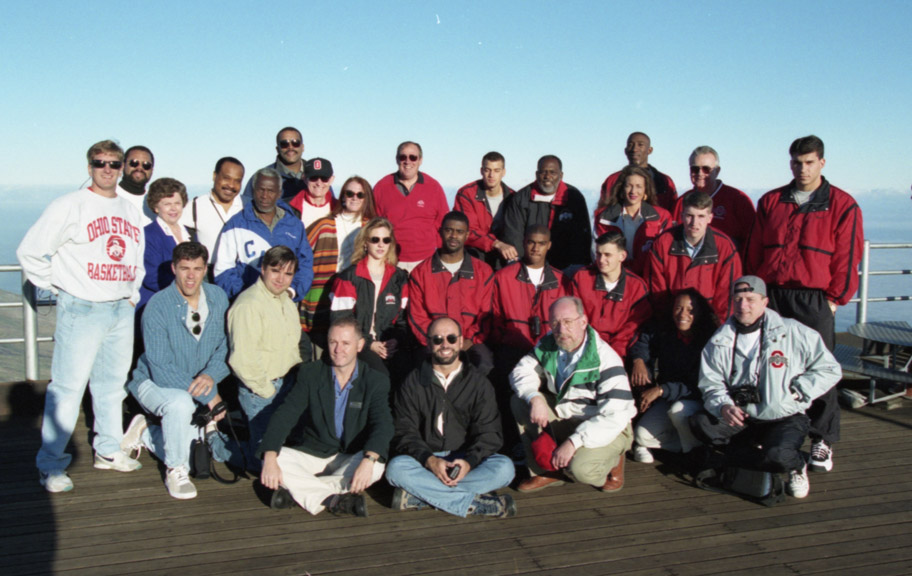
Members of the trip, including athletes from the basketball team, pose for a portrait in S. Africa, 1996

Members of the trip, including athletes from the basketball team, pose for a portrait, 1996
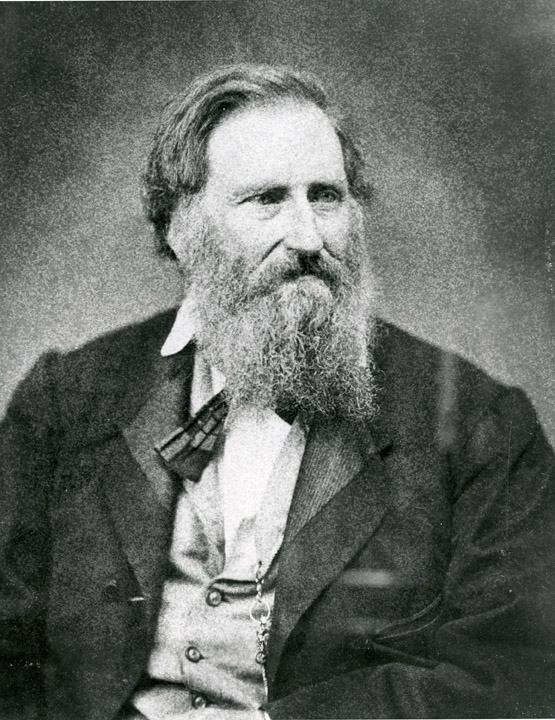
Twelve Days: For OSU supporter Sullivant, teach “all that is worth knowing”

Joseph Sullivant, 1878

Joseph Sullivant, 1878

We’d like to launch this year’s “Twelve Days of Buckeyes” celebration by focusing on one of OSU’s earliest and biggest support: Joseph Sullivant, a prominent citizen of Columbus whose influence on the University’s earliest development was strong and unwavering.

Sullivant was the son of Lucas Sullivant, one of the first settlers of Franklin County. Lucas Sullivant came to Ohio from Kentucky as a surveyor of military lands and stayed, building his home in Franklinton, on the western side of the Scioto River. Joseph Sullivant was the youngest of Lucas’ three sons, born in 1809. All of the boys received a quality education, and Joseph was sent to a boarding school in Worthington for a time, before he later followed his next-eldest brother, Michael, to Ohio University. He finished his studies at Centre College in Danville, Kentucky where he had family.

Throughout the rest of his life, Sullivant spent his time in a variety of services, public and private, that helped in the development of the city. For instance, before the age of 21, the state legislature appointed him to found the Philosophical and Historical Society of Ohio and was its curator and secretary for a number of years. He also served for many years on the Columbus Board of Education. As the years went by, he became known for his pronounced and liberal views on political questions such as education.

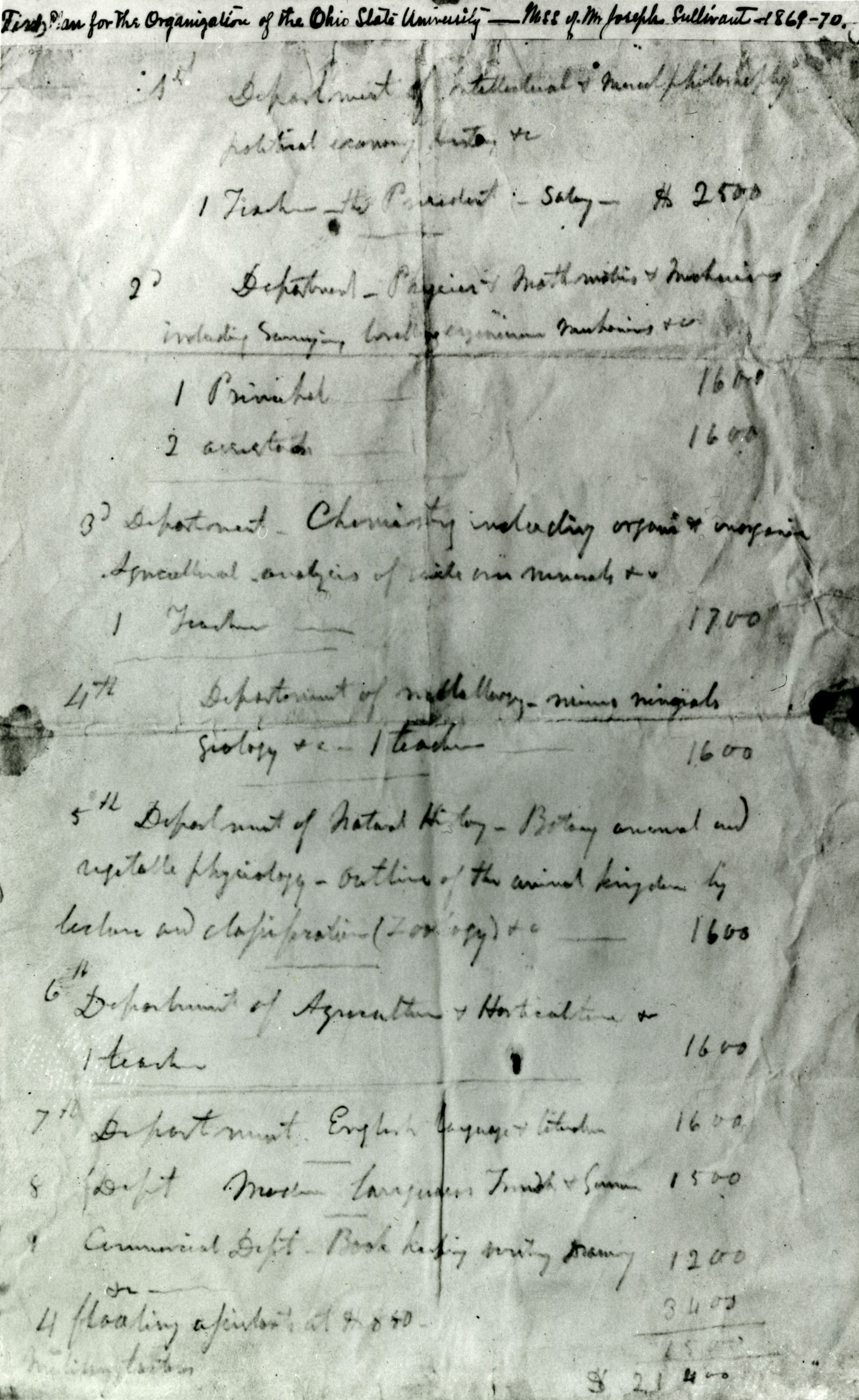
Sullivan's plan of organization for the school, 1869

Sullivant’s plan for the organization of the University, 1869

After the Oho state legislature passed the law to create the Ohio Agricultural and Mechanical College, Sullivant lobbied hard for it to be located in Columbus. He wrote an impassioned letter to the citizens of Franklin County, printed in a local newspaper, asking for their support of measure to approve the sale of bonds whose proceeds would be used to buy the land for the new college and build its first classrooms. The measure passed.

While Sullivant lived in Kentucky, he took an interest in agricultural education, and later in Columbus joined the state board of agriculture. As a member of that board, Sullivant would be a prime candidate to be selected for the new college’s first Board of Trustees. But when then-Ohio Gov. Rutherford B. Hayes nominated him for one of the seats, Sullivant at first asked Hayes to withdraw his name, knowing that his outspoken views and liberal positions on many issues would stir opposition in the Ohio Senate. Hayes refused, and the Ohio Senate ultimately confirmed Sullivant.

 As the Board of Trustees went about deciding the new college’s curriculum, Sullivant’s views on education became apparent. While some Trustees argued for the new college to focus solely, at least at first, on only those courses related to agriculture and mechanical arts, Sullivant advocated that the new college should “develop in all directions.” He went on to say, “If we had means, I would teach all that is worth knowing…What the farmer and mechanic need, like all other men, is a good education, and in proportion as that is general and liberal will they be best fitted for their special vocations.”

The University's original seal, designed by Sullivant, 1871

The University’s original seal, designed by Sullivant, 1871

Despite the controversy of his selection, Sullivant held great sway when it came to the final curriculum for the new college: his plan for ten departments of instruction was approved, although only six were in place when the college actually opened in 1873.

And if all that wasn’t enough, Sullivant designed the University’s original seal.

Sullivant died in 1882. In 1970, as the University celebrated its centennial, the Board of Trustees honored Sullivant by renaming the former Ohio State Archaeological and Historical Society Building (it had moved to its current home near I-71) after him.  

– Filed by C.N.


Korean War Anniversary: Conflict had multiple effects on OSU

Ohio State students in the Marine Reserves were some of the first called to active duty in Korea, 1950

Ohio State students in the Marine Reserves were some of the first called to active duty in Korea, 1950

Last week marked the 60th anniversary of the Korean War, which affected campus measurably, despite the fact it was being played out halfway across the globe.

Students in Company C, 7th Infantry Battalion, left Columbus for Camp Pendleton in September 1950. Within weeks, some of the men were in Korea, Japan and Guam.

Students in the Company C, 7th Infantry Battalion, left Columbus for Camp Pendleton in September 1950. Within weeks, some of the men were in Korea, Japan and Guam.

One of the first developments at OSU, according to a history of OSU Pres. Howard Bevis’ administration, was the appointment in autumn 1950 of a committee on Civil Defense, whose mission was to give Ohio communities the “knowledge and facilities” at the University to help them cope with atomic warfare. By March 1951 University emergency facilities had been inventoried by the campus Civil Defense Council, and local and state authorities had been notified of their availability. A War Emergency Committee was also created.

Because of the threat of atomic warfare, the city made extensive preparations for civil defense against such attacks. (At the time, Columbus was seen as a logical target in Ohio.) In early December 1950, OSU Vice President Bland Stradley announced the University would work both with Columbus and with Franklin County officials in preparing against atomic bombs.

Another effect of the war was a ban by the National Production Board on the construction of buildings for “amusement, recreational or entertainment purposes.” (St. John Arena’s construction did not begin until 1954, after the war ended.)

John F. Archer, 1944

John F. Archer, 1944

One of the biggest effects of the war, of course, was on enrollment. Early on, a University committee was created to coordinate information about the draft and calls to service of faculty and students. Like World War II, OSU faced a considerable dip in enrollment because of the war, so University officials tried to stem off an even further drop through a coordinated campaign to encourage male students to stay in school until they were called up, instead of enlisting. At the beginning of the winter quarter of 1951, Bevis issued a letter to male students, urging them to “stay in school as long as you can and do your work the very best you can! Whatever happens, this will make you of greater service to your country.”

In June 1950, the Alumni Monthly reported that dozens of Ohio State alumni were on the front lines when the war broke out. The first OSU casualty was Lt. John F. Archer, who was killed in action July 29, 1950. He had withdrawn from OSU during World War II to fight in that conflict; in the two years in which he served in World War II he won five battle stars. 

Older posts Newer posts