MD: When I started working at Princeton I remember how people would hear that a delivery of newspapers had arrived at the library — papers that had been collected for months in Tokyo and then been in transit for more months — and they would come from all over campus to find out who had won a kendo tournament 6 months earlier or the latest about pop culture or whatever…. It is amazing how many changes I’ve seen in my career. Just think about your future — how many changes will still be coming in the years ahead???
CM: It’s kind of terrifying! Ha ha. Here are a few questions that tie together – when did you first encounter manga (and do you remember what it was you saw), and what were you drawn to about it? Generally, “why manga?”
MD: Manga. My very first encounter with manga was actually here in Thompson Library in the early or mid 1980s. There was a guy who used to drive in to Columbus for help in translating manga that he got from someone in Japan. He needed help with slang and dialect words. As you can imagine from what I wrote earlier about my background in Japanese, this was quite a challenge for me! Still, he kept coming back, so I guess whatever help I gave him was worth something. There was another guy around the same time who needed similar help with vocabulary about Okinawan karate. These two people helped me to realize that there were information flows from Japan that were happening outside of academic publishing flows — and that they really mattered. Anyway, that guy with the manga helped me realize that manga were important in Japan and I started buying a few titles each year from around the mid-1980s. Lucy Caswell moved those into the Cartoon Library collections.
CM: Would you say that you were particularly drawn to manga? Is there something about it, or the role it plays in Japanese culture, that made it especially worth collecting to you?

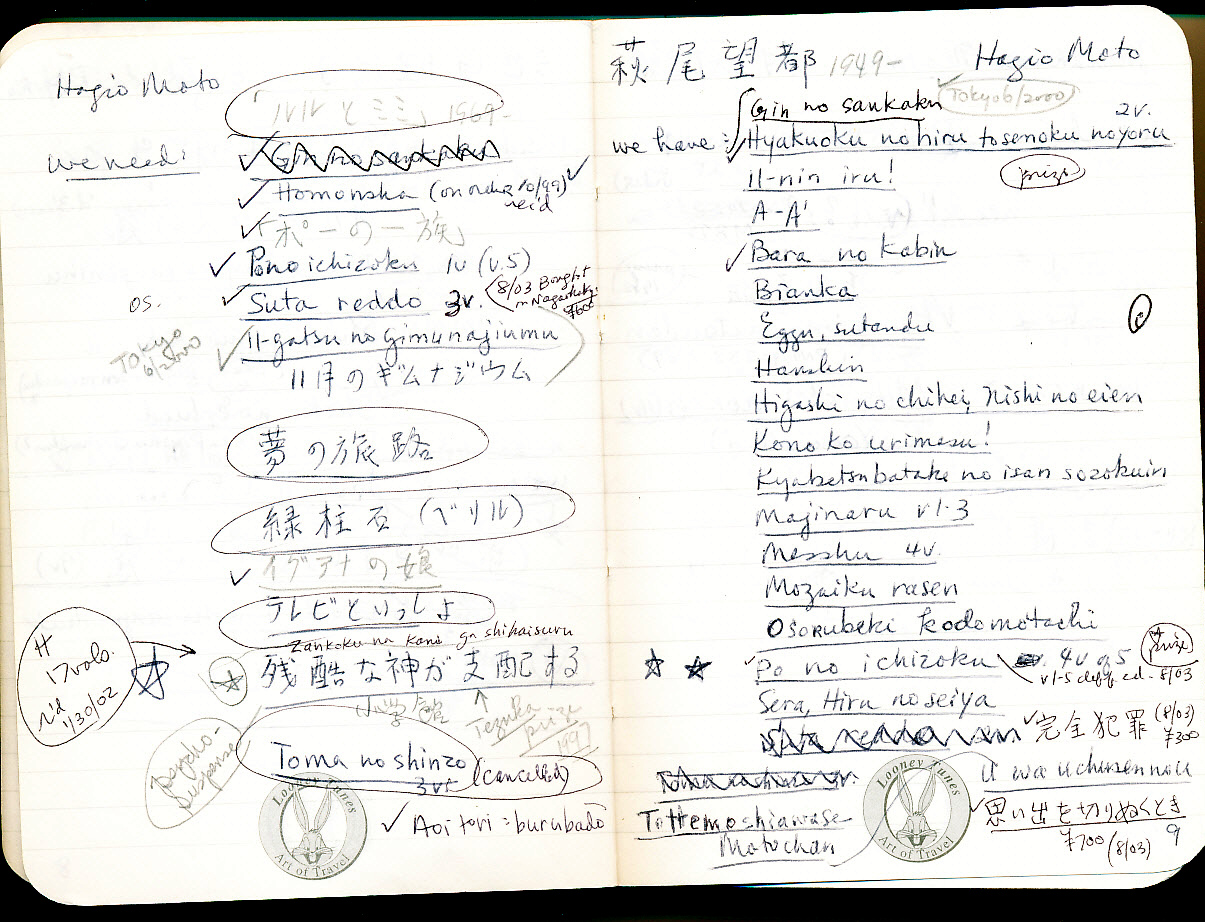
Maureen’s notes on Hagio Moto, one of the artists in the current BICLM Shojo Manga exhibit.
MD: When I lived in Tokyo in 95-96, that just happened to be at the height of manga publishing, which I have heard was in 1994. Manga were everywhere! It was unbelievable. Also, I went to an exhibit at the Kawasaki-shi Shimin Museum about the history of manga. This helped me to realize that we could build a manga collection that would “match” the main Cartoon Library collections. When I came back I talked about this idea with Lucy Caswell, and we agreed to set aside some money from each of our funds for purchasing manga. Also, we wrote a grant application to the Japan Foundation to fund some key foundational purchases to establish the collection. After that I became more “serious” about putting together a “broadly representative” collection of manga to support research and teaching. Perhaps the most fascinating thing about manga is how mainstream it is in Japan, how basic it is for their culture. Furthermore, since everyone reads manga, it is a great way to connect with Japanese people. I have met so many fascinating people through manga. I cannot say the same about the literature, history, philosophy, etc books that comprise the main parts of the Japanese collections! One time I was taking a trip on the bullet train on my way back from Sendai where I had visited the Ishinomori Shotaro museums and had several bags full of manga — the Japanese lady sitting next to me on the train, a middle aged/senior citizen, asked me about the books. I told her about the collection I was building and we had a wonderful conversation. It turned out that she was a Catholic nun. Anyway, she also asked if we had some specific titles and I said that I was familiar with them, but that they were hard to get, so we did not have them yet. Well, the next day a parcel arrived at my hotel with those titles!! Her name was Kazuko Sato and one of the books was Asaki Yume Mishi, a manga version of The Tale of Genji. Her donor name is entered in our catalog. There have been a lot of instances like that. When I have been at conferences in Japan, people bring bags of manga to give me. Just recently when Masami Toku was here for the symposium she made a point of saying “thank you” to me for building the manga collection. This activity has been a way to connect with people!
CM: That’s incredible!!! And it certainly does prove what you were saying about how embedded manga is in the culture if a Catholic nun was reading them, ha ha!
I’m curious to know how OSUL reacted your desire to collect manga, if it was supported or not back then.

Notebook page showing different editions of Tetsuwan Atomu, which Maureen has been collecting.
MD: The support at Ohio State has been great! On the one hand, Lucy Caswell — who had her hands full to overflowing with the Bill Blackbeard collections and other materials — embraced the idea of collecting manga. Jenny Robb has also been enthusiastic. The library administration has supported the effort, including recently by hiring someone for two years to oversee the move of some manga into the circulating collections. The Japanese studies faculty has also been behind me, despite the fact that none of them are researching manga — they all realize that eventually the next generation will be using these as research materials.
CM: That is such great news, and we are so lucky to have that kind of support. Many institutions don’t. On that same note, how did you initially start working with Lucy Caswell? Any stories there, or was it just a given that you would work with her since the Cartoon Library was already formed?
MD: She was hired a bit before me, but around the same time. So I knew her as a colleague. I started buying manga and books about manga that went into the East Asian stacks. She discovered them because of the call numbers and asked me if she could move them to her collection, once she moved over to the Wexner Center location. Then I started buying for the Cartoon Library location and we started having conversations about manga. She had begun to hear about manga from cartoonists, including Art Spiegelman, as I remember. So she wanted to do more about collecting them. Lucy and I worked together well. We are both strategic thinkers! We both enjoy collecting! Also, I liked the challenge of connecting manga with American cartoons and comics. The general discourse was that they were different, but I found similarities. For example, I collected newspaper manga — which many people did not even realize existed.
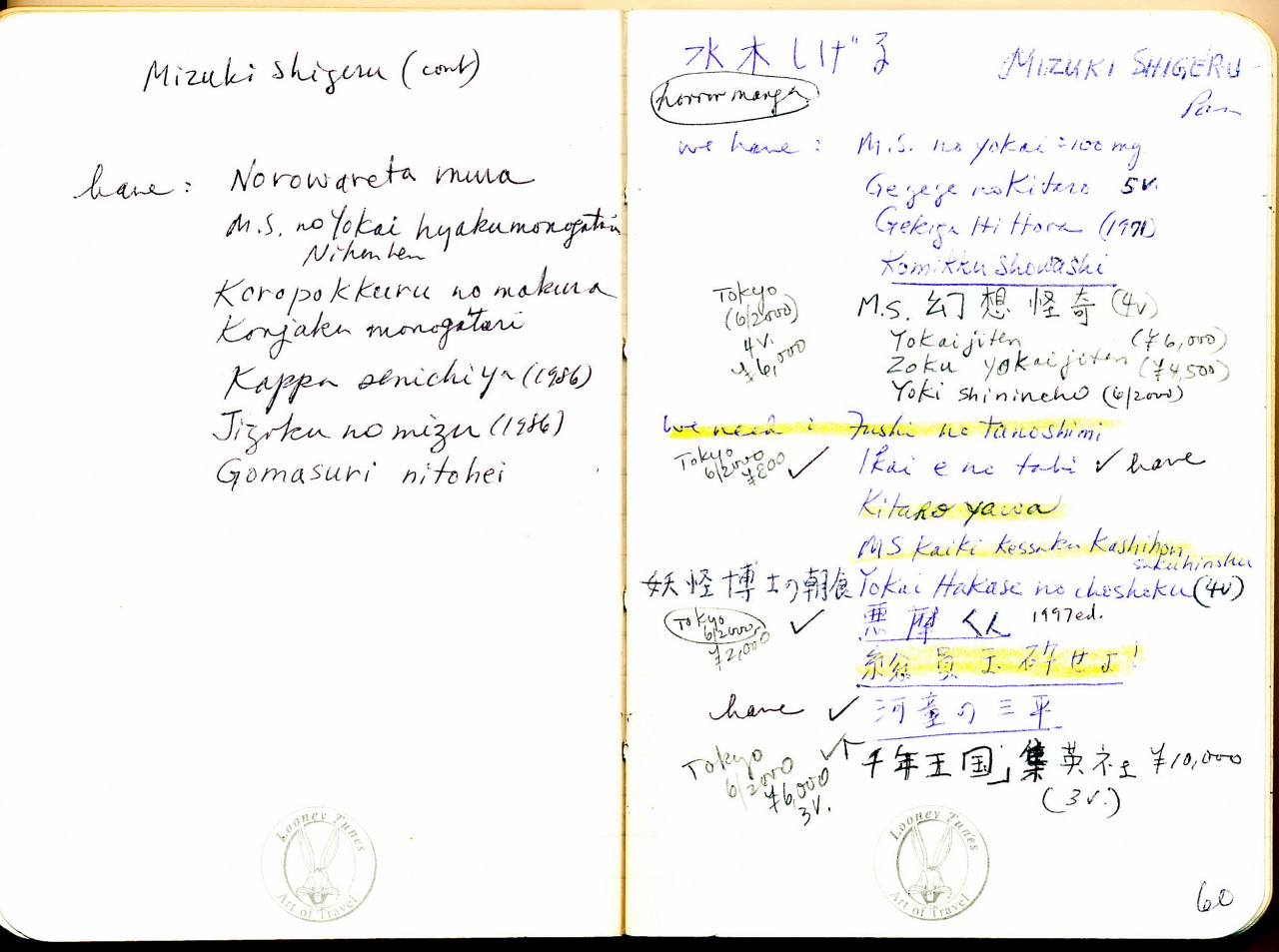
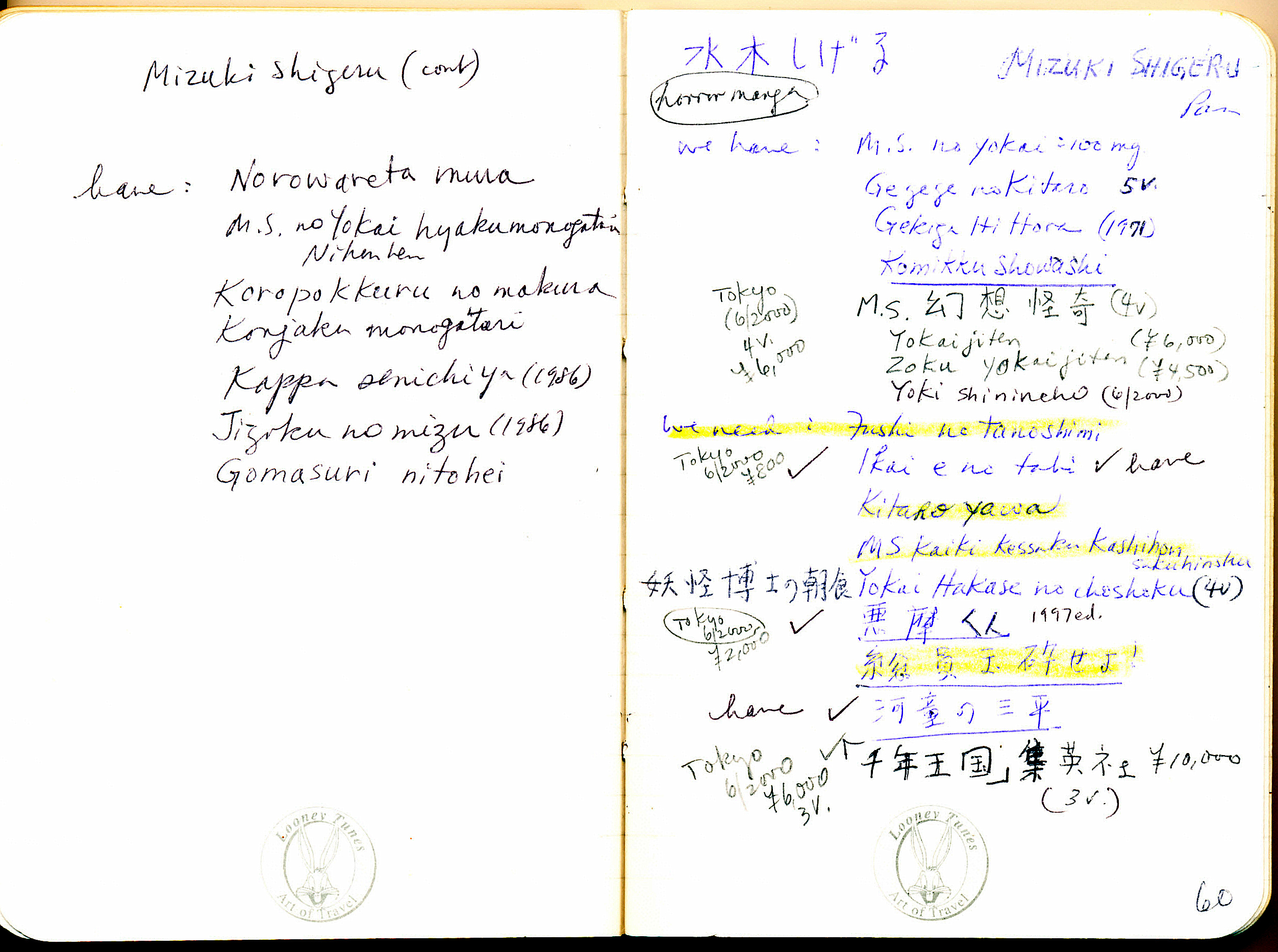
Maureen’s notebook from June, 2000- shows purchases she made in Tokyo of Mizuki Shigeru.
CM: You guys are quite the pair – you both really revolutionized the collecting of cartoon art in American libraries- I hope you realize that!Could you tell me about some of the classes you have taught using manga/about manga, or how you’ve worked to integrate manga into the curriculum over the years?
MD: Well, collecting manga has just been a side job for me — only a tiny part of my work. I wish I could have devoted more time to it….
So an interesting thing was that I was collecting all these manga that were connected to the CGA materials in some way — or famous mangaka such as Tezuka Osamu, etc. However around 2000 when manga started being translated in great numbers I noticed that those manga were different from the ones I had collected. Around that time we had a new library director and soon an emphasis developed around teaching. We were encouraged to propose to teach freshman seminars. I proposed one on “Analyzing the Appeal of Manga” I thought that it would give me a chance to talk with young people about why they liked reading manga, and how to appreciate those manga. That was such a fun course!!! I learned so much from my students!!! I taught it from 2006 to 2010. After that I was discouraged from continuing to teach it — the emphasis has shifted within the libraries! However, I was encouraged to continue teaching the “Understanding the Global Information Society course (which is now a required course that will be taught by Johanna Sellman and Jose Diaz next year). I started teaching that in 2009.
In 2010 for the last time I taught the Analyzing the Appeal of Manga course, I made it an all-Tezuka + Urasawa Naoki reading list. The students loved it! Previously I had only included one Tezuka on the reading list each year, but by making it all-Tezuka the students were able to follow his career chronologically and catch some of the “intertextual” puns and references that really make reading Tezuka fun. Then they could also see how Urasawa Naoki echoed Tezuka in the works we read. That seminar was such a memorable experience for all of us! Through teaching the freshman seminar, my involvement with the student clubs began. Some students just did not want to stop getting together around discussions of manga after the course ended. I really enjoyed working with them to set up the clubs! So, as I mentioned, collecting manga for the library has really been about connecting with people in so many ways!
CM: To be clear, these were manga books in English, or in Japanese language?
MD: The freshman seminar books were all in English! We just read volume one of a title. I arranged the readings according to the original publication in Japan. This really helped the students — because all the translations came out at the same time, although the books were originally published over decades in Japanese. As for people with whom I connected, I met many people in the manga world in Japan. Lots of people have helped me learn about manga in Japan. As for why manga are important in a library context. First of all, they are primary sources — can be used by linguists, people studying all sorts of subjects such as history, literature, culture. global flows of information, too! Second, to support creativity. Manga are inherently creative and inspire creativity. Finally, the world of manga is very participatory. I’ve mentioned how they have helped me connect with people. People who read manga want to do things — cosplay, draw, write, discuss, etc. Having manga in the Japanese collection has made it a more dynamic collection, more engaged with people around campus and in the community.
CM: Great answer! What are some of your personal favorite manga?
MD: I love Doraemon!! Also, I love reading Tezuka and encountering his intertextual puns and references. Other favorites include Mizuki Shigeru and Takahashi Rumiko. I love Dragonball!! While I was living in Japan I became a big fan of Shiriagari Kotobuki, who writes manga for the Asahi Shinbun. I would read his manga every day — he takes the pulse of the nation and really nails it every day!! As I was thinking of what to say about favorite manga, I realized I have not been collecting his manga books for a while. This is really bad. I have a lot of catching up to do, because I read that he has been doing some amazing work in writing post-Fukushima manga. Another manga I really like is Oishinbo — about eating and food!

Yamiuri Sande manga (Sunday newspaper comics from Japan, 1930s)
CM: Sounds like I’ll have to check them out myself! Tell me about one or two most unique manga items you have collected?
MD: Most unique… That would have to be the newspaper manga, Jiji Manga and — more recently — Yomiuri Sande Manga. Also, the original manga by Tezuka. I got that because we were planning to have an exhibit for the Astro Boy birthday. I found it in a used bookshop in Tokyo. I remember that it was a rainy day — and I was carrying this amazing manga under my arm….
CM: Was there anything that you wish you could have gotten for the collection, but never could?
MD: I wish we could have more original manga. I hope my successor will concentrate on getting such materials.
CM: What do you see as the future of manga in the classroom and the library? Did you ever expect it to come this far?
MD: As for the future, I have actually been surprised at how slow it has been for manga to be included in teaching and research. Since English translations do not stay in print very long, it may be hard to incorporate them into teaching, though. Already a great number of students are drawn to study Japanese language because they want to read manga and watch anime, etc. At OSU enrollments in Japanese remain high, mainly for this reason. Perhaps, the availability of the manga collection draws more students to OSU to study Japanese??? I hope so!!
CM: Looking back, what is your proudest and moment in your career at OSUL?
MD: My proudest moments at OSU… those were probably related to my early web sites and other Internet-related initiatives. In the mid-90s I had a lot of grants to promote use of the WWW for resource sharing among Japanese collections. That work has continued with the Wiki projects I initiated, including the index of Jiji Manga http://library.osu.edu/wikis/library/index.php?title=Jiji_Manga and Mangajin http://library.osu.edu/wikis/library/index.php/Mangajin as well as other manga-related wiki pages. I am also really excited about the new manga collection development strategy, which emphasizes manga magazines and original manga. In particular, I am really happy that I could arrange the first donation of manga magazines from the Kyoto International Manga Museum. Those materials have now been
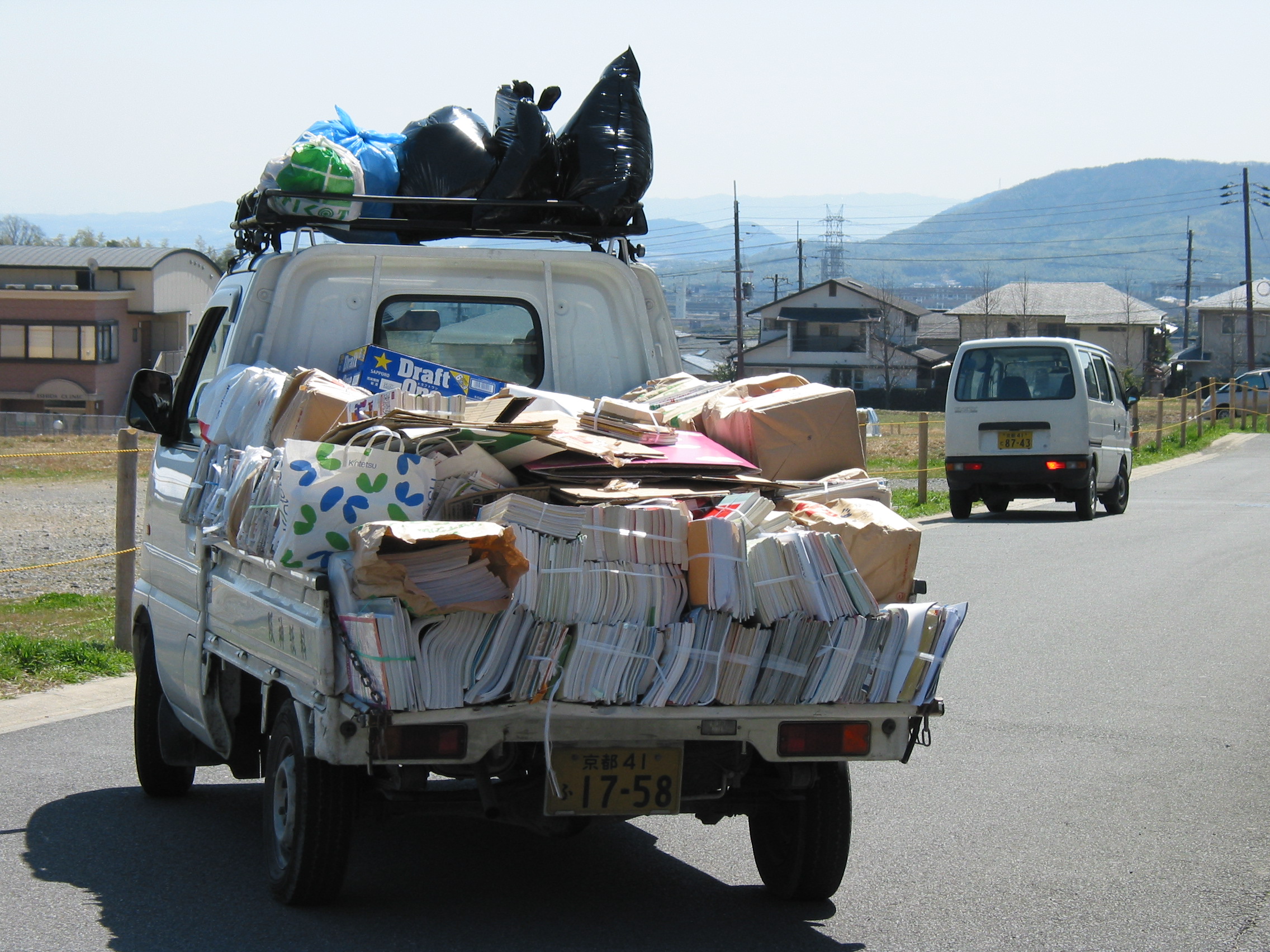
processed and are available for researchers. When I lived in Japan and saw the recycling trucks going around collecting people’s old manga in exchange for rolls of toilet paper and boxes of tissue, I felt despair! How could we ever collect manga? Volumes that were issued in millions of copies were essentially unavailable for researchers!! However, with cooperation with Japanese institutions such as the KIMM, I really hope that the Billy Ireland Cartoon Library and Museum can continue to collect these works and make them available for researchers!
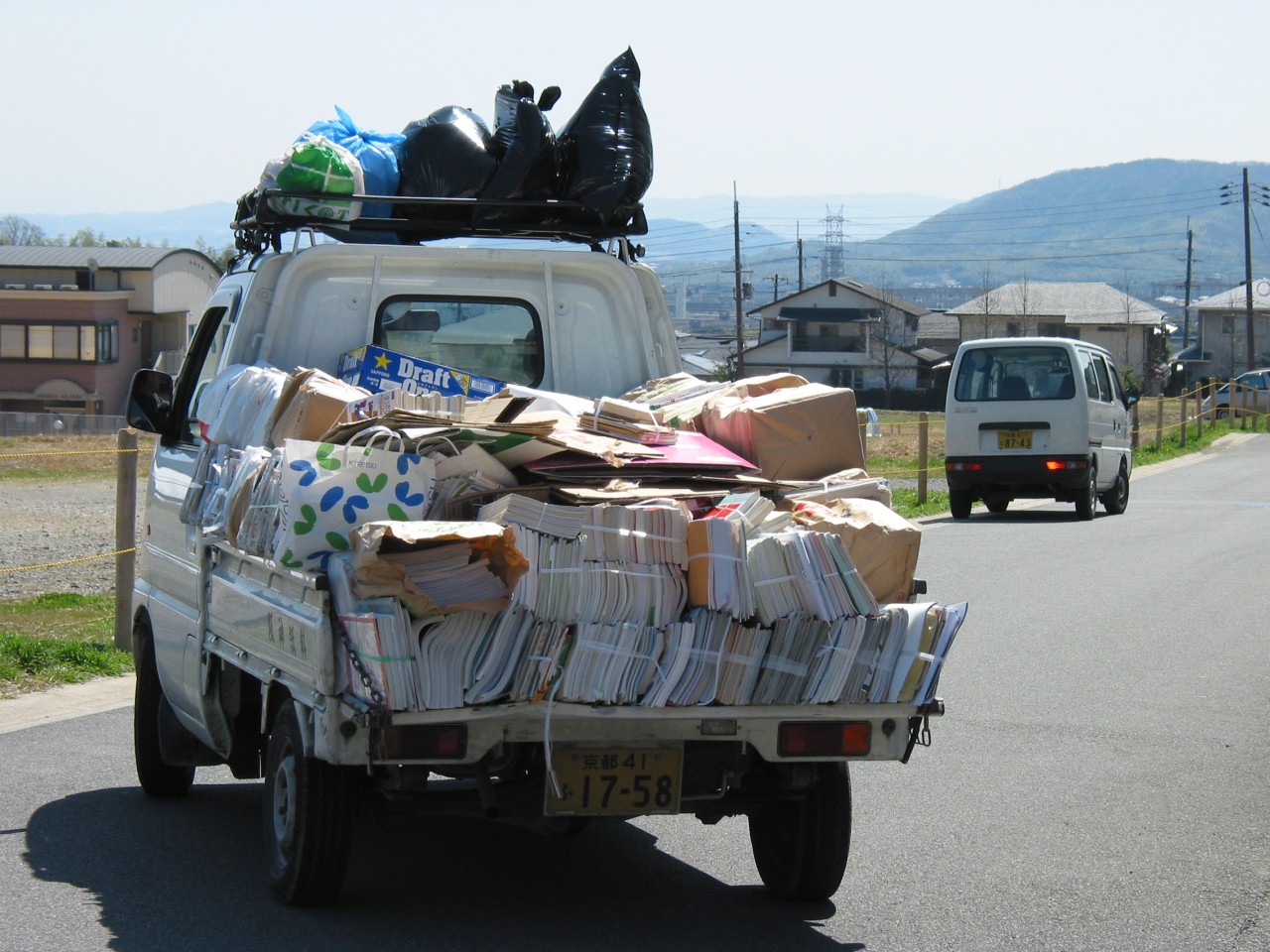
Recycling truck full of manga in Maureen’s neighborhood in Kyoto in 2004
CM: I’d love to hear more about stories from your collecting trips in Japan and people you met who helped you along the way…
MD: I have had so many memorable experiences on collecting trips in Japan! First of all, I want to mention Makino Mamoru. I met him through my involvement with Japanese cinema scholars and Kinema Club
http://kinemaclub.org/about-us/history He specialized in collecting materials about Japanese film history — documentation, not the films themselves. I met with him a few times and viewed his collection. Also, he invited me and my family for “bonenkai” (year-end party). Through those conversations I learned about how to collect materials to support research on popular culture — books listing the “best” ones, biographies, directories, guides, how-to books, etc — all these are important research resources. In 2001, I had a wonderful visit to the Japan Cartoonists Association. Yanase Takashi was president. He was the creator of
Anpanman — he recently passed away. I met him and several other famous cartoonists. The purpose of the visit was to let them know that we were planning events to celebrate the “birthday” of
Astro Boy (April 7 2003) to see if we could get some cooperation. That did not happen by the visit was fun! Also I went to Tezuka Productions which also was fun! They donated some books and things. The
Astro Boy birthday events was definitely one of the high points of my career!! We had events all spring in 2003, including an exhibit. It was covered in the
International Herald Tribune! I worked on that with Professor Mineharu Nakayama, who has been a great supporter of the manga collection. He gave me the first list of manga to prioritize collecting — back in 1997. We got a grant to bring in speakers,etc. I gave a presentation — again in Japanese– at the Japan Society for Studies in Cartoon and Comics (Manga Gakkai) in 2004. That was about challenges of collecting manga in an American academic library. At that conference I met/saw many cartoonists and people active in the manga studies community. Also, I gave another talk in Japanese — on copyright issues and manga studies — in 2009 at International House in Tokyo. One of the key people whom I met on several occasions in Japan is Shimizu Isao. He donated some wonderful resources to our manga collection, including the “akahon manga” (little manga books) about which he wrote a monograph. I met with him a few times. He is a collector as well as a prolific scholar and is very generous, meeting with people like me and others who are studying manga.
CM: I really wish I was here when you guys had the Astro Boy celebration, it sounds so wonderful.
Is there anything else you’d like to add? If not, I just want to say thank you so much for taking the time to talk with me- I have learned SO much from you over the past 3 years, and am so sad that you’ll be leaving. Whether you feel like your job is truly done or not, I hope you know you are leaving a major legacy behind you, that generations and generations of OSU students and scholars in the future will be so grateful for. You’re our manga hero!






Recent Comments