Category: Found in the Collection (page 9 of 53)

Collection Spotlight: The B.N. Duncan Collection

We recently finished processing the collection of underground cartoonist B.N. Duncan, and to celebrate we are featuring him on the blog today!
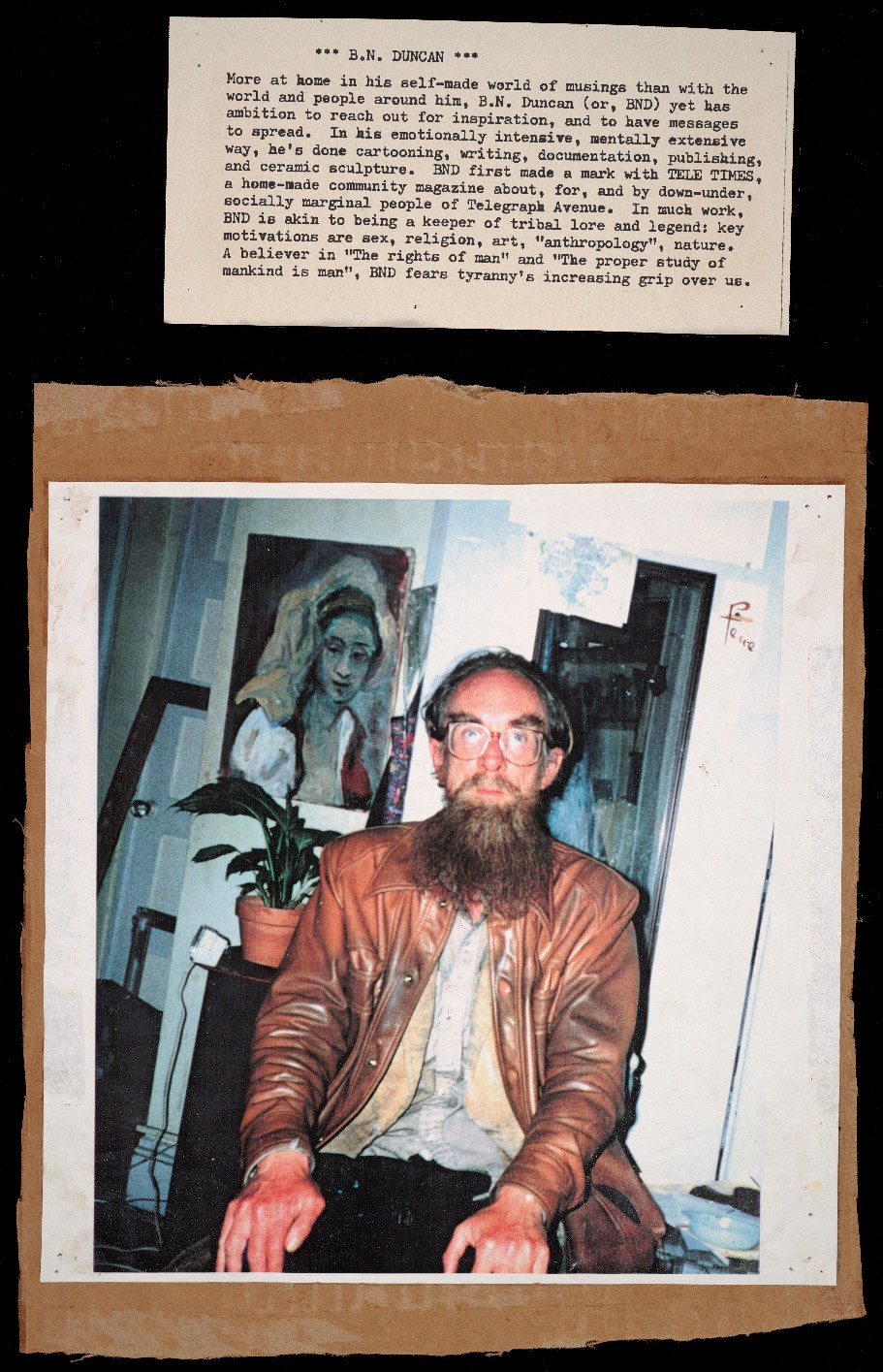
B.N. Duncan was born in Rochester New York in 1943. He grew up in Berkeley and Pasadena. As a child he had an avid interest in anthropology, paleontology and primates. In junior high school he acted in plays and drew for his school yearbooks. After graduation he attended Pasadena Community College but he suffered several mental breakdowns there. He returned to Berkeley in 1966 diagnosed with schizophrenia. Encouraged by his art teacher, Dick Warner at Vista Community College, he began cartooning in the early 1970s. He lived most of his life on Berkeley’s Telegraph Avenue working as a cartoonist, editor and publisher. His full name was Bruce Nicholson Duncan but he preferred to be known as B. N. Duncan or just Duncan.
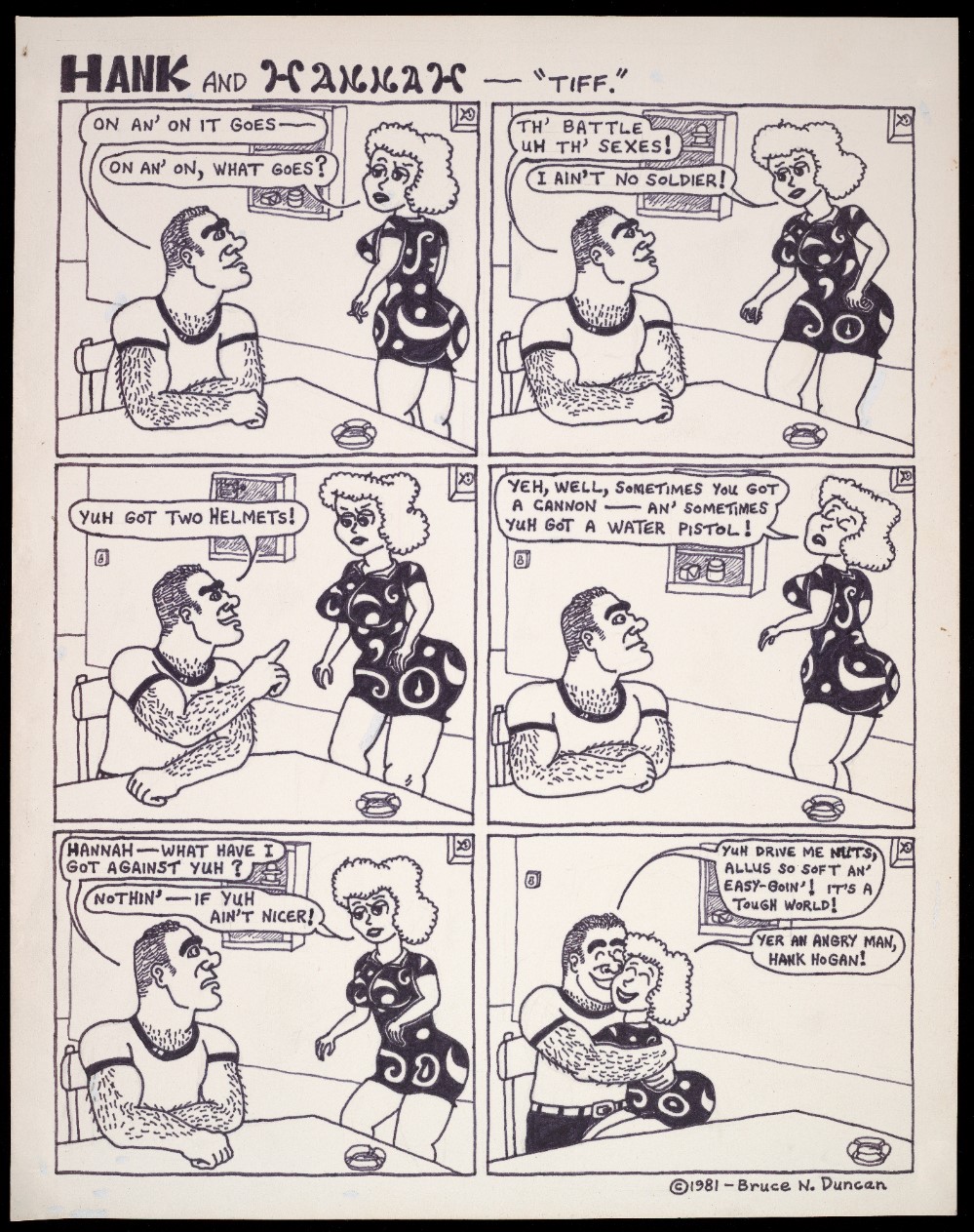
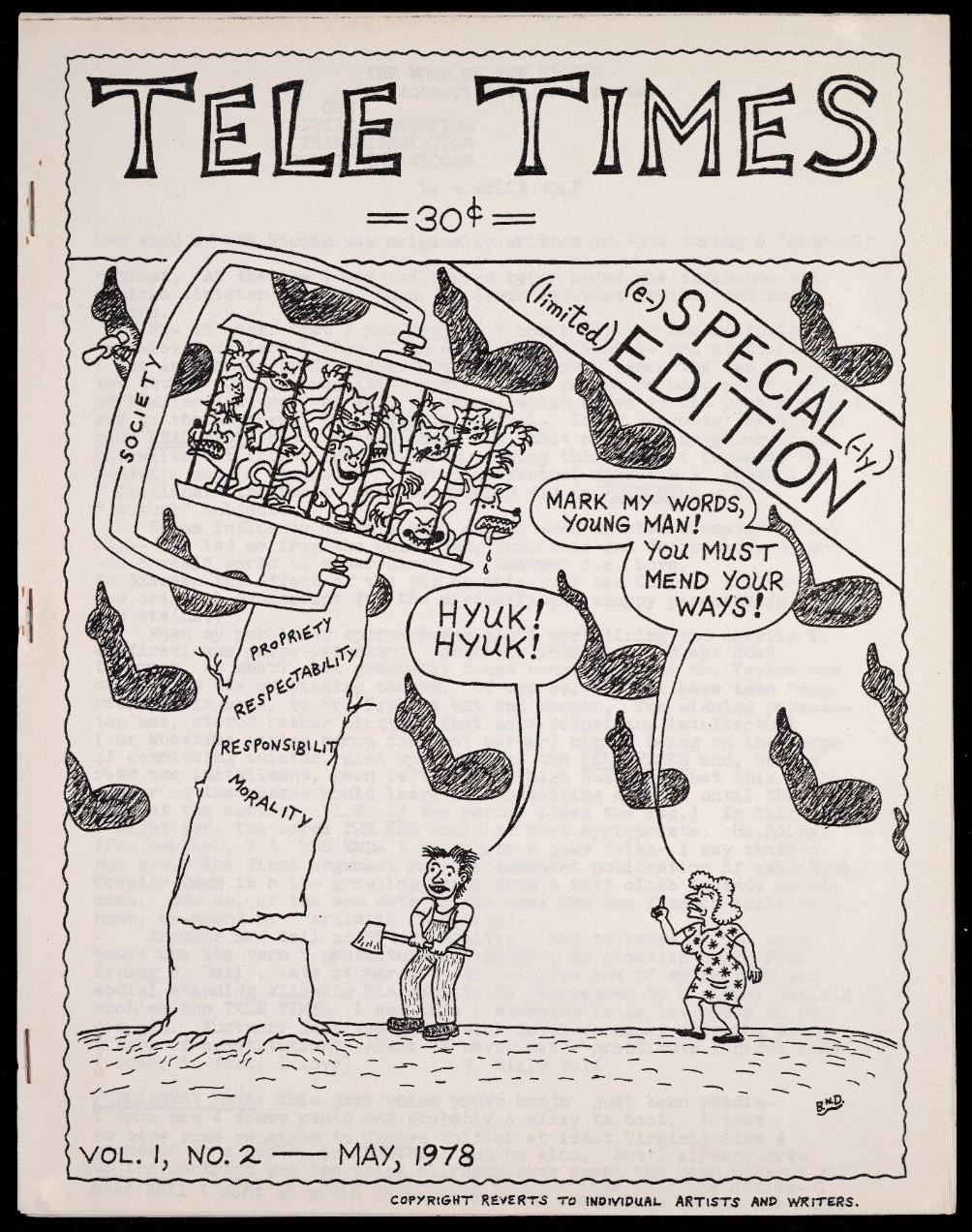
His first comic strip, ‘Hank and Hannah’, about a couple and their relationship, was published in porn newspapers and new wave zines. Another strip ‘Berserkeley Blues’ was published by the Berkeley Daily Gazette in the late 1970s and it was through it he met Telegraph Avenue street person Wild Billy Wolf. Wolf was working on a zine called ‘The Tele Times’. Duncan collaborated with Wolf on early issues and provided art for its first cover in 1978. Duncan eventually took over the publication, making it his own vehicle to share his passions and interests and a way to celebrate the outsider art and writing he enjoyed. Duncan produced over 30 issues of ‘The Tele Times’ until it ceased publication in 1982.
Duncan drew for the underground comics ‘Weirdo’ and ‘Mineshaft’ and he corresponded with a wide range of other underground cartoonists and writers including Harvey Pekar, Robert Crumb and Kim Deitch. Duncan drew heavily on this correspondence for the final issue of The Tele Times ‘Here we go’ #30.

He had a strong interest in sadomasochism and drew cartoons for ‘Growing Pains’ the publication of the San Francisco ‘Society of Janus’ as well as other S/M publications. He self-published the cartoon compilation titles ‘Top Comedy and Bottom Burlesque’, ‘So be it’ and ‘Buttock’s Blasting’ and in 1995 he published a collection of S/M cartoons through Greenery Press called ‘Mercy??’’No!!’

In the early 1990s with the encouragement of the Berkley Friends Church he published two collections of spiritual cartoons called ‘Nature and Spirit’ and ‘Seeking Vision’. His lifelong interests in anthropology, paleontology and zoology are evident in both these and in his experiments with clay sculpture. He was a frequent visitor to the San Francisco Zoo.
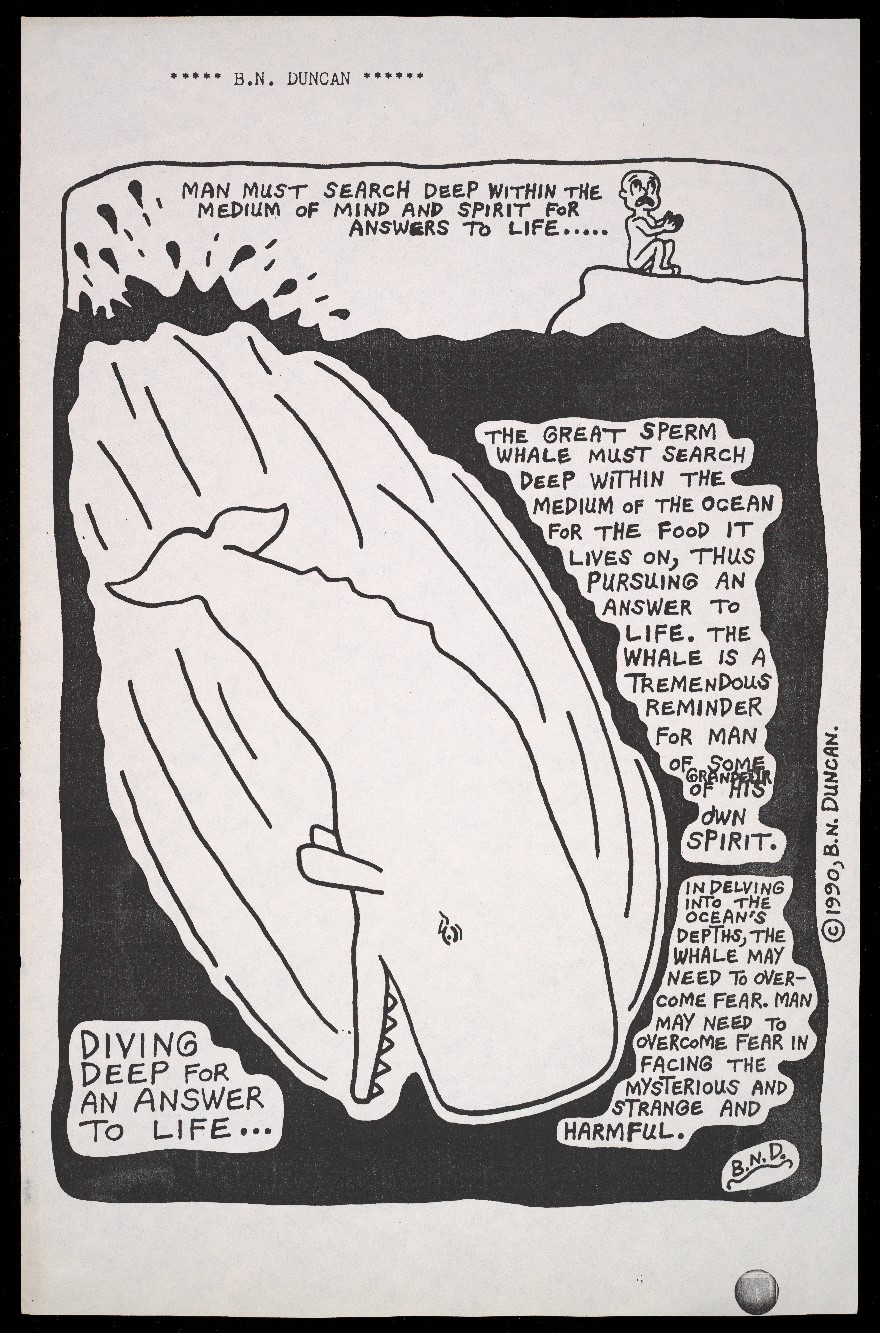
From 1990-2004 Duncan collaborated with cartoonist Ace Backwords to create an annual calendar called the ‘Telegraph Avenue Street Calendar’. It featured Berkeley street people and the stories of the socially marginalized in and around Telegraph Avenue. Duncan took thousands of photographs of street people for the calendar and taped many interviews with the homeless, work he considered ‘street anthropology’. Through both ‘The Tele Times’ and the ‘Telegraph Avenue Calendar’ he made enormous efforts to promote the art of outsider and street artists living in and around Berkeley. He believed that ‘even people on a society’s margin have something to contribute to its sensibility and spirituality’.
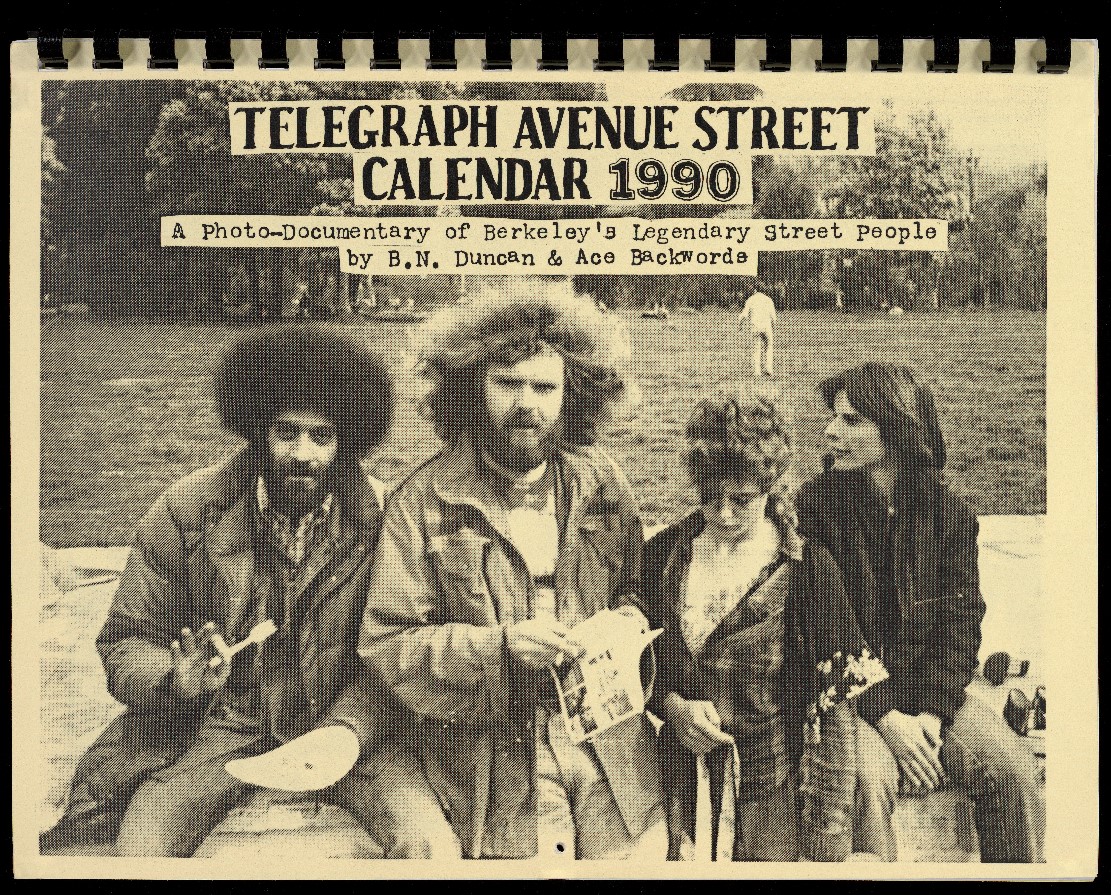
The B. N. Duncan collection represents a lifetime of work not only in underground comics and self-publishing but it also offers a snapshot of life on the street for the homeless and marginalized in and around Berkeley at the end of the 20th century. It includes Berkeley memorabilia, examples of street publications and eighteen boxes of Duncan’s photographs of street people, some of which featured in the ‘Telegraph Street Calendar’. The collection also contains Duncan’s audio recordings which offer additional documentation of life on the sidelines of society in Berkeley at this time.  There are many examples of work by Berkeley homeless artists who Duncan helped and encouraged including ‘Sparky’, ‘Cliff Mason’ and ‘Narayana’ and the blown up photocopies he used for an exhibition he collaborated on with Ace Backwords called ‘Artists on the fringe’.


The calendar ceased publication in 2004 and Duncan’s suffered ill health in his final years. He died in 2009 aged 65. We would like to thank Duncan’s sister Elaine and his friend and fellow cartoonist, Ace Backwords for their donation of Duncan’s work to us and for their advice and help in processing the collection.

-Ann Lennon, Archives Associate, Billy Ireland Cartoon Library & Museum
Student Profile of Cartoonist Udo J. Keppler

Found in the Collection: Udo J. Keppler

by Emily Glassmeyer, BICLM student employee

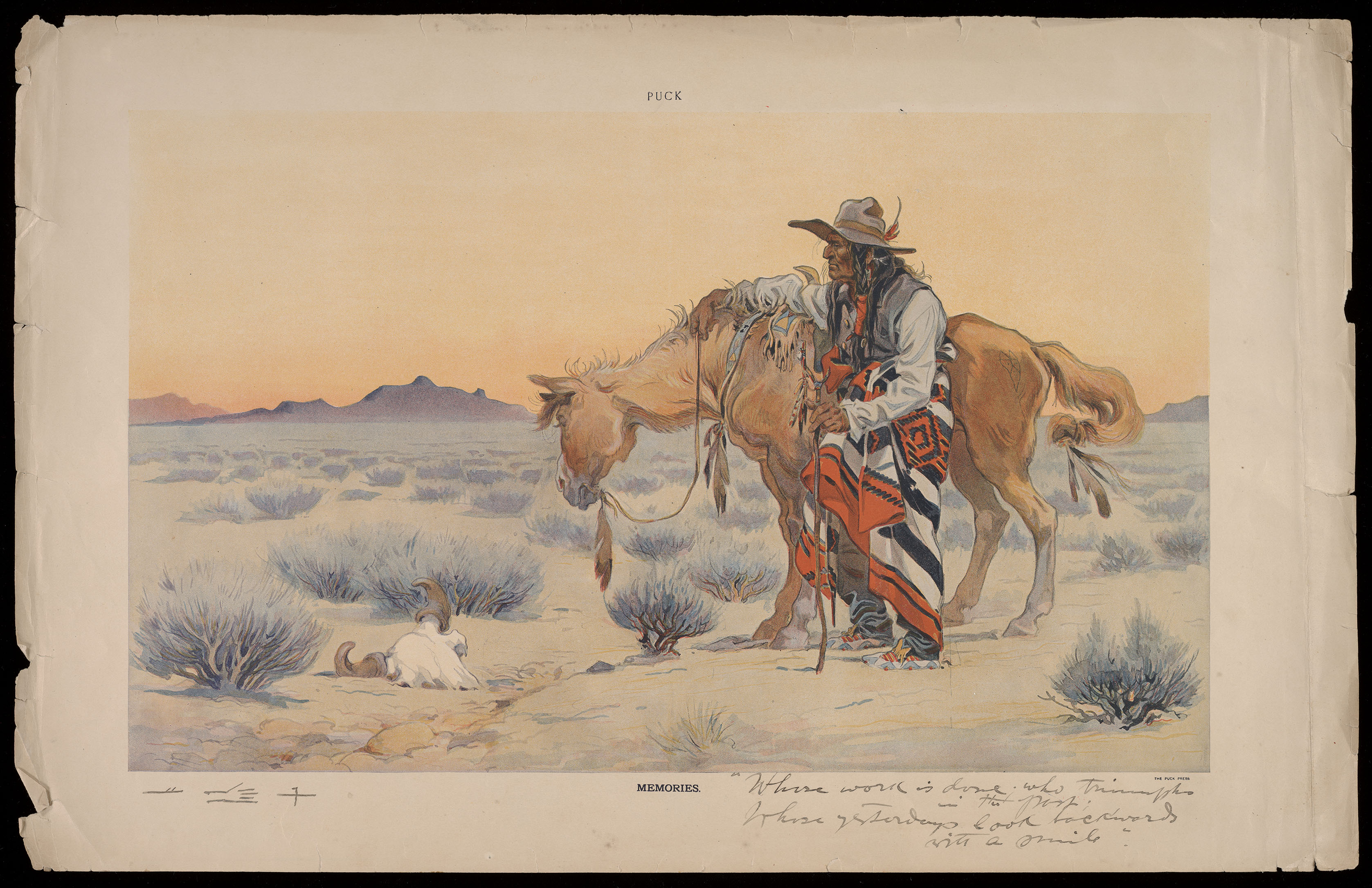
“Memories,” created by Udo J. Keppler in 1910. This piece can be found in the Draper and Sarah Hill Collection at BICLM

One of the greatest pleasures of being a historian who works at BICLM is the access to 19th and 20th century periodicals like Puck and Harper’s Weekly. These volumes give us a glimpse into the lives and perceptions of those of the past – though, their views often did not age well. These periodicals were largely run and read by a white, middle-class, male demographic. As a result, their handling of topics regarding people of color and women are often reliant on distasteful stereotypes and oversimplifications of identities prevalent during the time. However, these tropes were fortunately not ubiquitous across the board.

Joseph Keppler, Sr. founded the American iteration of Puck Magazine following his move to New York in 1872. He passed his love of cartooning and political engagement to his son, Udo J. Keppler, who worked at the magazine with him. While in New York, Udo became richly engrossed in the cultures and practices of the local Seneca tribe of Iroquois. When he took the reins of the magazine in 1894, he merged his advocacy for nationwide women’s suffrage movements with his knowledge of Iroquois culture, best exemplified in the following:

“Savagery to ‘Civilization’,” by Udo. J Keppler. Created in the early 1900s. This piece can be found in the Draper and Sarah Hill Collection at BICLM.

When I first discovered this piece, I was critical of it. Based on what I knew from previous coursework, I was displeased at the implication that these were “rights” of the Iroquois women. On the contrary, they weren’t so much “rights” but inherent facets of their matriarchal culture. To be a woman within Iroquois tribes meant that they were an important trading partner, they played a vital role in medicinal practices, they chose which men would speak in the council and depose those who did not fit their interests, and ultimately, they were the ones responsible for the future of the tribe. It is not that progressive Native American men gave up some of their patriarchal power, but instead that that power was not the focus of their systems, and that the rights of women were inherent to their cultures and traditions. Keppler knew this, and used a simplified image of Iroquois culture to showcase how radically different their treatment of women was from the rhetoric and legislation of the American government

I soon found out that Keppler was embraced by the Seneca people, that he was an honorary chief and a key Native American rights activist. I came to realize that it was not so much that he failed to acknowledge the complexities of Native culture, but instead he knew that in order to make his point digestible to the American public, he had to simplify the realities of Native life and use the prolific rhetoric of the time to push his message– to make it appealing to mainstream white America, who often conceived of Native Americans as backwards. His simplification of Iroquois gender relations was political –all in the hope of encouraging the readership to advocate for change. If these “savages” could do it, why couldn’t they?

Joseph J. Keppler Jr. (Udo J. Keppler) receiving the Seneca Silver Star on September 23, 1937 from Jesse Cornplanter. Image from Cornell University’s Library Native American Collection.

Not only was he fully aware of Iroquois culture, but he had befriended Chief Ed Cornplanter, whose ancestors had been directly involved in the American Revolution. When the Chief died, Keppler fostered an enduring friendship with his son Jesse Cornplanter, who took over his father’s place as chief after returning from WWI. Not only was Jesse the new chief, but he was also a well-regarded artist, performer, informant to scholars and anthropologists, and played a vital role in documenting the histories, mythology, religion and ceremonies of the Iroquois people. Through his advocacy and relationship with Cornplanter, Keppler was well respected within the Seneca Iroquois community. His activist work in cartoons within Puck and elsewhere were of immense importance to their community.

“The Great Spirit,” created by Udo J. Keppler in 1920. This piece can be found in the Draper and Sarah Hill Collection at BICLM.

“The Great Spirit,” created by Udo J. Keppler in 1920. This piece can be found in the Draper and Sarah Hill Collection at BICLM.

Sources & Further Research:

For more information about Udo Keppler & Puck at BICLM, see:

For more work by Udo Keppler at BICLM, see:

Billy Ireland Cartoon Library & Museum Art Database

For more information on representations of Native American women within the suffrage movement, I recommend The “Other” as Political Symbol: Images of Indians in the Woman Suffrage Movement” by Gail H. Landsman (1992).

History of American Women: http://www.womenhistoryblog.com/2008/05/iroquois-women.html

For more information on Udo Keppler and Jesse Cornplanter’s friendship, see:

http://nac.library.cornell.edu/exhibition/northeast/northeast_6.html

https://oac.cdlib.org/findaid/ark:/13030/c8vd70zm/entire_text/

Older posts Newer posts