Category: Found in the Collection (page 5 of 53)

Student Post: Gigi D.G.’s “Cucumber Quest”

Michael Patton is an Actuarial Science major graduating in May 2020. He’s been formally working at the Billy Ireland Cartoon Library & Museum for all of his four years at Ohio State,  in the reading room and in the stacks. He also did some volunteer work in high school during his summers.

While sorting through materials from the stacks in the Billy Ireland’s Lucy Shelton Caswell Reading Room, it’s always brought me a sense of contentment to be surrounded by all the beautiful and fascinating materials on the shelves. Some are books I know and love, others are on my list of books to read. But every now and then I get the chance to share something I love when patrons come in to find something new themselves. When I feel appropriate interjecting, I’ll usually suggest Blankets by Craig Thompson to esteemed ladies and gentlemen. But what makes me happiest is when they bring their children, and I’m able to share Cucumber Quest (First Second, 2017).

Cucumber Quest is the magnum opus of cartoonist Gigi D.G., started all the way back in April 2011 as a webcomic, continuing to this day and only recently finding its way to print and to the shelves of the Billy Ireland. It follows a timid boy named Cucumber learning magic who is suddenly told he must go on an epic quest to save the world accompanied by his little sister Almond, who wants to be a knight to fight villains. There’s a great sense of being a tongue-in-cheek parody of the “hero’s journey” as Cucumber points out everything wrong with expecting a little kid like him to save the world: For example, the mystical Oracle that gives Cucumber his quest dodges his question about why she can’t use her powers to stop the great evil instead. Soon after he begins his quest, Cucumber finds the McGuffins that will be used to resurrect said evil and proposes stopping the quest in the first place, but his dad tells him “You don’t want to go down as the most boring legendary hero in history, do you?” Cucumber’s little sister even gives the villain’s minion (who she ends up having a possibly romantic rivalry with) one of said McGuffins so she can create the villain for them to fight, thus creating the need for them to go on their legendary quest. Apart from one other member of Cucumber’s party, everyone else’s priority seems to be instigating the adventure rather than actually saving the world.

I’m quick to simply suggest Cucumber Quest to a kid in the reading room partially because it has an engaging art style that can be appreciated by readers of all ages. D.G.’s anthropomorphic bunny characters are so expressive they almost seem animated in each panel’s still image, bringing life to the page as she elicits comedy and drama alike.
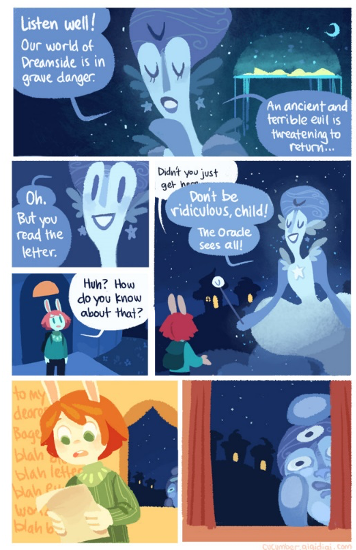
Much of D.G.’s humor comes from absurdity: There’s the absurdity of everyone imposing Cucumber’s world-saving quest before the world is even in danger, but there’s also littler absurdities like one of our heroes learning the spell that grants “the power to order a pizza from anywhere, but only when nobody is in the mood for pizza”. Or, when a show in-universe spoofs our main villain, the Nightmare Knight, as he uses his “nightmare powers” to give the most terrifying nightmares of all, depicted as the text: “where’s a bathroom”, “late for school even though you graduated 5 years ago”, “naked at improv”, “won the lottery (of bees)”, and worst of all, “three butts”. It’s gags like this that highlight to me how the series can appeal to audiences of all ages, with absurd non-sequiturs any kid-at-heart can laugh at like “three butts”, but also how “naked at improv” and the graduation one lampoon common nightmares by young adults under societal pressure.

But just because the world is absurd and cute doesn’t mean there’s nothing underneath the surface for more matured tastes. Although it’s funny to see the hero’s journey forced upon Cucumber, the series uses this to explore the idea that our hero is trapped within it. Cucumber has no desire to fight villains and even wants to make peace with them at every chance he gets. And what’s even more interesting is that while the villains also seem playfully aware that they’re part of a “hero’s journey” (in the canon of the CQ, this quest has literally been repeated 100 times every 5,000 years), they’re resolute in their goal of stopping our heroes as if this is the first time again. This becomes even more interesting when you consider how their creator and boss, the Nightmare Knight, is also “trapped” within his role.

While Cucumber’s being forced into the quest is played for laughs, there’s always a sense of intrigue as the reader gets closer to learning why he and his friends must embark on their journey. The second half of D.G.’s commentary on the “hero’s journey” comes from the most commanding presence on the villain’s side: the Nightmare Knight, resurrected by a would-be world conqueror Cordelia and her adorable minion/adoptive daughter Peridot, is the true star of the show in my opinion. As he grows closer with Peridot and Cordelia’s captured princess, the Nightmare Knight is revealed to have much more of a heart than his appearance lets on. As he opens up to others in Cordelia’s castle, we’re treated to a prideful but sweet entity that long ago lost its taste for world-conquering and has a suppressed love for his minions, who want nothing more than to crush Cucumber in his name.

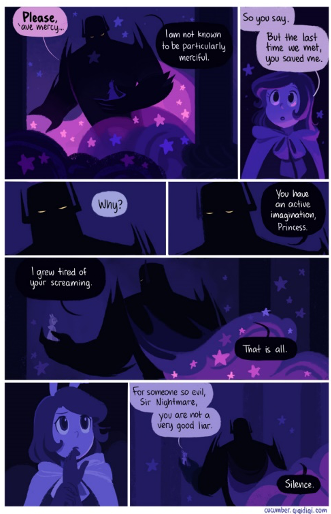
This creates a great sense of drama within the story as other characters start to piece together how the Nightmare Knight does not actually have his eyes set on conquering the world. His limited interactions with our heroes reveal to Cucumber that he might be the only other person outside of his adventuring party who wants to see their game end and make peace. As the story goes on, Cucumber even begins to wonder that their real enemy might not be what they seem.

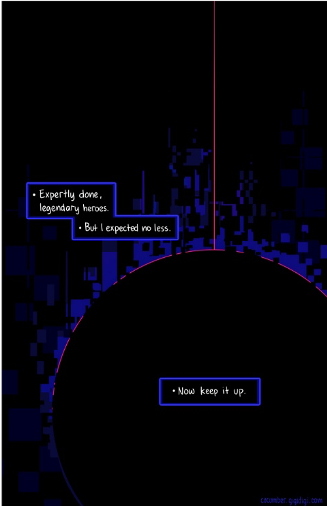
In addition, D.G. is also not afraid to challenge our heroes’ bravery in the face of certain doom. When our heroes encounter each of the Nightmare Knight’s minions, they become so artistically pronounced it’s as if they’ve taken control of the page. From their uniquely flavored text bubbles to their color scheme and insidious style creeping all around, it conveys to the audience that each villain they encounter is a true presence that they haven’t the faintest hope of overcoming.
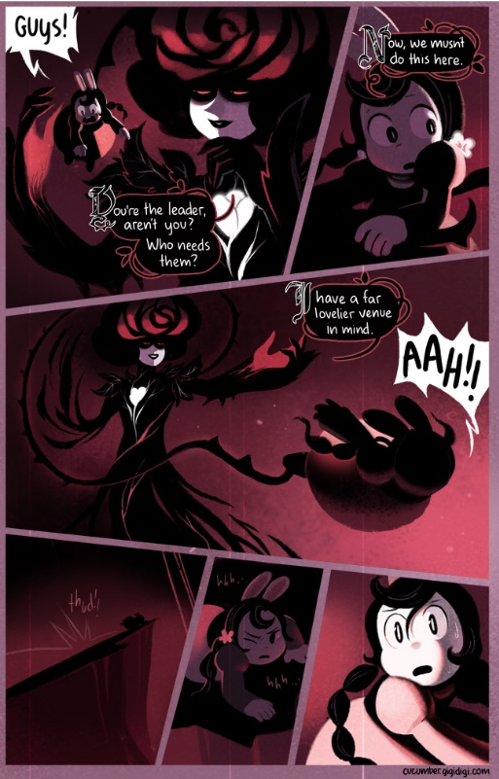
A friend of mine shared Cucumber Quest with me soon after we met in high school and he learned of my love for comics. As such, it is not a comic I read as a child. But if I had, I believe it might have a place along some of my absolute favorite comics such as Bone, Amelia Rules! and Calvin and Hobbes. Rather than dwell on “years lost” or what have you, I like to instead recommend it to kids of all ages coming to the Billy Ireland reading room as I’m doing my work. Although, I would argue it’s not aimed only at kids, but more specifically kids-at-heart who grew up playing Nintendo games like Paper Mario: The Thousand Year Door and any entry from the Kirby series. Such young-at-heart video game fans might also be interested to know that Gigi D.G. is friends with Toby Fox, and contributed to his 2015 runaway sensation Undertale.

Cucumber Quest can be found in the Lucy Shelton Caswell Reading Room at the Billy Ireland Cartoon Library and Museum, in the kids section next to the Snoopy doghouse. Alternatively, you can find it online at http://cucumber.gigidigi.com/.

-Michael Patton

Student Post: Drawing Blood by Emily Winter

Emily is an English major pursuing a career in library science. She has worked at the Billy Ireland Cartoon Library and Museum for two years. She is interested in comics and 19th century medical history.

In addition to working at the Billy Ireland, I’ve had the privilege of collaborating with Professor Jared Gardner on the Drawing Blood website. The site began as an accompaniment to the exhibit Drawing Blood: Comics and Medicine, which Gardner curated for the Billy Ireland in 2019. Since then, Gardner and I have been developing the site into a scholarly resource that documents the shared history of comics and medicine. We hope to show how the popular medium of cartoon art has played an integral part throughout the history of medicine. Careful attention to medical prints and cartoons can lend contextual understanding of both medical and print history. They reveal not only how the field developed, but why as well.

In this promotional post, I’ve selected two items from the Billy Ireland’s wonderful Hale Scrapbook to show you.

Both prints are by George Cruikshank (1792-1878), a British caricaturist and illustrator. His father, Isaac Cruikshank, was a prominent caricaturist of his era who employed both George and his brother Robert in the family’s print factory. By early adolescence, George had already created a large body of work under the tutelage of his father. Despite having other professional aspirations, George continued to work as a caricaturist when his father died in 1811. George, now the principal breadwinner for his mother and sister, sold his drawings to over twenty different print-sellers. That same year, George became the resident caricaturist for the periodical The Scourge: A Monthly Expositor of Imposture and Folly. His early career in caricature was marked by lampooning the Royal Family and satirical takes on the tumultuous politics of Regency London as well as social commentary on day to day life in Georgian England.

His satirical prints could be so devastating that in June 1820, King George IV offered to pay George £100 as long as he pledged “not to caricature His Majesty in any immoral situation.” Cruikshank transitioned to the work of book illustration, joining his brother. Here too, George succeeded, providing illustrations for more than 850 books, including illustrations for several of Charles Dickens’ works.

By 1835, George had secured his fame as England’s most important graphic artist. George, being the preeminent artist of his time, was praised as a “Modern Hogarth”. Capitalizing on his fame, George began his own publication called Cruikshank’s Comic Almanack. The almanack did well until the publication of Punch magazine in 1841 which virtually destroyed Cruikshank’s dominance in the market. The publication finally ceased in 1853.

In the 1840’s, George turned his satirical genius towards the Temperance movement, illustrating pamphlets warning against the evils of drink. He continued in this vein for the next thirty years until his death in 1878.

The cartoons showcased here belong to Cruikshank’s early period of satirical work, yet these cartoons are neither political nor social satire. Instead, Cruikshank turns his satirical view towards the ever-important topic of health. Regency era Englanders were no strangers to suffering and for the health-conscious Brit’s the threat of disease or a bout of a painful malady was always topical. Who hadn’t, at some point or another, felt the pain of a headache or suffered a bout of the colic? Yet despite its universality, the highly subjective experience of pain remains difficult to describe and measure. The visual language of cartoons compensates for the imprecision of language and diagnostic tools through graphic representation. Cruikshank does precisely that in his pieces, The Cholic and The Headache, depicting the sensation of pain while fancifully reimagining its cause.

1 The Cholic, George Cruikshank, 1819, The Hale Scrapbook

While we tend to associate colic with the prolonged periods of intense crying in an otherwise healthy infant, this is only one application of the term. Colic actually refers more generally to pain that starts and stops abruptly; its often gastrointestinal in origin and results from the contraction of muscles around a blockage of a hollow tube such as the colon, the gall bladder, or the ureter.

In The Cholic, two creatures work in tandem to cinch a rope around the waist of a thin elderly woman, who clutches at her waist while shrieking in pain. While her condition is clearly caused by the two sadistic creatures, the portrait upon the wall behind her suggests another cause. The image of the corpulent woman quaffing some gin suggests that overindulgence may be the real cause of this affliction. Interestingly, the clipping of The Cholic found in the Hale Scrapbook differs from the other documented and digitized copies of the print.

Image result for the cholic gilray variant print

Figure 2 The Cholic, George Cruikshank, 1819, The Wellcome Collection

As seen above, the print shows several more imps terrorizing the elderly woman. The demon’s ready pitchforks, sewing needles, and spears to attack the woman while a number of imps on either of the rope have multiplied. Some sources suggest that presence of the demon holding the sewing needle indicates that a tight corset compressing the stomach is the cause of the woman’s colic, making the piece social satire on women’s fashion. I find this to be a somewhat anachronistic interpretation of the print. The Regency Era saw the popularization of the Empire Silhouette, a style that highlights a more natural waist. Accordingly, women wore the short corset, which supported the breasts while leaving the waist and hips free, or a full-length corset with light boning. The kind of tight compressing corsets with heavy boning that sparked health controversies wouldn’t come into style until the mid-1820’s and the “corset question” wouldn’t reach its height until the 1860’s. This timeline doesn’t exactly fit well with the 1819 publication date of the cartoon, but it could be possible edits were made later on to fit the changing fashions; a hypothesis that would support the two different versions of the cartoon.

Figure 3 The Head Ache, George Cruikshank, c. 1819

The companion piece titled The Head Ache shows a similar scene to that of The Cholic. An agonized man is bedeviled by imps, his face contorted in pain, and his eyes rolling back in his head. Two imps drill into his head—one with a bit, the other with an auger. A third demon stands on his shoulder, holding a red-hot poker. Two more imps stand on either side of the man—one blaring a music horn into his ear the other loudly reciting from the book he holds. The empty vial hanging limply from the man’s hand speaks of curatives failing to provide the relief they promised, while the man’s slumped posture and slack limbs show his resignation to the onslaught.

This print succeeds in capturing the differing sensations of a headache, showing pain that ranges from pounding and piercing, to stabbing and burning. Cruikshank even shows the sensitivity to noise a headache sufferer may experience.

The French poet Charles Baudelaire wrote, “The special merit of George Cruikshank… is an inexhaustible abundance of the grotesque… the grotesque flows unceasingly and inevitably from Cruikshank’s pen, like pluperfect rhymes from the pen of a natural poet. Cruikshank’s grotesque is mainly made of extravagant violence of gesture and movement, and explosive expression. All his little characters play their part with fury and boisterousness, like actors in pantomime.” The grotesque elements of Cruikshank’s cartoons help capture the experience of pain so convincingly. The elements Baudelaire highlights are all exquisitely at play in these caricatures, from the sheer agony of the sufferers’ face to the devilish glee each demon exudes with their facial expression and physical form. These medical caricatures do not aim to represent scientific models of disease, but to show the lived experience of the patient. Invisible pains are externalized and exaggerated to a grotesque degree so even one unfamiliar with a specific pain can empathize. At the same time, the comical aspects of these pieces allow the reader to laugh at the absurdity of pain. The humor of the piece isn’t mocking the sufferer. Instead, the laughter it provokes is cathartic. A brief release from pain’s lonely burden, even if only for a moment.

Image result for the gout gillray

Figure 4 The Gout, James Gillray, 1799, Wellcome Collection

The informative nature of these cartoons is not restricted to medical history as they tell an interesting story about the genealogy of influence in cartooning. For example, compare the image presented above to the ones we’ve already viewed. They bear a striking resemblance, don’t they? Indeed, the British Caricaturist and Printmaker James Gillray, author of the cartoon titled The Gout, was a major influence on Cruikshank’s art. One can see the thematic similarities, such as how both artists personify pain as a devilish external force. As well as technical similarities, such as the cross-hatching used to signify shadows and intensify the scene.

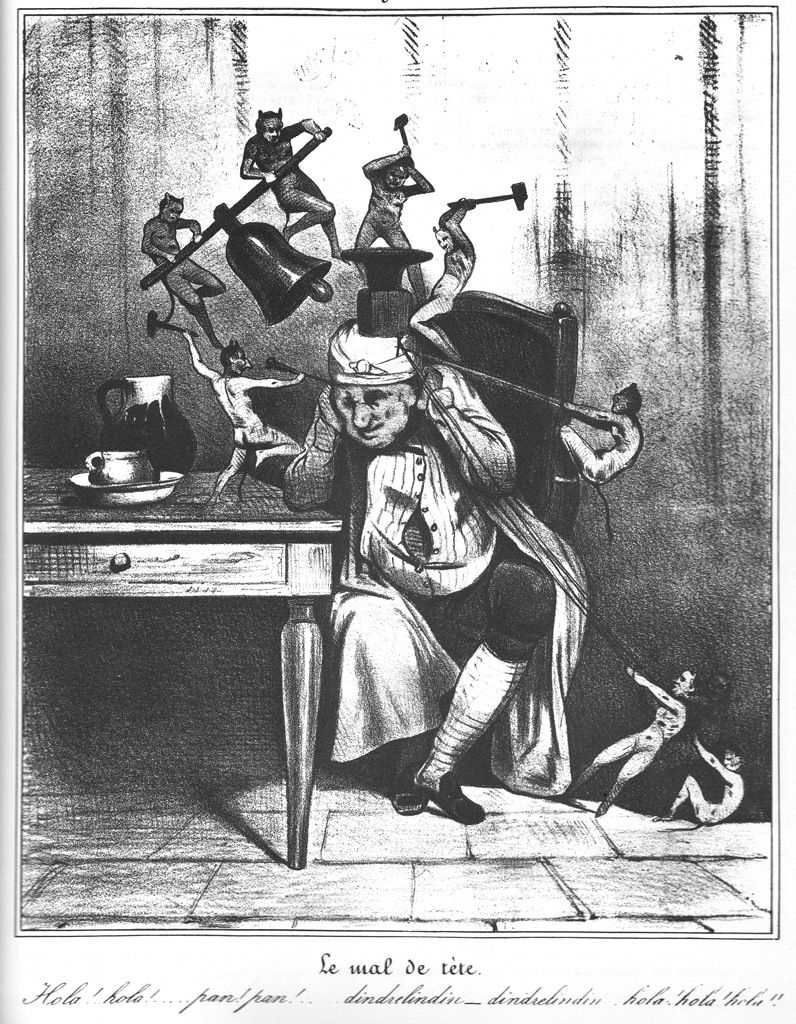
Image result for Le mal de tête, Honoré Daumier,

Figure 5 Le mal de tête, Honoré Daumier, 1833, Wellcome Collection


Image result for La Colique, Honoré Daumier

Figure 6 La Colique, Honoré Daumier, 1833, Wellcome Collection

In turn, Cruikshank’s medical caricatures provided inspiration for other artists like the French caricaturist Honoré Daumier. Daumier’s prints, La Colique and Le mal de tête, borrow both their composition and namesake from Cruikshank’s own cartoons.

Altogether, these cartoons tell an interesting tale that interweaves medical history and cartooning, and it is only one of many tales that are out there. If such stories intrigue you, then I suggest you visit the Drawing Blood website to read more like them. We cover a wide range of topics from the Coronavirus epidemic, to the roots of the Anti-vaccination movement, to the etymological origins of Quack doctors!

Older posts Newer posts