Category: Found in the Collection (page 40 of 53)

Found in the Collection: Gardner Rea (1894-1966)

One of the very first cartoonists to appear in the The New Yorker in 1925, Gardner Rea is yet another among the strangely large number of cartoonists from Ohio. In accordance with his drawing style, any and all information about Rea seems to provide just the most basic outline. Rea lived out the majority of his life in Brookhaven, New York, in a home that he specifically designed to not have a front door. Visitors could only enter through the back, and in many of his obituaries he is noted for standing with his back to you as you spoke- facing a blank wall instead.
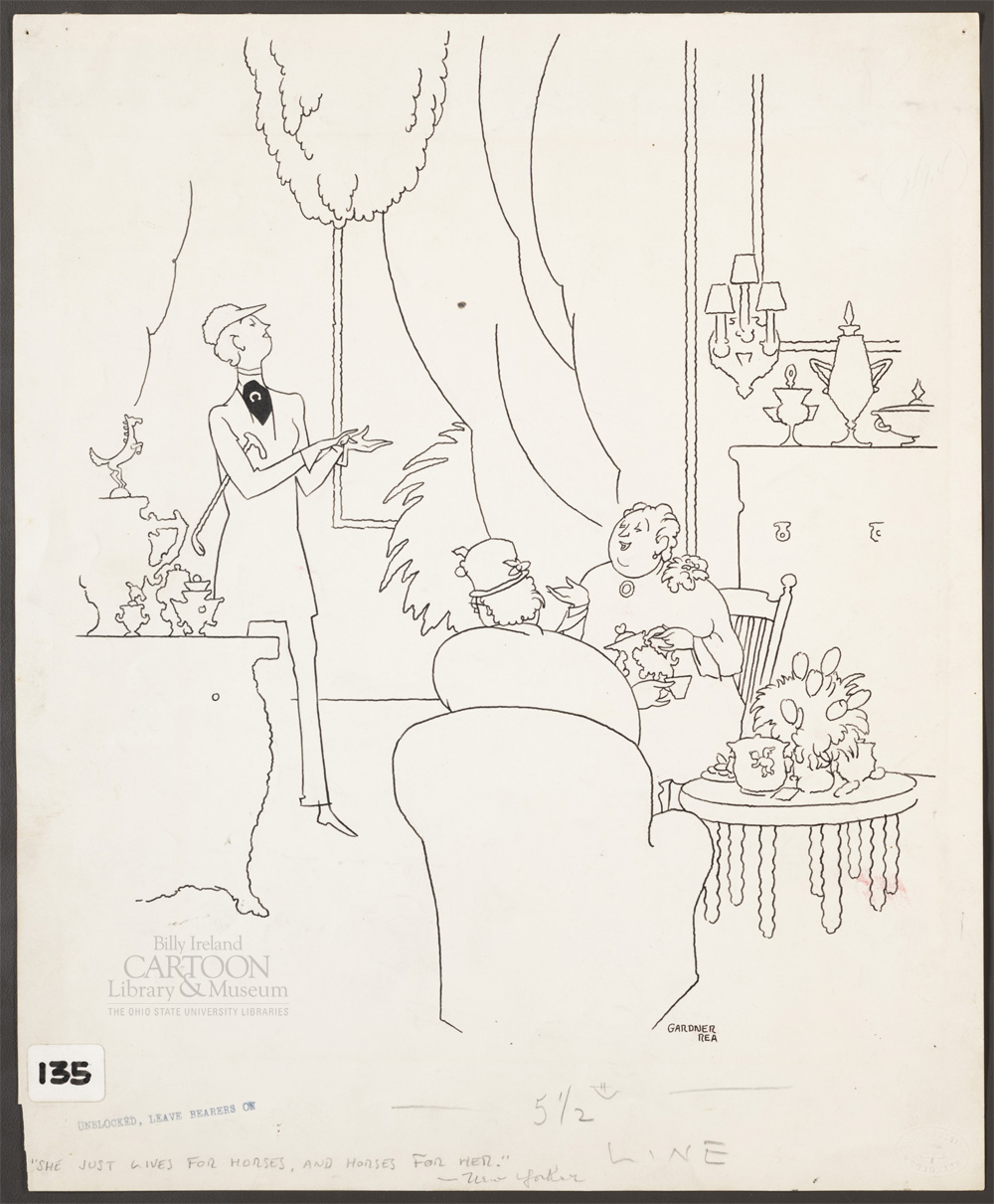
She just lives for horses, and horses for her.” Gardner Rea original. From the International Museum of Cartoon Art Collection, The Ohio State University Billy Ireland Cartoon Library & Museum (click to enlarge)

But despite this idea of him, Rea was hilarious and an absolute master of line work. His distinguished style of undetailed illustrations with a singular spot-black and total command of design and shape were the least of his contributions- at one point he was writing up to 40 gags a week for other cartoonists like Charles Adams and Helen Hokinson.
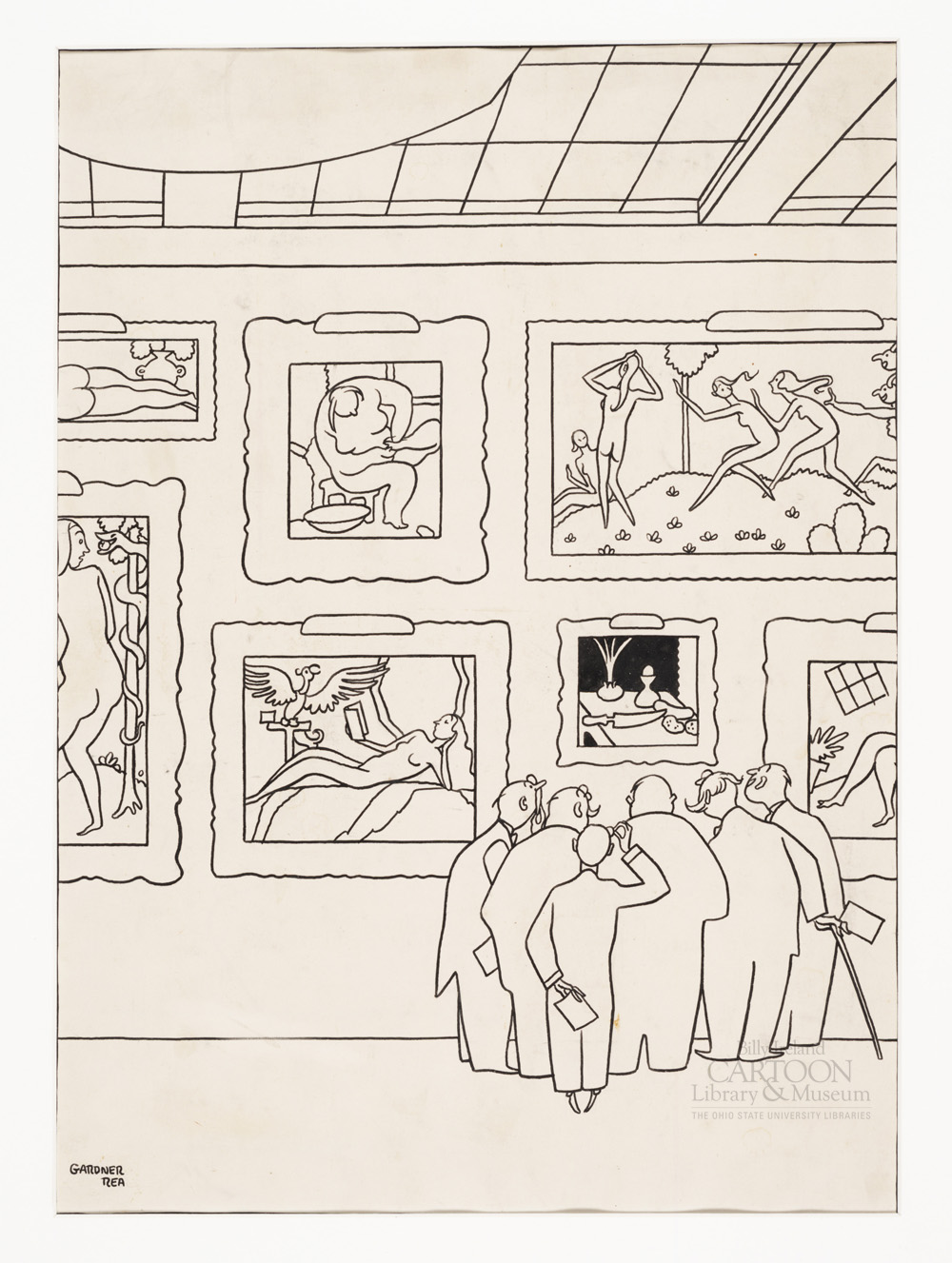
The Triumph of Technique” Gardner Rea original. From the International Museum of Cartoon Art Collection, The Ohio State University Billy Ireland Cartoon Library & Museum (click to enlarge)

Rea attended East High School in our beloved Columbus, Ohio, and came here to The Ohio State University for his undergraduate degree. He edited the campus humor magazine, and is noted to have proudly won a prize from the Serious Poetry Committee and the Humorous Poetry Committee for the same poem. His cartooning career launched at age 15, when he sold his first cartoon to Life, and appeared occasionally in Judge and Puck later.

Gardner Rea original. Gift of Barbara Rea Renwick, The Ohio State University Billy Ireland Cartoon Library & Museum (click to enlarge)

Possibly Rea’s most distinct feature was his wiggly lines, for which we love his quick explanation: “nobody will catch on when I’m senile.”

Found in the Collection: Lyonel Feininger’s “Wee Willie Winkie’s World” (1871-1956)

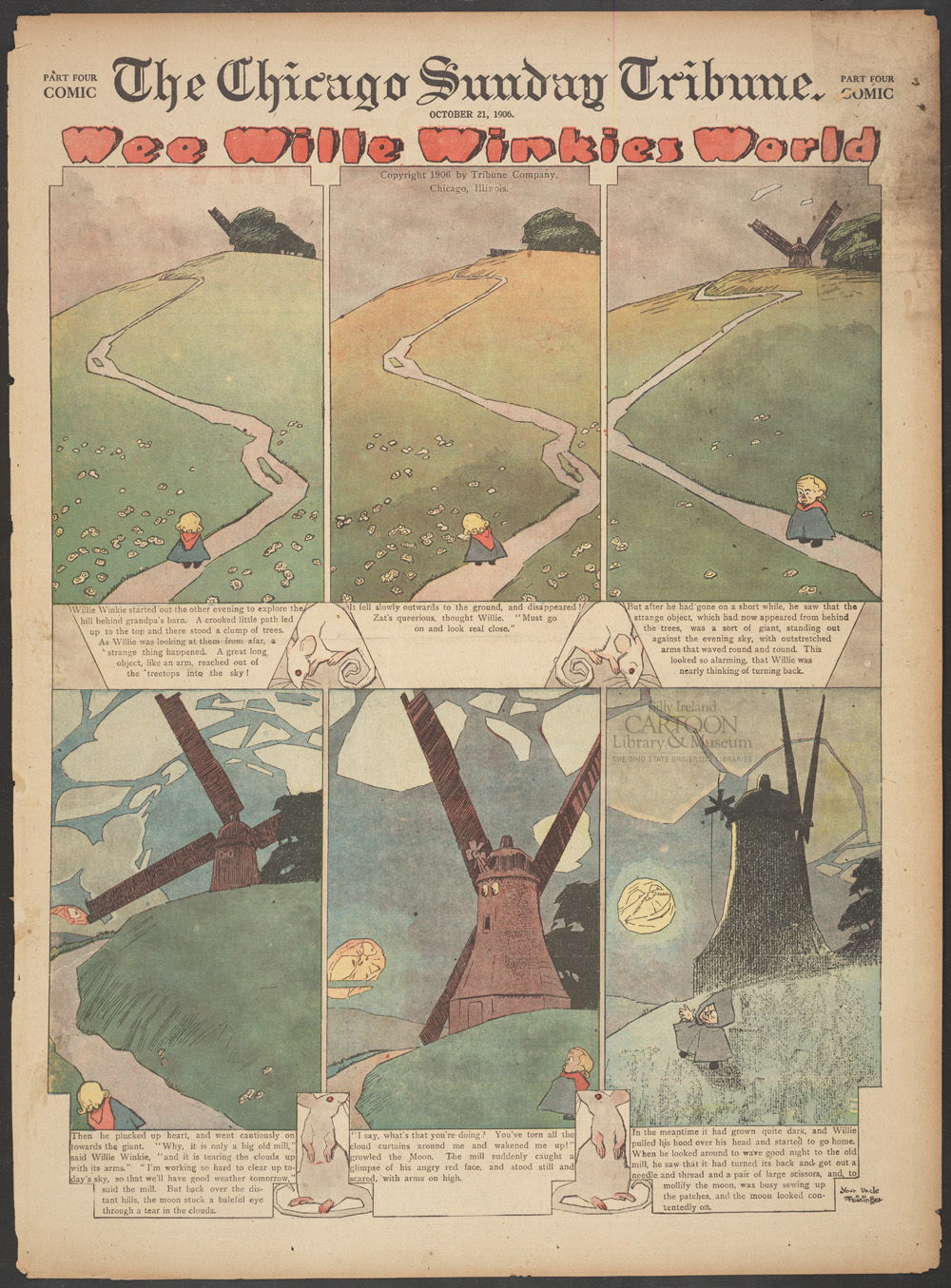
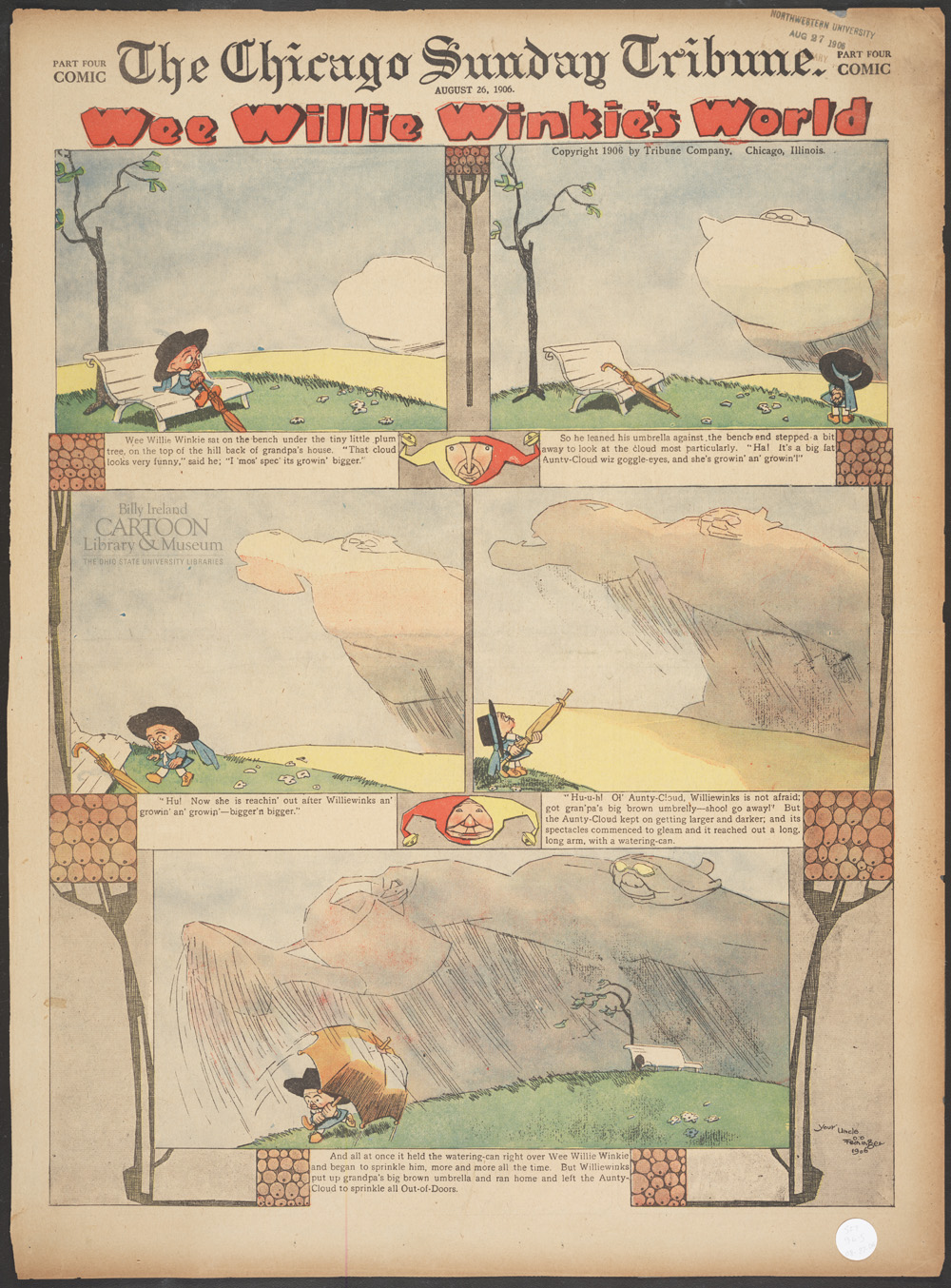
Named after the Scottish nursery rhyme by William Miller, the world in which Lyonel Feininger’s Wee Willie Winkie exists is an astute and awe-inducing illumination of a child’s imagination, following in the vein of McCay’s Little Nemo in Slumberland but in a style filtered through odd, kaleidoscopic angles. Each installment finds Willie roaming through the landscape of the countryside and seaside, interpreting and relating to his world by anthropomorphizing just about everything in it. From tree-trunks that look like elephants, to obtuse faces found in the contours of a rock, Willie’s world is sweet and alive. Below, the sun putting himself to bed by pulling the evening clouds in like a blanket, is a perfect representation of Feininger’s brilliance, and one of our personal favorites.

Lyonel Feininger’s “Wee Willie Winkie’s World”. From the San Francisco Academy of Comic Art Collection, The Ohio State University Billy Ireland Cartoon Library & Museum (click to enlarge)

Although the strip lasted less than one year back in 1906, Feininger’s exploration of the layout and ornamental design of the newspaper comics page in Wee Willie Winkie’s World was groundbreaking. The imaginary element of his observations is further accentuated by the lack of speech bubbles in the comics, so as we read it we’re more deeply submerged in participating in an abstracted version of a child’s reality.

Lyonel Feininger’s “Wee Willie Winkie’s World”. From the San Francisco Academy of Comic Art Collection, The Ohio State University Billy Ireland Cartoon Library & Museum (click to enlarge)

Feininger, who is far more well known as an expressionist painter and a founder of the famous Bauhaus school, was born and raised in NYC but spent the majority of his influential years in Germany. In the 1930s, his work was deemed to be “degenerate art” by the Third Reich, and as the situation worsened he returned with his family to New York not long after.

Lyonel Feininger’s “Wee Willie Winkie’s World”. From the San Francisco Academy of Comic Art Collection, The Ohio State University Billy Ireland Cartoon Library & Museum (click to enlarge)

His career as a cartoonist was short-lived, and better remembered through his other strip The Kin-der-Kids, which also ran just under a year during about the same time as Wee Willie Winkie’s World for the Chicago Tribune. His reasons for stopping are lost to history, but rumored to be the result of a struggle with his editors.

Lyonel Feininger’s “Wee Willie Winkie’s World”. From the San Francisco Academy of Comic Art Collection, The Ohio State University Billy Ireland Cartoon Library & Museum (click to enlarge)

To see more of Lyonel Feininger’s work, we hope you’ll check out our Lyonel Feininger Digital Album where you can learn more about his life and view a collection of his digitized tearsheets.

Older posts Newer posts