Author: Caitlin McGurk (page 80 of 158)

New Exhibit! GRAPHIC DETAILS: CONFESSIONAL COMICS BY JEWISH WOMEN

Miss Lasko-Gross, Self-Portrait, July 30, 2010

Miss Lasko-Gross, Self-Portrait, July 30, 2010

OhioStateLogoContact: Caitlin McGurk
The Ohio State University
Billy Ireland Cartoon Library & Museum
1813 N High St.
Columbus OH 43210-1393
614-292-0538
cartoons@osu.edu

FOR IMMEDIATE RELEASE: March 11, 2015

Upcoming Exhibition and Reception at The Billy Ireland Cartoon Library & Museum

GRAPHIC DETAILS:

CONFESSIONAL COMICS BY JEWISH WOMEN

March 28, 2015 – July 5, 2015

Columbus:  The Billy Ireland Cartoon Library & Museum will celebrate Women’s History Month with the opening of Graphic Details: Confessional Comics by Jewish Women, a groundbreaking touring exhibition providing the first in-depth look at a unique and prolific niche of graphic storytelling – Jewish women’s autobiographical comics.

While the influential role of Jews in cartooning has long been acknowledged, the role of Jewish women in shaping the medium is largely unexplored. This exhibition of original drawings and reproductions—curated by Sarah Lightman and Michael Kaminer; traveling exhibition conceived by Zachary Paul Levine and Yeshiva University Museum—presents the powerful work of 18 U.S., Canadian, and international artists whose intimate, confessional work has influenced the world of comics over the last four decades, creating an entirely new genre.

Spotlighting the raw, revealing voices of Jewish women and their singular presence in graphic storytelling, the exhibition illuminates the intersection of experiences that make these diaristic comics so compelling. By turns funny, outrageous, poignant and embarrassingly intimate, the works in Graphic Details reflect the artists’ individual journeys, refracted through a distinctively Jewish lens in a pop culture art form.

Many of the original artworks on display have never been exhibited in public until now. Artists run the gamut from pioneering Wimmen’s Comix and Twisted Sisters artists of the 1970s and 1980s to the superstars of the new generation. Participating artists include: Vanessa Davis, Bernice Eisenstein, Sarah Glidden, Miriam Katin, Aline Kominsky-Crumb, Miss Lasko-Gross, Sarah Lazarovic, Miriam Libicki, Sarah Lightman, Diane Noomin, Corinne Pearlman, Trina Robbins, Racheli Rotner, Sharon Rudahl, Lauri Sandell,Ariel Schrag, Lauren Weinstein, and Ilana Zeffren. This iteration of the exhibit also includes selections from The Ohio State University Billy Ireland Cartoon Library & Museum collection.

The public is invited to the opening program and reception for Graphic Details: Confessional Comics by Jewish Women,  scheduled for Sunday, April 19 in The Billy Ireland Cartoon Library & Museum’s Jean and Charles Schulz Lecture Hall and museum galleries. The program features special guests Trina Robbins, Sarah Glidden, Miriam Katin, and curator Sarah Lightman

1:30-2:45Sarah Lightman: Curator’s Tour – Museum Galleries

3:00 – 3:30Trina Robbins – Artist Talk – Jean and Charles Schulz Lecture Hall

3:30 – 4:00Sarah Glidden – Artist Talk – Jean and Charles Schulz Lecture Hall

4:00 – 4:30Miriam Katin – Artist Talk – Jean and Charles Schulz Lecture Hall

4:30 – 4:45 – Break

4:45 – 5:30 – Roundtable/Q&A moderated by Sarah Lightman – Jean and Charles Schulz Lecture Hall

5:30 – 7:00 – Catered exhibit reception – Will Eisner Seminar Room / Museum Galleries


This event has been made possible through the generous help of our co-sponsors:  Department of English; Project NarrativePopular Culture StudiesMelton Center for Jewish StudiesDepartment of Women, Gender, and Sexuality StudiesDepartment of Arts Administration, Education & PolicyHumanities Institute; and Advanced Computing Center for the Arts and Design (ACCAD); and Department of Comparative Studies

About the curators:

Sarah Lightman is a leading voice in the field of autobiographical comics. She is an internationally exhibiting artist, curator and author of numerous academic articles and editor of the first book on Jewish women and comics: Graphic Details: Jewish Women’s Autobiographical Comics in Essays and Interviews (McFarland 2014). She is a director of Laydeez do Comics and is working on her graphic novel The Book of Sarah which will be published by Myriad Editions.

Michael Kaminer is a New York-based writer who collects original cartoon art. His story for the Forward on autobiographical comics by Jewish women became the inspiration for Graphic Details. Michael is the restaurant critic for the New York Daily News, and contributes to The New York Times, The Washington Post, the New York Observer, and other media.

Also on display March 28-July 5 at The Billy Ireland Cartoon Library & Museum: World of Shojo Manga! Mirrors of Girls’ Desires

http://cartoons.osu.edu/events/world-of-shojo-manga-mirrors-of-girls-desires/

——————————————————————————————————-

About the Billy Ireland Cartoon Library & Museum:  The BICLM is one of The Ohio State University Libraries’ special collections. Its primary mission is to develop a comprehensive research collection of materials documenting American printed cartoon art (editorial cartoons, comic strips, comic books, graphic novels, sports cartoons, and magazine cartoons) and to provide access to the collections.  The BICLM recently moved into its newly-renovated 30,000 sq. ft. facility that includes a museum with three exhibition galleries, a reading room for researchers and a state-of-the-art collections storage space.   The library reading room is open Monday-Friday 9 a.m. to 5 p.m. and Sunday 1 – 5 p.m. The museum is open Tuesday-Sunday from

1 – 5 p.m.  See http://cartoons.osu.edu/ for further information.
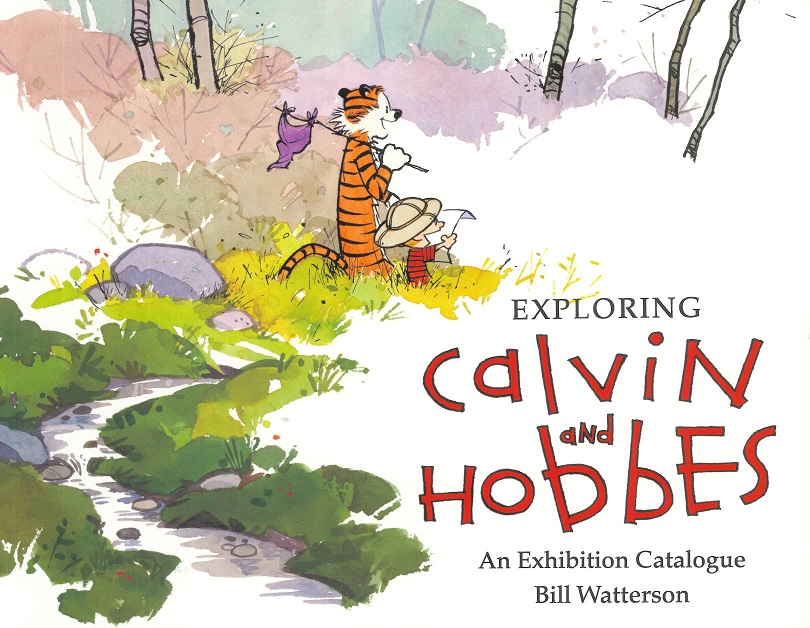
NEW! Bill Watterson retrospective book, “Exploring Calvin and Hobbes”, shines new light on Watterson’s thought process, inspirations

Wattersonbookcover

Comprised of exclusive chats between cartoonist Bill Watterson and The OSU Billy Ireland Cartoon Library and Museum curator, Jenny Robb, Exploring Calvin and Hobbes is the longest interview with the widely beloved Watterson ever to be published. While providing an opportunity to study Watterson’s mastery of the comic strip art form through engaging characters, thoughtful writing, and creative layouts, this definitive book also gets to the heart of what makes the Calvin and Hobbes creator tick.

Many of you joined us between March and July of 2014 for The Billy Ireland Cartoon Library & Museum’s (BICLM) exhibit Exploring Calvin and Hobbes, a revisit of the beloved comic strip created by Watterson, which included work from his collection of more than 3,000 originals housed at the BICLM. The show broke all previous attendance records and delighted thousands of Watterson fans, old and new.

But even if you didn’t make it to the show, you are in luck! The show catalogue was released TODAY and includes a new and extensive Watterson interview with BICLM curator Jenny Robb. And of course no Watterson book would be complete without art from cartoons and cartoonists that Watterson identifies as influential, including Peanuts, Pogo, Krazy Kat, Doonesbury, Pat Oliphant, Jim Borgman, Flash Gordon, Bloom County, and Ralph Steadman.

As a special treat for our friends, Bill Watterson is allowing us to share some excerpts from his new book, Exploring Calvin and Hobbes, right here on the BICLM blog. The Billy Ireland Cartoon Library and Museum is so very lucky to call Calvin and Hobbes creator, Bill Watterson, a friend.  We hope you enjoy this sampling of the new work and we’ll see you at the museum!

Calvin&Hobbesexcerpt:


JENNY ROBB INTERVIEWS
BILL WATTERSON

Billy Ireland Cartoon Library & Museum, The Ohio State University
April 17, 2014

JR: It’s been a pleasure working with you on the exhibit Exploring Calvin and Hobbes, and I’m delighted to have this opportunity to sit down with you to ask you some questions about your life, your career, and comics. To get started, can you describe what it was like to grow up in northeast Ohio?

BW: I grew up in Chagrin Falls, which is a small town, an outer suburb of Cleveland. It was originally a mill town in the 1800s, and a paper-bag factory was still going when I was growing up. They used to dump their dyes right in the river, so as a kid I remember seeing the river turn red and so on, if you can believe it.  The town is fairly upscale now, but back then maybe a little less so. There was a hobby shop, a stationery store, three little drugstores, two hardware stores, and so on. Small local businesses where you could get pretty much anything you’d need without driving somewhere else. The Main Street bridge goes over a big natural waterfall, and Victorian buildings surround the town triangle, which has a bandstand in the middle of it. It’s one of these quintessentially American towns that dot Ohio. Very Normal Rockwell – all white, very Republican. I had a sheltered childhood. 
Our house was on a one-acre lot, at the outskirts of the village, with a big woods behind us. We didn’t own the woods, but it extended all the way to the river, and you couldn’t see an end to it. Our yard dropped continuously from the back door to the woods, so it was a truly fabulous sledding hill. There were a handful of neighborhood kids about my age, so we messed around unsupervised in a way that kids don’t seem to do anymore. Many of our mothers were home, so they’d just turn us loose and nobody worried.
Sometimes in the strip I tried to illustrate those big empty summer days spent messing around. It seems very anachronistic now that kids’ lives are organized to the minute. 

JR: My husband and I are looking at houses, and whenever we see one with a woods, we call it a Calvin and Hobbes backyard.

BW: To be honest, we didn’t tramp around the woods all that much. Because it was low and heading toward the river, it was somewhat marshy and brambly. You’d get stuck full of prickers of tangled in brush, wit your feet starting to sink into muck. We’d venture in occasionally, but it’s not like I was Christopher Robin.
But I loved having that much nature around us. It mitigated the suburban feel, which I imagine is why my parents chose the property. Having something a bit wild and mysterious and beautiful at the end of the yard was a memorable thing. 
Now it’s a subdivision, of course. Looking at a cul-de-sac of McMansions doesn’t have the same impact on the imagination. We like to think their basements are wet.

JR: So what were you like as a child?

BW: Everybody else was really weird, but I was completely normal. (laughter) I was generally a quiet kid. I live in my head like Calvin, but I was the opposite of Calvin in terms of courting excitement and risk. It wasn’t hard for me to meet the expectations of grown-ups, and I quickly figured out that if you did that, they left you alone and you could do what you wanted. So that was easy. It was negotiating the snake pit of school kids that I found difficult. My home and the slightly older kids in my neighborhood were a refuge.
I loved to draw, of course. When I was about Calvin’s age, I was very interested in birds and dinosaurs, and I liked to draw them. I say I was interested in them, but I don’t know that I actually read or learned anything about them. I just thought they were cool to look at, and I got so I could identify and draw all sorts of them. My interests were quite fanatical in their way–and at the same time, incredibly superficial!

JR: Your parents were encouraging?

BW: Yes, very encouraging, very supportive. My mom was basically my audience until I went to college, and my dad often introduced me to art supplies. He could draw pretty well, although he never had much time for it until later. When I was doing the strip, we’d go out and paint together on visits. 
I think my dad was the one who told me Pogo was probably drawn with a brush. I tried copying Pogo characters–this was maybe in high school–but a brush line is hard to control at best, and because my brush was too large,–probably a watercolor brush,–I couldn’t do it. It was very frustrating, so I went back to pen, and it wasn’t until college that I gradually figured out you can get tiny brushes that will make a thin line, and I worked on developing the necessary touch. There was never any information back then, but I always had materials to play with.
Really, I suppose the biggest gift my parents gave me was a lot of time. There was never a sense that I should be doing something else. If I was up in my room drawing, nobody bothered me. That kind of time is just indispensable. It’s not a luxury, it’s an absolute requirement. You’ve got to mess around–it’s the only was to figure stuff out.
It’s hard to reconstruct this accurately, though. My memory is that I spent hours and hours drawing, but it may have been fifteen or twenty minutes, who knows. A kid’s idea of a long time is not reliable information. But I drew comics from a very early age. It was the only kind of art I understood, and it connected immediately. The simplicity of the drawings was like a big welcome mat. My whole childhood was about cartoons. I just loved them.


…to read the full interview, pick up a copy of Exploring Calvin & Hobbes at a bookstore near you!

For more information, check out Michael Cavna’s review of the book for The Washington Post here


Older posts Newer posts